A Robin Hobb Rereading Series, Entry 504: Assassin’s Fate, Chapter 45

Read the previous entry in the series here.
Read the next entry in the series
here.


Another excerpt from Bee’s journals precedes “A Princess of the Farseers.” As the chapter begins, Bee reflects glumly on her new status as a royal. The passage from Kelsingra to Buckkeep is glossed, Bee noting complaints about the necessities of royal travel as she rehearses events. A reunion with a maid from Withywoods prompts emotional release, and Bee begins to be integrated into the courts. She and Shun are initially polite but cool after their shared experiences, and Bee finds herself beset by duties and tutors and the sniping of pampered court ladies that she adeptly addresses to Shun’s relief.

Bee is adept with more than one kind of cutting.
Photo by Ali Pli on Pexels.com

Bee begins to settle into routines, one of which is with Beloved, now masquerading as Lord Chance. Some of them also touch on the Skill, in which Bee remains untutored and therefore of some vexation as her thoughts leak out at night. Reunions with Hap and others do ease her, however, even as she continues to struggle with the changes and comes to better and better understandings of a father she has mourned. Bee does take some opportunities to act out, struggling for reconnection and earning some rebuke.

One evening, Bee finds herself wandering the halls of the keep and stumbles upon Thick. From him, she begins to find a new friend and to learn more of the Skill. It is, for her, a strange taste of normalcy she had lacked.

The present chapter reads as sort of a passing thing, one intended primarily to move action along to its next point of importance rather than to do anything on its own. For the most part; there are some rather pointed goings-on that might well be read as toothing-stones from which another series might be constructed. The exchange in the present chapter between Bee and Violet over Shun is one such; Bee even remarks upon being certain to come into conflict with Violet again (780). While, in effect, a bit of petty sniping, it is one that serves a useful purpose–Bee is to be commended not only for taking up for one who had helped her, but also for rebuking scorn unearned–and it is one that gestures towards ways in which Bee is being set up to succeed the Fool. Speaking uncomfortable truths to adjust behavior is a function of the character-type the Fool has been by the in-milieu time of the present chapter, and Bee seems well positioned to keep on doing that very thing.

I note, too, that the present chapter does much to address the tension surrounding how Bee is and should be treated. While her numerical age is not entirely clear from the narrative, and her growth has been noted to have proceeded at a strange pace, Bee is somewhat ambiguously a child. She is not an adult, certainly, but given her experiences and her nature, she is not a child as other children are; she knows too much and too well, and much of it unpleasantly. As with the Fool, she crosses a number of categories, multidimensionally liminal, and how others must react to her is uncertain. Given the presence of the Skilled, however, with whom she might be able to share more (and “might” does a lot of work, here), those around Bee might (and, again, “might” does a lot of work, here) well be expected to understand her position better. She has responsibilities to those around her, certainly, but they also do to her, and it seems to me as I read the chapter again that the latter could use more attention.

I’m still happy to write for you; fill out the form below to begin!

← Back

Thank you for your response. ✨

Or you can send your support along directly!

A Robin Hobb Rereading Series, Entry 503: Assassin’s Fate, Chapter 44

Read the previous entry in the series here.
Read the next entry in the series
here.


An excerpt from Bee’s journals about reading Fitz’s writings and him destroying many of them precedes “Up the River.” Bee and her companions depart Bingtown in haste aboard the Vivacia, exploiting a loophole in Trader laws to allow themselves cover for executing their intentions. Joined by the Kendry, the Vivacia proceeds to and up the Rain Wild, Bee glossing the transit and the sights she notes along the way, as well as relating in summary the reports of events she makes to those who ask about how she has fared. Beloved attempts again to reconcile with her, to less effect than he might have hoped.

Scenery?
Photo by Juan Felipe Ramu00edrez on Pexels.com

The Vivacia reaches Trehaug and ties up alongside Tarman for a hurried transfer of supplies and crew. Bee is welcomed aboard the old barge and watches events. The Kendry joins the other two liveships, and both are stripped of as much as the Tarman could take on while the ships’ captains confer. All watch as the Vivacia imbibed shipped Silver and begins to transform; the Kendry does, as well, even as a delegation from the Rain Wild Traders approaches and attempts to interdict the ships’ transformation into dragons, finding no success.

Later, Leftrin notes changes in the Tarman as Bee laments the barge’s slow up-river progress. Beloved lays out some of his understanding to Bee as they proceed, and they arrive at length in Kelsingra. There, they are met by Skill-users from Buckkeep, one of whom doses Bee against the Skill at work in the city. Skill-work that had been going on is related, and it is determined over Beloved’s objections that a Skill-pillar trip is in order to get Bee back to Buckkeep.

As often, the prefatory comments attract attention. In the present case, Bee’s assertion that she means to collect and write down Fitz’s accounts helps to address a question I noted earlier that the texts present: who is the author (within the milieu; outside it, of course, the answer is obvious)? It’s not a total answer, however. While it can be posited that Bee herself does a lot of the writing that constitutes the Farseer, Tawny Man, and Fitz and the Fool novels, and no few components of the prefatory materials are themselves cited as deriving from elsewhere (about which some previous comments are here), not all of them seem accessible. And there are some other factors at work, I think, but that is something only clear from the vantage of rereading; I think I’ll address those factors as they come up. For now, it will be enough to say that a partial answer is posited, but a full one to the question of “Who is doing the writing, really?” is not in evidence…at least not yet.

In the chapter itself, I think there is more for me to say about how the Traders mimic or emerge from the experience of the early United States. Some geographical cues are present, although they are only a few and serve primarily to reinforce ideas already present rather than to introduce new ones–fittingly enough, given how late in the novel the present chapter is. Legalistic notes are more evident, I think, with the reference to fines and the peculiar loophole at work in Trader law reported as being at work. In the chapter, the comment is made that, if a ship is underway when the local legislature passes a law, that ship cannot be held in violation of that law; this would seem to be a somewhat merciful thing, an acknowledgment that promulgation of a law has to be part of a law’s enactment and enforcement. This brings to mind the idea of “free, prior, and informed consent,” one applied in international law and by treaty especially to indigenous peoples and groups…something with which the United States has had some decided difficulty but which, as with so much else, is held out as an aspirational best practice. As in other chapters, then, the Traders are held out as something like a refinement of the early United States, albeit not with one-to-one correspondences in place, in the present chapter.

I’m blazing to write for you; fill out the form below to begin!

← Back

Thank you for your response. ✨

Or you can send your support along directly!

A Robin Hobb Rereading Series, Entry 502: Assassin’s Fate, Chapter 43

Read the previous entry in the series here.
Read the next entry in the series
here.


Testimony from a Skilled apprentice written at Nettle‘s direction prefaces “Bingtown.” As the chapter begins, Bee wakes, assessing herself and the injuries she has sustained. She also nurses her dislike of Beloved, Amber, and the Fool, regarding each as a distinct person and not wanting much to do with any of them. Perseverance tends to her, urging her to make use of the limited time to experience liveships, since they will all transform. He also urges her to use the Skill to heal her own body: “You can’t make it unhappen, but you don’t have to carry around what they did to you. Don’t give them that power over you” (748). Bee reluctantly agrees and slowly begins to restore her body, working a little at a time to minimize others’ comments.

A sign of having survived…
Photo by http://www.kaboompics.com on Pexels.com

As the Vivacia continues away from Clerres, Bee finds herself more attuned to the liveship and the family that strides her decks. The liveship refuses to return to Divvytown in her haste to transform, and those who wish to make the return are allowed to do so, though they must bear the news of Kennitsson’s death. Bee undergoes a change, her skin darkening somewhat, as the voyage continues.

Bee finds herself obliged to address ennui and listlessness as she is, in effect, a passenger on the liveship. Beloved attempts to connect to her, and Bee rebuffs the efforts.

At length, the Vivacia arrives in Bingtown, where there is much upset. The pending end of the liveships has thrown the Traders into something like panic, but Bee, Perseverance, and Spark are delighted to find Lant awaiting them. He relates how he had escaped Clerres and arrived in Bingtown. Soon after, Althea conducts the group to the Vestrit home, where Ronica welcomes them. The older woman relates such tidings as she has, noting the brewing political difficulty among the Traders and having a small meal served to her guests. Bee is taken by the service, and she is gratified by the gift of clothing made to her. When her identity as a Farseer and the child of FitzChivalry is noted, Ronica exults, reporting developments in Kelsingra, to which Bee and her party will travel and from which they will return to the Six Duchies…by Skill-pillar, with which Bee is uncomfortably familiar.

The present chapter is not the first portion of the Realm of the Elderlings corpus to be titled “Bingtown”; there are three chapters in the Liveship Traders series with the title (here, here, and here), and there are many others in it and the Rain Wilds Chronicles that have the town in their title along with some other words. There is a small project, I think, in reading the chapters against one another; I recall making similar claims about other sets of chapters sharing titles. Contrasting length, reading level, characters present, rhetorical devices at work, and the like could prove interesting; for those involved in teaching literature, it might also well serve as a useful and possibly manageable student exercise. If I pretend for a moment that I’m going to be back at the front of a classroom, obliged to come up with some assignment for my students in a class on Hobb (single-author seminars happen!), it’s something I might well do. Even if it is not the case that I will be so, perhaps someone reading this is; I commend the exercise to you (but I would like citation for it, please).

As often, the prefatory materials compel some attention from me. This time, the notion of following what amount to being road-signs making things easier…it’s obvious, really, in retrospect, but it only can be so if the signs can be read. Use of the Skill-pillars has been…challenging throughout the Realm of the Elderlings corpus; much of that use has been unknowing or in desperation. That there were runes and sigils on the Skill-pillars was only revealed later in the novels, and even then, the focus of the narrative has been on characters not fully trained in the use of the Skill; indeed, Fitz was born into and raised up in a time when knowledge of the magic was waning, and his training (by Galen, at least) was conducted only with great reluctance. It is not to be wondered at that he and others like him would use the Skill poorly, nor is it to be wondered at that a campaign to divest of Skill knowledge would leave gaps into which many might fall. What is obvious to those accustomed to a thing is hardly so to those not taught; the prefatory materials on the present chapter serve as a reminder of it, of the need to check assumptions made.

In the chapter, proper, I find Perseverance’s comments to Bee about healing of interest. (Clearly, since I quote him.) It is tempting to read the comment as somewhat naïve, to think only a child could assert that the removal of a physical mark is enough to reject the power of whoever made it. In context, however, it reads differently; the quote from Perseverance comes as he has discussed his own Skilled healing and the erasure of an injury done him in Bee’s defense. He speaks from experience; while he has not endured what Bee has endured, he is far from sheltered and untouched, so that it is not in ignorance that he comments as he does. And he does not say it is an easy thing to do, either; his commentary explicitly cites the help he has had in arriving where he is, and the very fact that he thinks to make the comparison to Bee bespeaks the degree to which the injury, while not even showing a scar from the Skill of the healing, remains with him. Moving forward from what has been done is a process, and it is one that few can do alone, but it can be done with time and care and aid…perhaps a bit cliché, but not untrue.

I’m not too taxed to be available to write for you; fill out the form below to begin!

← Back

Thank you for your response. ✨

Or you can send your support along directly!

A Robin Hobb Rereading Series, Entry 501: Assassin’s Fate, Chapter 42

Read the previous entry in the series here.
Read the next entry in the series
here.


Part of a letter from Prilkop to the Fool precedes “Furnich.” The chapter opens with Fitz recalling what the Fool told him of his earlier escape from Clerres and attempting to follow along with it. The path laid out, Fitz proceeds, his progress traced and the difficulties he faces reported as he addresses them. Motley rejoins him early in his progress, Nighteyes approving of the crow, although all three acknowledge that there will be no full bond among them.

Such corvid beauty!
Photo by Siegfried Poepperl on Pexels.com

One night, as he rests, Fitz assesses himself through the Skill, noting changes to his abilities since being splattered with Silver. He reaches out through the magic and is overwhelmed by it, even as he notices again the presence of larger entities within its flow. The experience leaves him puzzling over it and himself.

Fitz’s progress continues, and his condition deteriorates. Nighteyes remarks on the presence of worms in him, and Fitz struggles to move onward. He notes additional changes in himself as he presses ahead, and he steals to survive as he does so. At length, he comes to a port and plies his magics to secure a berth on a ship headed where he wants it to go. The passage on the ship is unpleasant for him, and Fitz finds himself in mind of Verity as he goes.

Arriving at last in Furnich, Fitz disembarks and makes for a Skill-pillar that has been reported to him. The presence of Skill-stone in the area hinders him, as the memories the stones exude tell of betrayal and despair. Motley warns him of others as he struggles onward, and he comes under attack–not out of his attackers’ need, but out of their boredom. Exercising his magics, Fitz kills them, although he is astonished at his ability to do so. He takes what he can from them and presses onward, at length finding the Skill-pillar and entering into it with the crow.

As is often the case, the prefatory materials of the chapter attract my attention. The comments about the limited survival of the contents of the library at Clerres bring to mind once again the Cotton Library and lamentation for what has been lost, both what is known to have been lost and what is no longer known. The confirmation in those comments of the rapacious attempted genocide of dragons by the Servants and the effects of the same is perhaps a bit on the nose; again, there is something cartoonish in the evil of Clerres on display, and I am struck again by it.

Further, the seeming assumption by Prilkop of primacy for White Prophets over others and of himself over the survivors of Clerres–“Our Servants,” he writes, and “I assumed the care of the few remaining Whites” (731)–stands out. While it is the case that he is the seniormost among them, Prilkop is also very much a relic of a time that seems no longer to exist, and he asserts a pride of place that the ill-gotten “longevity of the Four” (731) implies is a danger. It is something of a trope that the long-lived and precognitive tend towards evil; they get bored and crave stimulation, or they become fixated on their visions and blind to the possibility that they may be in error. It happened in Clerres already; Prilkop seems positioned to repeat the error, or at least to reiterate the sytems that conduce to the error.

So much said, the comment that “Many [of the refugees from Clerres] have ceased dreaming” (731) is suggestive. Whether this is an opening for potential further development in the Realm of the Elderlings corpus of competing centers of power (not that I expect Hobb to explore that kind of thing; I make no such demands, even as I can see possibilities) or simply a nod towards verisimilitude in that things go on even when others do not look on, I am unsure. But I can see that there are things that could be done with it, given Marvell’s “world enough and time.”

As to the main chapter: It is with some interest that I note Fitz’s comment early on that he has left open a leadership position that Prilkop might fill (731). He does have something of a tendency to play kingmaker across his career as an assassin; for but two examples, early in his training, Chade makes explicit reference to Fitz of possible changes in leadership, and Fitz’s actions secure Dutiful’s succession. That Fitz does such a thing again is telling; he may not be Prilkop’s friend, but it is clear that he does, as averred, respect him.

I note, too, that the chapter, proper, reinforces the depravity of Clerres. In Furnich, the memories of the Elderlings fleeing Kelsingra and its cataclysm bespeak the planning of the Servants, who lay in wait to eliminate the refugees of that city. If it is the case that Prilkop was unaware of such planning–and it seems to be so, given his presented nostalgic idealism and the reported timing of his journey to Aslevjal–then it calls into question how good a leader Prilkop can be of even so small a group as he has taken into his care; he seems blinded by his hope no less than were the Servants by their greed. If it is the case that Clerres might well rise again, it seems it will be on a shaky foundation.

If.

Even now, I continue to be available to write for you; fill out the form below to begin!

← Back

Thank you for your response. ✨

Or you can send your support along directly!

A Robin Hobb Rereading Series, Entry 500 (yay!): Assassin’s Fate, Chapter 41

Read the previous entry in the series here.
Read the next entry in the series
here.


Comments from Bee’s journal about her journal and her reaction to the Fool reading it preface “Vivacia‘s Voyage.” The chapter follows Bee and her companions as the Vivacia bears them away from the ruin of Clerres, the liveship communing with her briefly. More survivors of the dragons’ attack, including Althea, are recovered, and Bee marks the shift in how others relate to the Fool-as-Amber. She also muses on her own multiplicity of names and identities.

I need to do more of this, myself.
Photo by betu00fcl nur akyu00fcrek on Pexels.com

As the voyage continues, Perseverance tends to Bee, and she spends much time sleeping. This occasions concern among her companions, but Bee is reticent in discussing what befell her. Perseverance relates as much of his own story and Fitz’s to her as he can, and Bee is comforted by the knowledge of her father’s love.

Later, the liveship summons Bee to her foredeck, where Brashen and Althea watch their son suffer. After some discussion, Bee works another Skill-healing on their son, mending many of his injuries. Amber arrives at the foredeck with warnings, and Bee reluctantly accedes to them. As she begins to recover from the experience, Amber and the liveship argue briefly, and Amber later confers with Bee about her abilities. Bee turns the conversation to the love between Fitz and the Fool, and the Fool attempts to turn it to her training as a White Prophet. Bee vents her resentment at the Fool, lying to him about Fitz’s words.

I do note with some pride having gotten to half a thousand entries in my rereading series. I do not expect at this point that nearly so many remain–but I have as much expectation about the days I have lived and will live, so I suppose that’s not something out of line. In both cases, there is still a fair bit for me to do, and I do look forward to getting at least some of it done. (Not that I expect something to happen that would prevent it, mind, but the possibility always exists.) There are many somedays.

Part of me wants to find the way time moves in the present chapter to be overly rushed. Some of that, much of it, is simply that I want to spend more time with the characters, my affective-reading self being as it is; I’ve spent a long time with Hobb’s work, invested much in it (though not so much as some, certainly), and it’s a familiar comfort that I don’t think I’m entirely out of line for wanting to keep hold of for a little longer. In terms of narrative structure, however, it makes sense; the voyage away from Clerres is not, itself, a focal point, but simply transit between focal points, a hastening towards a denouement over which there is no need to linger. It needs done, and there are a few items of interest along the way, but this is an instance where the destination matters far more than the journey. (That I have gotten sucked into rereading at length as I have written this is also a factor; I know what carries me away.)

To continue on with the affective reading: I’ve commented more than once about the ways in which my experiences correspond with Fitz’s, particularly as regards his interactions with Bee, and I find that the present chapter shows Bee growing in some ways I see my own daughter moving. She’s not got much trouble with people trying to stand in loco parentis with her, which is good, but she does have a way with words, and when she decides she will be sharp with them, I find swiftly where I am quite tender, indeed.

Then again, if I cannot be tender with my daughter…

I continue to be available to write for you; fill out the form below to begin!
← Back

Thank you for your response. ✨

Or you can send your support along directly!

A Robin Hobb Rereading Series, Entry 499: Assassin’s Fate, Chapter 40

Read the previous entry in the series here.
Read the next entry in the series
here.


A brief adage from Chalced precedes “Warm Water.” As the chapter itself begins, Nighteyes complains of boredom as he is obliged to wait with Fitz for death to come. Fitz notes being surprised to still live, rehearsing his situation in some detail. He and Nighteyes confer internally, the wolf urging him to make a decision and act upon it rather than simply waiting, and Fitz searches what he can reach for some tool to help him. He encounters the titular warm water and is surprised again, attempting to determine its source. Belatedly, he realizes it is a bit of Elderling magic, and he settles into reverie and self-pity for which the wolf rebukes him.

Maybe?
Photo by Rostislav Uzunov on Pexels.com

Fitz soon finds out, the hard way, that Chade’s exploding powder can detonate underwater, spurred by the Elderling magic, and the Silver that he had carried splashes all over him. Nighteyes reminds him afterward that the Silver has afforded Verity and the Fool abilities to reshape and rework objects, and Fitz applies himself to reshaping his surroundings to permit his escape. So freed, Fitz slowly pushes forward in an attempt to reunite with the Fool and Bee, and he recognizes the impact his exercise of magic has had upon his body.

At length, Fitz emerges into open air and sees the ruin of Clerres. He also sees the Vivacia pulling away, and he attempts without success to Skill to Bee. Fitz further spies Motley, and Nighteyes remarks that the crow has seen him. He and the crow confer brokenly, and the crow delivers food to him. Drinking from a spring afterward, Fitz encounters Prilkop, who shares food with him amid an awkward conversation. Fitz learns much of recent events from it, and Prilkop mourns what good there had been in Clerres that has been lost with its destruction.

The two part with respect but not friendship, and Fitz finds Capra in the night. An assassin yet, he takes fatal vengeance for the Fool and for Bee, then departs.

The brief prefatory comments put me in mind of JC 2.2.34-35, the comment that “Cowards die many times before their deaths; / the valiant never taste of death but once.” I’ve written before about Shakespearean correspondences in Hobb’s Realm of the Elderlings corpus, if with a different focus and a narrow scope due both to the structures of conference papers and the fact that fewer of works existed in the corpus at the time; it is, again, perhaps another scholarly someday that I would return to and expand upon said conference paper with the fuller works in place. That there should be such evocations is unsurprising; there is a reason that so much ink is spilled across so much time about how Shakespeare pops up after himself, and given the privileged position Shakespeare’s works continue to occupy in such conceptions of English-language literary canons that persist, that Hobb would make use of such resonances, consciously or not, is almost inevitable.

The latter parts of the chapter command some attention. The ending, with its comment about the half-chicken Fitz purloins from the slain Capra, strikes me as particularly funny. There’s something about the juxtaposition of the simple pleasure in tasty food and the grim, magically-enhanced work for which Fitz has long been trained and in which he has been reportedly adept that prompted laughter from me–although I admit to being primed for such things, having been steeped in Jenkinsian lore and having written a paper I wish had been published but that led to some useful tutorial materials, at least. And perhaps it is the case that such bits of humor point towards expectations about primary audiences, as well, another in a long series of scholarly somedays.

I am taken, too, by Prilkop’s near-fawning over Capra in the wake of the destruction of Clerres. That Prilkop prizes parts of his ancient home has been clear for several chapters, and he is not in error to point out that there were many in Clerres who could not rightly be held accountable for the many heinous misdeeds done by the Servants, their chosen Prophets, and the cult surrounding both. But for him not only to take delight in people surviving the dragons, but also to lionize Capra’s assumption of unitary leadership and to believe her promise of return to older ways (716), strikes me as…naïve, at best. Given the color dynamics at work (and acknowledging the ways in which earlier portions of the Realm of the Elderlings corpus), I find myself in mind of Uncles Tom and Ruckus, and it’s a markedly uncomfortable line of thought for me. That it is presented as a negative helps to some degree, but that there is still the invocation of such a stereotype…as I note, it’s not comfortable reading for me.

I remain available to write for you; fill out the form below to begin!

← Back

Thank you for your response. ✨

Or you can send your support along directly!

A Robin Hobb Rereading Series, Entry 498: Assassin’s Fate, Chapter 39

Read the previous entry in the series here.
Read the next entry in the series
here.


Comments about the Treasure Beach on Others’ Island precede “The Vengeance.” The chapter returns to Bee as she watches what the dragons do that emerge from the Paragon, and she assesses her situation as she directs Perseverance to seek what can be found amid their tumultuous surroundings. Survivors begin to gather and take stock of their collective disposition, and Bee sours on the Fool. Kennitsson’s death is reported, as is the poor condition of the son of Althea and Brashen, and the Fool and Bee confer about their loss, Bee souring on him yet further, and rapidly.

Nothing so kindly or quaint as this, no.
Photo by Thanh Binh on Pexels.com

Bee continues to watch the dragons wreak ruin on Clerres, and those that emerged from the Paragon are joined by Heeby and, unexpectedly, by Icefyre. Motley joins the onlookers as Icefyre enacts his own revenge on Clerres, and the crow soon flies among the dragons as Prilkop emerges to offer Bee and her companions assistance. Prilkop urges the Fool to sue for peace, but the Fool replies that the dragons will have none of it, and Tintaglia joins the fray. The Fool urges Prilkop and his own companions to flee, and Bee speaks her own recriminations of Clerres.

Conversation is interrupted by Brashen’s recovery and his son’s report of events to him. The dragons’ ruin of Clerres continues around her and her companions, during the night and into the morning. In the morning, the dragons that had emerged from the Paragon claim the body of Kennitsson, consuming it and his memories, and one of them shares his name, Karrigvestrit, adopting the ship’s family’s name as part of his own. The dragons depart, and the survivors begin to take care for themselves. Bee finds, to the surprise of most assembled, that she can heal with the Skill. Rapskal joins the group, offering awkward condolences and reporting the imminent arrival of the Vivacia before joining those assembled in remembrance.

Bee wakes the next morning to breakfast served by Perseverance and a report from him. Part of the report is that the Fool has sought Fitz again; the Fool returns, unsuccessful, and Bee hardens her heart against him.

The prefatory materials of the chapter call back to the beginnings of the Liveship Traders novels, laying out explicitly the rules Kennit violates in his own trip to the shore in question. As at several earlier points in the Realm of the Elderlings corpus, there is an impression with them that the rules are of advanced age; they are presented in the current chapter as if in translation, and in their earlier appearance, they are presented as long-known lore. It is another implication of the long term at work in the Realm of the Elderlings, one reinforced by Icefyre’s comments and the Fool’s about the ways in which Clerres worked to commit what amounts to genocide on the dragons. Icefyre, after all, had been encased in the ice of Aslevjal long enough that his image had faded to a dull shadow under the ice and reports of his presence had become tales told by the old around the fire at night, and even though it is made clear throughout the Realm of the Elderlings novels that dragons inherit memories from their forebears and from what they eat, his tirade is plain that he was, himself, present at Clerres as dragons were slain by deceit and trickery. It is the case that language seems to change more quickly in the absence of mass media than in its presence; consider the differences between Wulfstan’s English and Laȝamon’s, Laȝamon’s and Chaucer’s, Chaucer’s and Malory’s, or even Malory’s and Shakespeare’s, then between Shakespeare’s and that of Wordsworth or Coleridge, and note how much remains from the earlier to the later. But given that there are characters present in the novels who live centuries and more, and that the passage of generations is remarked upon, there still has to be a long time involved.

I suppose it is something that emerges as a frustration of Hobb’s motion away from the Tolkienian tradition, something certainly clear in earlier series as I have remarked once or twice (and probably will again). Then again, Hobb herself notes her indebtedness to Tolkien, and I have noted, too, that, despite her motions away from the Tolkienian tradition, Hobb works in conversation with it. That she works over long scales of time is not unlike the chronologies presented in the appendices to The Lord of the Rings and in The Silmarillion–and there is a correspondence to the latter in the present chapter, as well, the description of Icefyre as he arrives at Clerres reminiscent of descriptions of Ancalagon the Black. But there is no heavenly mariner to send him tumbling to the ruin of mountains, no shining savior to plead before gods for release from evil. And there are still many other ways in which Hobb moves away from The Professor, even as there are some ways in which she remains clearly his student.

Want me to write for you? Fill out the form below!

← Back

Thank you for your response. ✨

Or you can send your support along directly!

A Robin Hobb Rereading Series, Entry 497: Assassin’s Fate, Chapter 38

Read the previous entry in the series here.
Read the next entry in the series
here.


An account of an early White Prophet introduces “Ship of Dragons.” The chapter begins with Bee regaining consciousness as the Fool talks to her, the experience painful to her because of the number of potential futures he represents. The Fool reports to Bee about Perseverance, carefully avoiding mention of Fitz until he is pressed directly for it and relates his expectation that Fitz is dead. Bee rails at the assertion, but as she searches within herself for the touch of his magics, she begins to accept that her father is gone.

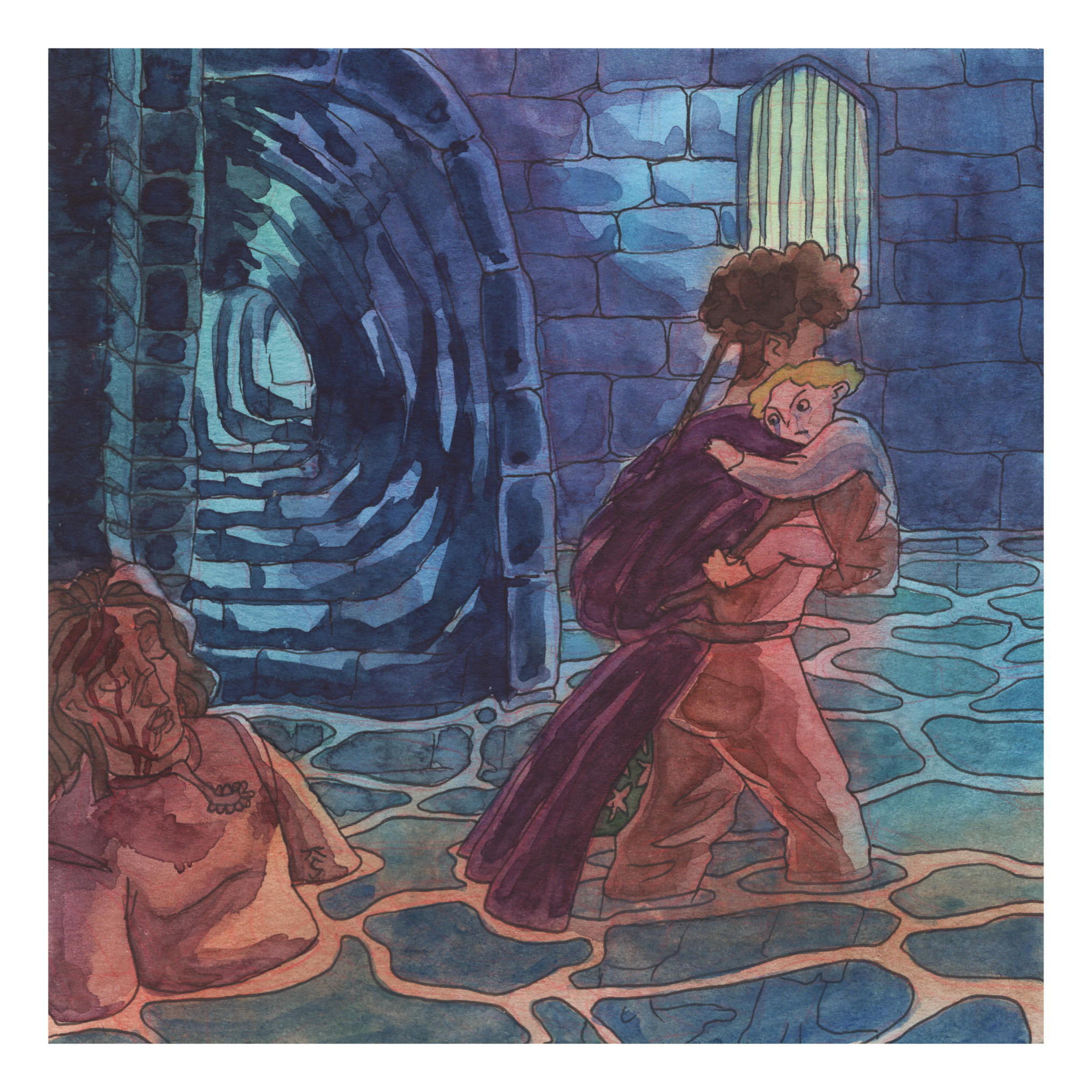
I do love this artist’s work!
Katrin Supernova’s The Tunnels, here, used for commentary

At length, the pair reach Lant, and the Fool urges more haste to escape. Lant bears Bee on his back, escaping the fortress of Clerres into the surrounding countryside, where they meet Spark again. The Fool relates their expected course of action: return to the Paragon and make for Buckkeep. Bee is told that she is an aunt, and Perseverance is collected. Escape continues, and the Fool muses on the arrogance of the Servants and relates the depth of the Skill-healing Fitz forced upon him. Bee finds herself relegated to being a child who must be protected, which chafes at her, and the matter of Prilkop’s whereabouts receives attention; he had fled, but to where was not marked.

The group reaches one of the Paragon‘s boats and are welcomed aboard. The boat reaches the liveship, and its passengers board. Bee is taken aback by the liveship but soon confers silently with the craft, exchanging news. The liveship begins to transform into the pair of dragons from whose cocoons it was made, and Per takes Bee to her cabin, leaving her to assess herself and her situation. She remarks what Fitz had brought with him to save her, sorrowing over some things and exulting in the presence of her books.

Bee’s reverie is cut off by an attack befalling the liveship. She reluctantly surrenders the Silver that had been promised to Paragon, noting the power it could have offered her, and Kennitsson relays it to the figurehead. As he, joined by the son of Brashen and Althea, does so, Bee, Per, and the Fool flee the ship. Swimming away, Bee sees the liveship assailed and burning, and as the ship sinks, two dragons rise from it and begin to go about the work of destroying those who assail them. Bee watches the dragons at their work with some satisfaction as those around her work to retrieve survivors.

The prefatory comments of the present chapter once again prompt attention. Although it is not explicitly stated, it is clear to me that Gerda and the people whom she serves are the forerunners of the Chyurda; the description of Cullena, her attitudes, and the people that spring from them seem very much in line with Kettricken’s people. Deszcz-Tryhubczak writes about them, and the texts of the Realm of the Elderlings corpus support such an assertion, with examples here, here, and here, among others. That the White Prophets are known among the Chyurda is itself such an indication; the “religion” is not known in the Six Duchies during the Farseer books, and if it receives attention in the Liveship Traders works, I do not recall it at the moment. The Chyurda are further removed, geographically, from Clerres than are Buck, Bingtown, or Jamaillia, yet they are aware of the “faith”; the easiest explanation is that there was some sort of mission from Clerres to the Mountain Kingdom, and the account of Gerda presented in the preface offers some confirmation thereof. It is likely a back-filling, part of an effort to connect and unify the Realm of the Elderlings novels across themselves (and one that is not always successful, I admit; see this and this), but it is something that, at least for me, works well enough.

In the chapter, proper, there is a lot going on, and it contrasts sharply with the remarkably brief chapter it follows. I have to wonder, in fact, if it might not have been better divided into two chapters, given the pivot of Bee in the cabin; she suddenly shifts from contemplation to flight as the attack on the Paragon gets underway. I can understand, in terms of structure, that that might not be advisable; the novel prior had largely worked to alternate chapters of narrative perspective. (That it does has some resonances that frustrate interpretations of the narrative’s relation, as I’ve gestured towards previously. If it is the case that the Farseer novels are Fitz’s papers written between the end of that series and the Tawny Man novels, and the Tawny Man novels are written between that series’ ending and the beginning of the Fitz and the Fool novels, when are the recollections and notes that comprise the Fitz and the Fool novels written, and by whom? The perspective of rereading and the foreshadowing at work even for a new reader suggest that the obvious answer is not the correct one.) Adding another Bee-centered chapter would disrupt that rhythm, even as it would also move the narrative toward being more Bee’s than Fitz’s, and that might not be the worst movement to make, given context.

And, to return for a bit to affective reading: I feel for Bee. Poor kid. As the father of a daughter, and one of whom I am quite proud, I know that the day will come when I leave her, whether I want it to be the case or not. I know that she will not be able to know me the way Bee knows her father; we are close at present (she will be a teenager relatively soon; I have some idea what’s coming), but even with that closeness, we do not share thoughts and emotions the way the Skill allows. I hope nonetheless to be and to have been such a father as will make my absence a sorrow to her, even as I want her not to mourn much at my passing–but I would not begrudge her satisfaction at the fall of those she believes undo me, if that should be what happens. It’s fantasy, for the most part, of course, but even in fantasy, there are things for which to strive in “real life.”

I’ll conclude with a short note: Happy Tolkien Reading Day (again)!

Join those who have gotten help with their work! Fill out the form below!

← Back

Thank you for your response. ✨

Or you can send your support along directly!

A Robin Hobb Rereading Series, Entry 496: Assassin’s Fate, Chapter 37

Read the previous entry in the series here.
Read the next entry in the series
here.


Information about the Pocked Man legend in the Six Duchies prefaces “Touch.” The chapter begins with Fitz regaining consciousness as the Fool seeks him out, bearing Bee. The two confer about their situation, and Fitz assesses Bee’s condition through the Skill, finding her only stunned. He and the Fool fare far worse, and Fitz constrains the Fool to accept Skilled healing and to take Bee and flee. He and Nighteyes confer internally as he does so, and when that work is done, he starts to sink into welcome oblivion.

Apt.
Photo by Rahul on Pexels.com

The prefatory comments of the present chapter call back to much earlier portions of the Realm of the Elderlings corpus, notably the early incidence of Forgings, Regal’s depredations on Buckkeep, and the death of Shrewd. The clear implication is that one or another of the members of Fitz’s group is being made parallel to that figure, and Fitz and Bee are the most likely candidates for being so (and in that order). The present chapter does not do much to reinforce that implication for them, however. Both are scarred, certainly, and Fitz has gotten to enjoy another encounter with Chade’s exploding powders, the very things that made him an image of the Pocked Man. Both Fitz and his younger daughter have been death-bringers in Clerres, but that has not been new to the present chapter. Why the image appears again when it does, then, does not swiftly become clear.

As I think on it, perhaps it serves as a counterpoint to Fitz’s brief prayer to Eda, made over the head of his younger daughter. It’s still uncommon for him to voice religious feeling, and Fitz remarks upon as much in the text, so the occurrence is marked. Given the repeated assertions that Eda and El coexist, there is some sense in presenting a figure tied to El in a chapter that features a rare prayer to Eda in its five-page span…but it still strikes me oddly.

I remain happy to help you get writing done at reasonable rates and without AI slop! Reach out through the form below to get me on board!

← Back

Thank you for your response. ✨

Or you can send your support along directly!

A Robin Hobb Rereading Series, Entry 495: Assassin’s Fate, Chapter 36

Read the previous entry in the series here.
Read the next entry in the series
here.


Complaints from Chade regarding the slow progress of research into the memory cubes retrieved from Aslevjal open “Surprises.” As the chapter, proper, begins, Fitz steels himself against the task presenting itself to him, Nighteyes offering wry comments within as Fitz make preparations to draw off and dissuade pursuit of Bee. Per and Spark join him, to his annoyance, and Spark makes some adjustments to his plans before helping Per to help Fitz away. Pursuit finds them and begins to engage but is caught in the trap Fitz and Spark had set up.

Wrong kind of boom.
Photo by Nairod Reyes on Pexels.com

Fitz is slowly brought back to Bee, with whom he confers again as efforts to effect escape form Clerres continue. She glosses her treatment, and Fitz conveys what news he can before he dozes off. He wakes to find himself in communion with Bee and appreciative of her strength in the Skill. Work to effect escape continues, and there is more conversation among Fitz, Bee, and the Fool, turning to prophecies and Catalysts. Bee is attacked by a released prisoner, and the prisoner is killed, to Prilkop’s sorrow. Kill totals are wryly calculated, and Fitz finds himself unable to assist the escape efforts.

At length, an opening is made into a secret tunnel, and Perseverance and Bee proceed therein. Work to widen the opening continues, and Spark joins those moving ahead. As the opening is widened further, Fitz sends the rest ahead. The Fool rejoins him, and the pair proceed, only to be told that their situation worsens. Fitz determines to proceed onward, and he is spurred by an explosion behind him.

As often happens, the prefatory materials attract some attention. It is remarked at a number of points in the Tawny Man and Fitz and the Fool trilogies that Chade had been reckless in his study of the Skill once it was made open to him, in part because he had been denied it due to his bastardy, in part out of a desire to mitigate the damage age and his particular lifestyle had done to his body, and in part because he was prone to obsession, particularly as regarded the acquisition of knowledge. The second part is perhaps the most germane to the circumstances of the chapter; Fitz comments that his body is sapping its strength to heal his wounds, repeating a process that has been at work in him since he had been ineptly healed decades before. (Chade had soon after attempted such healing on himself, if with less error due to calmer circumstances.) There is a useful warning against rushing headlong into knowledge not fully explored in the example, even as Chade’s complaints betray an eagerness to thus rush–but he is not wrong that those with greater experience and breadth of knowledge might do better to accurately classify and identify materials than apprentices, who are by their very nature less informed than they might be. There is a tension in place, to be sure, and one that memory suggests Hobb treats elsewhere; I remember Fitz noting that not all knowledge should be written due to the perils of misunderstanding and misuse. I suppose it’s something of another scholarly someday, yet another in a growing litany of them.

I do find Fitz’s comments about his life as the Fool’s Catalyst a bit amusing. The quip that “Sometimes [the Fool] is very sure a dream will come true….And then I make it not true” (642) did get a laugh out of me as I sat at my desk rereading and typing. It’s an oversimplification of events, of course–Fitz often enough acts in such ways as ensure the Fool’s visions come to pass–but I can recognize a father’s attempt at levity with his daughter for what it is easily enough, and I appreciate it.

I’m still happy to help you get writing done at reasonable rates and without AI slop! Reach out through the form below to get me on board!

← Back

Thank you for your response. ✨

Or you can send your support along directly!