Reflective Comments for the November 2018 Session at DeVry University

Continuing a practice I most recently iterated at the end of the September 2018 session at DeVry University, and following closely the patterns established in previous practice, comments below offer impressions of class performance among students enrolled in my sections of ENGL 135: Advanced Composition and ENGL 112: Composition during the November 2018 session at that institution. After a brief outline of each course and selected statistics about it, impressions and implications for further teaching are discussed.

ENGL 135

Students enrolled in ENGL 135 during the November 2018 session were asked to complete a number of assignments in quick succession. Many, and the weightiest, related to the overall course project; others were homework meant to practice skills used in the workplace and in later stages of the course project. Those assignments and their prescribed point-values are below, with relative weights shown in the figure below:
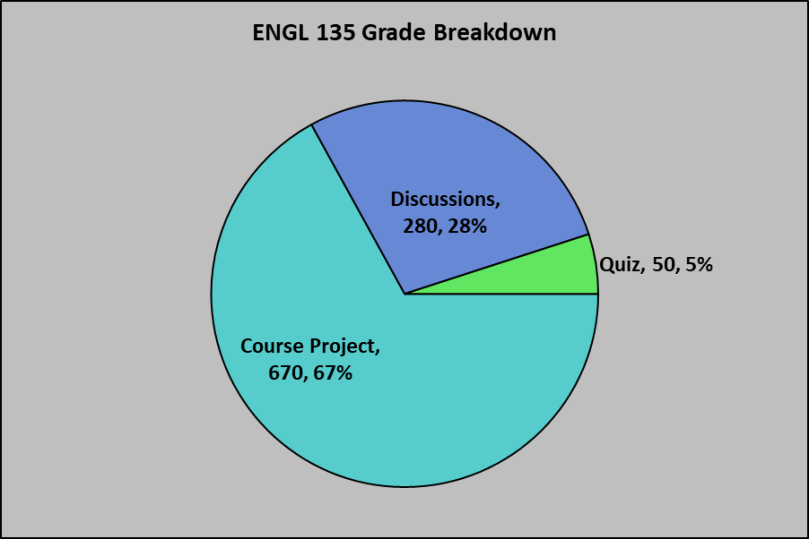
ENGL 135 Grade Breakdown November 2018

  • Course Project
    • Topic Selection, 50 points
    • Research Proposal, 50 points
    • Annotated Bibliography, 100 points
    • First Draft, 70 points
    • Second Draft, 80 points
    • Presentation, 100 points
    • Final Draft, 170 points
    • Career Planning, 50 points
  • Discussions, 280 points
  • Homework, 50 points
  • Total, 1000 points

As before, most assignments were assessed by means of rubrics provided by the institution or amended from them for ease of use. Some few were assessed on a percentile basis from standardized testing conducted as part of University-wide course requirements.

The section met online, with office hours generally taking place Monday evenings at 6pm Central time. Its overall data includes

  • End-of-term enrollment: 18
  • Average class score: 730.925/1000 (C)
    • Standard deviation: 210.112
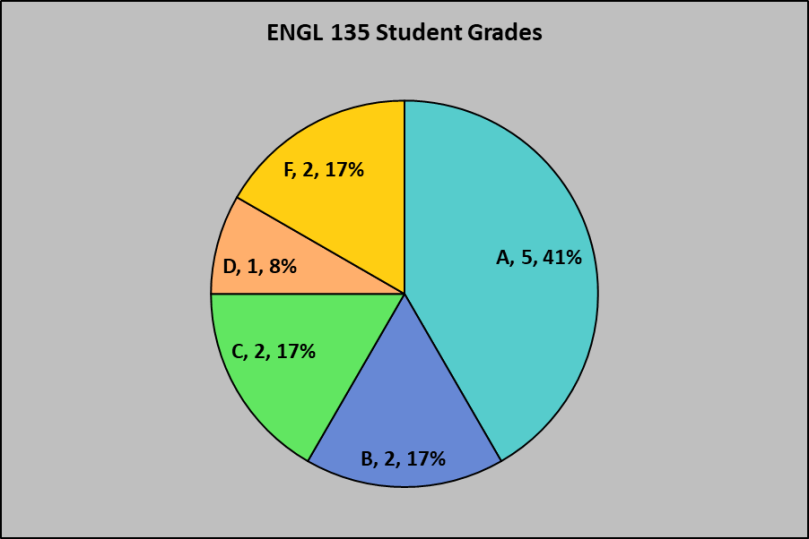
  • Students earning a grade of A (900/1000 points or more): 5
  • Students earning a grade of F (below 600/1000 points): 3

Numbers of students receiving each of the traditional letter grades are indicated below:

ENGL 135 Students by Grade

Comments about the session will follow in Impressions and Implications, below.

Return to top.

ENGL 112

Students enrolled in ENGL 112 during the November 2018 session were also asked to complete a number of assignments in quick succession. Most concerned a series of short papers, presented in planning sheets before submission as full essays; a final essay additionally went through an intermediate draft before final submission. Those assignments and their prescribed point-values are below, with relative weights shown in the figure below:

ENGL 112 Grade Breakdown November 2018

  • Papers, 690 points
  • Discussions, 310 points
  • Total, 1000 points

Assignments were assessed by means of rubrics provided by the institution or amended from them for ease of use.

The section met in Room 111 of the San Antonio campus Wednesdays at 6pm, with office hours generally taking place Monday evenings at 6pm Central time. Its overall data includes

  • End-of-term enrollment: 9
  • Average class score: 610.9611/1000 (D)
    • Standard deviation: 299.4946
  • Students earning a grade of A (900/1000 points or more): 0
  • Students earning a grade of F (below 600/1000 points): 2

Numbers of students receiving each of the traditional letter grades are indicated below:
ENGL 112 Students by Grade

Additionally, since the class met physically, it was possible to take attendance. All students in the section missed at least one class meeting; some missed quite a few more, as indicated below (with the figure being classes missed, students missing that many classes, and percentage of students falling into that category):

ENGL 112 Students by Absence

Comments about the session will follow in Impressions and Implications, below.

Return to top.

Impressions and Implications

I confess to feeling some dismay at the lower performance of the November 2018 session against the September 2018. While ENGL 135 had more A-earning students than its earlier counterpart, it also had more students fail–and ENGL 112 had no students earn overall As, though it also had students failing. In each case, the lower grade was due to non-submission; many students got many zeros for work because they simply did not submit it. I have to wonder what else I could have done to chivvy them along.

Matters were complicated by a data loss I experienced late in the session. I typically keep my teaching notes and materials in a USB drive; the one I had been using ceased functioning. In retrospect, I had some indication that such would be the case, and I did not act upon it; I suffered as a result. Student grades were not affected; those I had recorded in the school’s system remained in place, as did my comments about them, and materials I had uploaded to this site also remained in place. Still, having to reconstruct information at the speed I did did not make things easier for me. How it affected my students is not as clear.

I feel, however, that my earlier-noted resumption of example-writing was helpful for my students. At the very least, I know that people were looking at the examples I posted; I have access to readership statistics, so that, while numbers were not as good as they were in August, they were still generally up. Enough students’ work mirrored the examples that I am confident some of the lessons made it through, which is good. Unfortunately, I am not teaching either ENGL 135 or ENGL 112 in the coming couple of sessions, so the examples will be let alone for a bit–though I mean to continue the practice with the next class I teach.

Moving forward, I also mean to follow another practice that I had in place for ENGL 135 but not ENGL 112. In my record-keeping, I more narrowly divided storage and commentary for the former than the latter; it ended up making grading easier and commentary clearer, despite having more assignments and more students in Advanced Composition than Composition. Though it requires more initial work from me, it makes for less work while I am amid work; I think I’ll continue to do it.

At the end, though, I am glad yet again to have had yet again the chance to teach, and I look forward to having it at least one more time as I move forward.

Return to top.

Initial Comments for the January 2019 Session at DeVry University

I have been offered a class for the January 2019 Session, a section of ENGL 062: Introduction to Reading & Writing, and I’ve accepted the assignment. It’s a class I’ve taught several times before, though it seems to have changed a bit for the upcoming term. (That’s good, because there were some things that needed adjusting, but it does also ask me to re-learn some things. But that’s also to the good.)

It can be a fun thing, indeed.
Image from Giphy.com.

I am likely to continue to offer samples of the work I expect my students to do, as I have noted that the students in classes where my examples are ready to hand do better on the tasks assigned them than those who were not. Too, I’ve not generated examples for the introductory students yet, and it can easily be argued that they are in the most need of additional assistance; I have been lax in not doing so previously, and I will address the lack. And it will help me negotiate the changes that have gone through since I last taught the course, which is also set to be to my benefit and my students’.

The class is set to meet in Room 111 of the San Antonio campus on Mondays at 6pm, beginning on 7 January 2019 and running through 2 March. It’s scheduled to run until close to 10, but how much of that gets taken up will depend on enrollment; keeping two students in for four hours is a bit much. And I will have to negotiate the MLK holiday, which will interfere with the class meeting. But that will be a relatively minor challenge–I already have plans in mind for how to proceed–and I am happy to be once again in a position to face it, to do again what I have long done and even longer trained to do.

In Response to Brian Rosenberg

On 4 December 2018, Brian Rosenberg’s “Actually, Academe Never Was All That Great” appeared in the online Chronicle of Higher Education. The article invokes New York Governor Andrew Cuomo’s August 2018 misspeaking about the lapsed greatness of the United States as a way to frame a more nuanced position–that some people miss a time that was far from great for a great many people–that it then applies to academe. It then presents a number of examples of exclusionary practices that were prevalent and emergent in the putative golden age of the academy before noting that many of the same forces and tendencies that underlie academe now are those that undergirded it then. The same social forces remain at work, the article holds, so addressing the problems of colleges and universities without addressing those social forces as well is folly.

The image is from the article to which I respond. It seems appropriate.

My experience aligns largely with Rosenberg’s assertions in the article. Academe is a (somewhat slowed) reflection of popular, public culture, moving lethargically as any organization does that is administered by those who have lifetime appointments or placement in systems that might as well be so. There is, despite the protestations of open minds and willingness to critically reflect, an ongoing privileging of those who are already in the system and a reticence at administrative levels to interrogate and, possibly, change things until and unless forced to do so. Some of that, of course, is the result of colleges and universities in the United States, generally, being beholden to the machinations of government; at public schools, particularly, legislative dicta overdetermine policies, and legislatures remain in large part bastions of cronyism and nepotism. The systems in place favor those who have experience with the systems already, so matters tend to perpetuate themselves.

And it is true, too, that matters have not always or often been good for large numbers of people in academe. I remember one year during my undergraduate days when the only professors on campus who were denied tenure–and not at the departmental or College level, either–were homosexual men, for example. I remember any number of other times when those who were connected somehow got better opportunities than their peers who produced more work and more favorably received. And while I know the adage that the plural of anecdote is not data, I know also that I am not alone in having such stories (but others’ are not necessarily mine to share). I believe those with whom I’ve spoken about such matters, who have consented to share their experiences with me. I know that there have been many who have been told that they do not belong, not because they did not belong in terms of academic ability (though there have been some who did not who were told so), but because they did not “belong” in the purported social structure being replicated by the university. (And there have been some who were accepted who did not have the academic heft even to ask. It is a fraught issue and an unpleasant one to think upon. But, unpleasant as such thoughts may be, the experience of that forcing-out and “normalizing” has to be worse.)

Help me spread good words this holiday season!

Class Report: ENGL 112, 19 December 2018

Class was given over entirely to the completion of eighth-week work: student evaluations (if not yet done) and the reflective postscript. It met as scheduled, at 1800 in Room 106 of the San Antonio campus. The class roster listed nine students enrolled, a decline of one from last week; four attended. Student participation was reasonably good. An online office hour was held on 17 December 2018; no students attended.

Students are reminded that the reflective postscript is due online as a Word document no later than the end of day (Mountain Standard Time) on Saturday, 22 December 2018. The session closes at that time, so no late submissions can be accepted.

Reflective comments are forthcoming.

Sample Assignment Response: A Reflective Postscript for ENGL 112 at DeVry University

To conclude from earlier work (here, here, here, here, here, here, and here), I will carry out the assignment my students are asked to complete for their final week of the session: a brief reflective postscript. Considering work that has been done and what work is yet to be done is a useful thing, and I nourish the hope that the example I might offer will help my students and others do find such use in their own work.

Memory is a tricky thing.
Image from Psychology Today.

For the exercise, students are asked to address a series of University-provided prompts in short paragraphs that should total some two pages of text when typed in double-spaced 12-point Times New Roman on letter-sized paper with one-inch margins. The prompts ask students to consider their work and advancement during the course, especially as pertains to the commentary essay of the last few weeks of class. It is a fairly common exercise, both at the University and in colleges more generally, so it is likely students will encounter it again–and, as noted, reflection is good practice, in any event.

For my own work, I began by setting up a document in line with the expressed formatting standards. That done, I copied the prompts over from the University into the document, highlighting them in green so I could easily see what I would be addressing and would remember to delete the copy-over before completing my work.

At that point, I moved directly into drafting my responses, considering my answers to the questions posed as I went along. The questions are open-ended, but not so open-ended that they demand much delimiting. As such, answering them proved relatively easy to do–which makes sense, given the time I’ve spent on the project reflected upon and its topic.

The content made ready, I deleted the imported prompts and reviewed my document for style and mechanics. After making the adjustments that needed making, I put the document into an accessible format, which I present here: G. Elliott Sample Reflective Postscript. May it and its predecessors prove of benefit now and in time to come!

This session’s done, but other classes await; help me help them, too!

Class Report: ENGL 135, 17 December 2018

Following up on the previous report, students were asked to comment on issues of design for their final papers (focusing largely on images and their integration into the text), as well as concerns of APA formatting. They were also asked to complete and submit their final papers; the present week asks for reflection on their work and its connection to their future plans.

The course roster showed 18 students enrolled, one fewer than last week; 16 participated in online discussion during the week. No online office hour was held on Monday, 10 December 2018, owing to other concerns.

Students are reminded that an office hour is scheduled for tonight, Monday, 17 December 2018, at 6pm CST. Students are also reminded that the following assignments are due before the end of day (Mountain Standard Time) on Saturday, 22 December 2018:

  • Discussion Thread: Looking Ahead
  • Course Project: Career Connections (due online as a Word document)

In Response to Noah Smith

On 26 November 2018, Noah Smith’s “America Is Poorer Than It Thinks” appeared on Bloomberg.com. In it, Smith articulates prevailing definitions of poverty–absolute poverty, determined by government figures, and relative poverty, determined by standing relative to the local median income–before arguing in favor of material in/security as articulated by Maslow in his hierarchy of needs. Smith offers examples of Maslovian material insecurity and extrapolates from them based on others’ research. Smith concludes with the assertion that a better, more complete definition of poverty such as that deriving from Maslow’s ideas can help in addressing poverty, which developed nations ought to do.

When the wallet looks like this…
Image from Getty.

I’m familiar with Maslow and his hierarchy of needs from the coursework I did to earn teaching certification in those long-ago days when I thought I’d be at the front of a high school classroom for my profession. As such, the idea that insecurity about basic physical needs could inform a definition of poverty seems sound to me–but I’ll admit to not being an economist. If such an idea holds, though, then it seems that Smith’s central assertion is correct; if poverty is insecurity regarding material needs, then many, many more people are impoverished than income alone would indicate. In my own case, working one full-time job, one part-time job, a contract gig, freelancing, and still not making enough that I can afford usable health insurance coverage or put back enough money that I can afford to be out of work for very long at all, the definition fits, even though I am aware that matters could be far worse than they are.

And that leads to another point, one on which Smith does not touch, though he motions that way. One of the things, at least in my part of the world, that prevents many people from seeking help is not so much pride as a sense that asking would indicate ingratitude for what is already had, that things are not worse than they are. Folks above the poverty line, even if only by a bare margin, know they are not “impoverished,” at least in that narrowly technical sense, so they do not seek assistance, even though there is no measure by which they are doing well. Less bad is still bad, but the way things seem currently constructed makes such matters an either/or proposition, and many people feel themselves on the wrong side of it who might not if they had a better rubric by which to assess themselves and their situations. It would not be a panacea, to be sure; there would still be people who would worry that they are not badly enough off that they ought to ask for a hand up. But they might at least act from a better idea of how matters stand, which would help.

I could use a hand staying further away from poverty. Your contribution is welcome.

Class Report: ENGL 112, 12 December 2018

After addressing a procedural concern and asking about questions from the previous week and before, discussion turned to concerns of revision. Concepts were discussed and a practice in the process offered. Upcoming assignments received attention. Time was allotted to students to conduct their own work and to complete surveys of instruction.

The class met as scheduled, at 1800 in Room 106 of the San Antonio campus. The course roster showed 10 students enrolled, a decline of one from previous weeks. Five attended; student participation was good. The regularly scheduled office hour on 10 December 2018 was canceled.

Students are advised that the office hour scheduled for Monday, 17 December 2018, at 6pm Central Standard Time is expected to occur. Students are also reminded that the following assignments are due before the end of day (Mountain Standard Time) on 16 December 2018:

  • Discussion Threads: Revision Process and Peer Reviews (3 posts/thread, rubric online)
  • Commentary Final, due online as a Word document

Sample Assignment Response: A Commentary Essay for ENGL 112 at DeVry University

To continue on from earlier work (here, here, here, here, here, and here), I will do more to round out the assignment sequence expected of the students in ENGL 112: Composition and develop the assignment students in the class are asked to do for their seventh week: a finalized commentary paper. I continue to hope that, despite the errors that are in any work, what I do will help my students and others to better understand what they are asked to do and so help them do it better.

Keep on doing it.
Image from tenor.com.

For the exercise, students are asked to revise their work from the previous week as needed and to add to it the remaining bulk of their papers, bringing their commentaries to a full five pages (1500 to 1750 words) plus title page and references list.  To complete it, I began by opening the document I’d made for last week’s exercise and saving it again as a new file for the final. (Keeping the earlier version separate allows for more radical revision in some circumstances.) Looking over it again, as it had been a few days since I had last done, so, I noted that I still had not settled on a thesis because I was still puzzling through my issue. I noted also that I had addressed appropriation but not appreciation; it was to the latter that I set myself.

I picked up writing where I had left off, moving directly into drafting as I thought through the issue and angle I had set for myself in the earlier work. As I drafted, too, I was able to determine a thesis, which I inserted into the usual place for such statements in first-year composition papers–the end of the introductory paragraph–before ensuring that connection to it sufficed throughout the rest of the text. I also made sure I offered the kind of conclusion to the paper–not filling out the repetitive “tell ’em what you’re gonna tell ’em, tell ’em, and tell ’em what you told ’em” model, but moving ahead from the thesis–I want to see from my students and, indeed, from most of the writing I read.

The content made ready, I reviewed my document for style and mechanics. After making the adjustments that needed making, I put the document into an accessible format, which I present here: G. Elliott Sample Commentary Final. I hope it will help others.

Help me keep doing this, please!

Class Report: ENGL 135, 10 December 2018

Following up on the previous report, students were asked to assess each other’s work on presentations related to their ongoing projects and to submit the same for instructor review and feedback. Presently, they should be working to complete their course projects, which are due this week.

The course roster showed 19 students enrolled; 18 participated in online discussion during the week. An online office hour was held on Monday, 3 December 2018; no students attended.

Students are reminded that no office hour is scheduled for tonight, Monday, 10 December 2018; other obligations have called the instructor away at that time. Students are also reminded that the following assignments are due before the end of day (Mountain Standard Time) on 16 December 2018:

  • Discussion Threads: Designing the Course Project and APA Workshop (3 posts/thread, rubric online)
  • Course Project: Course Project, Final Draft (due online as a Word document)