One More Office Piece

I have made something of a practice of writing about the office spaces I have inhabited, ranging from a 2012 CCC piece through four samples of work for student use (here, here, here, and here) and a few more reflective pieces (here, here, and here). I still inhabit some of that office space; I’ve not relocated my home office yet, since I still live where I did, and I still have a part-time teaching position, even if I’ve not been assigned a class for the current session. But not all of that office space is still mine; I’ve lost jobs, and one of the schools I’ve taught for has closed since I left it. (There’s another I think might before terribly wrong, if things continue as they have been for a while, now.) In one case, I’ve moved from one office to another, not because anything wrong has happened where I work, but because I have assumed a new position that has a private office among its trappings–and, since I’m in a new office, it’s time to write one more office piece.

20190909_085000
The new office, which is mine, just as the photo of it is.

It was not a long move to get from the most recent former office to the current one; I am now in a large private office just off of the lobby where my former desk–ably staffed by a new hire–sits. Most of what I had at that desk remains there or near there; it was tied to the position rather than to me, and I inherited a fair amount of material from my predecessor in my present position. I also brought a fair amount of stuff from home that I had had for previous office spaces and had packed away against not having a private office of my own to post it in. (Yes, I have the home office, but there is only so much space on its walls, and much of that is taken up with shelving.) Having arrayed it as I have, I do run into the problem I address in my 2012 CCC piece, that the honors and awards I have on display can be read as evidence of my insecurity.

At the same time, the people who have seen my office have commented favorably on it; they like the way it looks (and smells), describing it as “professional” and “homey,” among other pleasant terms. It does not read for them as covering my fears (though, just over a week into the job as I write this, I have a fair number of fears to cover; I am not certain I am ready, though I trained for this for years). Instead, it reads for them as justifying the trust that has been placed in me by awarding me the position I hold. It helps them to know that they are in good hands–and I hope that I can, indeed, wield such hands for them.

The privacy of the office is itself an indication of that trust. Even more than before, I am in a position to handle sensitive, confidential information; not only do I still deal with treatment matters, but I also attend to concerns of the agency’s finances and personnel, things that even those who can handle the clients’ data well cannot be privy to. And I may, in time, have to deal with disciplinary matters I would rather not have to address, though I will do so as the need arises; privacy is good for that, as well, and that I am afforded that privacy is, again, a mark of trust.

I hope to be worthy of it, and for quite some time to come.

Furnishing a new office ain’t cheap. I could still use some help.

A Robin Hobb Rereading Series: Entry 29: Royal Assassin, Chapter 4

Read the previous entry in the series here.
Read the next entry in the series here.


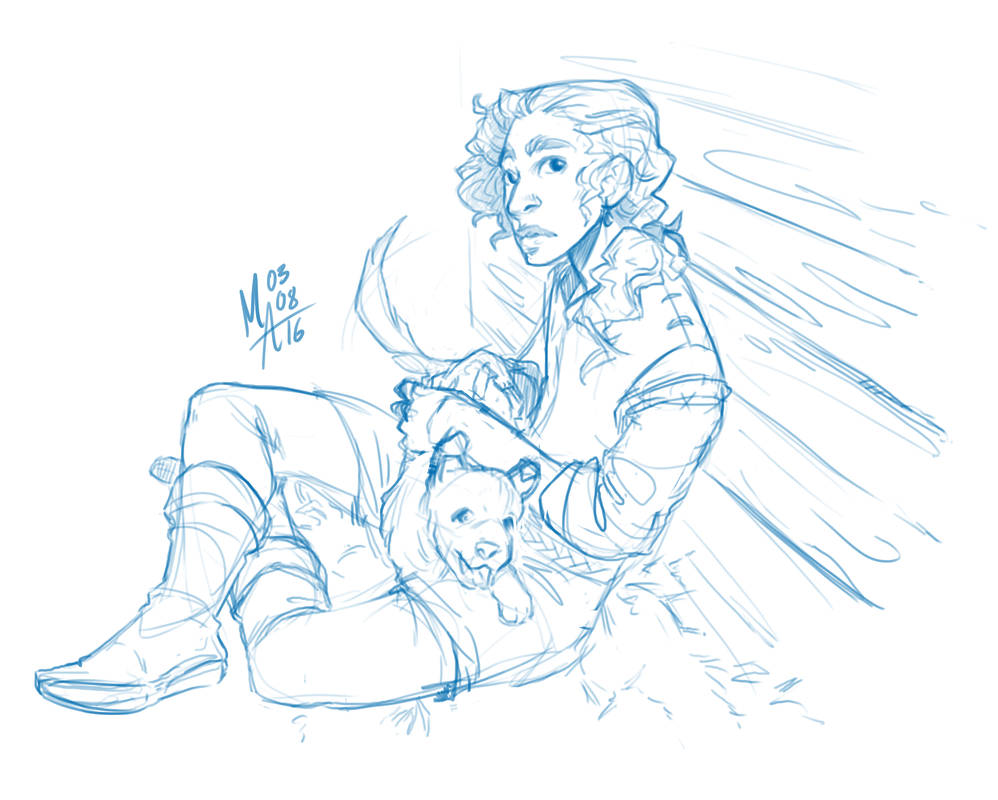
A chapter titled “Dilemmas” follows and opens with a brief rumination on the Wit and the Skill before portraying Fitz waking alone in his room and staggering off to make ablutions. He returns to bed and to a fitful sleep.

Fitz and Nighteyes by Manweri
Michelle Tolo / Manweri’s Fitz and Nighteyes on DeviantArt: image used for commentary

When he wakes again, he finds his chamber has been tended to. As he avails himself of it, the Fool enters and checks on him, bantering with him acerbically before leaving just ahead of Patience and Lacey bustling in to check on Fitz. They fuss over him, and Patience presses upon him the folly of his putative attempts to woo Molly, citing the entanglements of his royal–if bastard–blood and Molly’s own potential prospects. Fitz protests to no avail, and Patience and Lacey leave him to rest.

After contemplating the decor in his chamber again, Fitz dozes off to be wakened by a summons from Chade. Answering it, he finds the old man considering a scroll. He is also clearly considering political implications, as he walks Fitz through a general idea of a way people might seek to exploit him. They exchange news, with Chade offering detailed information on the problems Verity and Kettricken face. Chade also offers some rebuke to Fitz for his conduct with Molly, echoing Patience’s warnings about the political ramifications. He offers some commentary about his relationship with Chivalry and Verity before returning to the topic of Fitz and Molly, urging him to heed Patience’s advice in the matter He also reiterates his warnings to Fitz for his own safety.

After their meeting, Fitz makes his way into Buckkeep Town, walking idly and taking in the gossip the place offers. Along his route, he encounters a vendor selling animals to be used for sport–including a young wolf. Fitz haggles for the wolf, purchasing him and taking him outside of the town, purposing to get him strong enough to fend for himself.

The wolf is of paramount importance in the series, and the level of engagement between Fitz and the wolf cub in the chapter makes that importance clear. Earlier events–the episodes with Nosy and Smithy in Assassin’s Apprentice–make clear that Fitz bonds to animals swiftly and deeply, and he already seems to share a particular affinity for the wolf he has found in a cage in Buckkeep Town. There will be more to come for the two of them, as is clear even without knowing from prior readings what will happen in the novel.

Less significant to the overall narrative, perhaps, is something that I noticed as I read the chapter this time and that I do not recall having noted before. Fitz wants to disregard Patience’s advice (and the emblematic name makes a bit of a joke) regarding Molly, and, having been an adolescent boy in the throes of lust that might have had something of love in it, I can well understand that desire and the recklessness that informs it. That is not what I note, though; what I note in this reading is that Chade’s reaffirmation of Patience’s advice seems, if not to persuade Fitz, at least to mollify him. Admittedly, Chade has a particular authority over Fitz, but there is still something of the “guys will only listen to ideas when other guys say them” about the matter. How to read it–a reflection of the prevailing standards surrounding the composition, a yoking of such behavior to immaturity, or something else–is not necessarily clear to me as I write this, but it is something that might stand some investigation moving forward.

It’s one of the things that I have loved about Hobb’s works. There’s a lot to unpack in them.

Any chance you could send some help my way?

A Robin Hobb Rereading Series: Entry 28: Royal Assassin, Chapter 3

Read the previous entry in the series here.
Read the next entry in the series here.


The third chapter in the novel, “Renewing Ties,” opens with a description of an old scroll detailing the encounter of the early Six Duchies ruler, King Wisdom, and the Elderlings after which the overall series takes its name. It moves to Fitz going back out into Buckkeep Castle before he finds himself drawn to a tower room to which Verity has summoned him via the Skill. The two of them confer frankly and surprisingly openly, and Verity seems to have great affection for his bastard nephew.

Image result for verity farseer
An image described as of Verity, used for commentary.
Source unknown to me; information will be welcome.

When Fitz leaves Verity, Lacey, Patience’s maid, finds him and bustles him to her lady. Patience quizzes Fitz randomly, and he begins to suffer again from the lingering effects of the poison that had been used upon him. Patience recognizes his infirmity and sends him off to rest–and he encounters Molly along the way. He is initially buoyed by the encounter, but as he elicits information from her, he finds himself rebuked for his seeming drunkenness and for the many lies he had told and allowed, and he learns that matters have been poor for her family. She leaves him despairing of his infatuation with her, and he staggers back to his room to sleep.

Again, I find myself reading affectively, sympathizing with the folly of an adolescent boy trying to make sense of lust and love at once, and I have to think that that correspondence informed my early regard for the novels; when I first read the Farseer books, I did so much closer to my own adolescence than I am now (though some might say I still need to grow up), and I was not much more adept than Fitz in such matters, if I was at all. It is as good a reason as any to start to make a fuller study of something, and better than most.

There are parts of me, even now that I am largely out of academe–I’ve given up the search for an academic job, and I’m not teaching in the current session at the one school where I do still get to stand in front of a classroom–that clamor for me to make some kind of insightful, scholarly comment about the chapter. And I could tease out something about, perhaps, a suggestion of something between Charim and Verity like that I have suggested lay between Burrich and Chivalry in the imagined past of the novel, or I could point out that Hobb subtly signals the ultimately untenable nature of chivalry through reflecting on Chivalry when Fitz’s eyes meet Patience’s and “She nodded slowly, accepting the lie [Fitz had told] as necessary, and looked aside. [Fitz] wondered how many times [his] father had told her similar lies. What did it cost her to nod?” Neither would be wrong, exactly, and either might be fodder for a short piece of commentary that might well be worth doing. So might a bit linking what happens in the chapter to more of the foreshadowing that is itself a common theme in the series of novels; looking ahead only to find later that such peerings were correct is something of a motif in the main Elderlings novels, perhaps the dominant one. (I’d have to do more work on that, though.)

At another time, I will have such things to write. I hope you will continue to read them.

I’d love to have your support.

A Robin Hobb Rereading Series: Entry 27: Royal Assassin, Chapter 2

Read the previous entry in the series here.
Read the next entry in the series here.


The next chapter, “The Homecoming,” reflects briefly on the founding of Buckkeep before moving to gloss the progress made by Fitz, Burrich, and the stableboy Hands from the Mountain Kingdom back to Buckkeep. It is a wintry journey and slower than might be hoped, the more so because Fitz’s condition impedes their travel. Too, when they lay over in an inland town, Burrich and Hands hear much of the disgruntlement about the continuing threat of the Raiders and the appreciation the people seem to have for Regal; Burrich takes the opportunity to caution Fitz that his uncle still hates him and will have him killed if he can.

Buckkeep at night by Winterkeep
Buckkeep at Night, by Winterkeep on DeviantArt.com, used for commentary

At length, Fitz and his party return to Buckkeep, where they are challenged by the gate guard. After a bit of banter, they are recognized and admitted, and Burrich has to caution Fitz again about returning to his subordinate place as a bastard princeling in a place where people care about such things. Fitz accedes to the wisdom, if with difficulty, as well as to the wisdom of allowing others to do for him what his condition prevents him from doing well. And after, when Fitz makes to report to King Shrewd and King-in-Waiting Verity, he is turned away by both and muses on the changes that have occurred while he was away and with the arrival of others before him.

The device of using rumors heard in passing through a town to gloss over events is a good one; exposition is often a difficult thing to do well, though it is also necessary, so any adept handling of it is good to see. But it is not as good as the depiction of the strange tensions of adolescence that Hobb depicts in Fitz; I am not so old that I do not recall the awkwardness of my own teenage years, though they were far less eventful for me than Fitz’s are for him, and I find myself reading affectively again as I sympathize utterly with a young man who, having had a taste of being something more, chafes at being returned to older, more constraining patterns. And I sympathize, too, with the desire to be open with someone, only to have that openness set aside–gently, perhaps, as Burrich does with Fitz, but still put aside. I have a person with whom I can be so open now, and I revel in it, but I recall not being able to do so. Again, though, it’s an affective reading, and something I ought to know better than to do.

Except that the idea that any would “know better” than to allow themselves to be moved by a character in a story is a strange one. To do the work of literary study, it is necessary to be able to remove reader from text to some degree, just as a physician must be able to look at the flesh of a patient as a thing apart from a person to some degree. Yet the physician who does not engage the patient’s humanity is decried, and rightly; no scholar, no practitioner, does well to separate the humane wholly. Acknowledging it is needed, yes, but ignoring it is certainly not.

Support the labor of doing this on this Labor Day.

A Robin Hobb Rereading Series: Entry 26: Royal Assassin, Chapter 1

Read the previous entry in the series here.
Read the next entry in the series here.


The first chapter, “Siltbay,” opens with an in-milieu reflection on the position of King/Queen-in-Waiting, which serves the Six Duchies much as the role of Prince of Wales serves the UK or Dauphin served the French monarchy; attention is paid to the holders of the title under Shrewd. It moves into a Skill-vision, with Fitz occupying Shrewd and learning both of the attack on the place in the chapter’s title and what it truly feels like to be an old man. He observes as Shrewd reasserts himself and issues orders to send aid to Siltbay; when the old man turns his attention to Fitz in his mind, their connection is broken, and Fitz makes to return to Buckkeep.

The Fool and King Shrewd by Crooty
Crooty’s The Fool and King Shrewd on DeviantArt, used for commentary

There is a bit of annoyance in the chapter–not because of what it shows, because the descriptions are well written and finely balanced, and they offer a useful musing on the status of the conflict in which the Six Duchies finds itself. No, the annoyance comes at the whiplash attitude in it. At the end of the prologue, Fitz had been ready to retire from the world; what is, in effect, a nightmare, if one “real” in showing what “is” in the milieu, turns Fitz around. It reads as hurried, somehow, something of a deus ex machina, and if there is antecedent for such in the tradition from which Hobb borrows for the novels as a whole (about which there is some discussion here), that does not mean it is the most desirable thing to see in the present text.

A sense of being rushed is something I have noted in others of Hobb’s works (this and this offer some short discussions thereof; there are others). I think it attracts my attention because I like Hobb’s writing as much as I do (and it should be clear I do; I spent the time doing a master’s thesis on her work, as well as presenting any number of papers on her writing and buying copies as circumstances have permitted across decades–and such projects as the present one). I want it to be without flaw, and so when I see something that I have to regard as being less than it could be, I cannot help but mark it. But that failing is mine, not that of the author whose work I have spent most time reading and writing about. (I think; I’ve not logged hours, but I’ve certainly written on Hobb more than I have Asimov or Tolkien, who are the two most likely competitors.)

A failing that will not be mine will be an end to the rereading before I have finished it. As I’ve noted, the reading I’m doing now is slower than I’m accustomed to doing, but that it is slower does not mean I am going to be giving up on it.

It’d still be nice to have you chip in to help support this.

A Robin Hobb Rereading Series: Entry 25: Royal Assassin, Prologue

Read the previous entry in the series here.
Read the next entry in the series here.


The second of the Farseer books, Royal Assassin, opens with a brief prologue, unlike Assassin’s Apprentice. In the prologue, titled “Dreams and Awakenings,” Fitz considers (in retrospect) various magics known to the Six Duchies. He notes both that magical knowledge tends to be transmitted orally and that it requires an inborn predilection for practice. He passes on to further consideration of the authority to treat a topic in writing, musing on it for a while before shifting topics again.

Michael Whelan’s cover art for Royal Assassin, which graces the copy of the novel I own and is hosted on the artist’s Tumblr page; it is used here for commentary.

Fitz’s narration shifts to consider his continuing admiration for Molly, and he comments at some length about his work as the apprentice assassin for the Duchies, quietly working for the betterment of the Kingdom through performance of heinous deeds. And he arrives at his status following the end of Assassin’s Apprentice: recovering slowly and shakily in Jhaampe from being poisoned and abused, to his annoyance. He is not eased when Burrich notes the difficulty in treating him, though in their conversation, he begins to reappraise the man who might as well be his foster-father. And, amid fits caused by the lingering injuries and damage from the poison, Fitz makes to order Burrich back to Buckkeep before finally falling into sleep.

The prologue serves as an interesting way to recapitulate the events of the first novel in the series for the benefit of those who might be picking up Royal Assassin before reading Assassin’s Apprentice–while not reading as a dreadfully dull repetition to those who have moved directly into the new novel from the last one. It also does admirably to lay out the beginning state of affairs for the still-young FitzChivalry, while offering in its initial retrospection an assurance that Fitz will outlast the events of the novel. That is important because of the novel’s position in its series; it is the second book in a trilogy, traditionally the member of a trilogy that positions the protagonist in the worse possible position. But Fitz will survive, readers are assured.

Of additional note is the bit of philosophical musing Fitz advances in the first few paragraphs of the prologue, those presented as being the work of his pen as he writes in times in the novel’s future and those following close after, when he muses to himself and not upon the in-milieu page about what right he has to document traditions in which he does not take part–particularly when his right to attest in writing to those of his own experiences is in question. Some irony could well be read into writers voicing, even through fictional characters, a reluctance to write about topics at some remove from themselves, or arrogance could be read into it, since such a stance implies that authors believe themselves to be experts in the areas upon which their writing touches. It is not as if Hobb does not make other comments about the craft of writing in her work, as I’ve noted before, so it does not come as a surprise to see such comments in the earlier parts of her corpus, even if how to interpret them may not be entirely clear.

Can I count on your support?

A Robin Hobb Rereading Series: Entry 24: Assassin’s Apprentice, Chapter 24 and Epilogue

Read the previous entry in the series here.
Read the next entry in the series here.


The final chapter, “The Aftermath,” opens with a description of a tapestry in Jhaampe that serves as a sort of call-ahead to later novels. It then moves to a gloss of the fallout from the previous chapter’s events, focusing on the beginnings of Fitz’s recovery and Burrich’s. What happened to August receives note, as does Regal’s behavior that glossed over all his misdeeds.

FitzChivalrySketch by MonsieArts
FitChivalry Sketch, by MonsieArts on DeviantArt
Image used for commentary.

Fitz recovers but slowly, and with difficulty, and Burrich accompanies him as he returns at length to Buckkeep. Matters seem to be improving there, with Galen dead and Kettricken’s presence enlivening things. And Fitz notes that it was Nosy who saved him from the pools, dying from the effort of it. He was a good dog.

In the following epilogue, Fitz returns to his narrative present–the novel has been recounted in an informed retrospective–to consider his lingering pains and condition. A boy in his keeping is noted, as is a friend with a quiet voice, whose “No” is the last word in the novel.

Most of the chapter is denouement and setup for the next volume; the epilogue is more or less all setup for later work. There’s not necessarily much to comment upon in either–but it is a good time to reflect on the experience of re-reading.

I welcome comments from my own readers, of course; I benefit from the work of others, and I try to acknowledge all of it I receive. (Check the embedded links and other citations in my work, please!) I know that the rereading has been a different thing for me; I’ve not usually read things in the way I’ve read the novel and plan to read the rest of them for this project. Reading for pleasure, I plow through novels, often chewing though hundreds of pages in a few hours before I recall that I am me and that I have a body that has needs that must be answered. Reading for scholarly work, I thumb through pages at high speed, seeking out tag phrases I recall or notes I’ve made in margins–when I’ve made them, which I’ve not always done–to develop the arguments I mean to make. Both are, if not rushed, intense and speedy things.

By contrast, the rereading has been a slower thing. I’ve proceeded a chapter at a time, pausing between each to write the gloss and to offer the reflections I have about what I’ve read. Sometimes, I begin to move to more scholarly activity, although generally informally; I’m not bound to any one style guide here, but have tended to embed links and move on. I have been trying to restrict myself to materials readily available; as I write this, I do still have some institutional access, but I know well that many of my readers will not, and I have no desire to exclude them. (Academic publishing is also a racket, but that’s a set of comments for another time and place entirely.) I’m sure it’s come across as vain or cute at times, but this is also ultimately a vanity project, not in support of a scholarly career as the project that inspired this is. So there’s that.

It’s been enjoyable for me so far, though, and I hope it’s been a pleasure for others, as well. I’ll be moving on to the next book in the sequence, Royal Assassin, soon; I hope you’ll come along with me!

Last chapter in this novel, though there’re more to come. Help me bridge the gap!

Sample Assignment Response: Rhetorical Strategies Persuasive Presentation

Typing Monkey GIF - Typing Monkey GIFs
Hopefully, it goes better.
Image: “Typing Monkey GIF” from Tenor.com

Another of the assignments students in ENGL 112 are asked to do in the July 2019 session, following a course redesign, is a “persuasive” presentation that derives from the earlier “persuasive” essay. The presentation should be five to seven minutes in length, containing five to seven slides (possibly more, if the references list is particularly long), and should provide a summary and breakdown of the earlier essay. Following previous practice, I propose to provide a more targeted one for the current session–the more so because the assignment is new to my experience of the present course (though I have examples relevant to other courses on hand).

To draft the presentation, I knew I would need to work from the materials I have previously developed, so I opened my saved copy of the earlier essay. That ready to hand, I did a reverse outline of it, noting how much space I allocated to which components of the paper (excluding cover page and references list, which take a prescribed length and “as long as they need,” respectively). Doing so showed me with an introduction, three points that take up approximately 206 words each, a final point that takes close to 400 words to develop, and a conclusion, plus references. That leaves me seven slides’ worth of material, possibly eight due to the length of my references list. Knowing I need to observe length guidelines and that the introduction slide cannot be the same as the introduction of the paper (the slide needs to reflect the cover page, with an overview slide that glosses the introduction to the paper), I knew I could not simply bring over the points as presented.

With two slides at the beginning and at least one at the end already reserved, I knew I had two or three slides to make my points. Normally, this would mean I would make two or three points only, out of the four available; generally, one slide takes one point. From my outline, though, I knew I had one point that outweighed the rest, and by a large margin. I figured that that point would get a slide of its own, reflecting its importance. The other three could be glossed together, perhaps in one slide, compressing them to effect. I would be able to touch on all of my points while emphasizing the importance of the most pertinent, while still allowing myself room to expand if I needed it.

A rough plan in place to put together the presentation, I opened a PowerPoint template I’ve long had for use in this webspace; it’s colored and formatted such that it lines up with the materials I present here, coming off as of a piece with them and helping me to present my work in a unified manner that increases my perceived professionalism, thus ethos. I saved it as my working project so that I could find it again at need and began to stub out the slides I knew I would need. Some adjustments needed making to keep my formatting consistent, which happens; one exception was the References list, which I allowed to auto-format in the interest of compressing the information. The slide can be looked at in isolation and at larger magnification, if needed, so its legibility amid the presentation is less of an issue than it might otherwise be.

Presentations rely on graphics to make their point, and I had not generated graphics in drafting the essay from which the presentation derives. I was obliged, then, to do so, rather than to use decorative graphics such as the GIF at the top of this blog entry; presentation graphics need to be informative rather than entertaining. I tend to use Excel to do so, finding the program useful for converting numbers to figures and setting them up appropriately. As I developed each graphic, I inserted it into the appropriate slide; the graphics take precedence over any text, so I placed them with the intent to insert text around them. I also inserted text-box captions, as appropriate. Too, I made sure to save my work with each adjustment; I’ve lost too many projects not to do so.

With the graphics in place, I inserted the text I wanted to have present. Reading straight from slides is far from ideal; the text on slides should serve as a set of guideposts for speaker and audience, rather than as a script. I placed the text with that principle in mind, moving swiftly to bullet out my ideas. Owing to my background, I did draft complete sentences for my text, but that need not always be the case, as long as what is presented conforms to the usage standards expected by an audience working in the field the presentation treats.

The text in place, it came time to record audio for the presentation. Moving slide by slide, I recorded short audio pieces to embed in each slide, saving after doing each; again, I’ve lost projects, and I have no desire to repeat the experience. I did not read straight from my preceding paper, though I had it ready for review; instead, I extemporized from each of the sections I had identified in the reverse outline, making sure to note my sources of support in my narration (in addition to where they appear in the presentation’s text already). Because I want my audience to engage with the presentation, rather than passively receive it, I made sure the audio does not automatically play; I placed audio icons consistently in the slides to ease access.

All that done, I reviewed my work, making adjustments I saw as needed to bring the presentation in line with stated requirements as nearly as I could determine. With that done, I put the presentation–which I hope is helpful–where my students and others can get it: G. Elliott Sample Presentation July 2019. It is a PowerPoint file, so it has to be opened with that program or a similar one…

I continue to appreciate support for drafting better teaching materials.

A Robin Hobb Rereading Series: Entry 23: Assassin’s Apprentice, Chapter 23

Read the previous entry in the series here.
Read the next entry in the series here.


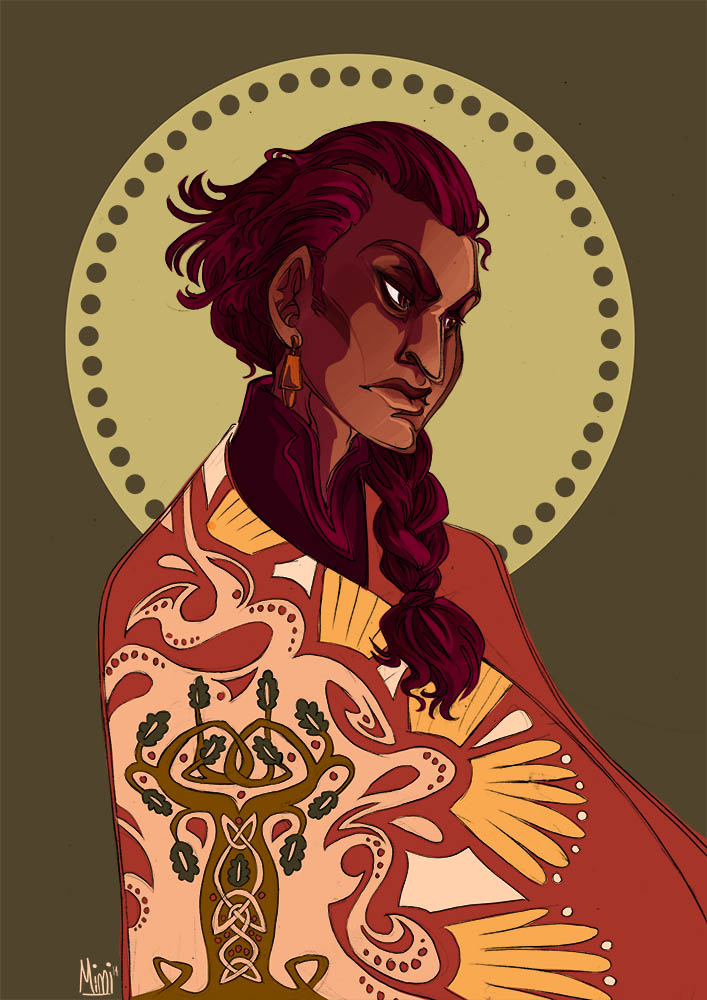
The penultimate chapter, “The Wedding,” opens with only a brief blurb about Shrewd’s approach to diplomacy and Verity’s adherence to that approach. It moves swiftly into Fitz’s assessment of his situation and his conversation with Burrich about it. Burrich notices the earring Patience had given Fitz and is taken aback by it.

Regal, the Mountwell Prince by Mimi-Evelyn
Regal, the Mountwell Prince, by Mimi-Evelyn on DeviantArt
Image used for commentary.

They are joined suddenly by Jonqui, whom they initially resist but shortly come to follow back into Jhaampe, where they find that Fitz’s room has been ransacked; Fitz realizes his store of poisons has been taken. They gather strength while Fitz frets over Verity; August arrives to deliver messages as he is commanded to do. After the Farseer cousin departs, Burrich attempts to offer Fitz his own strength through the Skill, to no avail.

After, Fitz and Burrich answer the summons that Regal had issued them, reporting to him in the hot springs that serve Jhaampe for baths. There, Burrich is incapacitated, and Regal gloats over Fitz as he tips his bastard half-nephew into a hot tub to drown. As Fitz flounders, he reflexively reaches out for Verity with the Skill, finding Galen coming to siphon his life away; Fitz, able through the slackness that precedes final surrender, offers Verity his own strength. Verity takes it, killing Galen as Galen had thought to kill him, and working powerfully through the Skill to leave August a message for Regal and to solemnize his marriage to Kettricken before he slams Fitz back into himself.

The chapter again motions towards the homoerotic relationship between Chvalry and Burrich that has received attention in this series already (here, for example). Burrich’s reaction to the earring–noting that it was a thing with which Patience, Chivalry’s widow, should not have meddled–reads less as a servant/master thing and more a thing between people particularly close. Given Melville’s comments about queerness in the novels at large, as well as Prater’s, Sanderson’s, and others’, it should not be surprising to find other suggestions of intimate relationships that transgress the “expected” dynamics of fantasy fiction in the Realm of the Elderlings novels.

The chapter also strikes a strange point of correspondence with generic expectations in offering Regal’s gloating as he makes to subdue Fitz in the baths. I have noted some of Regal’s more “normally” evil tendencies before, and I recall a 2007 course paper I wrote treating antagonist oration of the kind Regal indulges in in the chapter; in the paper (and I cringe at some of the writing I did then, but I think the idea is reasonably good), I argue that such narrations “permit character explication, in-text tactical movement, narrative pacing, and reader catharsis and return.” That is, they help show more of the character involved, allow time to move to more advantageous positions, provide a sort of lull between bouts of more intense action, and allow readers to come back to the text refreshed. Regal’s narration serves such functions, certainly, and his actions end up facilitating the undoing of his and his half-brother’s plans–fitting the trope neatly and reminding readers that Hobb continues to work with the dominant Tolkienian tradition of fantasy literature.

The next one’s the last one–in this novel. Help me bridge the gap!

A Robin Hobb Rereading Series: Entry 22: Assassin’s Apprentice, Chapter 22

Read the previous entry in the series here.
Read the next entry in the series here.


A chapter titled “Dilemmas” follows, opening with Fitz recounting a dream of the Fool and returning swiftly to Fitz puzzling out how he can resolve the situation in which he has found himself. He turns to his cousin, August, prevailing upon him to send through the Skill to Shrewd for direction. August reluctantly accedes, or appears to, but Fitz is left with no clearer sense of what to do.

Image result for strychnine poisoning
A dilemma, indeed, such poisonings…
I am given to understand it’s a public domain image, but I’m having trouble tracking the source; any ideas?

The ceremonies that bind Kettricken to Verity continue through the day. Amid them, Fitz observes August and Regal, and he determines that they discuss his own mission, which gives him unease. It has not lifted by the time he reports to Regal’s chambers as he had been bidden. Regal does not speak with him directly, but has his attendant provide Fitz directions and materials before sending him on his way.

Fitz, somewhat addled by chemicals, proceeds. He confers briefly with Kettricken, then goes to Rurisk, laying out what he knows of the continuing plot against him. Kettricken arrives in time to see Regal’s own plot come out; he has arranged for Rurisk to be poisoned independently, with Fitz poised to take the blame for it. In the ensuing fracas, Fitz kills an assailant but is taken, himself.

Fitz wakes to find Regal gloating over him. He soon passes into a drugged delirium in which he hears voices conferring through the Skill and becomes aware through the Wit of Nosy’s grief at Rurisk’s death. The old hound helps Fitz out of his bindings, and Burrich, following the Wit that he admits being able to sense, helps Fitz leave his captivity.

One thing that the chapter does well, among the many things that Hobb’s writing generally does well, is convey the notion of the narrative world existing outside the main narrative. Fitz becomes aware that there are plots involving him that he does not know about, and their presentation makes clear that they have been long in the making. It has a strangely decentering effect on Fitz. The narrative of the novel is recounted from his perspective, informed by commentaries appearing at the beginning of each chapter, so it makes sense that it focuses on him, but the present chapter makes clear that Fitz is far from the only actor in the milieu–and far from the most effective, in the present circumstance.

Tolkienian-tradition fantasy fiction usually focuses on characters who are themselves the most important people within their milieu. Frodo and Aragorn are the key figures at the end of Tolkien’s Third Age; Rand al’Thor is, in effect, the messiah of his own world; Ged becomes the de facto ruler of Earthsea, at least for a time. FitzChivalry Farseer, though, at least in the present novel, is but one piece among many in play on the board, and, in the present chapter, he seems to have been played badly.

We’re coming up on the end of one and the start of another. Help me bridge the gap!