I have made more than one post speaking to my old nerdy habit of playing tabletop roleplaying games (RPGs), as well as posts regarding my thoughts about designing them. As to the latter, I find myself taking a fair bit of inspiration from Rich Burlew’s The New World series, hosted on Giant in the Playground; I’ve discussed the series elsewhere, as well. In that spirit, then, and working from materials I’ve posted in other places, I offer what appears below.
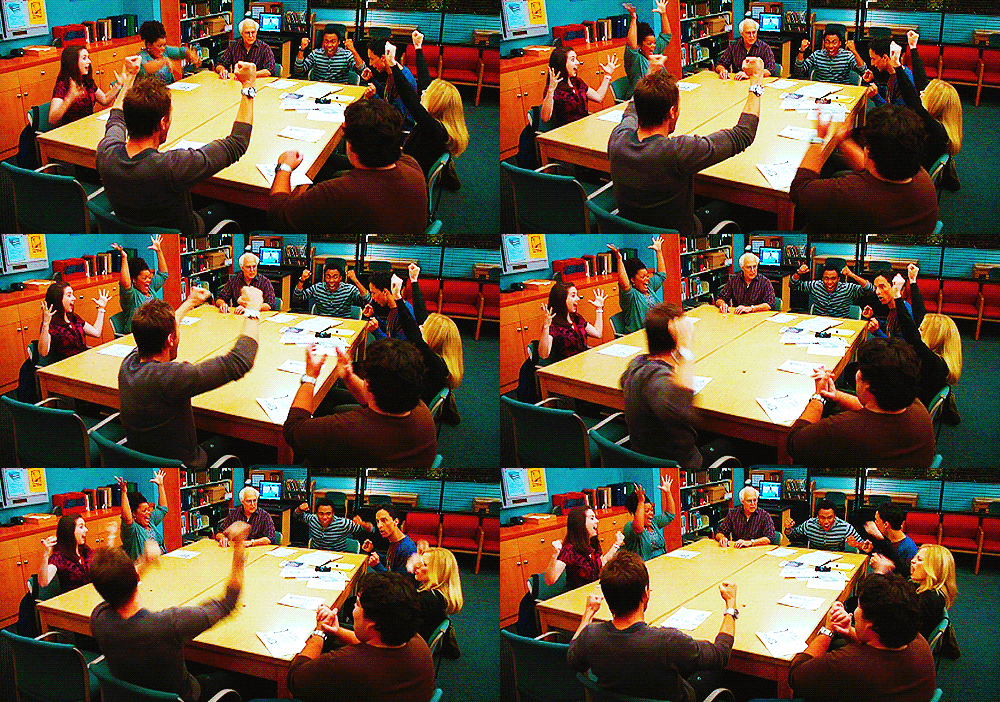
Seems someone had a blast. Image from Phys.org.
Having noted before that my attempts to develop an RPG worked from sixes, and knowing that one of the things that people tend to do is try to explain the machinations of their observable universe in terms they can understand–usually gods and the like until observational technology allows for other ideas to take firmer hold–it makes sense to me that any RPG milieu in which I might work would offer religious ideas. And since RPGs admit of things that do not necessarily occur in the “real” world, those religious ideas might even have some in-milieu truth to them. That said, I am not necessarily convinced by religious ideologies, myself, and even if I might compose what I call a series of hymns in another webspace, it is not as an act of worship that I do it.
The idea of an anti-worship, though, of a religion that abjures the influence of the gods, is an interesting one. (I admit to being inspired in part by an episode of Star Trek: Deep Space Nine, as well.) If I follow that idea, then, and the earlier materials I’d glossed, then I would seem to need six gods to steer away from whatever people I might focus upon for the RPG milieu. The Stupid God is one against which I have inveighed at length already in what may someday be a collection of verse I would release for publication. (It might be nice to earn a bit of money in such a way.) Such a god, one that revels in and promulgates folly, would seem to be one to abjure, one to send away from the self and towards opposition. The Angry God, which I have also mentioned in other writing I’ve done, would seem to be another; there are certainly things about which to be angry, and there are benefits to being angry at times, but I’ve had a lot of anger in me for far longer than ought to have been the case, and I have not benefited from it.
Those are only two, though, and I do not know that both should be shunned as such; I have no reservations about condemning the Stupid God, for reasons I hope would be obvious, but, again, there are times anger is merited, and the god of such a thing would be useful to have on hand at such times. What to do with the others is not yet clear to me, but it is good to have some idea of how to proceed, of what slots to fill–and there is always room for things to change and grow.
May the Stupid God not claim too much of that room!
There was a time in my life that I did a fair bit of traveling. I used to go back and forth across states, both for social and for professional reasons, visiting friends and giving conference papers at various scholarly gatherings. After moving back to Texas, however, I grew much more sedentary, staying at home more and going other places–both in town and out of town–less. This has been partly because my family has needed me to be home, but part has also been that I do not need to go places as much. I do not conference as I used to do, and the friends I used to go galavanting across states to see are too far away for me to visit often or at all.
A grey day while I was away. Photo is mine.
The recent trip to Raleigh reminded me of the change. My flights went well enough on the way up, though I was vaguely ill at ease with the now-unfamiliar motion of commercial aircraft, and my ears did not appreciate the descents from the heavens. I was able to sleep on one flight, though not the other, and it might’ve been nice to do so. I did do better at settling into my room than used to be the case for me, too, laying out what needed it before resting a little bit (and even then remaining active; writing soothes me).
Perhaps it is the years and the changes in my life that have made me better at this than I used to be. It’s certainly not recent practice; I’ve not traveled since last May (though I’ll be going again this May, too). But it is good to be reminded that I can do such things at need, and it might be better to know that I can actually enjoy myself a bit along the way.
As this post emerges into that part of the internet where it is easily seen, I will be on my way to attend the wedding of my second-best friend from graduate school. (I attended the wedding of my best friend from graduate school several years ago now–sensibly, since it was also my wedding.) It’s been a while since I’ve been to a wedding, to be sure, and I find myself thinking about what such the institution marked by such ceremonies continue to mean. It seems a fitting thing to write about now.
Fairly typical image, this. Image from Pinterest.
I don’t know how my friend’s marriage will go, although I expect it will go reasonably well or better. But I do know how mine has gone so far (“so far” because I am not done with it yet–and do not mean to be anytime soon), which is to say pretty well. My wife and I argue, certainly, and sometimes over stupid things. And there are times we get onto one another’s nerves, to be sure. I’ll not elucidate details; it suffices to note that there are such circumstances.
But though the annoyances and vexations are, they matter little against the many benefits I derive from being married. One of the chief among them is that, like our daughter, my wife inspires me to be a better person. I love her, so I want her to be happy and supported, and learning how to help her be happy and ensure she is supported has helped me to be less of the selfish git I have been too much conditioned to be. And I have taken specific, concrete steps to be a better source of happiness and support for her; if it is the case that my changes have not been speedy in all cases (though there have been a few that have been pretty quick), I can at least point to progress in them as I continue to try to make more of it. She deserves to have me at my best, after all, so it behooves me to be that best as much as I can.
I know that not all marriages are such. I see enough of them fragmenting or standing not stably but stultifyingly; my line of work being what it is shows me many such. I know that not all spouses support one another, that not all spouses look to one another partly as muses from whom to draw inspiration, as friends, as lovers, as confidants; I know that many look to marriage as exploitation. And there are ways in which it is and remains so, given the social structures from which the institution as typically expressed in the United States through the past several decades emerges and into which it feeds. Even mine, in which I work to give more to it than I take from it, has such overtones; I do not know how or if they can be fully escaped.
I know, though, that marriage can be a fulfilling thing, if it is made to be. I hope that my friend will find his own marriage such in the days, months, and years to come. And I look forward to the continued work of making my own marriage such a thing.
For the final sample of the session, I’ll be drafting the kind of postscript that students in the class are asked to compose. They are prompted to look back at their self-assessed strengths and weaknesses in reading and writing, then to articulate in one paragraph how they plan to overcome those challenges that presented themselves during the session before, in another paragraph, noting how they mean to continue to improve upon their performances as they move forward through classes. Students are asked to submit those reflections in an APA-formatted document. Consequently, I’ll be doing much the same.
It seems apt. Image from Pinterest.
To begin my own work on the exercise, I once again set up an APA-formatted document in double-spaced 12-point Times New Roman type, with one-inch margins on letter-sized paper. I constructed my title page and stubbed out my main text as appropriate, inserting running head and pagination as needed. And I then pulled up my own self-assessment from the first week of the session, which I reproduce here from the online discussion:
To offer an example:
What do I do well as a reader?
Through dint of practice, I read swiftly and deeply. That is, I can make my way through texts quickly, and I both retain much of what I read and assess it against / integrate it into what I already know relatively easily.
What do I do well as a writer?
I write regularly and often, working to address multiple audiences through multiple venues–and I think I do well at it.
What could I improve upon as a reader?
I could read more than I do. The past few years have not seen me with as many books in hand as I ought to have–and certainly not so many as I used to have.
What could I improve upon as a writer?
I could also write more than I do, sending what I write to publication venues that might reject me and would offer more honest critique than I often get.
I look forward to your responses.
With that list before me, I considered how I had worked to address the challenges I’d identified, drafting a narrative report of that work as my first paragraph of response and making sure to include explicit reference to my earlier words to help my readers understand my topic of discussion.
The second paragraph required a bit of adjustment; I’m not enrolled in any future classes, and I am not likely to become so. (I toy with the idea of going after an MBA, but that’s a later concern–if it ever becomes one.) But the fact that I am not in any formal education at this point does not mean that I cannot look for ways to improve my performance further, and reflecting on that allowed me to draft materials for the second requested paragraph.
The materials composed, I worked to make the writing more accessible to my expected primary audience, again acknowledging a consistent issue in my work. Once it was at a place I felt comfortable giving it to that audience, I reviewed my work for alignment with the orthographical standards at work in the course. Finding no deviations, I rendered the document into an accessible format once again, which I present here as what I hope will be of useful service to my students and others: G. Elliott Wk 8 Sample Assignment Response.
Last week, noted here, I posted a sample of a response essay, another piece working to emulate the work my students are asked to do. I felt obliged, for several reasons, to address a slightly different prompt than that offered to them, but I still feel that the model offered was useful. But there is more to do, both for the students and on the piece I offered, for which reason I proceed now to narrate my process for arriving at a model for the revised essay expected of students and to provide the model arrived at. I do so in the continuing hopes that my students and others will benefit from my efforts.
Sometimes, you succeed beyond expectation. Image from Giphy.com.
The week’s assignment asks students to take the draft provided the previous week and expand upon and revise it with comments from the instructor. While the previous week would have admitted of a partial draft (I did not offer one), the current exercise requires a completed draft, albeit one admittedly brief. Aside from the expectation of fuller development (“fuller” instead of “full” because every piece of writing can be refined further), requirements follow those of the previous week’s work.
To mimic the exercise, I began by opening the previous week’s assignment and saving it under an updated name; doing so allowed me to retain a base copy in case things went strangely during revision while still letting me make updates–and helping me to find them. Then, as with a previous revision exercise, I printed out a hard copy of the text on which to make my initial edits. (I might note, too, that when I review my own work in hard copy, I rarely use red ink, preferring blue ink or pencil. Both stand out from the black ink of the printed pages while avoiding the glaring sense of “problem” that arises from red ink. Pencil allows for more adjustment, though it tends to smear a bit, while blue ink tends not to do so.)
As I went through the earlier draft, I did so looking first for ways to make the content more accessible. I expect that relatively few of my students–my anticipated primary audience–are familiar with the content I discuss, so I have a particular burden to make that content clear and understandable. Additionally, as I reviewed my work, I found that I was not satisfied with how I had transitioned into a couple of paragraphs, so I adjusted those transitions, as well as making the aforementioned changes to content.
With my on-paper notes ready, I moved into adjusting the electronic text. As before, I worked from the end of the paper back to the front, so that my changes did not move others that would need making. And I made sure to save my work repeatedly; I’ve lost papers before, and even so brief a work as the present exercise would be an annoyance to redo. I also reviewed the text for readability; again, accessibility to the primary expected audience is a concern, and I know my tendencies well. But the document tested out as at an acceptable reading level while still reading how I would have it, so I accounted it good enough.
The essay revised, I gave it another quick review to ensure that its orthography was as it should be. Nothing showed up to that review, so I rendered the document into an accessible form that I present here in the hopes that it, too, will be helpful: G. Elliott Wk 7 Sample Essay.
In an earlier post, I make mention of focusing my tabletop roleplaying game (RPG) design efforts on a mechanical system that uses six-sided dice for ease of reference and access. It’s not the only such piece I’ve put together, though; for example, I drafted one on Rich Burlew’s work for another venue, and it is with Burlew’s comments in mind that I proceed. He makes the comment that mechanics and story should interact meaningfully; they should fit together, rather than one being a vehicle for the other or added onto it. Things should make sense together (despite the fact that the broader world does not, not by half). And since narrative requires milieu, and RPGs are narratives, the mechanics need to integrate into the milieu smoothly.
Shiny. Image from AnimatedImages.org.
That notion in mind, and knowing that I mean to use six-sided dice, I started looking for convenient “natural” sixes. Two emerged in short order: cardinal directions and numbers. The former might seem to be counter-intuitive; as typically represented, the cardinal directions are but four: north, south, east, and west. But up and down are also to be considered, making six principal directions and offering six points of reference: north, south, east, west, zenith, and nadir. It’s obvious upon being pointed out, really, but it’s not often pointed out that I’m aware of, so it seemed a useful beginning point.
The numbering takes a bit more explanation. But if I follow the tendency of RPGs to have human or humanoid player characters–“humans in funny suits,” to borrow one turn of phrase that Burlew is not alone in using–then a five-fingered hand suggests itself. I can count six numbers on one such hand: zero to five. If I add another hand, I can reach thirty-five without working through knuckles, as some finger-counting systems do. And that sketches out a base-six numbering system; zero to five on one hand, then back to zero with a finger raised on the other hand. The place-value even begins to situate itself.
Those two sixes, aligning neatly with six-sided dice, have their own implications. Some move in directions that will bear exploring elsewhere. Some, though, admit of more local treatment. For example, the idea of a body-based numbering system that invokes place-value, which I am told by those who study and teach math was quite a development, suggests that the narrative milieu is one that values arithmetic. It’s a strange thing to have emerge, particularly for the work of someone whose degrees are all in English, and not one that I had expected to emerge.
That’s part of the allure of stories, whether read or narrated along with others and the help of dice, that things emerge from them that had not been expected. There is often comfort in the familiar, certainly, and there is nothing wrong in itself in stories following predictable patterns. But there is something special about new and un-thought-of things popping up out of even basic background work that thrills as a writer. I can hope that, in time, such things will also prove to be to players’ delight.
Last week, noted here, I had another instance of encountering an assignment for students that did not demand a new sample from me. I was fortunate to have already developed a number of samples of the kind of work students were asked to do, so I gathered an assortment of them for ease of reference and left them for the students to read through. There was some pushback from them on how I want things done–I am of the opinion that summaries need to identify their subjects, which not all of my students seemed to appreciate–but they seem to have done largely well with the exercise.
It’s like that sometimes. Image from Odyssey.
The assignment for the present week appears to be another such thing. Students are asked to expand upon their summary work by writing a response to the issue treated by the summarized piece, and the examples of summaries that I had provided to students contain responses. As such, I thought I had already done the work for this week that I sought to do to help the students. But that is not entirely accurate.
For the present week’s assignment, students are asked to write a draft of a response essay. It needs to be in APA format, and it needs to make formal reference to an outside source–in the present case, the article that had been summarized in the previous week’s work. A four-paragraph structure is suggested by the University; introduction, one paragraph relating and explaining personal experience with the subject, another summarizing the article and explaining its relevance, and conclusion. And that expanded structure suggests that I compose a sample to help guide students.
To do so, I began by stubbing out a document according to the APA format template my students and I had developed in the class. That done, I looked at my current-to-the-writing news feeds for an article to summarize and respond to; as is ever the case, I do not want to do the students’ work for them in putting together examples for their use. Nor yet do I want to be too narrowly constrained against future iterations of the class for which I write the examples. Ultimately, I pulled up an article I had long bookmarked for another project; it seemed appropriate to turn to it for the present work.
Having decided upon a piece to which I would respond, I entered its information into the required References list, looking at APA standards to do so. I then read it, annotating it for summary. And it seemed a simple thing to then draft the summary, since I would either be responding to it or prefiguring it, so I did so.
With the summary written, I then considered whether my own comments would precede or succeed it. The former would have the advantage of leading from my own situated ethos to the invented ethos of outside documentation, corresponding to traditional rhetorical ordering by placing what might appear to be a stronger point in the stronger position. The latter, though, would figure my work as a more direct response, moving from the abstract to the concrete in a way that often reads well for students. Given that the piece is meant as a sample for students, the latter course suggested itself more strongly, so I drafted my own comments after giving the summary.
As I drafted, a thesis emerged for me. I took it, rephrased it slightly, and put it in the “expected” position–just before the body of my essay begins. I then drafted an introduction to move readers into the thesis smoothly. I followed that with a conclusion that moves forward from the thesis into an idea of what can be done with that thesis, a style of conclusion I typically prefer in shorter academic pieces.
The draft compiled, I gave it a quick review to ensure that its orthography was as it should be. Nothing showed up to that review, so I rendered the document into an accessible form that I present here in the hopes that it will be helpful: G. Elliott Wk 6 Sample Essay.
I have made no secret, of course, that I am and have long been involved in roleplaying games, not only the iconic Dungeons & Dragons, but also Legend of the Five Rings and others. It should come as no surprise, then, that I have thought from time to time about putting together a game of my own; it should also not be a surprise that I have acted on such thoughts in the past. Indeed, my second-to-last undergraduate project was an honors thesis in which I did that very thing, though I did not do it at all well. I was not nearly so gifted an undergraduate as I thought I was, and it shows in how clunky and, well, pretentious the work I did then is.
One way to make it rain… Image from Giphy.com.
I still toy with the idea, of course. I enjoy playing, and I can’t play unless I have folks with whom to play. And that means I have to make any game I would design accessible to people, both in terms of ease of rules and in terms of cost to play. Playing tabletop roleplaying games can be quite expensive; the rulebooks that typify them are not usually inexpensive, and even if someone can get years of use out of one, the initial outlay is something of a hurdle. I’ve not got a necessarily robust collection of gaming books, and I’ve spend hundreds or thousands on them over the years; those who have more have doubtlessly spent far, far more.
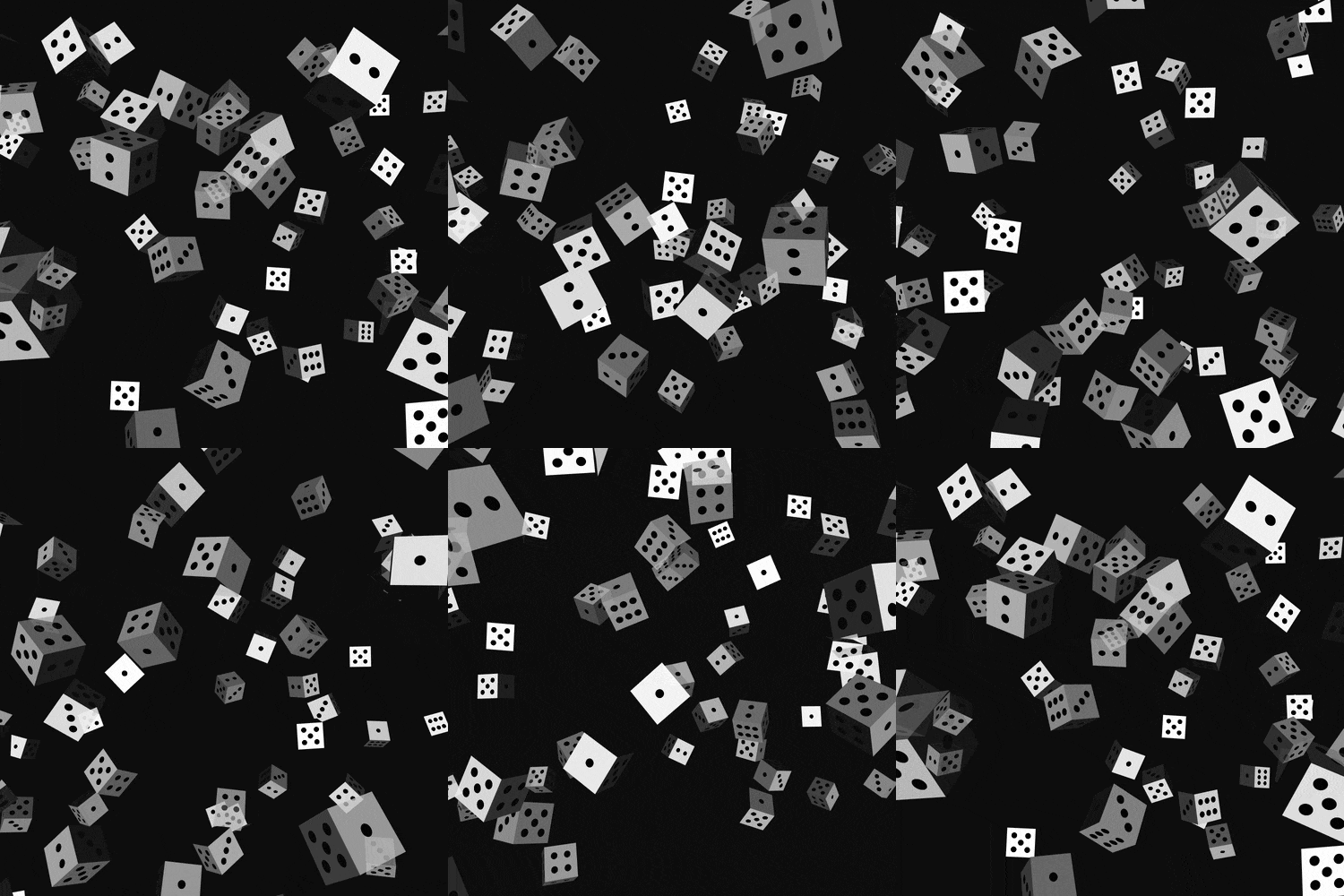
There are dice to consider, as well. One of the most common accoutrements of roleplaying games, dice can be found in extravagant numbers and styles, and they become foci of lore and jealousy, among others. They also become money-pits. My own experience in buying dice–and mine are loyal and good, though not necessarily fancy, as far as such things go–has been to the tune of hundreds of dollars across my time gaming. Again, I’ve gotten years out of them, and I did pick them up a few at a time, but it’s still an investment to get the dice roleplaying games typically demand.
Part of that cost comes from the fact that roleplaying games typically play with different types of dice, not just the cubical dice most familiar, but other sorts typically rendered as Platonic solids plus ten-sided dice. (There are other versions of such dice available, of course; my daughter picked a set that mimics gaming dungeon paraphernalia, for example.) Though they are more and more common now, they are still at a higher price-point, and they are still less accessible than the plain cubical dice that can be gotten at supermarkets and convenience stores.
It is to help get around that concern of accessibility that, when I designed a gaming system, I made sure to base its mechanics in six-sided dice. They are easily had, easily replaced, and familiar from centuries of use in popular culture. And not only as gambling devices, though that is their most common depiction; I remember elementary school math classes that used them for some basic statistics, for example. As such, when I went to set up a system to bring people in, I did so with six-sided dice at the core.
As I’ve found out in the time since, trying to orient other things around sixes has been more of a challenge. But that’s something I can return to later on…
Earlier in the session, I found myself thwarted in my attempt to provide a sample assignment response when the first week’s assignments were quizzes alone. As I sat down to draft a response for the fifth week’s assignment, though, I found myself having the opposite problem. Instead of encountering an assignment I could not meaningfully or ethically exemplify for my students, I encountered one I have already abundantly exemplified for them. Instead of having no work that could be done, I had ample work that had already been done–which is a much better situation to be in than that I had had before.
What the students are asked to do in my class this week is read an article, write a summary of it, and write a response to it. I have no shortage of such things already available, in this webspace and elsewhere, even if they are not necessarily in the APA format requested by the institution. But I’ve practiced that format enough with my current students that I do not know that I need to give it them again, so, instead of making an offhand reference to where they can find examples in this webspace, I’ll give a list of a few of them that seem to have attracted most attention:
In a post I recently made to my personal blog, I make reference to some of the teaching and gaming I did as a graduate student. I remember both fondly, at least at this point, and I have done what I can to take the best parts from both into future iterations of my work in the classroom and at the table; I’ve had less success than I might hope, to be sure, but I have still had some success. And some of that success has focused on a single practice that came from the tabletop gaming I administered into some of the teaching I’ve done. It doesn’t always translate into a given class, of course; different courses call for different assignments and different techniques. But that a tool is not universally applicable does not mean it is of no value, and because I think there is some value in the practice–having students overtly commend one another in private reports to the instructor–I think it fitting to spend some time discussing it more formally than my personal blog admits.
Not atypical, this… Image from Wikipedia, which I’d not normally use.
To explain the activity a bit: When I was in graduate school, I ran a large tabletop roleplaying game. Normally, such games will have a referee and four to six players; I was the referee, and I had thirteen to fifteen at my table. It was not always a ruly bunch, to be sure; so large a group in which individuals need longish periods of devoted attention tends to go that way. But we got on more or less well, and the players enjoyed what I gave them (I think; please don’t tell me if I’m wrong). And part of that, I think, was that I gave them encouragement to play well–beyond the intrinsic value of participating meaningfully in an ongoing extemporaneous story. For I had each player vote at the end of each gaming session for the player other than themself who had done the best job of playing at the table that night.
By asking them to do so, I encouraged them to more fully inhabit their character and the narrative milieu in which those characters were enmeshed, and to do so in a way that helped the others at the table. And I encouraged them to attend to the performances and participation of others to reward behavior that, through authentically developing and communally-determined practices, was optimal for the group as a whole. In effect, the players came to agree on community standards for behavior and participation, and they looked for ways and reasons to praise one another, rather than make mock of one another as is common at gaming tables and in too many other places in the world.
To apply that idea to classroom practice took a bit of doing. For one, it only works well in group settings, and I tend to shy away from group assignments when I can. My experience, as both student and teacher, has been that one or two group members will do all of the work, while the others coast by on the labors of the diligent. (A rant threatens to emerge; it may do so later.) However, much of the teaching I have done has been of classes that have institutional mandates for group projects (the public speaking class at DeVry was one such; the technical writing class at Oklahoma State University was another).
In the latter, particularly, I had some success with having students report on their group’s and individual group members’ progress in the assigned projects; I made it part of assignment guidelines, requiring them to submit progress reports as daily assignments, so that there was extrinsic motivation to address the tasks. (Most of the students in that course were in another writing class only reluctantly; the extrinsic motivation was needed.) But I noted with some annoyance that, while I would see participation and submission from several group members, I would not see accurate assessment of those participants who weren’t; a few noted to me that they were reluctant to “throw [another student] under the bus,” even when the group’s work as a whole suffered because of such a student.
I understand the impulse, to be certain. I’m not alone in having heard that “snitches get stitches and wind up in ditches,” or other words to that effect, and I was not immune to the shame of being a tattle-tale. And, at one level, I was content to let students undercut themselves; if they did not care more about the work and their reward for it, I saw no reason I ought to do so. But, as one of the students who was exploited by group work, I hated the idea of such exploitation continuing even when students had a mechanism to prevent it (part of the students’ grades came from the mutual assessment, so they could have excluded non-participating group members).
When, instead of asking students to identify the group members who had done least, I asked them to identify those who had done most, I saw a much better response rate from them. Additionally, I received much more detailed feedback on student performance from the other students’ perspectives, which was of great help. Some of that did run to specific notes about other students’ non-compliance with the standards of their groups, which also helped me to make the adjustments I needed to make as I oversaw the groups’ work. In essence, it worked in more or less the same way with my students as it had with my players, for which reason I commend the practice to use in other classes.
It is not universally applicable, of course. Not all classes require or admit of group projects, at least not conveniently. And there are courses that operate under stricter institutional mandates, obliging specific assignment sequences and lecture topics. But where it can be deployed, the practice of having students cite and justify each other’s excellence is a useful one.