Some might ascribe some Supernatural importance to this day That sees eagles fly for miles in the evening A spooky day in spooky season Though not so much as might have been Were the moon but new or full
Well, I am in Texas… Photo by Lucas Andrade on Pexels.com
From where I sit in open stands It’s a Friday night like any other Bright lights shining as the band plays And there’s always the hope they Will not suddenly be cut off No matter what number the day
I’m happy to write to order for you–and at reasonable rates! Fill out the form below to get started!
A day has come again that I’ve marked before (here and here in this webspace), and I confess that it’s somewhat snuck up on me. Twenty-three years on–and, for me, three degrees, a marriage, fatherhood, and a number of jobs and relocations–I recognize, when I think about it, the lasting harm that has been done and that continues to be done because what happened while I was sitting for a percussion techniques class in support of a dream long since set aside and in the minutes afterward happened. But I do not think on it often, which is almost certainly less than it deserves, and I had not been thinking about it until I looked at my calendar and saw a gray notation with a simple description.
Still not going to put up a picture for this.
I’m not sure whether or not I should offer an apology for it.
I acknowledge that I am in a position of privilege regarding the events of 11 September 2001 and the continuing effects therefrom. I didn’t lose anyone I know in the attacks or in the illnesses that have befallen those who first responded to them. I didn’t lose anyone I know in the decades of armed conflict that followed (and that continue, if with perhaps less intensity and certainly less media attention, even as I write this). I’ve known people who have been affected, certainly, and by more than simply living in the pervasive surveillance environment that emerged with perceived justification in the wake of the attacks and the jingoism inhaled with seemingly every breath, even if less and less of it is exhaled anymore, but the direct effects on me and on most of mine have been…minimal, I think. So much is not true for all, as I well understand, and I am not making mock of the losses that have been suffered; I am, however, explicitly disclaiming suffering such losses, myself, and noting my gratitude that I have thus far been exempted from them.
I have, at times, thought that my responsibility is therefore to mark the event, to take time on its anniversary to pause and reflect and remember what was lost. Something was taken from me on that day, even though I lost neither goods nor people; something was taken from us all, and it is difficult even for those who can, unfortunately, enumerate their losses to actually put into words what that something is. Futures have been foreclosed that might have been faced to better effect than the future of then in which we live now, but that’s true of all events. And while it is tempting to think that things were better before, it is a challenge to find a useful measure by which to make such an assessment (although it may well be that my reaching for such a thing is, itself, a result of the event; it is certainly a result of things enfolding that event and which yet linger in other places than my mind, but that discussion is definitely for another day). Might-have-beens are fictions, and while I believe in the value of fiction, I know I am not as adept in its creation as such things deserve to have their makers be.
I remain…uncertain how to regard this day. Even amid it, even if I take the time to pause and hear again the intonations of the thousands of names whose owners were lost that day, there is work I have to do–because for me, for many others, though not for all, life continues as it has continued. I can only hope that what I do helps to make it better.
I’m not putting up the ad today, either, though it might well be the most US thing I could do. It just doesn’t feel right at the moment.
Read the previous entry in the serieshere. Read the next entry in the serieshere.
After an excerpt from an instructional text, “Settling In” opens with Bee holding still and attempting, without success, to evade detection by Fitz. He summons her to confer with her about Lant and his situation, and talk turns to Bee’s Farseer status. The two discuss her knowledge of her heritage, and Chade’s motivations for sending Lant to Fitz are noted. Bee intuits similar motivations regarding Shun, and she considers what she has learned and how. Fitz notes his neglect of her, and the two make shift to repair their relationship.
Image related. Photo by Madison Inouye on Pexels.com
Life at Withywoods slowly begins to adjust to the presence of both Shun and Lant, and Bee continues to call on Per, who notes with some annoyance that he and the other children of the manor will be included in lessons. Per also notes local gossip surrounding Fitz–as Badgerlock–and Shun, much of which takes Bee aback. She is left fuming about her situation and the changes to it, and she moves to address them with Fitz, only to find him in the final stages of enacting changes to her bedroom that had not been discussed with her. She intuits the reasoning for Fitz’s actions and plays along in front of others, realizing unexpectedly the place she has in their lives.
Somewhat overwhelmed, Bee withdraws to her old rooms, assessing them and the loss of things made by her mother’s hands for her. Fitz soon joins her, and she rages at him for not having consulted her in his haste to address the issue of the messenger. He accepts the rebuke, to her chagrin, and he lays out plans for the coming days. Bee’s anger is not assuaged, but she accompanies him as he makes to see about his next tasks.
As I reread the chapter, I was put in mind both of Gilman’s “The Yellow Wallpaper” and Woolf’s A Room of One’s Own. While it has, admittedly, been some time since I read either piece–they’re both both earlier and later than my usual studies–and there is a tension between them, and neither is an exact parallel for Bee’s situation in the present chapter, there are echoes of both in it. Add to the list of scholarly someday projects, or to the list of “I’m not the right kind of scholar for this, but I’d read it” projects that have come up throughout this rereading series (and other parts of this webspace I yet maintain).
I noted, too, that the present chapter is of a more “normal” length than the previous–or than a number of other chapters that focus on Bee. Again, I am not sure what pattern is present or what can emerge from identifying such a pattern, but I cannot shake the feeling that there is some information to be gleaned from investigating it. But that’s already been a scholarly someday for a while, now, and I don’t think I need to belabor that point at this point.
Further, and again again, I found myself reading with no small affect as the narrative followed Bee and her vexation at both the public perception of her father and at being treated as a child. It’s not easy to realize the ways in which beloved family members are seen by those outside the family; while public perception of my parents has been more or less in line with how they are at home, I’ve got any number of cousins and other collateral relatives for whom so much is not true. (I know what my reputation has been among several publics, as well; there’ve been times I’ve been more or less at ease with it and its alignment with how I am when in less public situations. But that’s another matter entirely.) And I learned early on that I do not appreciate being spoken for without being consulted; there were more than a few heated arguments about that point in my youth, and it was an early source of friction in my marriage. (My wife and I have long since addressed the issue, however.) My own daughter is not much more fond of it than I was (or am), and while I try to consult her for things before making decisions, I know I don’t always do well at it–and her vexation with me at such times is not unjustified.
I found myself more touched by Bee’s longing for the things her mother’s hands had made, not all of which were preserved by her father. I’m not as good about being unsentimental in my life as I ought to be, I know; even if I do try not to be so attached to things, I would weep to lose some of the stuff that I have, and for no more reason than that it was given me by my parents. I know the same is true for my daughter–perhaps more so, because she does not have the hang-ups about expressing emotion that I do. (“We live in a society,” after all.) She’s long demonstrated that she keeps a detailed inventory of her stuff in her head, and she’s complained to her parents more than once about the loss of some thing or another that really did need to go to the garbage or really was a better fit for some donation bin than for her then-current needs. And all that’s without the overlay of the loss of a parent–really, the parent, given Fitz’s own issues with parenting–that Bee suffers…I’ve got a frame of reference, but I’m still looking at it from some remove.
I’m happy to write for hire for you; fill out the form below to get started!
There was rain in the middle of the afternoon that Did more than tamp down the dust of summer days that Gathered amid the heat of staring at Helios too long while Aestas danced her dance again and Theros strutted about unclad and Auxo and Damia were upstage and marking whose eyes followed them
Shocking, I know. Photo by Johannes Plenio on Pexels.com
The gutters filled and street-sides flowed Asphalt made to mirror the lights passing by and The hanging curtains from on high as Thunder rumbled that was not just the semis streaking past Jake complaining despite being told to shut his mouth Every drop is dear, every one praised as a gift
I’m happy to write to order for you; fill out the form below to get your piece started!
I’m happy to write to order! Fill out the form below to get started!
Read the previous entry in the serieshere. Read the next entry in the serieshere.
Following a journal entry that references Fitz’s first encounters with Chade, Verity, and Burrich, and his recognition of the Fool as more than he seemed, “The Tutor” begins with Fitz’s recognition of FitzVigilant’s arrival amid the commotion surrounding the renovation of Withywoods. Fitz assesses the new scribe as the latter formally presents himself, and he issues directives concerning Lant’s billeting. He also assigns the new scribe the task of teaching the youth of the estate, which is accepted after a moment’s hesitation.
A bit advanced, perhaps, but the right kind of thing… Image from Social Science Space, here, used for commentary
While Lant is seen to, Fitz rifles through his belongings. While he finds no evidence of assassin’s craft, he is surprised at the effete nature of Lant’s belongings and, pleasantly, at the quality of teaching materials he has brought with him. Fitz reconsiders his expectations of Lant, returns things to their previous arrangement, and makes to confer with Bee about him.
I note in the present chapter something of a reiteration of Hobb’s disdain for men indulging in finery. I’ve noted it here, here, and here, among others, particularly in the context of reinforcing stereotypes about homosexuality; I recall, also, that Regal is repeatedly described as attending closely to sartorial matters, far more than the “good” characters in the texts are apt to do (with the exception of the Fool, but the Fool frustrates a lot of analysis). I’ve seen others comment on it before, and I both acknowledge that the idea is not of my own devising and apologize that I did not take the appropriate notes to be able to reference it later when I encountered it before. But that I am not taking credit for the idea does not mean I am not able to point out when it seems to me to be reinforced once again, and that reinforcement remains a point of vexation for me with regards to Hobb’s writing. There is so much in it that is so very well done, and to see this thing that does seem reductivist and stereotypical being employed yet again…chafes. (Too, while I know that biographical criticism is fraught, and it is inappropriate to ascribe to the author the views or perspectives espoused by any one character, it does become more of a question when such a view is evinced among many characters across a milieu and cultures within it, as is the case with the present subject.)
I find the presentation particularly odd in the present chapter, focused as it is on a scribe. Hobb places substantial importance on writing in her works, for reasons that are entirely understandable (as I’ve suggested before); it’s only sensible that a writer would espouse the value of writing. The juxtaposition of a character in a profession that the milieu typically values and an overriding trope of disdain seems…odd to my reading. I’m not sure what to make of it at this point; I suppose this will be yet another of the many, many things I’ll address in my scholarly someday…
I’m happy to write for you! Fill out the form below to let me know what I need to make the words start to flow!
It would appear to be a time of year once again that I mark, year after year after year after year. In general, my sympathies and inclinations regarding the topic of work have not changed, even if my professional situation has varied across that time and to this. After all, I am once again management, even as I do maintain a small income stream from freelancing (and you could help with that; I write for hire, with no AI plagiarism or hallucinations involved), having changed jobs since last time I waxed verbose on the subject of labor and the US holiday that acknowledges it (in that most distinctly US of ways: sales and reliance on low-paid work that is decidedly not low-skilled when done well). I do not have a large crew working under me, and I do what I can for that crew, although I am somewhat limited by circumstance and structure in what that “can” extends to, but that does not mean I am unaware of the surrounding situations and circumstances, nor yet that I am unsympathetic to them.
Looks like a hot time… Photo by Kateryna Babaieva on Pexels.com
I continue to acknowledge the need for work and the nobility of the same, and I continue to believe that it ought to be compensated in such a way as to ensure that those who are diligent about it need not worry that they will lack the resources needed to continue to do that work. I know that not all are in the situations I occupy, that they do not have the same levels of investment or interest in the endeavors I do, and I do not expect them to act as if they have them when they do not. I have refused to, certainly, and I think correctly; I can hardly hold others in scorn for doing what I believe is right for me to do.
I do not buy into the narrative that “nobody wants to work anymore,” at least not in those terms. I do not think it is the case that a higher percentage of people do not want to work now than did previously; having the training that I do, it seems to me that people remain the people they have been in a great many parts of their lived, and it defies reason that they would be different in regards to regard for work when they clearly are not in so many other ways. I do think that it is the case that many believe there is little point to working when they do not see the benefits to themselves of doing the work, and I do think that many are applying to themselves and the saleable commodity of their labor the same logic I’ve seen applied to many things, that it’s better to receive no income from a given asset or resource than to sell it for less than they want to get for it.
If working won’t pay the bills, why go to the trouble of it any more than renting a storefront for less than the tax due on it? And how many of those who complain of “excessive salary demands” are content to let spaces sit empty on main streets in towns like the one where I live or the one where I grew up? Why is the reasoning any worse for the one than for the other?
If it is the case that the response to “You don’t like the job?” is either “Start your own business” or “Train up for a better one,” why would there be so much griping about taking the time to do either or both of those things–which will necessarily mean there’s less available labor to answer any given help wanted ad?
(This leaves aside the issue of the number of help wanted ads that are lies in one form or another. They’re out there, and in greater numbers than should be–which isn’t hard, since the number as “should be” is zero. But that’s going to require more discussion than I’m willing to engage in at the moment and in this little bit of webspace.)
It’s a fine thing and a good thing to set aside a day to honor what deserves to be honored, and honest labor, individually or in association, deserves to be honored. It is a finer thing and a better one, though, to act throughout the rest of the year as if the thing deserving honor is actually honored. In many things, such an ideal is not achieved, but that it is not in many things does not mean it is right for any of them.
As ever, many need to do better than they do. I do not exempt myself from this, certainly; there is likely more I could do, even within the constraints under which I operate. I do not necessarily recognize them, and I would likely balk at some of them; like many people, I am somewhat greedy, somewhat grasping, and somewhat inclined to see to my own comforts over the needs of others. I am human, after all, despite the protestations of some folks I have known. (If nothing else, some bloodwork I had done has proven it.) But I am able, at least, to recognize that I am and have been in the wrong, and I am able to take at least some steps to work towards being in the right–not for the acclaim of doing so, but because that work needs to be done.
This is the day to note the value of work, isn’t it?
In any season, I am happy to undertake the work of writing. Fill out the form below to hire my pen!
Claudia’s husband never bestrode these hills Having many of his own to tread But his time has held sway upon them During which time they have burned yet again Feeling their immolation in annual tribute To glories long gone and a long way from here
Picture possibly related. Photo by Joe Ambrogio on Pexels.com
In truth that those here know in their flesh The name of the ruler doesn’t matter The weather will do what it does without regard For those upon whom the sun shines brightly Upon whom the rain will refuse to fall And Aestas is yet dancing
I’m happy to write to order for you; fill out the form to get your piece started!
I‘ve never made a secret that I do a lot of reading. Indeed, I’ve done rather the opposite, and there’ve been a few times that I’ve done it to such excess as has prompted people to punch me in the face. I’ve also not made a secret that I’ve read Tolkien and that I’ve read about Tolkien; it shows up in many entries to this webspace, but perhaps most emphatically here, here, here, and here. I’ve got other stuff I’m doing on the subject, as well; I’ll discuss that more later. It should come as no surprise, then, that when I saw “Tolkien’s Deplorable Cultus” by Robert T. Tally, Jr., pop up on one of my social media feeds, I was interested, and I read it. And, given my history of such things, it should not be a surprise that I feel the need to engage with the piece by responding to it.
Picture possibly related. Photo by Chris LeBoutillier on Pexels.com
Tally’s central argument is that Tolkien’s Legendarium is amenable to a Marxist reading that can be used to at least partially counteract the vocal hypercapitalist / neofascist actors and their supporters that are appropriating the Legendarium and, by extension, fantasy literature as a genre. For him, “Fantasy is fundamentally the literature of alterity, a means of empowering the imagination to think of the world differently,” and that a Marxist reading of Tolkien’s work and the genre for which that work is the dominant, guiding example has value in “exposing its ideological limits while also limning its potential for helping us to imagine radical alternatives.” Although some might have problems with Tally’s specific framing, I think he is correct; the text does stand multiple interpretations, fantasy is necessarily concerned with alterity and thus inherently offers access to other ways of thinking (and perhaps being), and pointing out the limitations of a thing does not preclude identifying and making good use of its potentials.
Tally does well to note the limitations of his proposed reading, commenting at some length on popular and academic receptions of Tolkien’s work as reinforcing hierarchies along racial and what might well be called ethnic lines. I am not sure that the associated contention that fantasy literature at large is thus received is accurate–and Tally also voices some frustration of it in a list of fantasy authors whose politics are decidedly out of step with such a world-view–although it is certainly the case that a great many fantasy authors echo, follow, emulate, or parrot Tolkien to a greater or lesser extent, such that the Tolkienian tradition of fantasy literature remains dominant in English-language texts. (It might in others, as well, but I am not sufficiently proficient in other languages to look into it at this point. It might also be argued that I’m not sufficiently proficient in English to know what I’m talking about, although I think it would be a harder case to make.) Tally also does well to point out those features of Tolkien’s writings that seem to animate vocal hypercapitalist / neofascist actors and their supporters in their seizing upon the Legendarium as support for their own positions, even if there are places in the article where I’d be comforted by seeing some more specific citations. And, on a more personal note, I do appreciate Tally’s identification of the inconsistencies in the actors’ stated positions, the ways in which what they claim to value fails to align with what they act as if they value; none of us is completely consistent, especially over time, but there are levels and levels of irony.
(As an aside, I do not like the citations provided. The information’s fine, so far as I can tell; I just like to have citations where I can see them. But that’s more an issue of the platform than the person standing on it; I’ve commented on such things before.)
Correspondences or resonances with other readings I have done come to mind as I further consider Tally’s article. For example, when Tally remarks on the seeming reliance of the vocal hypercapitalist / neofascist actors and their supporters on Jackson’s films for their understanding of Tolkien’s works, I was put in mind of Sturtevant’s Middle Ages in Popular Imagination. I also found myself in mind of a number of pieces by Helen Young when reading Tally’s discussion of the embedded racial hierarchies at work in Tolkien, including but not limited to commentaries early on in Travels in Genre and Medievalism. The series “Race, Racism, and the Middle Ages” on The Public Medievalist also came to mind for me (partly because of overlaps, I admit). I understand well that a journal article can only take in so much at a time, however.
I think I will have some use for Tally’s piece in some work of my own that I’m doing (again, I’ll talk more about it later). I think I may have some use for his ideas in other work that I’m doing; given my predilections, I have to wonder how Hobb’s Realm of the Elderlings or Soldier Son works (and I am going to get to those, I promise) would work under such an interpretive rubric. As with so many other things, though, that’s a “someday” project. I’ve got more than enough to do right now, and there’s never as much time to do it as might be best.
I’m happy to do this kind of writing–and many others–for you. If you’d like me to do so, please fill out the form below, and we’ll get started!
Read the previous entry in the serieshere. Read the next entry in the serieshere.
After the transcript of a somewhat degraded message seemingly from Riddle to Nettle, “Perseverance” opens with Bee musing bitterly on Shun’s influence on Fitz and Riddle, noting the men’s failures of her in favor of the elder. Changes ongoing at Withywoods attract her attention, not entirely favorably, and she puts in at the stables, assessing the mare that she had been told had long since been assigned to her. While there, she encounters a stable boy who introduces himself as Per and the mare as Dapple. Per explains that he is truly named Perseverance and that he will later be called Tallestman after he exceeds the height of his father–Tallerman–who himself exceeds the height of his father, Tallman.
Amazing. Give it a lick. Photo by Pixabay on Pexels.com
The pair, Per and Bee, confer further, the former noting at the latter’s suggestion that a better name for the horse than Dapple is Priss. Bee agrees, and she accepts Per’s offer of readying the animal for riding, despite her trepidation. With his further assistance, she mounts and begins to ride, albeit with him guiding both girl and beast. The exercise concludes successfully, and Bee determines to attempt it again the next day.
Bee withdraws to her private sanctum in the hidden corridors of Withywoods, considering the cloak she has made her own. Taking it up, she stalks out covertly into the manor, watching. As she does, she sees FitzVigilant arrive at Withywoods, assessing him from his appearance and demeanor as he is greeted by a servant and starts for his accommodations.
Bee is disturbed from her musings by the arrival of the cat in her acquaintance. She reluctantly admits the cat into her warren of corridors, making provision for it and offering a warning. The cat agrees to assist her in exchange for further consideration, and the two seem to begin to form a bond.
The present chapter is another relatively brief one, shy of ten pages in the edition of the text I am reading–and I am reminded once again that I really ought to spend some time with a full set of the Fitz-centric Elderlings novels in a single edition so I can pull out page-lengths. It’s a project for another time, one of the many “somedays” I’ve seen as I’ve worked through the rereading and even before, when the pages of my personal journals boasted ideas for papers to be written and how rather than focusing on the shapes of my days and the experiences of my loved ones in them. (I do think the current use of those pages is a better one; I think that my daughter, and maybe some others to follow her, will get some good from the daily record that they cannot from my scholarly ambitions. But the earlier use remains on the pages I used to write no less than in the pixels I produce.) I still don’t know what, if anything, looking at that kind of data will reveal, but I do think there is something there to look at. There’s meaning to be found in every detail, “intentionally” placed or not.
Aside from that, though, I think the present chapter does well at presenting children’s interactions. I’ll admit to being inexpert in such things. My daughter is an only child, although she has a fair number of friends in the neighborhood and outside it, so I’ve not watched a lot of child-on-child interactions. My own childhood is many years ago, now, and what I remember about my interactions with other children is…not kind. (I was not a good friend, having a massive chip on my shoulder, and my mouth often wrote checks my ass could not cash. I was also not a good brother. I take some satisfaction in having taught my daughter to do better than I did.) But what I have seen and what I do know seems to be in line with the kind of fixation and interaction Hobb depicts. The plain presentation of information moving from topic to topic with little transition and rapt attention seem in accord with what I recall others doing and what I’ve gotten glimpses of my daughter doing. It’s a pleasant enough thing to witness, even through print, however long it might actually get to last.
School’s back in session. If you need help generating or answering instructional materials, reach out; I can help!
I‘ve written a time or two before about excursions my family and I have taken, going out and about in the vicinity of our own little part of the world. In truth, it’s an odd thing for me; I’m a homebody (if I put things politely, which not everybody does or should), not inclined to “get out” much, so trips further than going to the gym, to work, to church, or to the grocery store aren’t commonplaces for me. That’s part of why I write about them. I know that my field trips don’t show up as being the kinds of things of which major events are made for a lot of other people, they stand out to me for their relative rarity, even as I am aware that they don’t go far into the field at all.
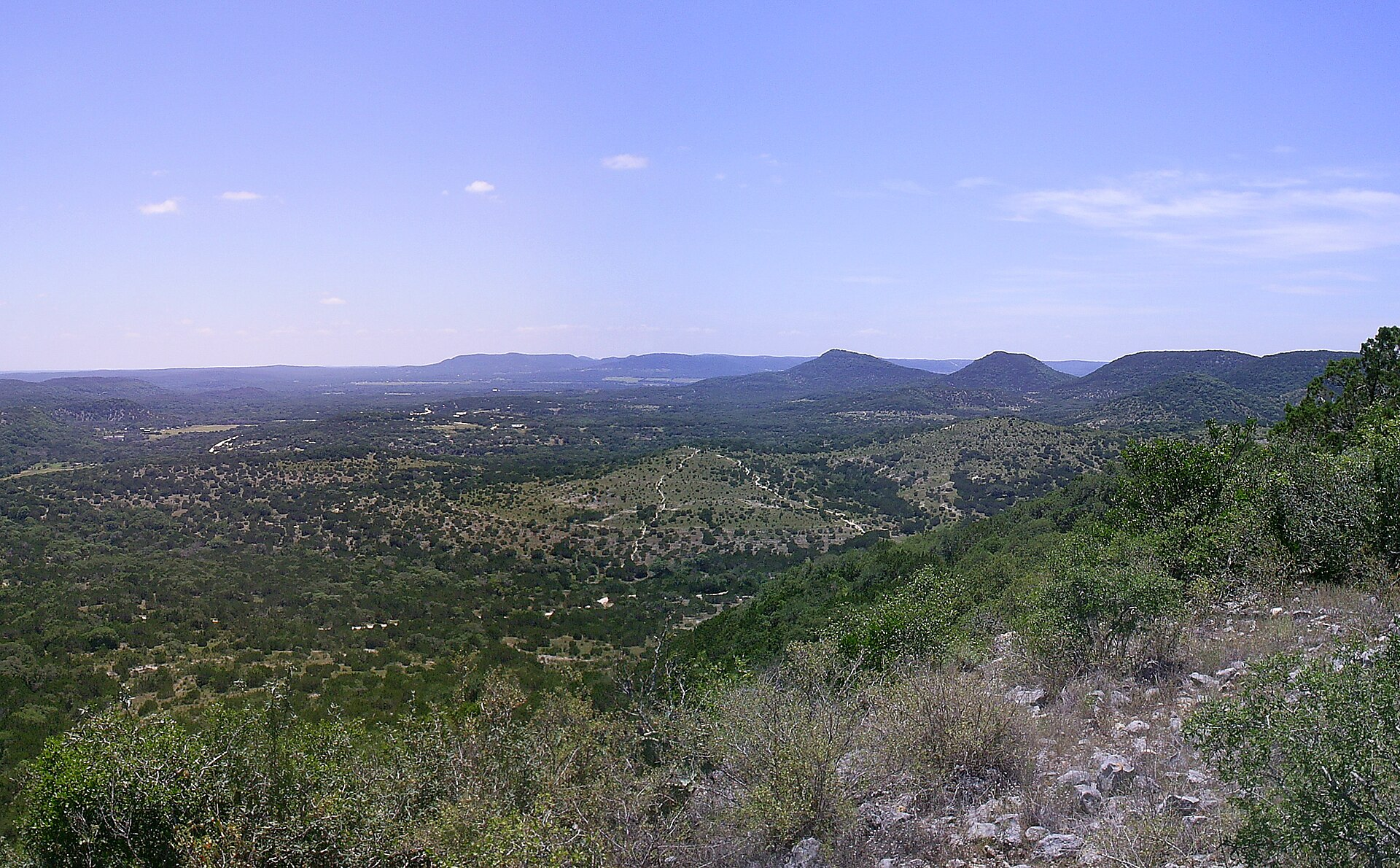
The most recent little expedition we took was this past weekend, one last hurrah before my daughter started school. (She returned to class on Wednesday. It’s a late start, I know.) We returned to the vicinity of Lost Maples State Natural Area, one of the gems of the Texas Hill Country, lodging for a few days at one of the properties operated by Foxfire Cabins. We’d stayed at another of the properties about this time last year, finding it a generally enjoyable experience, and we decided we’d work to make it something of a family tradition. Hence the return this past weekend, when many of the area schools had already started back up, making for a less crowded time for us to enjoy.
My wife, my daughter, one of her friends (whom I’m still considering how to pseudonymize; I don’t generally discuss minor children by name for privacy reasons), and I made our way down to the location on Friday afternoon, my wife having taken off work and my own job being such that I’ve not been in office on Fridays for some months, now. Our drive was reasonably good, although we got off to something of a slow start, as there were some errands that needed running before we could pack up and head out. Too, we got delayed along the way; stopping off for lunch took longer than expected, as did going to the grocery store along the way. But, as ever, the drive was scenic, with the rolling hills parting at times to offer spectacular views of hardy trees stretching to the limits of vision in the distance.
We got to our lodging, the Alta Vista cabin operated by Foxfire, in good form around five pm. A two-bedroom, one-bathroom place with a wraparound porch, firepit, grill, and picnic table, the cabin–and the neighboring Buena Vista–offers remarkable quiet and excellent views of the towering hills enfolding FM337. There was a bit of a trick to finding it (including a steep drive up an unpaved drive), to be sure, and another window unit would have been welcome, but it was from the outset a good place and restful.
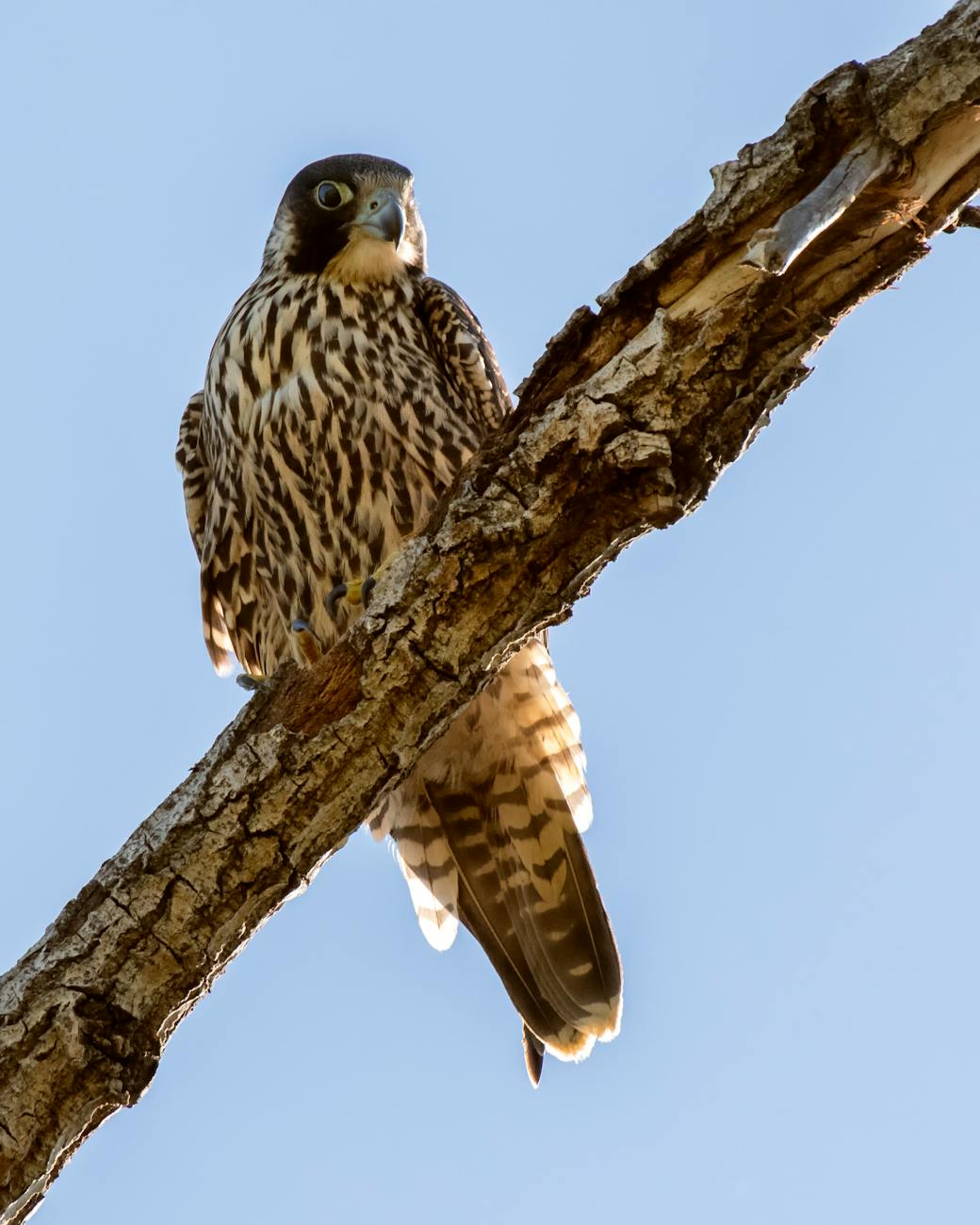
The next morning, all four of us on the trip slept in until close to nine. After breakfast, we went to the main Foxfire facility, right on the upper Sabinal River. There, my wife and the girls swam a bit, the latter playing with the children of another group of families that were having something of an annual reunion on the property; given that I swim just about as well as a rock (about which more later), I abstained. My wife and I got some information about local happenings, as well, and we decided that we would make arrangements to take the Frio Bat Flight tour that evening. Right off the intersection of TX127 and FM2690, the tour takes visitors to the entrance of a cave system that hosts between 10 and 12 million Mexican freetail bats–a colony whose emergence shows up on weather radar as often as not. The guide was informative, and the setting was beautiful–although I was sad to see the falcons hunting the emerging colony miss so many of their attempts.
Shown not eating. Photo by Frank Cone on Pexels.com
We drove back to Alta Vista by way of Utopia, missing much of the scenery in the darkness that followed the bats’ emergence. After another long sleep, and a Sunday morning breakfast, though, we were back at it, heading down FM337 to Leakey (pronounced “Lake-ee,” for those not familiar) to see about visiting a river outfitter and floating the Frio. The one we visited in town gave an…unhelpful answer, but the next one we called, Happy Hollow in Concan, was much more accommodating. With them, we made arrangements to rent inner tubes and be shuttled upstream on the Frio River–I believe to the crossing on FM1120, but I could not see road signs from where I was sitting–to enter the river and float on down. While the water was generally low, and I managed to scare my daughter and entertain her friend with the prospect of my drowning where the river got deeper (she had complained of nearly falling through one tube, so I switched her to one with a net, and I went into the water more energetically than I expected), it was a generally peaceful, pleasant experience. Much of the float was shaded, and the people still on the banks so late in the season were friendly.
After the float, a picnic lunch, and more swim time for my wife and the girls–I abstained again, not wanting to tempt matters–we drove back down to TX127, where we put in at The Frio Float, a little ice-cream shop right on US83. I got a small cup of ice cream that I ate with delight; my wife and my daughter’s friend each got floats with Dublin Bottling Works Texas Red Creme Soda, and my daughter got a big helping of a strange concoction of ice cream and toppings. The three of them overestimated their capacities, which made for a bit of a delicate drive back to Alta Vista (once again by way of Utopia, although with much better views in the daylight than in the previous darkness), but things were well settled by the time we got back and lit up both the grill and the firepit on site.
Monday morning, we didn’t sleep in near so much, as we had to eat our breakfast, pack our stuff, and skedaddle. My wife and I both had to go back to work on Tuesday, and the girls had their Wednesday start of school; in preparation for the latter, there was a Meet the Teacher Night we were pleased to attend. It was a sadness to leave, as it most always is to return to the real world from a vacation from it, but we’re already looking towards next year, and we got back to our lives with more vigor for having had the time away.
I’m happy to help you meet your writing needs! Fill out the form below to get started!