Read the previous entry in the series here. Read the next entry in the series here.
The succeeding chapter, “Trader for the Vestrit Family,” begins with Keffria cleaning out the bedchamber she had shared with her husband; in the tumult that beset Bingtown, it was despoiled, and her efforts leave it “Empty, clean, and somewhat cold.” She considers it a reflection of her life as Ronica enters and asks after Selden; Keffria notes that he is packing to relocate to the Rain Wilds and that she is letting him do so because she has nothing better to offer him in Bingtown. Their own financial situation and the current status of negotiations to set up the new Bingtown government and division of land and materials are glossed. So are their hopes that Althea will return home; Keffria presses her mother about her husband, and the two women discuss Keffria’s twinned dislike for having to manage her own affairs and pride in doing so well until Rache arrives to indicate, with some displeasure, that Jani Khuprus has arrived to take Selden.
Jani muses on the status of the Vestrit home as she awaits the inhabitants. As they join her, she notes her hopes for Selden and their towns before laying out two offers. One, her personal offer as she formally accepts stewardship of Selden in honor of the agreement between the Vestrit and Khuprus families, is to host the Vestrits in her own home. The second, on behalf of the Rain Wild Traders, contradicts it, obliging Keffria to remain in Bingtown as the official representative of the Rain Wild Traders. She demurs, but Selden seeks to persuade her to accept, noting the other Elderling cities along the Rain Wild River that await rediscovery and the prospects of an ennobling interchange between human and dragon. And an agreement is struck among them.
The present chapter expands from the ideas of the previous in offering possibilities. There are legal avenues open to Keffria at this point in the narrative that would allow her substantial agency, and though she does not find any of them entirely satisfactory, she reaches an arrangement that brings her some contentment; she is the controller of her own affairs, but she only arrives at that point by giving up control of others’ dealings and doings. And that, as with her daughter far away, is surely instructive.
Read the previous entry in the series here. Read the next entry in the series here.
A chapter titled “Flights” follows and opens with Reyn startling awake in Tintaglia’s clutches as the dragon seeks a place to land safely. He reviews their progress together, and he comes to reconsider the dragon as she shares her situation with him, and as the dragon heads off, Reyn tries to hunt some of the sea bullocks to aid her. The gesture confuses the returning dragon, but it also seems to mollify Tintaglia, and they confer about their expectations of the others’ species as their time together continues. Reyn is left uncertain of his feelings and of the price he and the rest of humanity will pay for the agreement he has made.
Something like this comes to mind. Image originally from Joel Garlich-Miller for the US Fish & Wildlife Service, thus public domain.
Aboard the pirate ship Motley, Malta tries briefly to comfort the Satrap, but his whining sours her on the project swiftly. She moves to join the ship’s captain, Red, at mess, and the conviviality of his table is noted as he asks after the Satrap; Malta attempts to demur without success, and Red lays out the situation with the Satrap plainly: he will be taken to Kennit, who will ransom the Satrap to the highest bidder. Red also propositions Malta, and she considers how she might avail herself of standing as his mistress to effect her father’s rescue. She refuses, and he accepts the refusal–though he also notes that she would be better off joining him and his crew than holding onto her earlier desires before releasing her to get information from the Satrap.
Though the chapter is a brief one, it does much to present possibilities–and not only for Reyn and Malta, on whom the narrative action focuses. Reyn’s conversations with Tintaglia reaffirm that the two species, human and dragon, can learn from one another and can find some accord, although they also reaffirm that there are fundamental differences between the two not likely ever to be bridged. Again, I know I ought not to read for parallels to present circumstances, but I also cannot help but see them; I cannot help but think there is some kind of comment being made about one or another of the many, many divisions within humanity in the readers’ world as Hobb depicts the separation between species in her narrative one. And Malta’s conversations with Red speak to a certain relaxation of social mores that even she entertains–if only briefly, and if only to reject them. But her rejection is less on the grounds of adhering to the mores than upon pursuing her own goals, which is surely instructive…
Once again I find my mouth full Working on what I have regurgitated And while there have been times that I have let go what I have had between my teeth Feeding it to such young as I nurtured Anymore there is but one who would feed thereupon And she is less and less likely to like the taste For which I can hardly blame her Since what comes up from in me Is all too often bitter As can hardly be helped Given the source So like the sailor’s wife the first witch saw I mounch and mounch But I have no husband Gone to Aleppo or otherwise And few enough with which to share
Yeah, this ain’t it. Photo by Peter Steele on Pexels.com
Read the previous entry in the series here. Read the next entry in the series here.
The next chapter, “Family Reunions,” opens with a confused Wintrow accompanying Etta aboard the Marietta, the two conferring about their removal from the Vivacia and Wintrow trying to puzzle out his purpose and the reasons for recent events. She notes her pregnancy to him, and they continue to converse awkwardly, and he advises her to hold the news from Kennit for a time.
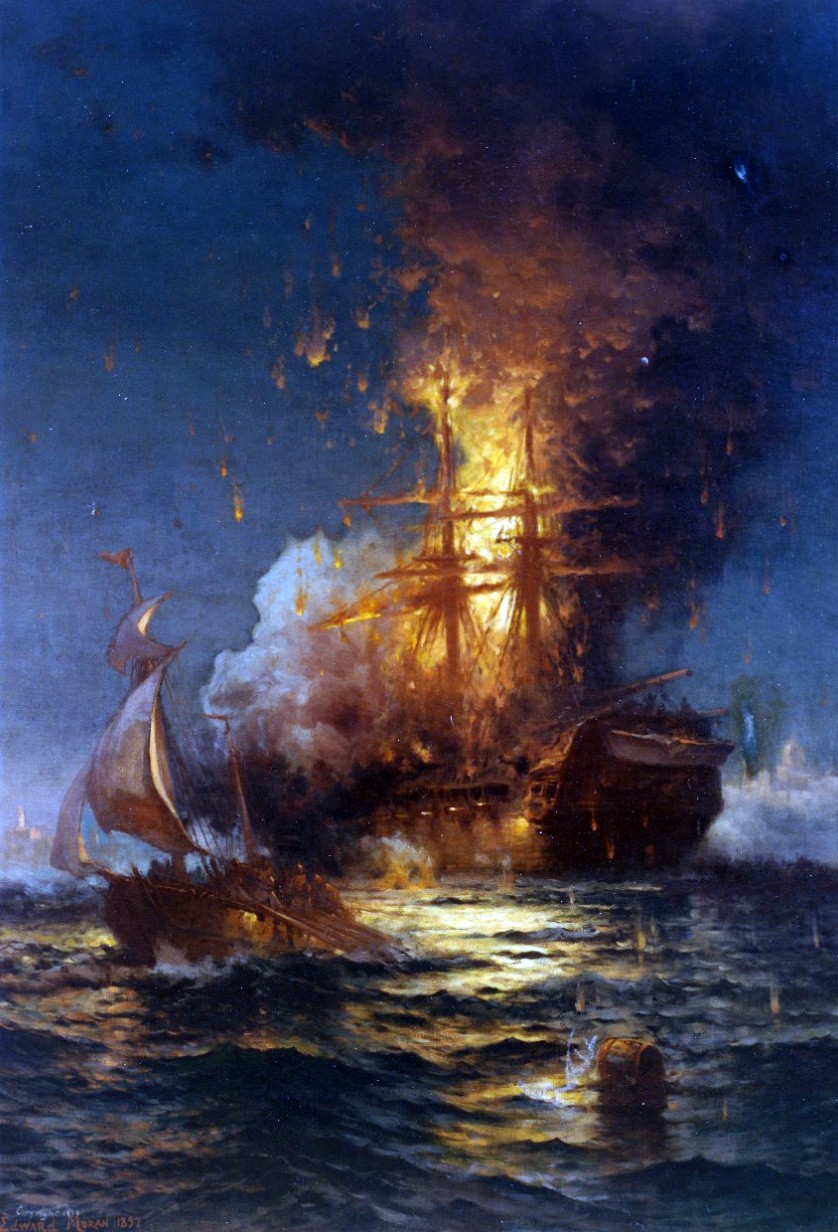
Something like this, perhaps? Image is Burning of the Frigate Philadelphia in the Harbor of Tripoli, February 16, 1804, on the US Navy’s website, which I believe makes it public domain; it is used for commentary here.
The Paragon withdraws inside himself as fire burns upon him. The ship is aware of the crew below deck, including Amber. The ship is also aware of serpents outside, in the waves, that press for the reawakening of the dragon memories within–and that the ship tries to reject.
Althea comes to aboard the Vivacia and takes stock of her situation. She reaches out to the ship and is rebuffed decisively and angrily; Kennit enters and cautions her against repeating the attempt, noting its sources. Althea asks about her crewmates and receives answers along with a spiced wine concoction; she is soon soundly intoxicated and lapses into unconsciousness. Kennit regards her avariciously, and the wizardwood charm on his wrist rebukes him sharply for his intentions.
Aboard the Paragon, Amber pleads for her own life and those of the crew. The personalities of the dragons within the ship reassert themselves forcefully, and Amber strives towards communion with them; the personality of the ship pleads for survival and is told to join or die. Realization of what she must do breaks upon her, and the dragons agree to share the body of the ship; Amber calls out raggedly to Clef, sending the boy to where Brashen commands a work crew with a message to try a hatch she had cut in the floor of the captain’s cabin while she dwelt aboard the beached ship earlier. Brashen redirects efforts to that end, reaching more of his crew and preparing to abandon ship. But the ship decides to live and closes the seams that had been allowed to spring open, the dragon-personalities deciding as Clef indicates.
Etta and Wintrow return to the Vivacia, finding Kennit angry at their return. He rebukes them and issues orders regarding Althea and Jek, and they accede to his manipulations as the ship sets out for Divvytown.
The issue of the mixed-plank construction of the Paragon comes up again in the present chapter, as does that of the torturous existence of dragon-personalities “beneath” the awakened liveships’. Certainly, the experience of integrating different personalities in the Paragon is an unpleasant experience for all involved, and it becomes easy to feel for the ship in the chapter; really, there seems there was never any chance for happiness for the vessel, even aside from the problems inherent in the origin of liveships, generally. This is not to discount the systemic problems of generational exploitation of genocide–because that is what happened, here. It is, though, to note that the Paragon was almost set up to directly experience failure and torment, not only from the oddity of construction, but also from being forced to bear witness to the traumas it saw early in life. And taking on Kennit’s burdens, as well…in many ways, Hobb is a sadist towards her characters. Authors must be so, of course; there is no story without conflict, and conflict necessarily inflicts upon those who undergo it. Text
Read the previous entry in the series here. Read the next entry in the series here.
The following chapter, “Paragon of the Ludlucks,” starts with Althea aloft aboard the Paragon, sighting the Vivacia. She reports the finding to Brashen, and the two confer about their plans before they make ready to confront Kennit–hopefully to talk and to reclaim the Vestrit family ship, but possibly to fight.
The proprieties at all times? Image taken from Tenor.com, here, used for commentary.
Aboard the Vivacia, Kennit receives a report of the Paragon‘s sighting that he does not seem to need. How he knows the ship is the Paragon confounds him, and the wizardwood charm at his wrist speaks ominously before Kennit orders a wary approach to the oncoming vessel, privately purposing to sink the Paragon for the liveship’s knowledge of his past. He joins Etta and Wintrow on the foredeck as the sight of the coming ship rattles him; Etta reports that Wintrow is torn, as he must be, by the situation, and Kennit orders him away with Etta as he tries to persuade Bolt. After he departs, having surprised them all with his swift insistence that his place is with Kennit, the pirate captain inquires if Bolt can have the serpents scuttle the Paragon; the ship answers in the affirmative but presses Kennit about the inquiry. She also calls in his debt to her, bidding him marshal his entire fleet to the escort of the serpents to the Rain Wilds and calling him by his full, true name–Kennit Ludluck–to bind him. He agrees once again and, after some discussion, the serpents swim off to assail the Paragon.
Brashen watches Althea and a boat crew make for the Vivacia, the time leading up to the expedition rehearsed; Amber had noted an imminence about the proceedings. Althea looks back to him and the ship before they proceed, and she is shocked by the attack of the serpents upon the liveship; she orders her crew to proceed to the Vivacia with all speed. Brashen orders his ship’s crew to brace for the attack and attempt to flee; the Paragon belays the orders and calls out to the serpents in turn, confusing them as Amber narrates what she can of events.
Shreever considers as the Paragon converses with the assembled serpents, prodding them away from Bolt. The white serpent Carrion upbraids the serpents for following orders that Bolt relays from Kennit, and She Who Remembers calls for a pause to gather more information. The call is not universally accepted, and a fracas ensues that catches the Paragon and the crew upon the ship up in it as collateral damage. Brashen orders such damage control as he can until Clef tells him that Althea’s boat has been seen to be capsized; he orders retrieval.
Kennit watches events from the Vivacia and orders an assault on the Paragon. Battle is joined and quickly won–by Kennit’s crew. Brashen surrenders to save his crew, and he is confined with them below decks as Kennit begins to tour the ship that should have been his. He finds the condition of the vessel agreeable–until the ship begins to speak to him, relating the sad story suffered long and beginning to rage as realization breaks. But the ship is persuaded to ancestral loyalty, and Kennit makes to burn what had been his family’s liveship–with the crew aboard.
Back aboard the Vivacia, Kennit is presented with the surviving boat crew–Althea and Jek. He bids them be taken aboard and has the ship set out for Divvytown–leaving Etta and Wintrow behind.
I am sure there are comments about competing masculinities that could–and perhaps should–be made, using the current chapter as explanatory material. Kennit’s seems to be toxic enough, to use a term that fits but that would not have been much employed when the novel was being written. (I say “much,” of course, because I am not as up on such discussions and their backgrounds as I perhaps ought to be; I do not know enough to say “not at all,” but I do know that the term was not part of mainstream discussion then as it often-wrongly is now.) Rather than trying to work through his trauma–and he does carry trauma, though that does not excuse his later actions–he seeks to eliminate what serves as the repository for it; rather than acknowledge and deal with his pain, he tries to deny it, the lives of others be damned. It is something that is all too common, of course–and the idea of sealing pain away is something that comes up elsewhere in the Elderlings novels; it is something of a theme in Hobb that might be worth untangling with further, careful reading…
I have commented once or twice before in this webspace about the ways in which I go about writing. As I’ve continued writing–that I have should be clear enough–I’ve made some changes to my processes, at least as pertains to some of the specific writing work that I do. One of the more frequent (and lucrative!) writing tasks to which I attend is drafting month-long lesson plans for various books and other works. It’s taken me a few tries to get a good process down that lets me move swiftly and effectively through the tasks, and because I think it will help, I offer an overview of that process below.
I can’t pull off such shorts Image from Giphy.com, here, and used for commentary.
When I accept an assignment–how I decide what I take is a discussion for another time, if ever–the first thing I do is get hold of a copy of the text to discuss. Sometimes, I already own a copy of it; I was an English major and I did teach literature for some years, so I do have a lot of books. Sometimes, I am able to borrow a copy from family or friends; I tend to hang around with literate types. On occasion, I make a quick purchase (business expenses are fun!), but most often, I take a trip down to the local library and borrow what I need. I pay into the public library system, after all, so I should be able to use it, much as I use roads and public utilities. And then I sit down to read.
Time was, of course, that I had time to spend days on end doing nothing but read. I remember those times fondly; I remember feeling myself grow intellectually, and I remember the feeling being exhilarating. No single moment stands out for me, admittedly, as is the case with some of my martial arts studies long ago or my band performances even further back, but it was a more sustained joy for me–and one that current circumstances no longer permit me. I have to work my day-job, after all, and I get to enjoy time with my family that I did not have when the thing I was supposed to do was my book-learnin’.
Now, though, I read in fits and starts. When I am able to devote hours at a stretch to a text, I make good progress through it; I do not read as swiftly as I used to, being somewhat out of practice, but I can still chew through several hundred pages in a day if given otherwise-idle time in which to do it. And I always read the text I’m writing up straight through once, reading as if just to read; doing so builds familiarity with the work, as I told students when I had them, which makes the subsequent work easier to do.
With the first reading done, I stub out the write-up. Again, I’ve gone through a few such write-ups at this point, and experience with them has helped me develop a template from which to work for the work I continue doing. It is set up with common expectations; I alter as needed, based on the work’s own subdivisions, getting the document ready to hold the required numbers of required items. Details of that, I must leave to the imagination; I do have to keep something to myself, after all.
Not that I’m incredible… Image from Giphy.com, here, and used for commentary.
Once the write-up is stubbed out, I begin reading the assigned text again, using the second reading to draft a summary of the text, section by section, chapter by chapter, passage by passage. The work I do in the Hobb Reread has been useful practice for such activities; it’s part (but only part) of why I keep going with that project. I might occasionally stop the summarizing for a moment to make a note of some comment that will be useful for one of the required items in the write-up, but, for the most part, I plow straight through on the reading-and-summary work as I reread the text for the first time. It is slower going on the second reading, to be sure, as the necessary pauses to type things out mean less focused reading, but the familiarity developed in the first read-through is a help.
The second reread, which I try to start the next day after I complete the summarizing, goes slower yet, and it is because it is on that second rereading that the bulk of the write-up gets done. Attention to the details of the text and its paratext matters; it is from such details that the lesson-planning proceeds. And I have to be judicious in what I select from the details; the lesson plans ostensibly align with Common Core standards, which means they are aimed at use with high school students, and such experience as I have being one and training to teach them tells me that there are some things to which I might attend and which I might well treat with college students that I dare not handle with them. Parents can be…difficult.
The third reading is usually the last for me; I try to have things done with the write-up when I am done with the third reading. The rule of three might be something of a cliché, I admit, but it is something that works in the situation I’m in, and, to borrow another cliché, it ain’t broke, so I ain’t tryin’ to fix it.
A few years ago, I ruminated on the observance that has come again today. The comments still largely apply; there remains something perverse in the tendency of the United States to commemorate events by sales and to make of what should by its own rhetoric be a somber occasion into a fetishistic paean to excess, but I will still take the opportunity to rest up a bit, being off from my regular job. I am not less perverse than others, and no few would argue that I am more so, not least because I make such comments.
This is the kind of thing, yes. Image from the US Army, here, which I believe makes it public domain.
There were several years in which today, and the weekend that is extended into today, saw my family move. When we left Oklahoma, we did so on Memorial Day weekend. When we moved within the Hill Country earlier, we did so on Memorial Day weekend. This time, we will not be; it’s not impossible we’ll move on Independence Day weekend, but this Memorial Day, we’re at home, more or less. Still, as I look toward making another such move, I cannot help but wonder if that is, itself, a fitting marker for the day. Is uprooting and relocating, starting a new life and necessarily leaving the other one behind, somehow mimetic in some small way of what today is supposed to mark and honor and which it commemorates only in perfunctory fashion for most, despite their full-throated jingoistic protestations? I suppose I could draft some verse that spins out a tenuous connection, holds it up to glisten in the light and seem larger than it is by the refraction, but I, being small, would struggle with such a task more than it likely deserves.
We are all of us small, in truth. Some of us are made smaller by such days as today, not because we could not measure up to those who have gone before, but because we have allowed ourselves to be made so–or, indeed, reveled in the diminution, thinking that what is gained is worth the exchange. As I look around, though, and see only some small pockets of quiet amid the tumult, and the smiles strained upon the faces of those outside them, I cannot think the price-tags accurate.
Read the previous entry in the series here. Read the next entry in the series here.
The ensuing chapter, “Prisoners,” begins with Jani Khuprus seeing to Reyn’s comfort as he prepares to be carried by Tintaglia once again. Dealings with the dragon are detailed, and Reyn and Selden confer briefly before Tintaglia goes aloft, bearing Reyn as he seeks Malta through the bond created by their dream-sharing some time ago and reinforced since.
This kind of thing again… Image is from the National Endowment for the Humanities EDSITEMent, here, which I think makes it public domain.
Malta wakes from a vague recollection of connecting with Reyn to survey her materially improved circumstances aboard the Chalcedean ship with the Satrap. She also rehearses the ways in which her situation has deteriorated with the reassertion of the Satrap’s power and prestige, but, after questioning her father’s regard for her, she resolves herself to continue to press her own position on the ship. The appearance of pirates disrupts the flow of her work, however, and the Satrap rejects the notion that the Chalcedeans would be overwhelmed by the advancing raiders. She begins to dress him in his demanded resplendence as the sounds of conflict reach them.
Aloft, Tintaglia shakes Reyn back into his body. They converse briefly, not without tension, and the search for Malta continues as Reyn muses over relative powers at sea.
Aboard the Chalcedean ship, the Satrap makes to assert himself to the pirates despite Malta’s attempts to dissuade him. She accompanies him above deck and finds that the pirates have taken the ship; she falters when the Satrap proclaims himself as such to the victorious pirates and sickens when she sees the carnage of the taken deck. Malta affirms his identity, though, and declares her own; the pirates, laughing in disbelief, take them and the ship into their possession.
The thought suddenly, strangely occurs to me that the Bingtowners and pirates seem to be the only people depicted in the Elderlings corpus who seem to have blue-water shipping as it is typically understood. Yes, the Out Islanders can likely make such crossings; the ships they are described as having do evoke Viking longships for Tolkienian-tradition readers (or Haida war canoes for others), and such vessels can cross open water, but the frequency of raiding and other clues suggest that the Out Islands are not so far from the Six Duchies as might otherwise be thought. The Chalcedeans are explicitly reported to use galleys, and while such ships in the readers’ world might have crossed the Mediterranean, they were more used closer to the coast than far from it. The liveships, though, and other traders’ vessels described are depicted as striking out across open ocean, though, or at least in terms like the ships of the Golden Age of Sail. Perhaps they are to be taken as “more advanced” because of the technological distinction? I am not sure, although that suggests itself as a point that could be made…
Circumstances seem to have confirmed something I suggested not long ago: I’ll be moving again. My wife has accepted a promotion that comes with a transfer, and while I’ll be keeping the job I’ve had for a while, staying where I am now would make for too long a commute for her to be tenable. As such, we’re relocating to a place from which we’ll both have a bit of a drive to where we need to go: Johnson City, Texas.
It’s a nice, place, too. Image taken from the city’s website, which, I believe, makes it public domain.
I know that I’ve had somewhat to say about living in the Hill Country, particularly in the town where I grew up–such as this. And I confess to some apprehension about the whole thing. Johnson City’s a lot smaller than Kerrville, and though it’s only an hour away on a fairly easy drive, it’s still away from a town I’ve been reminded offers a lot of good–that I’ll now not have quite so easy access to as I do now. (Yes, I’ll still be working where I work, which puts me just outside of Kerrville, but there’s a difference between commuting to a place for work and living in that place.) And my daughter will be leaving friends she’s known for years, which is not an easy thing to do.
At the same time, the coming relocation has shaken a number of things loose that have needed to be shaken loose. It has pushed me to be more appreciative of things, for one, and such appreciation is frequently noted as a good thing. Too, the promise of new things to explore and to do entices, and Johnson City offers a fair bit for that; there’s history to the place, including a national park, as well as a pretty good children’s museum and some good food and drink.
Further, at long last, we’re buying a home instead of renting. I’d planned to for a while, as might be guessed from comments I’ve made about wanting to put down roots and provide more stability for my family. Somehow, though, there was always some reason for me not to do so, not to put out feelers and get ideas about what I could do on that score; the pending relocation somewhat forced the issue. And it was scary; in many ways, it still is. But it’s also exhilarating, and the further I get into the process of it, the more excited about it I get; I am looking forward to having the keys in hand, and I am looking forward to the new adventure that the move presents.
Read the previous entry in the series here. Read the next entry in the series here.
The chapter that follows, “Strategies,” opens with Althea relocating into the first mate’s cabin aboard the Paragon, with Haff settling into the second mate’s berth, and Amber complaining bitterly about the oppressive humidity and fog. She rehearses a conversation she had had abed with Brashen the night before, noting their situation and inveighing against the former first mate. They also voice a vision of a future together, possibly despite their families’ desires and Bingtown’s disapproval. Althea sets the vision aside, turning instead to more practical matters of how to handle Kennit and attempt to reclaim the Vivacia. Pointed questions from Jek interrupt Althea’s reverie, and a tense conversation is soon diverted by laughter and consideration of how matters have fallen out in the wake of the attempted mutiny and successful desertion before Althea muses again on what they will do.
A studied, subtle insult? Image from Michelle Tofahrn, here, used for commentary.
In Bingtown, Serilla confers with Mingsley over tea, reviewing their current situation and the fallout from the work to reconstitute Bingtown’s government. The Trader is aspersive, but Serilla retains control of matters, assuming a position for herself in the negotiations outside the various factions still present in Bingtown and articulating her expectations of the nascent political order. Mingsley rails against her, but she takes his imprecations as benedictions.
Also in Bingtown, Reyn watches the Kendry return to port with a shrunken crew; Tintaglia notes to him that the Ophelia is following soon after. He muses on the changes he has had a hand in enacting in the liveships and in the Traders’ society that relies upon them for its economic heft. He notes that he should be happy, but he is not, largely because Malta remains absent. Selden retrieves him from his perch, explaining as he does some of the cognitive differences between dragons and humans. Selden also asks if he is turning into a Rain Wilder, noting some fear of drowning in memories; Reyn offers the boy reassurance as he can.
It is a brief chapter, certainly, although not as brief as some. Even so, it manages to counterpoint the previous chapter well; I note again the parallels between Malta’s work and Serilla’s, as well as the ways in which they run askew of one another (discussed here and here, among others, and with a content warning). And I note the overt consideration of unintended consequences on Reyn’s part; reintroducing a powerful species to the world after it had been driven nearly to extinction cannot but alter things. Hobb is scarcely the first author to treat such ideas, of course; Crichton is perhaps the most prominent prior example, but he is not the only one. Still, it tends to be something treated less in fantasy fiction than in science fiction, and it makes for an interesting thought experiment, in any case.