To continue my practice of drafting sample assignment responses for my students, I am working to follow the pattern my first-semester composition students are asked to follow and work through a series of writing assignments ostensibly meant to introduce them to the processes and demands of academic writing. Unlike ENGL 135, ENGL 112 does not ask students to address a single project, but instead calls for them to address different writing tasks throughout the term, working in small pieces to foster a skill-set that will, hopefully, serve them well in their future coursework and in their continuing lives outside the classroom.
It’s not a bad model to follow. Image taken from Giphy.com
The first piece of writing students are asked to do is a profile essay; in the first week of class, they are asked to prepare for it, reflecting writing as an ongoing process. Specifically, that preparation asks students to conduct an initial rhetorical situational analysis, examining their prospective profile topic, their angle of approach to it, their purpose for treating their topic as they do, characteristics and needs of their audience, and their own authorial perspectives and biases. It seems a good exercise to have students do, certainly, and one that would be helpful to have repeated with more detail in successive writing classes. (That it is not part of the standard assignment sequence in those classes, I know–I teach said classes.)
As with my efforts in the previous session (here, here, here, here, here, here, and here), I eschewed the University-provided template as I began my work on the exercise. Setting my Word document to 12-point, single-spaced Times New Roman with one-inch margins on letter-size paper sufficed. And, given the exercise’s constraints, I did not set up a title page or running head for the document of my response; I did, however, insert page numbers, and I offered something of a heading and title, following my practice in assignment documentation given to students. (Students will please note that this is not APA format.)
With my document’s layout set up, I proceeded to address issues of content. I started by copying the relevant questions over from the University template. That done, I began to address them, answering openly and honestly as best as I could. Given my predilections and associations, as well as the exercise’s guidelines, I opted to focus on an event–and a particularly nerdy one, at that, which can be found here: http://shadowsovernaishou.com/paintedcity/index.php. Answers to the several questions emerged easily from that decision, and I addressed the prompts of the exercise with little difficulty.
The content made ready, I reviewed my document for style and mechanics. After making the adjustments that needed making, I rendered the document into an accessible format, which I present here: G. Elliott Sample Profile Process Planning Sheet November 2018. I hope it will be useful for my students and others in the days to come.
For the first class meeting of the session, introductions were made to the discipline, course, and instructor. The materials provided in the course shell were expanded upon, assignment guidelines were reviewed, and time was afforded to students to work on their assignments.
The class met as scheduled, at 1800 in Room 106 of the San Antonio campus. The course roster showed 13 students enrolled. Five attended; student participation was reasonably good. An online office hour was held on Tuesday, 29 October 2018; no students attended.
Students are reminded that another office hour is scheduled for tonight, Monday, 5 November 2018, at 6pm Central Standard Time. Students are also reminded that the following assignments are due before the end of day (Mountain Standard Time) on 11 November 2018:
Discussion Threads: Introduction, the Brand of You, and Discovering an Angle (3 posts/thread, rubric online)
Profile Process Planning Sheet, due online as a Word document
Continuing on from earlier work (here, here, here, here, here, here, and here), I mean to narrate my process for compiling a final draft of a researched paper. (I offer it even though the session has ended when I began the project.) As before, I’ll not be using the template provided by the University, though my results will be similar, given the formatting constraints placed on it. I hope that my students and others’ will find my continued efforts to be of help.
It can feel like this, even if the paper’s a sprint rather than a marathon. Image taken from the Huffington Post, here.
For the assignment, students are asked to compile a conference-length paper of approximately 2500 words (excluding title page and reference list) that incorporates illustrative graphics. It is a fairly standard final assignment for second-semester composition classes, and the requirements of the University present no unusual challenges for it.
Since the final draft is supposed to be a reworking of the earlier materials, I began by opening the earlier documents and reincorporating the main text of the labeled first draft into that of the second. Prewriting and references were excepted from the copy-over, the former due to irrelevance, the latter due to already being in the second draft’s materials. The file-name and title were changed, too, to reflect the current exercise.
Reviewing the materials I had showed me that I was somewhat short of requirements for the exercise–a page or two, in the event. As such, I knew that I needed to develop more material for presentation, and a direction to move for doing so suggested itself quickly. I am in a community band, and began looking into support for such ensembles in part because I am in one. Applying my findings to my own situation was an obvious step to take to do expand my paper, and offering something of a prospective test case is a common motion made by academic papers, of which the overall course project for ENGL 135 is supposed to be an example.
Consequently, I stubbed out a place for me to make such a presentation and left the paper itself aside for a bit; I knew I would need more information to present the test case, as well as to develop another graphic (because I recalled the assignment asking for two; the template provided to students includes two, for example). Data regarding the population in my local communities and regarding charitable work done in the area seemed to me to be good places to start looking, so I delved into the local municipal and county websites and records, as well as a directory of charitable organizations with which I am familiar from other work I do (GuideStar, to be specific). US Census Bureau data was also incorporated. Income and assets information was pulled out and made accessible (including graphical representation) before being explained in terms of how it conduces to the idea of local support being ideal for my own community band.
With the content compiled, the formatting was re-checked to ensure ease of reading. A review of content for style was conducted, as was proofreading. All that done, the document was rendered into an accessible format, presented here: G. Elliott Sample Final Draft September 2018.
I find that I have some comments to make about revisiting my old practice of composing sample assignments for my students. I think they will go into the reflective comments on the session that are forthcoming. I hope they will be of some value to my students and others in time to come.
Continuing on from earlier work (here, here, here, here, here, and here), I mean to narrate my process for putting together a presentation of the sort my students are asked to compose during the sixth week of the session. There is not a template available for the students, but I am hopeful that my work will provide them something they can use to guide their own work–and something that will be helpful for others, as well.
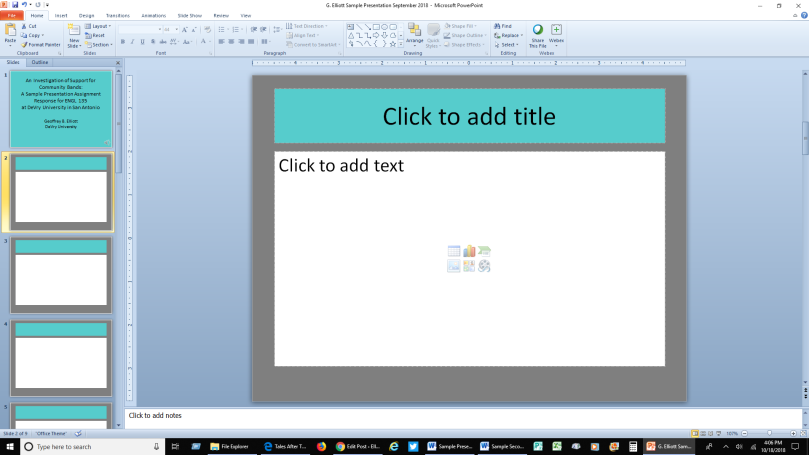
I did a lot of staring at this sort of thing. The image is a screenshot from while I was working.
For the assignment, students are asked to develop a five- to seven-minute slide presentation with embedded audio and slides that follow basic design principles. The presentation should give an overview of the project as a whole, since a full read of a conference-length paper will generally take eighteen to twenty minutes; students are encouraged to frame their issue, present their thesis, and support that thesis before offering a conclusion and a slide displaying their references in APA citation style.
In putting together a slide presentation, it is necessary to have a consistent color scheme that allows for easy reading and that conveys an appropriate impression. Working in this webspace fortunately gives me the basis of an easy one to use; I mean for my sample work to reflect my other work, as well as to travel with me if and when I must go elsewhere. (I remain contingent “visiting” faculty at DeVry.) I had earlier developed a color scheme working from that of this blog, adding complementary colors according to common design principles and using the tools available at Paletton.com.
Color scheme in place, I opened the earlier exercises to cull information from them. Following the recommendations made to students, I copied my thesis and major arguments over to another document, as well as my references list. I also copied my title over before adjusting it to suit the present exercise; consistency across the project suggests itself as something useful to maintain. And as I did the copy-over work, using the fact of the ongoing project as justification for doing so, I arranged my materials for presentation on individual or related slides. The order differs from that presented in the paper itself, something that the shift in medium seems to warrant.
That done, it remained but to generate and populate the slides. I first generated a title slide, coloring it in the accent color I had chosen and filling in title and authorial information. I next developed a blank content slide, establishing it as a basic pattern for use in the rest of the presentation. Looking at my notes, I determined that I would need a slide for a presentation overview, at least six for content, and at least one for references, totaling at least eight slides; I consequently made as many, duplicating my pattern slide until I had enough to start. I also left one blank at the end in case I would need to add or insert others later.
With the basic presentation set up, I saved my work and began to insert text into the slides. First, I worked to insert my references, knowing that I would have to make adjustments to formatting and the like to make them legible but not overpowering. Having them ready to hand helped, as well. At length, I was able to get all of them into the presentation, although it took several slides to do so; the first of them got an audio note explaining matters, one swiftly followed by an audio note on my title slide. I determined I would position the audio cues consistently on slides throughout my presentation, making it easier to find them for my audience and presenting a more uniform–thus more polished–appearance.
Afterwards, working through the content slides, I made sure to work with bulleted text only, eschewing complex sentences and more erudite vocabulary in favor of ease of reading and orientation. And, because I was working in PowerPoint, I made sure to save my work repeatedly as I went along, not wanting to have to go back and re-do work if it could be avoided.
I worked through the slides in order afterwards, moving from the presentation overview through the thesis into content and the conclusion. Along the way, I inserted the text before inserting audio, using the former as a guide while I put in the latter. And, again, I saved my progress after each component of each slide. I have had to reconstruct work before, and it never goes as well the second time as the first.
The materials compiled and saved, it remained but to put them where they can hopefully serve as a helpful example for my students and others’. To wit: G. Elliott Sample Presentation September 2018. (It is a PowerPoint presentation, so it requires software that can open a .pptx file to view.)
Continuing on from earlier work (here, here, here, here, and here), I mean to narrate my process for putting together a draft of the sort students are asked to compose in their fifth week of the session. As before, I’ll not explicitly use the template provided by the University, though the results will still hopefully be similar enough to what the school requires that my students–and others’–will find my efforts helpful.
Although not quite right, this is what most people think about when they think of revision. Image from Inside Higher Ed.
For the assignment, students are asked not so much to revise what they have already submitted as to add onto it, completing the paper begun in the first draft. As such, the assignment title is something of a misnomer; it is a second first draft rather than a second draft, as such.
Rather than starting a new document and formatting it, I added onto the document I had generated for the first draft, making sure to save the new version under a different name (i.e., replacing “First Draft” with “Second Draft” in the file name). I made similar adjustments to my title page and first page of actual text, ensuring consistency across the material being developed. I also marked the prewriting for deletion from the current exercise, as it is not called for in the putative second draft, but I retained it at the outset of development due to its notes for expansion.
I then moved to the end of the already-written text, placing the notes for expansion I had on hand where I could use them most readily. Noting that doing so brought up a source for which I had an annotation but had not yet included in my document, I made sure to enter that source’s citation into my references list, ensuring that I would not forget to do so. The citation came, as had several others, from my earlier annotated bibliography–and, since I was working on that part of the paper already, I decided to develop that idea for a bit (working from the summary and earlier discussion in the annotated bibliography, as well as from the original article) to see how it could work.
That source introduced and put to the service of my stated thesis, I moved back up the page and addressed the other development note I had brought down from the first draft of the paper. Its source was already in my references list, so I had nothing to do on that score, but I did pull up the original article again to be sure I all of the information available from it that I would need. Or I attempted to do so; library services disallowed access to the article I needed, despite my having logged into the University’s library. I was obliged to put that part of the work aside for a time as a result, which rankled.
Fortunately, there was much else for me to do. I realized swiftly that I had exhausted my previously-acquired resources and, given the difficulties I had had with the University library, I turned to an open online search to help fill the void. Doing so led me to Google Scholar, where I searched for “supporting community organizations,” restricting the initial search to pieces published after 2010. Unfortunately, the results that came up were located behind paywalls, but I recalled that my local library has database access, so I ran a similar search on its databases, adding restrictions to articles, book chapters, and case studies. One article suggested itself for inclusion in short order; information was integrated from it.
That done, I used my local library resource to pull up the article I had earlier searched for in the University library. I was able to bring it up without any trouble, and so I integrated the materials I needed from it into my essay, as well. As doing so took me to the end of my notes from earlier, I deleted the prewriting materials; they had outlived their utility to my present purpose.
Still needing more support to make the case, and needing information more narrowly targeted to the specific thesis with which I was working, I ran another outside search. It was a simple Google search for “community band.” More than 693 million results were returned, but the first page offered enough material–or a gateway to enough material–to make a reasonable case. Information was culled from websites to make the necessary case–as well as to generate the graphic for which the overall assignment calls. (The second draft in itself does not, but it is not a bad thing to look ahead when composing a project in explicit stages.) The information was entered into an Excel spreadsheet and used to generate a graphic that was subsequently cut-and-pasted into the Word document in which I did my composition. Necessary figure data was incorporated, as well, and citations for the sources for my graphic’s data were integrated into the references list.
As I reviewed assignment guidelines to ensure that my work would continue to serve as a useful guide for my students, I noted comments that only the latter sections needed to be developed in the second draft. To align my work more fully thereto, I deleted the text I had developed for the first draft–although I did not adjust the references list further.
Looking at the document at that point, I noted that I had enough material developed to move on to a conclusion. My earlier materials had pointed towards final remarks looking for a call to action. I drafted my conclusion with an eye towards my own purposes and my own ensemble; I have an idea for how I might further expand it for a final draft, if I find I need or want to do so.
With the content compiled and directions for further development set, the formatting was re-checked to ensure ease of reading. A review of content for style was conducted, as was proofreading. All that done, the document was rendered into an accessible format, presented here: G. Elliott Sample Second Draft September 2018.
Continuing on from the previous week, students were asked in discussion to consider their future prospects. They were also asked to connect their efforts in the current class and other courses to job prospects, working in part from the Occupational Outlook Handbook.
The course roster showed 13 students enrolled, a decline of one from last week; all participated in online discussions during the week. An online office hour was held on Monday, 15 October 2018; no students attended.
Students are reminded that the next office hour will be today, Monday, 22 October 2018, at 6pm Central Daylight Time. Students are also reminded that the following assignments are due before the end of day (Mountain Daylight Time) on 27 October 2018:
Discussion Thread: Looking Ahead
Course Project: Career Connections (due online as an APA-formatted Word document)
I have been offered two classes for the November 2018 session, ENGL 112: Composition and ENGL 135: Advanced Composition. I’ve taught the latter before–during the current September 2018 session, in fact–but, while I’ve taught first-semester composition any number of times at other institutions (as noted here, among other places), I’ve not yet done so at DeVry. It is the only class in the main writing sequence at that school I’ve not yet taught, so it will be good to get that course under my belt and get a full view of what DeVry asks its students to write.
This would be a nice classroom to have. Image from University Business.
It will have been noted, I hope, that I have resumed generating examples for my students to follow. I do not think I will do so for ENGL 135 quite yet again; I’m presently in a cycle of doing so, anyway. But I will doubtlessly do so for ENGL 112, partly for the reasons I’ve tended to do so in the past, and partly to help me get a feel for the course cycle expected of my students. (Too, I feel compelled to put materials into this webspace, and doing so for my students helps with that.) I also mean to continue my practice of posting class reports, although the timing on them will shift to reflect the fact that I have an actual class meeting schedule this time around.
To wit, the ENGL 112 class will meet on Wednesday evenings at the San Antonio campus; the ENGL 135 is another all-online section. Both classes begin on 28 October 2018 and run through 22 December 2018. I am happy to have the opportunity to teach once again and put the skills I have theoretically developed through more than a decade of teaching and more than a decade of study to use one more time.
Continuing on from earlier work (here, here, here, and here), I mean to narrate my process for putting together a draft of the sort students are asked to compose in their fourth week of the session. As before, I’ll not explicitly use the template provided by the University, though I will be including the prewriting students are asked to submit (and about which I have some comments, below). The results should still be similar enough to what the school requires that they will be useful for my students–and I hope they will prove useful for others, as well.
For the assignment, students are asked to present an introduction and an argumentative section incorporating previous research, as well as a title page and references list. Content should come after the University-determined pre-writing, which students are also expected to submit under their title page. Formal sectional division is encouraged but not required; more important is that the draft present a sound beginning and a solid thesis, and that it move smoothly forward from that thesis.
As in previous exercises, I began by formatting my document, setting my typeface to double-spaced 12-point Times New Roman and inserting running heads as appropriate. I also stubbed out spaces for the prewriting, the main text, and the references list–as well as setting up the half-inch hanging indentation required of reference list entries. That done, I copied over relevant materials from earlier portions of the project, since my title should largely remain in place, and my references entries should already have been in order. Such adjustments as I needed to make to suit the specific exercise were made–converting “Annotated Bibliography” to “First Draft,” for example.
That done, I brought over the prewriting questions from the University’s template, leaving myself space to answer them. I did what I could to keep the formatting from the template in place. The prewriting itself is not part of regular APA formatting, so its inclusion need not adhere to the standards promulgated by that body–though concerns of usage should remain consistent throughout the document as much as possible in any case.
Prewriting framed in–I did not begin with completing it for reasons I lay out below–I moved on to composition, working directly from materials I had already compiled for earlier exercises. The proposal and outline offered sound initial materials, although I did adjust them slightly to offer a more conversational narrative introduction before moving on to incorporate materials I identified in earlier exercises as offering useful context for discussion. Owing to concerns of audience, I sought to keep my paragraphs relatively short–an average of 125 to 150 words seemed a good target. (In the event, I tended to exceed that length more than to adhere to it.) I also worked to keep the reading level of my paper in and around the high school level for the same reason. (I often overshoot audiences.)
One thing I made sure to do as I moved through composition was to insert entries into my reference list as I made references to items. I have heard many students–and other writers–say they compose their references last; I have had to assign many students lower grades or begin academic dishonesty proceedings no few times because of that practice. It is not a pleasant thing to do; to avoid it happening with my own work, I make sure to build my references as I go. I commend the practice to others’ use.
As I compiled my first paragraphs, I did go back to the ostensible prewriting, filling in items that had become clear to me. I believe I have noted in this webspace that I do not compose linearly, the less so when I move between composing multiple documents as narrating my processes obliges me to do. It will not work for all, to be sure, but I appreciate the flexibility doing so offers me, as well as the authenticity it lends to my accounts. And while I did so, I made sure to align my terminology to what the school’s materials uses; I call things by different labels at times, but since the example is supposed to serve my students, it needs to follow what they are asked to follow.
After getting my introduction in place, though, I hit a bit of a snag. I found myself with a clear idea of where to take my rebuttal and refutation, and I had some means to get back into my central argument from them (and I made such notes in my prewriting materials, as well as stubbing out space for later development). I did not, however, have a clear idea of how to proceed with the direct support of my argument past that point. I imagine the situation is similar to that which my students face, and so I tried to put myself in my students’ position. As I did, I noted that the draft does not need to be a complete paper; there is more to be added in the next assignment given to the students. Knowing that I did not have to generate a full eight- to ten-page paper all at once offered some relief, though the impulse to delay unduly showed, and it was and is one that needs to be fought.
The realization in place, I proceeded to flesh out the rebuttal and refutation, working from the notes I had made and from earlier exercises. I also filled in more of the expected prewriting. I may not adhere to it as the exercise continues, but it will be useful to have something of a framework as I move ahead. And I would note the same to my students. They are not bound by their outline; it is a guideline, not a rule, to follow as needed and not otherwise. I was at ease, then, setting up the informal sections I had ready and leaving the rest for another time.
With the content compiled and directions for further development set, the formatting was re-checked to ensure ease of reading. A review of content for style was conducted, as was proofreading. All that done, the document was rendered into an accessible format, presented here: G. Elliott Sample First Draft September 2018.
I note above that I have some comments about the prescribed prewriting. To be sure, I do a fair bit of prewriting when I work on projects of my own, and I do expect that students who want to write well will do some sort of prewriting. The specific form, however, is not something I am happy to regulate, and I have noted to students previously that they are free to use the school’s form if it helps them–and that they should back-fill it from their draft if it does not. I understand assigning a grade to the completion of the prewriting as a way to get students even to attempt such a thing. And I understand restricting options both as a cost-saving measure and as a means of easing assessment burdens. But none of that means I think it is an ideal teaching practice.
Continuing on from the previous week, students were asked in discussion to present a draft of their presentation for peer review. They were asked to revise the previously submitted second drafts in light of instructor and peer comments, as well, improving upon the earlier materials and generating said presentation.
The course roster showed 14 students enrolled, a decline of four from last week; 13 participated in online discussions during the week. An online office hour was held on Tuesday, 9 October 2018; two students attended, albeit briefly.
Students are reminded that the next office hour will be today, Monday, 15 October 2018, at 6pm Central Daylight Time. Students are also reminded that the following assignments are due before the end of day (Mountain Daylight Time) on 20 October 2018:
Discussion Thread: APA Workshop (3 posts/thread, rubric online)
Continuing on from earlier work (here, here, and here), I mean to narrate my process for putting together an annotated bibliography of the sort students are asked to compose in their third week of the session. As in earlier posts, I’ll not be using the template the University provides its students, although what I do produce will again be remarkably similar, as the University’s template works in APA format. I still continue to hope that my remarks and the resulting document will be helpful for my future students and others’.
As might be guessed from the screenshot, I’ve done some annotated bibliography work.
For the assignment, students are asked to develop an introduction and five three-part annotations; the annotations are expected to consist of an APA-style citation, a summary of the cited source, and an assessment of that source’s usefulness to the project. Annotations should be alphabetized by citation, and the sources they treat should be secondary (that is, talking about a thing rather than being the thing itself) sources of a scholarly nature. The introduction does well to note the thrust of the overall project and the methodology and rationale for source selection.
As in previous exercises, I began by formatting my document, setting my typeface to double-spaced 12-point Times New Roman and inserting running heads as appropriate. I also stubbed out spaces for my introduction and annotations, since the formatting should shift within the latter; citations take a hanging indentation, while paragraphs such as the introduction, summaries, and assessments take a first-line indentation (half an inch in all cases). I also inserted a blank line between annotation-stubs to make future reading easier. Titles and running heads were inserted as usual and appropriate, as well.
Because I had already done some work establishing a thrust for the project and laying out search methods, I worked first on my introduction. Since the project is a continuation of work already done, I brought over what I could from previous materials, incorporating the earlier work without comment. (This can only be done ethically if the carry-over is within the development of a single project, as in ENGL 135. Carrying work from term to term or class to class–say, from ENGL 112 to ENGL 135–requires citation.) Although I had cited and summarized two sources, however, I felt I should not bring them over; the idea is to find more information, rather than to re-hash information already obtained.
As such, I re-ran my initial search to bring up the results I already knew I had, and I looked again at those I had not already incorporated into the project. One such source focused on instrument maintenance, rendering it useful for other purposes than mine; another served only as the front-matter of a journal, making no argument. The third, though, looked at the decades-long endurance of one organization, suggesting that it might speak in some way to support; I read it, finding a small amount of useful material in it. As such, I drafted its citation, summary, and assessment, incorporating each into my bibliography. (Note that the citation omits database information, following current APA guidelines reported on the Purdue OWL.)
Annotating the source, however, exhausted the resources from the initial search, so an expansion of search parameters seemed in order. The first such was to open the search to articles dating back to 2008–ten years prior to work on the project and after several of the significant cultural events that continue to influence the project-present. Three more articles emerged, of which all three promised some use; all three were reviewed, and those that were found useful were included in the bibliography. As they were, notes were added to the introduction to account for the expanded search method and rationale. Further notes were added to account for an article revealed in the references of another, as well as an outside piece resulting from an additional search.
As notes and annotations were finalized, formatting was adjusted to ensure that citations were not abandoned by the rest of their annotations. A review of content for style was conducted after, as was proofreading. All that done, the document was rendered into an accessible format, presented here: G. Elliott Sample Annotated Bibliography September 2018.


 Elliott RWI