Read the previous entry in the series here.
Read the next entry in the series here.
The present chapter deals in a lot of racist tropes.
The twenty-first chapter of Shaman’s Crossing, “Carnival,” opens as Nevare returns to his dormitory after his meeting with Captain Maw, feeling the impending dismissal. He determines to make a quiet night of Dark Evening, but a note from Spink tucked into his coat attracts his attention. Reading it, he finds that Spink and Epiny have arranged to meet, and he determines instead to rush off to such rescue of his cousin and his friend as he can effect.
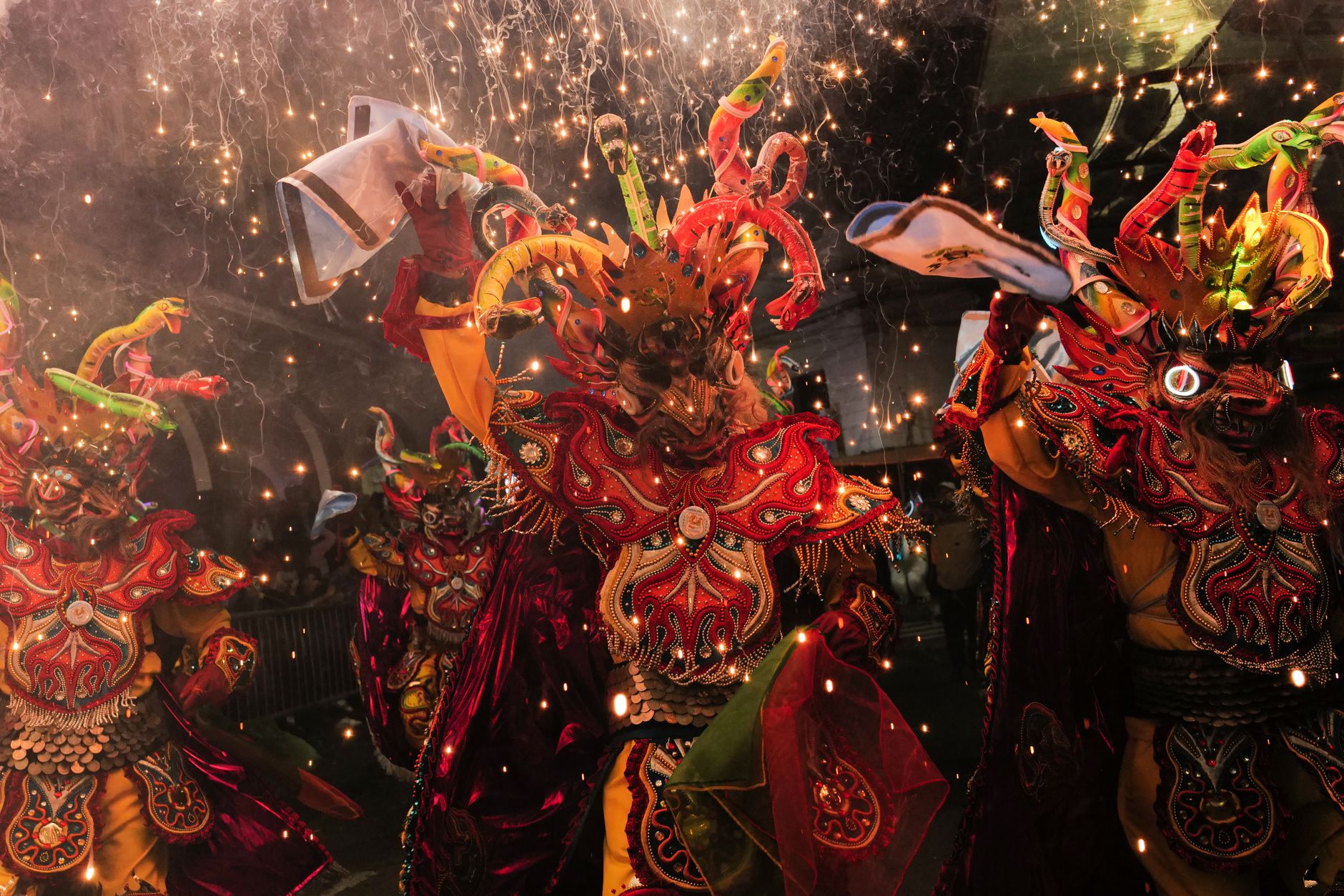
Photo by rodwy cazon on Pexels.com
A cart-ride later, Nevare is deposited into the filled streets of Old Thares, beleaguered by festival-goers of varying vulgarities and indulgences in the same. Shocked thereby and concerned at the thought of Epiny’s exposure to the same, Nevare’s search for his cousin continues, albeit without success.
Nevare does encounter several of his cohort at a collection of “FREAKS, GROTESQUES, AND WONDERS OF HUMANITY” (483). They greet him warmly and report that Spink had accompanied them but wandered off; Nevare is carried along with them through the collection. Details thereof are presented as Nevare sees them, and he finds himself facing a display of Specks who are described as they plead for tobacco. Nevare’s comrades engage the display, and Nevare’s hand weaves a strange sign as he recalls a dream. At the sign, the Specks confer briefly and determine to dance a particular dance, the Dust Dance. As they do, they spread a dust around themselves and onto the watching crowd.
Nevare urges his fellows to leave, and they tour the remainder of the collection. Separating from them, Nevare finds himself confronting a pair of massively corpulent people, Eron and Candy. Eron relates a strange story of having been affected by plague in such a way as made him so fat as he is, his military career cut short by Speck magic. He warns Nevare against the Barrier Mountains as the youth excuses himself, leaving off his mission to find Spink and Epiny and determining to return to his dormitory.
To address the chapter-length issue: the present chapter, in the edition of the novel I’m rereading, runs 22 pages in length, approximately 3.73% of the novel. The expected acceleration of events seems to be in place in the present chapter; Nevare’s motion through the titular carnival is somewhat disjointed* and hurried, and if it is not the case that there is a new narrative arc at work for the novel, itself, it does seem clear a major event takes place. Where the motion of the chapter slows and expands, that major event stands out. Given its position in the novel, it is one likely to be of substantial effect for the remainder of the series.
Also, for indexing purposes, the following: Barrier Mountains, Beggar, Caleb, Candy, Captain Maw, Carneston House, Caulder Stiet, Colonel Stiet, Dance of the Blowing Leaves, Dark Evening, Dust Dance, Epiny Burvelle, Eron, Far Entia, Gimpy, Great Square, Jaris, Jensen’s Horse, Juggling Hidaspi Brothers, King’s Cavalla Academy, Kort Braxan, Marrea, Natred Verlaney, Nevare Burvelle, Nightshades, Old Thares, Ordo, Oron, Plague, Potatoes, Princess, Rory Hart, Sergeant Rufet, Specks, Spinrek “Spink” Kester, Syinese, Tobacco, Tree Woman, Trent, Trist Wissom. A busy carnival might be expected to show many performers and participants.
A comment attracts attention: soon after entering the throng in Old Thares, Nevare is confronted by a woman dressed as a tray of fruit and remarks at her offer of tasting said fruit that “The peaches are large but they are surely well past their season” (480). It is a particularly good show of wit, especially from Nevare; indeed, it does not seem of a keeping with most of his other dialogue in the novel, both for its cleverness and its strange stiltedness. (I’d think contractions more in keeping, honestly.) In the event, the “peaches” on offer “were actually her powdered and painted breasts surrounded by wax fruit on a ledge of stiffened fabric,” shocking Nevare (481). I, myself, am put in mind of Mardi Gras festivities in New Orleans; when I attended them, I saw many breasts, painted and displayed abundantly. (Unlike Nevare, I did not rush away.) I am also put in mind of Christina Rosetti’s “Goblin Market,” although I note the gender inversion at work and the presumptive dearth of ill effects upon the taster in the present chapter. And I must note the mismatch from expectations: peaches are less often breasts than they are genitals (the divet and fuzziness making the connection clearer there), although the more common melons might well not play quite so well in the context.
Another comment attracts attention: viewing Eron and being addressed courteously by him, Nevare finds himself “suddenly uneasy to have the spectacle turn into a person” (495). While speaking to the kind of thing Metsäpelto discusses, at least obliquely (Eron is a spectacle because he is corpulent), it is more telling as an indicator of Nevare’s–and Gernia’s prevailing–social attitudes. Repeatedly in the text, when Nevare is obliged to reconsider his assumptions, he expresses discomfort; Eron, being presented initially as an object to be viewed for entertainment, forces such a reconsideration by speaking to him politely and in the kind of militaristic terms Nevare has been trained from infancy to understand and to regard favorably. That is, he makes himself someone that Nevare cannot blithely disregard. The power of dehumanization suggests itself emphatically in the exchange–along with the several other things the exchange does, about which the continuing reread will doubtlessly comment.
That Gernia is racist is clear at least as early as “Harbinger.” A number of the succeeding chapters reinscribe that racism, directly and tacitly. The present chapter fairly strikes the reader over the head with it; the ways in which non-Gernian characters are depicted echo, decidedly uncomfortably closely, caricaturish stereotypical presentations of non-white races and ethnicities in all too many places, both formerly and presently. They are called subhuman, savage, unintelligent, animalistic, lust-inducing, all pejoratives applied to colonized, subjgated, often enslaved populations (about which Young comments); Nevare’s complicity in those presentations argues against him being a sympathetic character, and if he is the agent through which the Dappled People work to stop Gernia’s expansion, it is also the case that Gernia seems worth stopping. And while it is not necessarily the case that a protagonist always hold or adopt positions with which a reader must agree, the bluntness of the confrontation in the present chapter is, in a word, stunning.
* For disjointedness in Nevare’s experience, “Crossing the Bridge” is a useful reference. That the earlier chapter is the fourth of, and the present chapter leaves four in, the novel seems an interesting bit of near-symmetry. And I am put in mind of any of the several iterations of Fitz’s disjointedness throughout the Farseer novels, as well.
I still do this without using AI; if that’s the kind of thing you’d like to have done for you, fill out the form below!


[…] Read the previous entry in the series here.Read the next entry in the series here. […]
LikeLike
[…] the previous entry in the series here.Read the next entry in the series […]
LikeLike
[…] back to “Crossing the Bridge.” There is not so much structural symmetry going on as has been the case, but it is the case that asymmetry prompts a feeling of motion through works of art; the […]
LikeLike
[…] “Magic and Iron,” “Journey,” “Crossing the Bridge,” “Sword and Pen,” “Carnival,” and “Plague.” The scene in the present chapter seems something of a refutation of those […]
LikeLike