The pseudo-sainted sought to earn acclaim
And gather glory to a sainted name
That he might greatly thereby grow his fame,
Though he may be a sacrificial goat
Thrown to the slaughter while the others gloat
Who at Stupid God’s table feast and bloat,
An offering to show the left the right
Can keep themselves still, standing in the light,
Hoping thereby to elide the blight
They represent, the one that plagues us all
Who seek to never be in that long hall
Where Stupid god conducts the running ball.
Distracting, they seek still to draw all in,
That Stupid God’s dominion might begin.
You know where it is… Map data from Google, you know…
In the United States, Black History Month begins today, with the call to reflect upon and celebrate the work of Black people in the country throughout its history, as well as to recognize the wrongs that have been perpetrated upon them and that continue to be perpetrated upon them by people who damned well ought to know better and therefore to do better. And along with it begin again contrarian calls that never get voiced except when, and which show themselves thereby not to be sincere, but instead artifacts of continued oppression, the toddler’s whine for special treatment when others are rightly lauded.
I’m sure there’s some symbol to find here… Photo by Marc-Antoine on Pexels.com
The toddler, at least, has the reason of not having full reason, the parts of the brain associated with such things not having fully developed. Perhaps it is the same for those who voice their contrarian calls, that they simply lack the maturity needed to see that celebrating one thing does not mean a denigration of another–or that, frankly, sometimes things have been done wrongly and continue to be done wrongly, and thus deserve rebuke and more. But I digress.
I should not, of course. What I should do, what I try and fail to do adequately, and what many others ought to do, is listen. I am not an expert. Many who act as if they are are not. Many who actually are are not in place to speak loudly on large platforms, but must get on with the daily business of living. And they do not owe their words to any, truly, even if those who ought to hear them, who need to hear them, would seek to seek them out. It becomes therefore the task of those who need to hear to listen to what is already said, to look at what is already shown, and to reflect upon those quietly and at length. But such tasks are hard to do, because they require those who will do them to shut their mouths and look away from the mirrors in which they gaze upon themselves, and they–and I–have grown so accustomed to open mouths and mirror-fixed gazes that it is uncomfortable to do otherwise that is currently done.
It is painful for others that things are done as they are. Should we not endure some discomfort to ease others’ pain? Or is that mild inconvenience too much to ask of many?
I think I know the answer. I hope that I am wrong.
I am happy to write to order for you. Do me a favor; take a few seconds, fill out the form below, and start the conversation about what you need written!
Read the previous entry in the series here. Read the next entry in the series here.
Another chapter, “Discoveries,” begins after a continuation of the exchange among bird-keepers, sending condolences and an invitation. As it does, Relpda wakes Sedric, to his annoyance, and he assesses his situation. Sedric tends to the dragon, if haltingly, and he tends to himself amid the injuries incurred fighting Jess. Communion with the dragon leaves him unsettles and uncomfortable, and Sedric begins to recognize increasing closeness with her, not entirely unpleasantly.
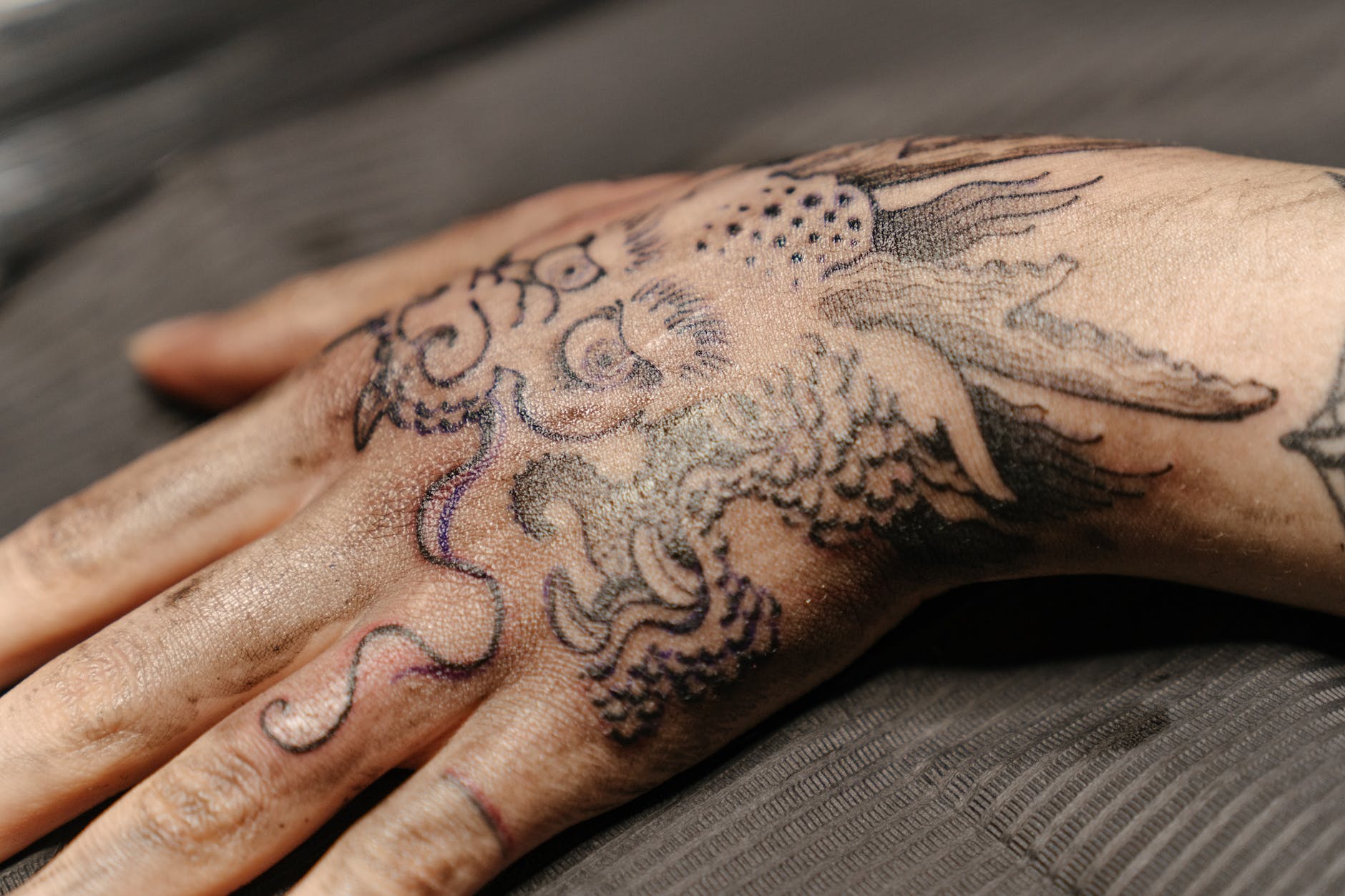
Not quite what the novel means by being marked by a dragon, I think… Photo by cottonbro studio on Pexels.com
Aboard the Tarman, Alise emerges on deck to find Thymara and Jerd conferring, and she begins to muse both on friendship and on the locket she found in Sedric’s goods. Turning away from such thoughts as are provoked, she moves about the ship and continues to muse on the differences between her situation and those of others, musing on Leftrin and the feelings he provokes in her. Soon enough, Leftrin joins her, and the two confer about developments. The likelihood of finding additional survivors and supplies is noted as rapidly diminishing, though Leftrin notes that Carson, who is searching, will have reason to find Sedric.
Thymara and Jerd confer about their own situations and the latter’s sexuality. Thymara is wounded by the conversation, and she moves away from Jerd, thinking uncomfortable thoughts.
Sedric continues his efforts on Relpda’s behalf, enjoying some success, if at the cost of some pain from the caustic waters and the unfamiliar exertion. The dragon grows somewhat panicked and petulant, and Sedric angrily pushes back. His doing so clarifies matters for Relpda, and the pair have something of a breakthrough. They work together for a time, and Relpda makes to rest. Sedric hears the call of a horn and calls out in response to it, being greeted by the searching Carson. Overjoyed Carson works to tend to Sedric and Relpda, and he reports developments among the dragons and keepers before pressing on to continue the search a bit longer.
Sintara muses on her situation, as well, conferring with Mercor about events and her responses to them. The other dragons are less sanguine about Mercor’s philosophizing, and they determine together to press ahead rather than die in sucking mud. Conversation among the dragons grows tense and approaches violence, but is defused partly by Mercor and the revelation that they are developing as dragons. The fragile truce brokered is broken by the silver dragon, now recovered, who proclaims himself–Spit–and asserts a place among the rest. Sintara watches for a time before settling in to sleep, joined soon by the other dragons.
It’s clearly been a while since I put myself to work on this long project, and I have no excuse. I can only say that I have been greatly busy with a number of other things, and that it is good to come back to Hobb’s writing once again.
As I return to the reread, I find myself questioning some sympathies I have had with the various characters. I’ve noted before that I tend to read with more affect than ought to be the case, something that my schooling would have had me leave behind but that I never have been able to shed fully. (Perhaps it is part of why I was never able to secure a tenure-line job. Ah, well!) I feel for the characters more than is seemly, something for which I have been teased and more by a number of people in my life. (It is a bit silly, I acknowledge.) I contend that it’s part of the quality of Hobb’s writing that the characters are so easy to feel with, even when they are not necessarily good or nice people.
Returning to the text, though, after so long away and in such an awkward position in the book–nine chapters in to twenty–I am not having trouble picking the narrative threads back up. (There’s a reason to write summaries.) The feelings, though, are not springing back as quickly as the memories are. I’m not sure what’s going on with it, really, whether it’s in me or in the text. (Some of each, perhaps?) Maybe it has to do with the fact that I’m fighting off a head-cold at the moment.
Be that as it may, however, I do note that the current chapter would appear to reward feminist reading, as I believe I have noted that the Bingtown-centered series tend to do. The “frontier” aspects of the work also continue (?) to attract my attention as I read; there is something decidedly pioneering about the keepers and their progress upriver, with much less of the baggage that so often associates itself with such narratives as they apply to the United States. There are no people living in the areas where the keepers travel and to which they are bound, although there once were (something of a commonplace, really); the keepers and their dragons are therefore not on track to impose the kind of oppressive settler colonialism so often seen in the readers’ world. But then, fantasy is supposed to show something of an idealization, an “other way” that could have been, had things been different.
I’m happy to write to order for you; reach out below and let me know what all you want me to work on!
Ragged breathing Throat raw from it When I can breathe Because it stops and starts again And I panic Ever so slightly Every time
How can I not?
For a bit of visual interest… Photo by Emre Can Acer on Pexels.com
The running will begin again And soon And I have no way to flee from it Fevered though my flight may try to be Yet such highs rarely fare well The descents from them Crashing down
If you’d like some writing done to order, let me know below!
They stand upon the plain with fist upraised
Amid the rain and think they offer praise
By buying pain to fill up others’ days
With coin they make with fire stoked by pages
That they have taken, stealing, while they rage
Who for their sake had spent both youth and age
In labor, hoping thus to wisdom spread.
But in those fires do those hopes lay dead,
And they spend and feed those fires without dread
Of what will come when all the coin is gone.
The debt to Stupid God they bear along
Will then come due, impoverish the throng,
Which would be well, would they suffer alone,
But they will not before Stupid God’s throne.
Leaning up against the bar and listening, watching, like his angel had told him before she took him up into the heavens.
Drink in hand, draining away slowly, savoring each sip just a little bit longer to keep a quiet peace inside.
But then the piano starts playing, and he knows this tune, this old standard of bygone days that still speaks in strains to ears not born since long after the composer died into the dust, man.
Synth plugs into amp, a toggle is flipped, and the mellow sound of a rubber-mouthpieced tenor sax swells up under the piano strokes, letting the keys lead and ringing along with them in a harmony bluer than the seas below, than the skies that they had left behind, cleaner than the corridors had ever been.
And the solo, when it comes, because it comes, steps carefully around where the keys part, and if it’s a mulligan, it’s one people are glad to have taken.
It’s a classic look. Photo by Mikhail Nilov on Pexels.com
A quick couple of toggles, a perfect shift down to Eb from Bb, rubber becomes steel, and a nasty, guttural funk backbeat joins throbbing ivories and sopranino echoics, punching up counterpoint in visceral pulses, buzzsaws humming in short bursts behind.
Let them look and listen and wonder what else is there.
Eyes close, body rocks, and all creation falls away.
Lyrics shift and call for something further afield, and the progression of music follows along, swing to bop to funk and further forward.
A second key under the left thumb is pressed, and the music drops an octave, slapping bass with sawtooth wave from mimicry of well-cut cane punctuating in three-octave jumps and sudden falls protesting words, going low to accent the high and going high to fill the silences between.
Bliss, man. Who can know such joy as this?
Like the work I do? Want some done for you? Reach out; let me know who I’m talking to!
Again, it rises, that old pressing need
To lift up voices, resist the shrill screed
That children from that darkness must be freed
Of rolling dice and telling lies for fun,
Which in the minds of many has begun
To wrap them in a cult, a mighty one.
And yet, those who might be thought at its head,
Did such a thing exist, as not, have led
Themselves to folly, and those same have pled
That they themselves but jested, did not mean
To anger those on both sides of the screen
Who now themselves have started them to wean
Away from sagging tit and milk gone sour.
Stupid God, we hope, laments this hour.
You know what I’m talking about… Photo by Armando Are on Pexels.com
Like the writing that I do? Reach out; I can do some for you!
I received a copy of Heather Radke’s Butts: A Backstory (Simon & Schuster, 2022, ISBN 978-1-9821-3548-5) as a belated holiday present (with the gift message “sorry it’s a little behind…”) and took the opportunity to read it in bed across the ensuing several nights. I found the series of interrelated essays, grouped into seven sections (Origins, Sarah, Shape, Norma, Fit, Bootylicious, and Motion, plus an introduction, conclusion, and other back matter) to be a reasonably informative and overall enjoyable read. Radke stakes out clear theoretical positions (which, I acknowledge, some will find objectionable) from which to approach her overall topic, using her own experience as a means of entry into broader consideration of the human butt, and the woman’s butt more particularly. Obvious jokes aside (and there are no few such, hardly a problem for me, although I know that some will not appreciate such humor), Radke’s book is an engaging read, one I felt was well worth doing; I might well have bought the book myself had it not been given me as a gift.
The cover, from the publisher’s website.
The overall approach of the text, moving from a personal introduction through the physical and physiological to a focus on others’ experiences and broader cultural contexts, returning irregularly but not seldom to personal reflection, struck me as generally sensible. Humanizing the topic by beginning with embedded personal experience is often a useful rhetorical maneuver, engaging both situated ethos (“I can talk about this thing because I have experience with this thing”) and pathos (“You should care about this thing because it affects people, clearly, and you are, I assume, a people”). That Radke acknowledges the limits of her approach is also a useful rhetorical move. She explicitly disclaims universality of experience and understanding, and she notes that the text emerges, in part, from her desire to address her own concerns about her butt (13). What this does is position her and her text not as a determination against which resistance can be made, but more as a report or a series of them; limiting her claims reduces the angles from which she can be attacked for her writing.
“Reduces” is not the same as “eliminates,” admittedly. As I note above, Radke takes clear ideological positions in her work, and while she does make efforts to acknowledge them explicitly, there are others that come across without being made overt. That they largely align with my own understandings does tend to make the text sit better with me than it might otherwise, but even in my overall agreement with and acceptance of her reports, I know that the unexamined assumption is often problematic. And even the examined assumptions are likely to provoke outcry from some quarters, some of which Radke anticipates–but only some. I can see places where Radke might be called out for her words, although I was not reading to look for such things; I have to think that those who would look for fault will find it. Admittedly, they would anyway, but there are some places where Radke makes it easier for them than might be hoped.
(I do not think Radke is lying, although I know that she, as all, misses some things and does not report on others. None of us can really report on what we do not observe, and the vantage point from which we operate does much to determine what we will and will not observe. Too, there are limits on the ability to convey what is observed, language being a blunt tool for some details, and there are always constraints on any given work. Standard stuff, really, although not always things about which readers think, and rarely things discussed by those who will decry a work for its content or what they are told is that content.)
In all, though, I enjoyed reading the book, and I commend it to others. I think I may well revisit it, when time and circumstances permit. It seems, among others, the kind of reading that would reward the kind of treatment I give other works for money: lesson plans and discussion questions…and I do need more writing samples…
Like the writing that I do? Take a minute, fill out the form below, and we’ll talk about what I can do for you!
Who suffers from the Words in a wonderful talking book written at the top of its reverse page Let that one beware The two-faced month matching the betrayer’s number on the hangman’s day Surely no good omen for those who believe
Dear friends, we have a winner! Photo by Aliaksei Semirski on Pexels.com
Even those who give less heed To portents put up in the past and handed down Dowries and remembrances of days gone by Tend to nerves
For me, it’s just another day My fears all run another way And I have not the time to play The credulous
I’m still happy to write to order; fill out the form below, and see what I can do for you!









 Elliott RWI