A Robin Hobb Rereading Series: Entry 115: Ship of Magic, Chapter 14

Read the previous entry in the series here.
Read the next entry in the series here.


The next chapter, “Family Matters,” opens with Kennit and Sorcor taking their captured slaveship, the Fortune, into port with a crew largely taken from the former slaves. When they are in port, Kennit reviews the charts from the captured ship as he lets it be known that he is taking offers on her. The ship’s status is rehearsed; it shows the stains of its service, and Kennit is struck by the condition of the former slaves as he tours it. The assigned captain, Rafo, notes the likely histories of the former slaves, and they misinterpret the reflexive eye-watering as tears shed for their condition.

The Print that Changed the World: The Description of the Slave ...
Something like this, perhaps, to great shame?
The Brookes diagram, on the Lafayette College website, used for commentary

When Kennit goes ashore, he finds his crew strangely eager. He also finds himself the center of an impromptu celebration, lauded as a savior by the freed people and the port town. He takes the chance to expand his influence, effectively bringing the town under his willing command. His empire has begun to form.

In Bingtow, Kyle and Keffria dine in advance of his shipping out. She asks to see Wintrow again, but is denied. Althea has still not returned to the Vestrit home, and Kyle is convinced she will return penniless; he presses Keffira to take her in hand when she does. He also presses for heartless economic decisions about family holdings, and their daughter, Malta, interrupts with questions about preparations for an upcoming social event. Keffria protests her suggestions, but Kyle sides with his daughter against her mother. When, afterward, Keffria voices her objections to Kyle’s permissions, he rebukes her angrily.

After Kyle storms off, Keffria muses on the changes in their relationship. Her reverie is broken by Ronica coming in. They confer about Kyle, Ronica casting aspersion on the idea of the Vivacia becoming a slaveship, rehearsing what she has learned of the conditions in them. She also notes the shifts to local government that have occurred, with new interests beginning to have a sizable voice. The threat to the Rain Wild River and the Traders upon it is also noted, and Keffria realizes that Kyle’s ignorance of Trader matters is a threat to them all.

Hobb goes to great pains to depict the evils of slavery in the chapter, both among the pirates and in Bingtown. She also goes to some pains to note the dehumanizing aspects of enslaving people, emphasizing that the system is destructive for all involved in it (though clearly more so for the people put into bondage than for those who put them into it). Keffira serves as an embodiment of the consumer who benefits from slave labor, able to justify it only insofar as she is able to avoid thinking about the practice. And, like many who are now in similar situations, she is unable to divest herself of entanglement in a corrupt system, certainly at a single stroke.

It is something which more people need to consider, certainly.

Care to lend a hand?


Another Rumination on Taxes

It is, once again and after a delay, Tax Day in the United States. I still have no doubt that, as this piece finds its way to the part of the Internet where it can be easily seen, people are still rushing to get materials together so that they can rush again through tax programs and hope once more they do not end up being audited, or so that they can speed down to one tax preparation office or another and pass the task off onto another. (Full disclosure: I still work for Liberty Tax Service in Kerrville, Texas, doing their social media work and the occasional odd job.) All the while, they are still like to complain about both the burden of filing taxes and actually paying them.

Lots of these today.
Image by Daniel Acker, taken from ProPublica.org and used for commentary

I find that I am not as sanguine about the matter this time as I was last. While I did get back some of what I paid in, having been stimulated, I look at how other countries have handled things and feel like I have been cheated; if I have been stimulated, it was not enough to get me where I’d like to go, and I feel unsatisfied. (Yes, I know, “that’s what she said.” Ha.) There is some word that more might be coming, but I am in doubt of it; I might well be called Thomas for this supposed fiscal messiah, ready to finger where the spear has thrust in before. I do not doubt that any such would be purchased in blood.

The thing is, I do not think the solution is necessarily to cut taxes. I am in a position to be able to get by without additional stimulation; indeed, what I got before did not go to daily expenses so much as to debt servicing, and though I need to do a fair bit of that work yet, I was not going to have to choose between paying what I owe and getting to eat. I know many people did have to choose that and still have to choose, and there is not enough philanthropy coming from individuals to solve that problem. (Clearly not; how many could be housed and still leave the wealthiest as the wealthiest? Yet they are not housed, nor yet are they fed and clothed, not even by those who claim that “the greatest of these is charity” as they “earn” more in a day than I do in a month or more.) But that what has been offered is better than nothing does not mean it is enough; I can be grateful for what has come and still want more to do so.

Or is it such that I should “count my blessings and seek no more,” as some have said to me? And if it is so, why should I try for better? Why should anyone?

Care to see if you can get me into a higher tax bracket next time?

A Robin Hobb Rereading Series: Entry 114: Ship of Magic, Chapter 13

Read the previous entry in the series here.
Read the next entry in the series here.


The chapter that follows, “Transitions,” opens with Brashen waking aboard the Paragon and considering the events of the previous night, and his situation. Realizing his straitened finances, he makes to head out and look for work. The ship greets him and advises him of where Althea has gone and warns him of some of the concerns in the work he purposes to do. The ship also turns to morbid talk of suicide and killing before Brashen leaves.

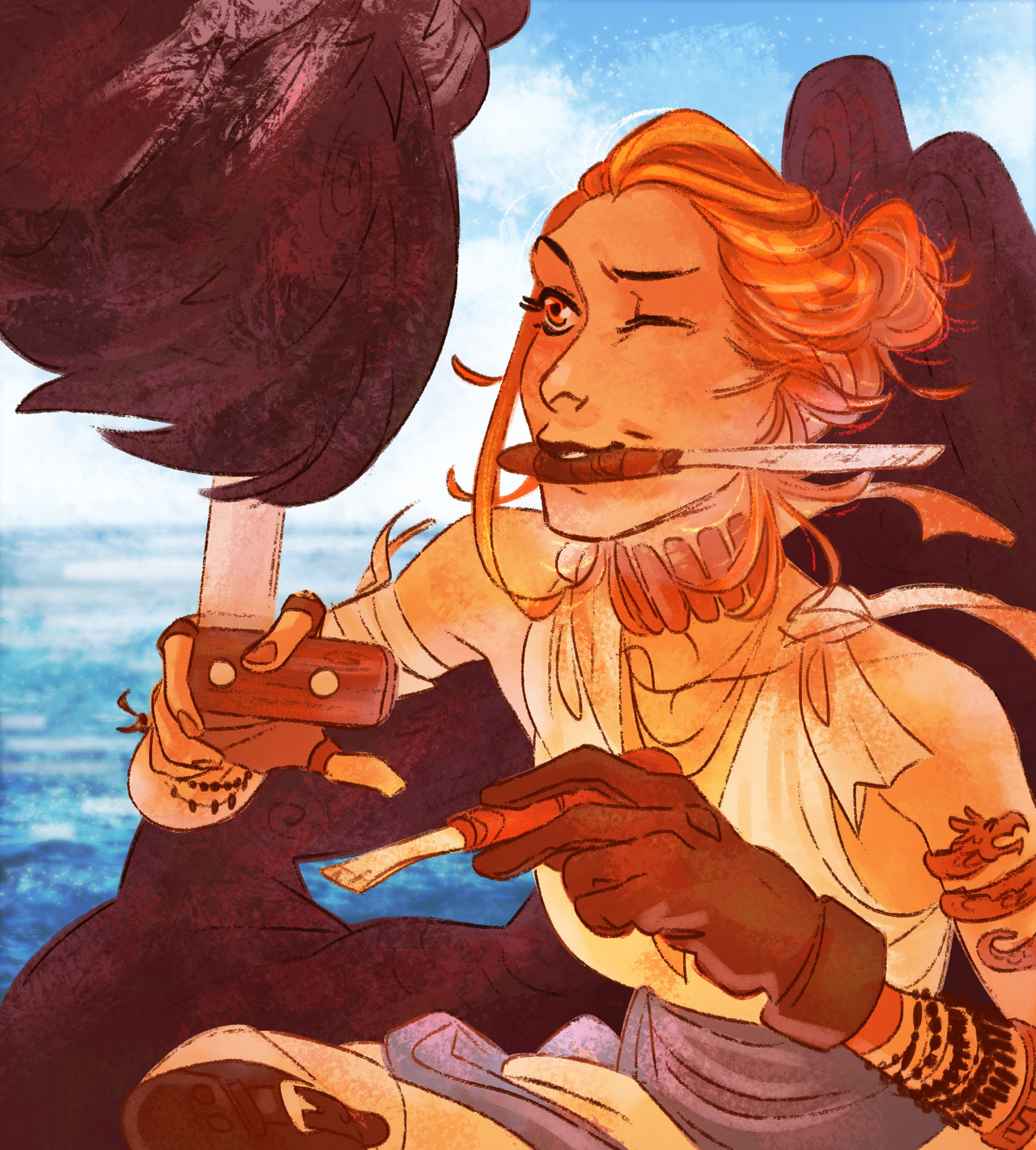
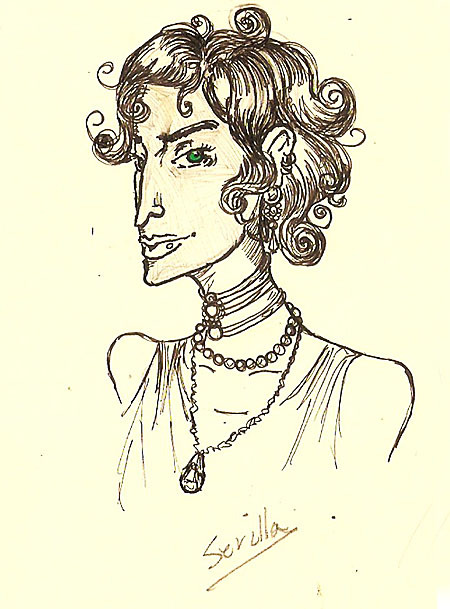
There’s a reason she keeps popping up, perhaps.
Amber: Liveship Trilogy by eternity8 on DeviantArt, image used for commentary

Meanwhile, Althea tries to pawn her jewelry in Bingtown, finding some success in addition to the increasing demands of daily living on one’s own. The shift in economics strikes her strongly, as does her withdrawal from Bingtown society. And she startles herself to arrive in Amber’s shop, at which she marvels before startling again to find Amber ensconced therein. The two speak of the Vivacia and slavery, with Amber speaking cryptically of a nine-fingered slave boy. She also gives Althea the gift of an intricately wrought bead in exchange for the chance to assist her later on.

Aboard the Vivacia, Wintrow works under the unkind tutelage of his father’s crew and considers his circumstances. Kyle summons him to his cabin to talk, and he does more to talk at him than with him. When Kyle offers an earring in token of an offer of early command, Wintrow refuses, citing his religious convictions; Kyle is angered by the refusal, and when Wintrow asks why Althea not be given the opportunity, Kyle angrily retorts that her sex makes her unfit. Wintrow argues against the sexism from Bingtown history, and Kyle replies from his own family background before dismissing Wintrow from his cabin. The second mate, Torg, returns him to his berth and locks him in, and Wintrow finds sleep amid despair.

In the night, Ronica calls on the Vivacia. Ronica tries to reach her husband through the ship, to no avail. She also learns that Althea has visited several times and leaves a message for her with the ship.

Once again, I find myself reading affectively as I reread the present chapter. It is not because of Kyle’s continued misogyny, the assertion that women somehow need to be protected from the concerns of working life, that they need to be kept happy and pampered; I know that I am in part the product of my upbringing in a part of the world that still does not do terribly well with issues of gender parity, and I know that I still have biases on which I am working, but I hope I am not the kind of tyrant Captain Haven is. Nor is it because of the foreshadowing of foresight coming from Amber, whose identity is known to Hobb’s readers at this point but which I will not make much of at the moment. No, it is because of Wintrow.

Wintrow, both as depicted and as he regards himself in the present chapter, excels in the environment of the monastery. Aboard the Vivacia, however, he is “Nothing remarkable….An indifferent ship’s boy, a clumsy sailor. Not even worth mentioning.” And while some of the attitude can be put down to adolescent angst and the upset at being utterly displaced, the shock is one I have seen described by those leaving academe, as well as one I have felt myself as I have done so. The university system as it has been in the United States and other places in the world is one that emerges from the monastery, and there is much of the monastic still about it in popular conception and, indeed, in the minds of some of the powerful within it (as witness some comments by a notable medievalist in May 2019, with which many disagree vociferously). So a monkish character might well invite identification from a bookish reader–and, as someone who spent twelve years in college earning three degrees in English (and focusing on medieval/ist literatures, no less!), I qualify as such a reader.

I did well in school, perhaps not as well as Wintrow in the monastery, but still enough to think that I was somehow special; life outside academe, though it goes well for me now, has disabused me of that notion. And I had my shift, my change well into my 30s; how much worse it would have to be for an adolescent…

Again, I read affectively, something I should know better than to do, given my academic background and formal training. But I still do it, which may be why I could not find a permanent place in the professoriate to which I trained.

It’s hot, here, but it’d be cool of you to send support!

A Robin Hobb Rereading Series: Entry 113: Ship of Magic, Chapter 12

Read the previous entry in the series here.
Read the next entry in the series here.


The next chapter, “Of Derelicts and Slaveships,” starts with the Paragon recalling times underwater, interacting with serpents. He is interrupted by Althea, with whom he begins to converse, if sullenly. She asks if she can sleep aboard him, and he agrees, though he notes that Brashen is staying aboard him, as well. She boards him for a night’s berthing, anyway, and he reflects on their earlier relationship.

Quite the figurehead.
Paragon by willowplwn on DeviantArt, used for commentary.

Brashen soon returns and makes for his own bunk. Althea asks for his advice, and he advises her to return home, and swiftly, noting that his own situation is in part because he waited too long to do so, himself. He also notes to her that she will have trouble finding work aboard ship because of her family connections, the Traders being fractious. He also warns her of the dangers of being a woman among a mostly-male crew, and she despairs of her course of action.

Elsewhere, the Marietta closes on a slaveship after failing to catch a liveship, the Ringsgold. Kennit and Sorcor confer regarding the pursuit, Kennit assigning it to Sorcor. He watches, coldly calculating, as his mate conducts a successful capture, and his attentions turn towards the serpents that follow the slaver. He finds himself entranced by them until the battle is ended, and he finds himself rebuking Sorcor after the mate reports the victory and its cost to the crew. He also assigns the taken ship to another crew member and considers the need to eliminate Sorcor.

The chapter makes a motion towards Althea adopting a trans identity. A number of scholars speak to such concerns in Hobb, though most focus on the Six Duchies novels rather than the Liveship Traders works. Katavić, Melville, Mohon, Räsänen, Sanderson, and Schouwenaars each offers an example; I need not reiterate what they have already aptly discussed, though what they do discuss begins to apply in the present chapter.

The chapter also reinforces earlier impressions of Kennit. He remains more concerned with money than with people–unsurprisingly for a pirate, of course, but still stunning against what he himself admits is a horrible situation. Similarly, the cooling regard in which he holds his mate is striking, even if not unsurprising for so mercenary a person in so mercenary a profession and position as piracy. The mate is a threat to him, particularly after the boost of a successful raid he led, and such a position as a pirate captain’s is not a stable one. Parts of the old internet chestnut The Evil Overlord List come to mind, particularly the comments about lieutenants (and I admit to being happy still to be able to bring that bit into the work I do; it remains fun, and I am not doing this for money or acclaim at this point, even if a bit of funding would be welcome).

Please continue to support this project!

A Thing Remembered from Teaching

I had occasion to write recently something that brought to mind for me some of the better days of my teaching, back when I had hope that I would have a secure teaching job and still had reason to think that I did a good job of it. It reminded me of a couple of things, actually, and I might write about the other one later–but the thing that came to mind first was the idea of students–of people, really–saying that they “don’t care.”

This is the kind of thing I was talking about. Dig in!
Image from Niteowlneils on Wikipedia, used for commentary and in what I believe is alignment with a Creative Commons license.

Now, the simple fact of making such a remark carries some certainty of care; it is an expenditure of time and effort to make such a statement, and expending them is not something done without some regard for the thing on which they are expended. The performance is itself an indication of caring; it is an instantiation of it, however small a thing it is. And it is a statement that tends to prove false quickly after being challenged, as I suspected and found when I was teaching at a technical school in Midtown Manhattan, back when I did such things in such places.

One session among the several I taught–and I did a lot of teaching, covering six or more sections of two or three courses in each of three fifteen-week terms at the institution, for which I was well compensated thanks to a strong and heavily integrated union–I fell back on an idea I had had the good fortune to learn early on in graduate school. Namely, I aligned my writing exercises–yes, following the not-too-apt generic model of composition classes because of institutional policies (because I did rather appreciate my paychecks) with problems I have spoken to, and others besides–along a single theme. One session, it was music; another, citizenship (I did try to be socially aware and engaged).

The first session I did it, though, I did it with food. I figured that all of my students ate, so they would all have material with which to work–and it was New York in which I was teaching, so there was no shortage of food to get and comment about. Given my own love of eating, and my then-budding enjoyment of cooking–my family uses it as bonding, among other things; cooking together helps us be together–I had some passion for the subject, and I figured that my students would have something similar.

Of course, there was the one student that is in every course at every school, it seems: the contrarian. And the one that session told me that he didn’t care what he ate; for him, he said, food was fuel and nothing else, not to be enjoyed or savored, but to be consumed and forgotten. (I am paraphrasing, of course; it’s been ten years or so, after all.) But I was still quick on the uptake then, as I am not so much anymore, and ready to reply with a riposte to a thrust of wit I was confident I could turn aside.

I asked the student if, since he did not care what he ate, why he spent money on food instead of fishing restaurants’ leavings out of dumpsters, where they could be gotten for free. After all, if it was not to be enjoyed or savored, but only to be consumed and forgotten, and the food still sound, why not? Or even if it was not quite sound, because, hey, he didn’t care, right?

He didn’t have an answer for me then. He did, however, have a paper for me when it was due, and I don’t recall that it was a bad one.

Did I bring you as much pleasure as a slice of pizza? Could you kick in the cost of one for me so that I can keep doing this? Click here, then, and thanks!

A Robin Hobb Rereading Series: Entry 112: Ship of Magic, Chapter 11

Read the previous entry in the series here.
Read the next entry in the series here.


The following chapter, “Consequences and Reflections,” opens with Althea consulting the Bingtown equivalent of an attorney regarding the terms of her father’s will. They are, unfortunately, clear, and clearly not in her favor. She also asks about Kyle’s oath about ceding the Vivacia to her if she could present proof of her honest sailor’s skills; her interlocutor notes that it would likely work, but counsels her against pursuing the action.

Disconcerting?
-Amber- by AngellaMireille on DeviantArt, used for commentary

After Althea leaves, she fumes, musing on her situation, and determines that she will not live on her sister’s charity. She also calls upon the Vivacia at the docks, reminiscing on the status of women among sailors as she does so. As she begins to confer with the ship, she realizes that she can feel Wintrow at work aboard her–and that his suffering marks the ship, to its potential future peril. When she is interrupted by Torg, she sits upon her anger and counsels the ship to set it aside; the ship does not, but acts against the mate.

As Althea leaves, promising to return to the ship, she wonders about the ship’s intentions and harbors dark thoughts of her own. She also has an uncomfortable encounter with Amber, though the two exchange no words, and there is no hostility made manifest between the two. After, she eats and gives thought to how she will proceed afterward, being unwilling to accept more of her family’s charity, and she begins to realize how dire her family’s situation is. She also gives more thought to the Vivacia and her nascent development, comparing her to other notable liveships–including the Paragon, whose history she rehearses in part; the part is tragic enough.

After the meal, she sends a note to Ronica and walks out amid the shops selling goods from up the Rain Wild River. She sees Amber again, at her shop this time, and considers her situation again before making her way towards the beached Paragon.

The story of the Paragon that Althea rehearses is, as noted, a tragic one, the more so given that it depicts the ship as having come into consciousness amid fear and pain. Death has already been established as necessary to quicken a liveship–three generations of a single bloodline–with implications that the Liveship Traders novels do begin to investigate, but there is a patent difference between lives ending of old age and its often-associated infirmities and the calamities that befell those whose lives quickened the Paragon. It is hardly to be wondered at that a consciousness that forms amid such trauma would have problems, as ascertained by the standards generally applied. (How apt the application is is something with which the books concern themselves later.) The repeated traumas clearly do not help, either.

Help me recover from the weekend’s holiday?


A Robin Hobb Rereading Series: Entry 111: Ship of Magic, Chapter 10

Read the previous entry in the series here.
Read the next entry in the series here.


The following chapter, “Confrontations,” opens with Althea waking to the sound of Ronica berating Kyle for punching his adolescent son. Kyle responds harshly before backing off of a position he realizes is perilous for him. Althea enters abruptly and confronts him, but she is soon distracted by tending to Wintrow. She rages against her nephew’s situation for a moment as he continues to try to remove himself from that situation, and, in a rage, Kyle vows that he will cede the Vivacia to Althea if any captain vouches for her seamanship. He also rages against his own son, sending him packing off to the ship under duress before rebuking Althea. Ronica quashes the argument. She accepts the blame for Althea’s disinheritance, explaining her reasons for it and noting the terms of Keffria’s enfranchisement. Althea cannot but continue to inveigh against the situation, and, in the face of the continued insistence upon it, she leaves.

image
This rather speaks for itself.
Meme from FitzChivalryFarseer on tumblr, used for commentary

Kyle resumes inveighing against Althea, and when Ronica rebukes him for his behavior, he turns his anger upon her–not physically, but still coercively, and partly through exploiting Keffria’s indecision. Ronica reassesses her elder daughter, not favorably, and she is shocked yet again when Kyle announces his intent to trade in slaves. When he is met with objections to that plan, he demands charts to the Rain Wild River, only to be told that they had been destroyed. He disbelieves and continues to rage, and Ronica takes herself and Keffira away from him.

Kyle’s patriarchal tendencies are on full display in the present chapter. He demands Wintrow’s obedience physically, notes that things are done well “for a woman,” and rages at the Vestrit women because they “have no sons to protect” them or “men to take over the running of the holdings.” He repeatedly asserts that he is “the man of this family” and therefore its rightful head, owed obedience by all in it. It is an all too common attitude even now, that the presence of a penis is the primary determiner of ability, and it is still an all too common attitude that command means the imposition of will despite the knowledge and expertise of others. I must confess to being guilty of some of the same follies, and I am trying to sit with the discomfort that being reminded of them produces in me. But perhaps I am overly affective a reader in doing so.

I note as I reread the ways in which Kyle approaches Kennit. Both of them appear amid the trappings of bourgeoisie success; Kyle stands in a house built by settlers over generations and staffed by servants, commander of a vessel owned by the family descended from those settlers, concerned more with money than anything else. He is not heir to that family, as such, but married into it and is imposing his own views upon it rather than even attempting to understand the people he seeks to rule. Might he, himself, be taken as a metaphor for colonialist discourse, especially given his physical description in the text? Might he point towards intersectionalities of oppressive structures? Might someone still vested in academe make such arguments?

Help me mark tomorrow’s holiday?

A Letter

Dear Friends,

I know I have not been as good at keeping in contact with you, individually, as I ought. And there are many excuses I could plead, some of which might even be acceptable ones, but they are only that: excuses. Guilty as my conscience is, I might offer such even if I had not done wrongly not to write to you or otherwise get into some kind of contact, but I did do wrongly, as I well know. So I offer my apology for letting it be so long since I have reached out to you; I hope you will accept it and that we can keep in touch, moving forward, but I will understand if you do not, if we cannot.

I have been working on several blogging projects, including this one; I still post poems at my personal blog, and I still post something that seems like scholarship or moves that way for the Tales after Tolkien Society. Here, of course, I have been working on my Hobb Reread–and I have been neglecting too many other things. Having left academe almost completely behind–I no longer teach, I only rarely tutor, and I have not been doing much in the way of research, having limited access to any apparatus–I should have a much more open schedule for things than I seem to do. But I do not do them.

Again, I make no excuses for it. I do note, though, that I am still working through my experiences, trying to make sense of them, trying to construct something like a cohesive narrative of how I fell away from my intent yet again–I was going to be a band director when I grew up, then an English teacher, then an English professor, and none of those seems to have happened and stuck–and arrived in my current situation. I do decently enough that I ought not to complain, as I well know. I have a decent job that lets me help people, I am engaged in my community (to some extent), and I have a good family; each is worth enjoying. But I cannot let go of some bitterness and hurt. I should, but I am not sure how–or I am not sure I will land well when I finally fall completely away.

There are senses in which I have let go of too much. For all the problems academe has–and there are many, many problems, not least of which are the systemic racism, sexism, and classism embedded within it, despite the lip-service paid to equality and parity by many–it did have transformative effects upon me, effects which depend in large part on continued involvement within it. I do not have access to information as I did before, or at least not as ready, and I do not have as much time to sit and take in that information as I once did, as much time to turn it over in my mind and make it fit into structures that only barely suggested themselves before. And I can feel my mind stultify from the lack.

But I have prattled on long enough by now. I hope you and yours are well and will remain so, and I hope that I will hear from you again.

Sincerely,

Geoffrey B. Elliott

A Robin Hobb Rereading Series: Entry 110: Ship of Magic, Chapter 9

Read the previous entry in the series here.
Read the next entry in the series here.


The next chapter, “A Change of Fortunes,” opens with Brashen approaching the derelict liveship Paragon. He banters with the ship briefly before boarding with permission and returning to a rack he had established on a previous excursion. The ship is strangely pleased to have him aboard again.

Anyway, here’s an adorkable sailor. I’m glad I got Brashen to look like I imagined him when reading.
The sailor himself, as reader emmitys puts it here; image used for commentary

Kennit and Sorcor confer aboard the Marietta. Kennit again pushes his idea of pirate civilization, and he begins to win Sorcor over to it, the added details presented doing more to persuade the mate of the captain’s plans. Sorcor’s vehemence against slavers surprises Kennit, but he agrees to the amendment on which Sorcor insists. Sorcor blanches a bit at Kennit’s plan to take a liveship, but he strikes a deal to pursue a slave-ship for every liveship they pursue–one to which Kennit agrees.

Wintrow faces his family as his father, Kyle, insists that he sail aboard the Vivacia instead of returning to his monastery. Wintrow tries to refuse, but he is knocked unconscious by his father.

The chapter delves further into the overt politicism of the Liveship Traders novels, especially in Sorcor’s emphatic assertions regarding slavery. The chapter affirms his experience as legal property and begins to touch on the horrors of such a status; no words can truly convey such horrors, of course, but the descriptions of the tanning work to which Sorcor was forced and the conditions aboard the slave ships are particularly evocative. (They are more so amid the current-to-this-writing protests of George Floyd’s murder, Breonna Taylor’s, and far, far too many others’.) That Hobb is pulling from depictions of the Middle Passage is clear, and it is equally clear that slavery is being presented as evil even by the standards of the evil.

I cannot help but note, also, Kennit’s reluctance to engage slavers in the way Sorcor calls for him to do (ultimately successfully, it must be noted, but still). Kennit drapes himself in trappings of wealth gotten through effort, yes, but still stolen, and he frames his plans in terms that read to me remarkably like the putative American Dream; what he describes rings of suburbia in my ears. Yet for all that, Kennit resists the idea of freeing slaves and ransoming slavers, preferring the economic benefits of interfering with the slave trade to the moral imperatives of interdicting it. Again, while such issues were far from inaccessible in the context of composition, present circumstances call for a much more emphatic, and much less sympathetic, reading. Kennit may not be a slaver himself, but he is okay with slavery–so long as it makes him money, and it is only when his continued tolerance of slavery begins to threaten his economic plans that he relents and agrees to work against it.

More people need to be better about it than Kennit than are.

We’re half through the year; send me a bit to help me make it the rest of the way?

A Robin Hobb Rereading Series: Entry 109: Ship of Magic, Chapter 8

Read the previous entry in the series here.
Read the next entry in the series here.


The following chapter, “Night Conversations,” starts with Keffria tending to her mother and her children before slipping into bed with her husband, Kyle. After they reconsummate their marriage, they fall to talking about the events surrounding the funeral. Kyle inveighs against Althea, and Keffria finds herself in agreement with him, musing on the “man’s load of decisions and work” her mother had faced instead of the genteel lives of other Trader women.

image
The lady of the chapter
A portrait of Keffria Vestrit by electorpeach on Tumblr, used for commentary

The conversation turns to Wintrow. Keffria’s hopes for and pride in him are rehearsed, only to be thwarted by Kyle rising, ostensibly to check on Althea, whom Brashen is escorting back to her family’s home. As they proceed, they banter–more drunkenly on Althea’s part than on Brashen’s. Althea vows to reclaim the Viviacia and to make Brashen her first mate when she is captain. Brashen makes note of a woodcarver’s shop–Amber’s–as they pass, and Brashen begins to muse again on his situation.

When Brashen delivers Althea to her family’s door, Kyle greets them–harshly, going so far as to swing on Brashen. The commotion rouses Ronica, who rushes in and quashes the upset, dismissing all present. Brashen stalks off towards the Paragon.

Elsewhere, the serpent Maulkin wrestles with memory, and the serpents he leads press on northward.

The present chapter shows more of the more overtly political / critical nature of the Liveship Traders novels. Keffria’s musings on her mother’s work and Kyle’s blatantly paternalistic, patriarchal attitude are foregrounded, and neither is portrayed particularly pleasantly. Keffria’s musings come off as naive and spoiled (particularly when read against Hobb’s biography, and while biographical criticism is fraught as a sole means for determining meaning, it does have some value in discussing contexts of composition), while Kyle’s conduct is stereotypical in form. Internalized and externalized patriarchy are on negative display, and not inappropriately, maugre the heads of no few who bewail “social justice warriors” in their purportedly escapist works.

It is still the case, unfortunately, that only escapist works seem apt to engage with issues of parity; the “real” world does not do much more, in the aggregate, than pay lip-service to it, when it even does so much as that. (Yes, I am aware there are exceptions. The overall tendency remains in place, however.) One of the things that escapist works do is show what could be; one thing no few works do, even those that purport to be nonfiction, is present what their writers think ought to be. For those who look at relative parity as being objectionable, I have many words, though few enough that I would include here; there are other places for me to say such things than this, and fog the air blue with those exhalations. I look with hope for such things, though, and if it makes me a fool to trumpet it, then I will be a fool, for I will not stop winding that particular horn.

Support is always appreciated.