A Robin Hobb Rereading Series: Entry 25: Royal Assassin, Prologue

Read the previous entry in the series here.
Read the next entry in the series here.


The second of the Farseer books, Royal Assassin, opens with a brief prologue, unlike Assassin’s Apprentice. In the prologue, titled “Dreams and Awakenings,” Fitz considers (in retrospect) various magics known to the Six Duchies. He notes both that magical knowledge tends to be transmitted orally and that it requires an inborn predilection for practice. He passes on to further consideration of the authority to treat a topic in writing, musing on it for a while before shifting topics again.

Michael Whelan’s cover art for Royal Assassin, which graces the copy of the novel I own and is hosted on the artist’s Tumblr page; it is used here for commentary.

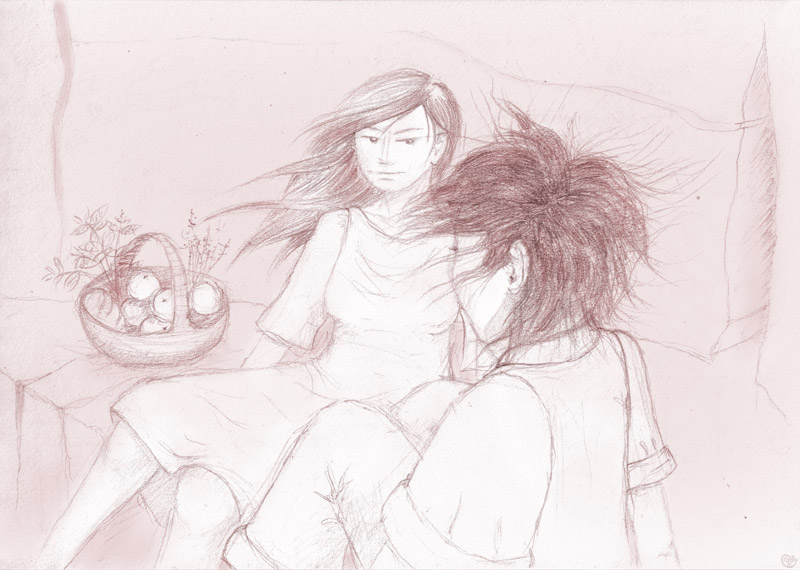
Fitz’s narration shifts to consider his continuing admiration for Molly, and he comments at some length about his work as the apprentice assassin for the Duchies, quietly working for the betterment of the Kingdom through performance of heinous deeds. And he arrives at his status following the end of Assassin’s Apprentice: recovering slowly and shakily in Jhaampe from being poisoned and abused, to his annoyance. He is not eased when Burrich notes the difficulty in treating him, though in their conversation, he begins to reappraise the man who might as well be his foster-father. And, amid fits caused by the lingering injuries and damage from the poison, Fitz makes to order Burrich back to Buckkeep before finally falling into sleep.

The prologue serves as an interesting way to recapitulate the events of the first novel in the series for the benefit of those who might be picking up Royal Assassin before reading Assassin’s Apprentice–while not reading as a dreadfully dull repetition to those who have moved directly into the new novel from the last one. It also does admirably to lay out the beginning state of affairs for the still-young FitzChivalry, while offering in its initial retrospection an assurance that Fitz will outlast the events of the novel. That is important because of the novel’s position in its series; it is the second book in a trilogy, traditionally the member of a trilogy that positions the protagonist in the worse possible position. But Fitz will survive, readers are assured.

Of additional note is the bit of philosophical musing Fitz advances in the first few paragraphs of the prologue, those presented as being the work of his pen as he writes in times in the novel’s future and those following close after, when he muses to himself and not upon the in-milieu page about what right he has to document traditions in which he does not take part–particularly when his right to attest in writing to those of his own experiences is in question. Some irony could well be read into writers voicing, even through fictional characters, a reluctance to write about topics at some remove from themselves, or arrogance could be read into it, since such a stance implies that authors believe themselves to be experts in the areas upon which their writing touches. It is not as if Hobb does not make other comments about the craft of writing in her work, as I’ve noted before, so it does not come as a surprise to see such comments in the earlier parts of her corpus, even if how to interpret them may not be entirely clear.
Can I count on your support?

A Robin Hobb Rereading Series: Entry 24: Assassin’s Apprentice, Chapter 24 and Epilogue

Read the previous entry in the series here.
Read the next entry in the series here.


The final chapter, “The Aftermath,” opens with a description of a tapestry in Jhaampe that serves as a sort of call-ahead to later novels. It then moves to a gloss of the fallout from the previous chapter’s events, focusing on the beginnings of Fitz’s recovery and Burrich’s. What happened to August receives note, as does Regal’s behavior that glossed over all his misdeeds.

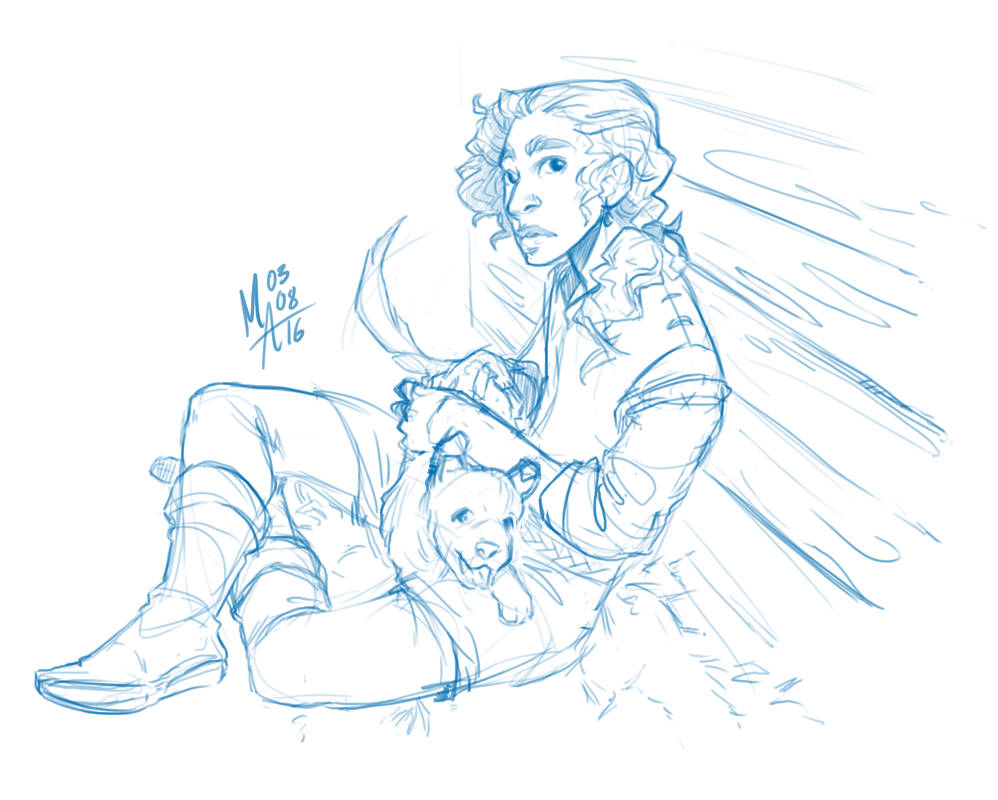
FitzChivalrySketch by MonsieArts
FitChivalry Sketch, by MonsieArts on DeviantArt
Image used for commentary.

Fitz recovers but slowly, and with difficulty, and Burrich accompanies him as he returns at length to Buckkeep. Matters seem to be improving there, with Galen dead and Kettricken’s presence enlivening things. And Fitz notes that it was Nosy who saved him from the pools, dying from the effort of it. He was a good dog.

In the following epilogue, Fitz returns to his narrative present–the novel has been recounted in an informed retrospective–to consider his lingering pains and condition. A boy in his keeping is noted, as is a friend with a quiet voice, whose “No” is the last word in the novel.

Most of the chapter is denouement and setup for the next volume; the epilogue is more or less all setup for later work. There’s not necessarily much to comment upon in either–but it is a good time to reflect on the experience of re-reading.

I welcome comments from my own readers, of course; I benefit from the work of others, and I try to acknowledge all of it I receive. (Check the embedded links and other citations in my work, please!) I know that the rereading has been a different thing for me; I’ve not usually read things in the way I’ve read the novel and plan to read the rest of them for this project. Reading for pleasure, I plow through novels, often chewing though hundreds of pages in a few hours before I recall that I am me and that I have a body that has needs that must be answered. Reading for scholarly work, I thumb through pages at high speed, seeking out tag phrases I recall or notes I’ve made in margins–when I’ve made them, which I’ve not always done–to develop the arguments I mean to make. Both are, if not rushed, intense and speedy things.

By contrast, the rereading has been a slower thing. I’ve proceeded a chapter at a time, pausing between each to write the gloss and to offer the reflections I have about what I’ve read. Sometimes, I begin to move to more scholarly activity, although generally informally; I’m not bound to any one style guide here, but have tended to embed links and move on. I have been trying to restrict myself to materials readily available; as I write this, I do still have some institutional access, but I know well that many of my readers will not, and I have no desire to exclude them. (Academic publishing is also a racket, but that’s a set of comments for another time and place entirely.) I’m sure it’s come across as vain or cute at times, but this is also ultimately a vanity project, not in support of a scholarly career as the project that inspired this is. So there’s that.

It’s been enjoyable for me so far, though, and I hope it’s been a pleasure for others, as well. I’ll be moving on to the next book in the sequence, Royal Assassin, soon; I hope you’ll come along with me!

Last chapter in this novel, though there’re more to come. Help me bridge the gap!

A Robin Hobb Rereading Series: Entry 23: Assassin’s Apprentice, Chapter 23

Read the previous entry in the series here.
Read the next entry in the series here.


The penultimate chapter, “The Wedding,” opens with only a brief blurb about Shrewd’s approach to diplomacy and Verity’s adherence to that approach. It moves swiftly into Fitz’s assessment of his situation and his conversation with Burrich about it. Burrich notices the earring Patience had given Fitz and is taken aback by it.

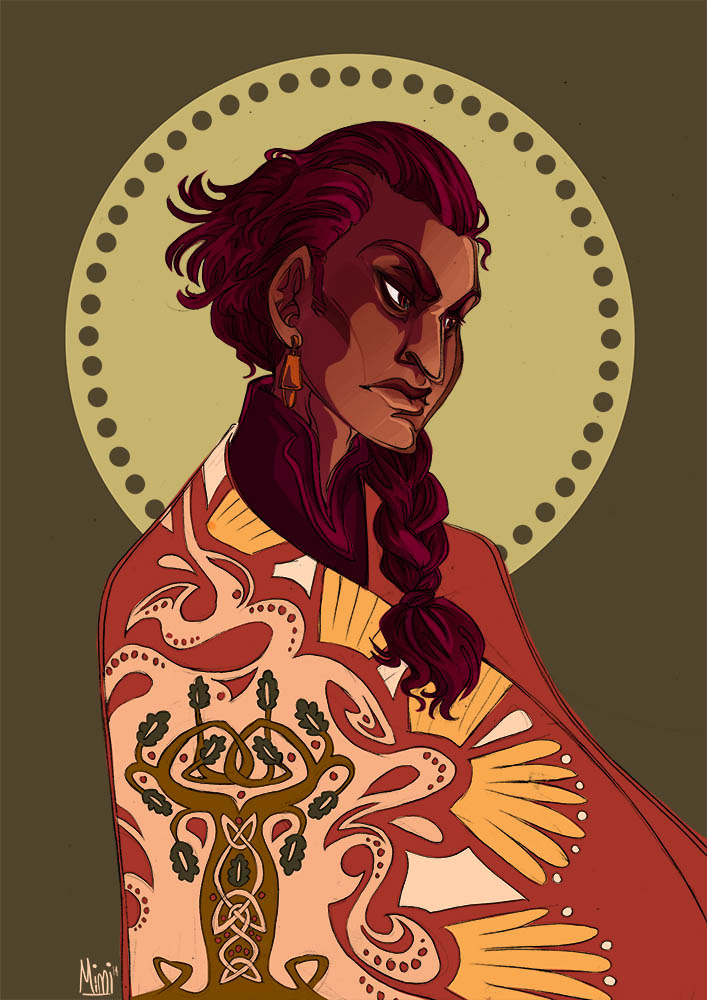
Regal, the Mountwell Prince by Mimi-Evelyn
Regal, the Mountwell Prince, by Mimi-Evelyn on DeviantArt
Image used for commentary.

They are joined suddenly by Jonqui, whom they initially resist but shortly come to follow back into Jhaampe, where they find that Fitz’s room has been ransacked; Fitz realizes his store of poisons has been taken. They gather strength while Fitz frets over Verity; August arrives to deliver messages as he is commanded to do. After the Farseer cousin departs, Burrich attempts to offer Fitz his own strength through the Skill, to no avail.

After, Fitz and Burrich answer the summons that Regal had issued them, reporting to him in the hot springs that serve Jhaampe for baths. There, Burrich is incapacitated, and Regal gloats over Fitz as he tips his bastard half-nephew into a hot tub to drown. As Fitz flounders, he reflexively reaches out for Verity with the Skill, finding Galen coming to siphon his life away; Fitz, able through the slackness that precedes final surrender, offers Verity his own strength. Verity takes it, killing Galen as Galen had thought to kill him, and working powerfully through the Skill to leave August a message for Regal and to solemnize his marriage to Kettricken before he slams Fitz back into himself.

The chapter again motions towards the homoerotic relationship between Chvalry and Burrich that has received attention in this series already (here, for example). Burrich’s reaction to the earring–noting that it was a thing with which Patience, Chivalry’s widow, should not have meddled–reads less as a servant/master thing and more a thing between people particularly close. Given Melville’s comments about queerness in the novels at large, as well as Prater’s, Sanderson’s, and others’, it should not be surprising to find other suggestions of intimate relationships that transgress the “expected” dynamics of fantasy fiction in the Realm of the Elderlings novels.

The chapter also strikes a strange point of correspondence with generic expectations in offering Regal’s gloating as he makes to subdue Fitz in the baths. I have noted some of Regal’s more “normally” evil tendencies before, and I recall a 2007 course paper I wrote treating antagonist oration of the kind Regal indulges in in the chapter; in the paper (and I cringe at some of the writing I did then, but I think the idea is reasonably good), I argue that such narrations “permit character explication, in-text tactical movement, narrative pacing, and reader catharsis and return.” That is, they help show more of the character involved, allow time to move to more advantageous positions, provide a sort of lull between bouts of more intense action, and allow readers to come back to the text refreshed. Regal’s narration serves such functions, certainly, and his actions end up facilitating the undoing of his and his half-brother’s plans–fitting the trope neatly and reminding readers that Hobb continues to work with the dominant Tolkienian tradition of fantasy literature.

The next one’s the last one–in this novel. Help me bridge the gap!

A Robin Hobb Rereading Series: Entry 22: Assassin’s Apprentice, Chapter 22

Read the previous entry in the series here.
Read the next entry in the series here.


A chapter titled “Dilemmas” follows, opening with Fitz recounting a dream of the Fool and returning swiftly to Fitz puzzling out how he can resolve the situation in which he has found himself. He turns to his cousin, August, prevailing upon him to send through the Skill to Shrewd for direction. August reluctantly accedes, or appears to, but Fitz is left with no clearer sense of what to do.

Image result for strychnine poisoning
A dilemma, indeed, such poisonings…
I am given to understand it’s a public domain image, but I’m having trouble tracking the source; any ideas?

The ceremonies that bind Kettricken to Verity continue through the day. Amid them, Fitz observes August and Regal, and he determines that they discuss his own mission, which gives him unease. It has not lifted by the time he reports to Regal’s chambers as he had been bidden. Regal does not speak with him directly, but has his attendant provide Fitz directions and materials before sending him on his way.

Fitz, somewhat addled by chemicals, proceeds. He confers briefly with Kettricken, then goes to Rurisk, laying out what he knows of the continuing plot against him. Kettricken arrives in time to see Regal’s own plot come out; he has arranged for Rurisk to be poisoned independently, with Fitz poised to take the blame for it. In the ensuing fracas, Fitz kills an assailant but is taken, himself.

Fitz wakes to find Regal gloating over him. He soon passes into a drugged delirium in which he hears voices conferring through the Skill and becomes aware through the Wit of Nosy’s grief at Rurisk’s death. The old hound helps Fitz out of his bindings, and Burrich, following the Wit that he admits being able to sense, helps Fitz leave his captivity.

One thing that the chapter does well, among the many things that Hobb’s writing generally does well, is convey the notion of the narrative world existing outside the main narrative. Fitz becomes aware that there are plots involving him that he does not know about, and their presentation makes clear that they have been long in the making. It has a strangely decentering effect on Fitz. The narrative of the novel is recounted from his perspective, informed by commentaries appearing at the beginning of each chapter, so it makes sense that it focuses on him, but the present chapter makes clear that Fitz is far from the only actor in the milieu–and far from the most effective, in the present circumstance.

Tolkienian-tradition fantasy fiction usually focuses on characters who are themselves the most important people within their milieu. Frodo and Aragorn are the key figures at the end of Tolkien’s Third Age; Rand al’Thor is, in effect, the messiah of his own world; Ged becomes the de facto ruler of Earthsea, at least for a time. FitzChivalry Farseer, though, at least in the present novel, is but one piece among many in play on the board, and, in the present chapter, he seems to have been played badly.

We’re coming up on the end of one and the start of another. Help me bridge the gap!

A Robin Hobb Rereading Series: Entry 21: Assassin’s Apprentice, Chapter 21

Read the previous entry in the series here.
Read the next entry in the series here.


The next chapter, “Princes,” opens with only a brief comment on the virtues of a particular herb. It moves thence to Rurisk breaking in upon Fitz in pleasant surprise that he yet lives. He lays out that Kettricken had thought to poison him before he could poison Rurisk, and that any attempted assassination plot against him now would be fruitless. Rurisk gives Fitz a message to take to Shrewd before collecting himself and Kettricken and departing.

Carry Me, Phyllanthus amarus, in an image from Wikimedia Commons, used for commentary

Fitz rests before attending more of the ceremonies marking the nuptials and the diplomacy attendant upon them. Amid them, Rurisk takes Fitz aside to show him the pride of his hunting dogs, and Fitz recognizes Nosy. Fitz make the time to speak to Burrich about the matter, laying out some of the old strain between them, but there is little reconciliation.

That night, Fitz is summoned by Regal. His uncle, drunk, demands a report on the progress towards killing Rurisk; Fitz demurs, and Regal voices discontent that things are not moving more swiftly. He commands Fitz to return to him on the next day, when he will be provided what he needs.

The herb named in the blurb at the beginning of the chapter, carryme, evokes the Phyllanthus amarus. There is some scholarship treating the herb, as witness this and this, among others. Medicinal properties and uses (including pain management) are ascribed to it, as are potentially damaging effects, which would seem to align with the introductory blurb, at least generally. And that is in keeping with Hobb’s stated desire for verisimilitude, though an interesting quirk does arise.

I’ve made the argument that Hobb’s Six Duchies echo the North American pre-invasion more neatly than the European medieval, and I’ve used the flora and fauna described in the Realm of the Elderlings as parts of that argument. Raccoons, for example, come in. The thing is, the Phyllanthus amarus is, so far as I can tell, native to southern Asia–though I will readily admit my investigation into it has been limited. (This is a volunteer project, after all; I cannot afford to spend too much time on it.) And it seems to prefer tropical and subtropical climates rather than the colder weathers of the Mountain Kingdom.

The plant’s presence in the narrative illustrates the dangers of looking for too much in the way of real-world correspondence in fantasy fiction–or any fiction, really. It is fiction because it does not have to be true in the sense of giving a factually accurate report of places and events. It often is true in other senses, usually revelatory of some kind of inner reality or guiding principle, but that truth takes teasing out of the sort that many abjure, being accustomed to having others do the work of thinking for them.

Do please help me keep doing this kind of work.

A Robin Hobb Rereading Series: Entry 20: Assassin’s Apprentice, Chapter 20

Read the previous entry in the series here.
Read the next entry in the series here.


A chapter titled “Jhaampe” follows. It opens with a blurb from a fragment that Fitz swiftly after reports reading later on. It proceeds to Fitz’s first impressions and description of the city itself, as well as the awkwardness of the entrance of the Six Duchies party into it. They end up being carried into the city, at which Fitz chafes.

Robin Hobb: Jhaampe by Starsong-Studio
Robin Hobb: Jhaampe by Starsong Studio on DeviantArt, used for commentary

Fitz does what he can to make the best of the situation, studying the surroundings with clear delight and practicing what he knows of the local language. It attracts the attention of Jonqui, with whom he converses, if haltingly, along the way.

He and the rest of the Six Duchies party are shown into the main hall of Jhaampe, which Fitz describes amid an inner lament for how exposed he will be as he attempts to carry out his assigned work. The ruler of the Mountain Kingdom and his children, Rurisk and Kettricken, are introduced, and Fitz realizes to his chagrin that such royal family as the Mountain Kingdom has has tended to him and those he accompanied.

Gifts are exchanged, and Fitz, to his surprise, finds himself presented to the Mountain royals. Rurisk notes his grief at Chivalry’s death, and the two talk briefly of Fitz’s father. Kettricken interrupts with questions about his training as a poisoner, which greatly unsettles Fitz, before leading him out into the gardens surrounding the royal hall. The two converse reasonably amiably, and Fitz takes the chance to speak well of Verity as he had been asked. Kettricken lays bare that Regal has been creating poor impressions of Verity and of Fitz in the lead-up to the nuptials. Fitz pleads misunderstanding her words, and she makes to re-explain when she is summoned away.

It is not long afterwards that Fitz becomes aware of having been poisoned. He takes such corrective measures as he can after the fact, with no small regret, but he survives–and looks forward with unease to what will come next.

A thought occurs as I reread the chapter and look at Starsong Studio’s art, above. One of the things that promotes bright colors in nature is the presence of poison. Monarch butterflies, for example, are noxious eating–and signal it by their bright colors. Any number of species of frogs do the same, as do no few sea creatures. Even many of the flowers Fitz compares Jhaampe’s buildings to are themselves toxic. Looking back on the beginning of the chapter after reading the end, the appearance of the town foreshadows its peril for Fitz. It is perhaps a subtle thing, but that does not detract from the quality of the writing; instead, it increases it that the foreshadowing is subtle.

Something else that calls attention to itself is the strange misunderstanding of the Six Duchies party’s entry into Jhaampe. Being carried in litters or palanquins can be seen as an indication of status; it seems the Six Duchies party, generally, regards it so. But it is also, as is noted in the chapter, a thing done for those whose mobility is limited–and the appearance of incapacity, however inaccurate, can be damaging. What other signs are interpreted in such ways as to cause confusion make for interesting investigation…

A new school year starts soon; help me buy supplies, please!

A Robin Hobb Rereading Series: Entry 19: Assassin’s Apprentice, Chapter 19

Read the previous entry in the series here.
Read the next entry in the series here.


The chapter that follows, “Journey,” opens with an in-milieu reflection on the general history and politics of the Mountain Kingdom, whence Verity’s chosen bride, Kettricken, hails. It is a harsh land with harsh ways that work well for it, if not for other places.

cropped-logo_fools-room-lowshot.jpg
Image of the Fool’s Room by Anya Elvidge, used for commentary

The chapter moves on to summarize the state of the Six Duchies–which is increasingly bad. Red-Ship raids and Forgings continue, with people carrying poison to kill themselves rather than being Forged. Discontent with Shrewd’s policies grows, both among the people and among the Dukes, themselves, with a schism growing between the coastal and inland Duchies. Shrewd seeks to quiet unrest with the royal wedding, and details of its arrangements–Regal traveling to Jhaampe, the seat of the Mountain Kingdom, to pledge for Verity, and Kettricken pledging at Buckkeep later–are noted. Galen leaves Buckkeep with Regal, stopping off in an inland Duchy, and Fitz finds himself at something of a loss.

To ease it, Fitz seeks the Fool, looking for him in his private chamber. The chamber is described in detail, as is its strange effect upon Fitz. So is the later summons Fitz receives from Chade. During their conference, Fitz asks Chade after his assignment to kill Rurisk; uncomfortable silence falls, broken by Chade’s note that Verity has interceded with Shrewd on Fitz’s behalf. Chade reminds Fitz that all are expendable against the need of the Six Duchies.

The next morning, Patience summons Fitz. He responds as bidden, and, after a brief and confusing exchange, Patience pierces his ear with an earring that had been Chivalry’s. She reminds him of his heritage and sends him off.

The following day sees Fitz line up for his part in the caravan to Jhaampe. The Fool offers him a purgative and a warning, and Fitz apologizes for having intruded into the Fool’s chamber. Fitz also receives new clothing for the journey, complete with a new crest assigned by Verity. Verity himself charges Fitz to speak well of him, and Fitz finds several of Regal’s men, Burrich, and Verity’s cousin, August, in the procession, as well.

Fitz glosses the progress of the caravan towards Jhaampe, noting its comforting familiarity. He also mulls over his coming mission. At length, the caravan is greeted by people from the Mountain Kingdom and sped in happiness to Jhaampe.

There is something a bit colonialist in the opening description of the Mountain Kingdom, an attitude that tacitly contributes to Tolkienian-tradition readings of the Elderlings corpus. Looking at a more itinerant people’s ways as “quaintly barbaric” speaks of an ethnocentrism that lines up with entirely too much of observed history. The reluctance of several members of the caravan to associate with the Mountain folks when they arrive at the Kingdom speaks similarly. It’s something I had not noticed in earlier readings of the novel, but something that comes across to me as I read now, and I think it speaks to some of the social changes that have marked nearly twenty-five years that the novel’s been in print and the personal changes of some twenty years of my reading it.

I wonder what will change in the next twenty to twenty-five.

A/C’s expensive. Help me pay for it?

A Robin Hobb Rereading Series: Entry 18: Assassin’s Apprentice, Chapter 18

Read the previous entry in the series here.
Read the next entry in the series here.


The next chapter, “Assassinations,” opens with notes about Chade’s efforts to rehabilitate a Forged One and to ascertain the causes and process of Forging from her. They are ultimately unsuccessful.

Fitz by FionaCreates
The young man ready to work
Fitz by FionaCreates on DeviantArt.com, used for commentary.

Fitz then begins to relate his disconnection from the stables at Burrich’s order, and the dislocation of his own life as a result. The Red-Sip Raiders grow bolder, as Fitz notes, and the people of the Six Duchies more restless. At length, Chade summons Fitz to his chambers and offers some apology for his earlier lack of engagement. He also rebukes Fitz for his dissolution before accepting his report of events and tasking him with part of Verity’s care.

Fitz ruminates on Verity and Regal, and he and Chade confer, before Chade delivers Shrewd’s assignment to Fitz. Fitz glosses over the work, offering only sketchy details of mercy killings and colder-hearted workings of justice against petty tyrants.

Fitz spends more time relating his work in caring for Verity. The older man, king-in-waiting after his brother’s abdication, has been expending himself in the exercise of Skill against the Red-Ship Raiders, aided minimally by the Skill-users Galen trained. Fitz begins to bond with his uncle, and Vertiy begins to understand what has been involved with Fitz’s training. He also reveals to Fitz what Chivalry had done to Galen, as well as what Galen had done to Fitz–but he commands patience in favor of unity within Buckkeep.

Fitz assents and offers his further assistance to Vertiy–who takes it through the Skill. Fitz suffers for it, and Verity explains by way of apology. He also notes that it was he who affirmed Fitz as a member of the Farseer family before dismissing him back to his other tasks.

Resistance to the Red-Ship Raiders, unrest occasioned by them, and preparations for Verity’s wedding all continue, as do heated discussions about them while Fitz is present. Verity’s admissions at one such discussion are heartfelt and disarming, and Fitz’s assignment to go with the wedding party is surprising. Less so is the implied assassination mission with which he is tasked, the elimination of the heir apparent to the neighboring Mountain Kingdom, which will result in Verity’s bride-to-be, Kettricken, ascending to that position.

There is something of a rite of passage, informal though it may be, in Burrich’s exiling Fitz from the stables. He has been a father-figure, after a fashion, to Fitz, and a young man leaving his father’s house is a fairly common feature of not only fantasy, but other kinds, of literatures. And, leaving, he goes through a period of dissolution commonly attributed to youths striking out on their own, as any number of complaints about “kids these days” attest. Soon after, he enters–re-enters, really–the working world for which he has been trained, even if the work is not always to his liking. But how many of us are actually always happy with our jobs?

It is interesting, too, the ways in which more of Verity’s character emerges in the present chapter. His recognition that he is not fit for the position he must discharge is one that doubtlessly resonates with many, if the myriad discussions of impostor syndrome are to be believed. It’s a wonderfully humanizing trait, and I recall being taken by it when I first read the novel. Anymore, it reads as another bit of verisimilitude among the many in Hobb’s work, but before…it informs, at least in part, my continued work with what Hobb writes.

Help me get through the sultry summer days?

A Robin Hobb Rereading Series: Entry 17: Assassin’s Apprentice, Chapter 17

Read the previous entry in the series here.
Read the next entry in the series here.


The chapter that follows,”The Trial,” opens with a description of a coming-of-age ceremony in which Fitz participates. It then shifts to Fitz conferring with Burrich about the upcoming Skill trial, which he is certain to fail due to Galen’s animus; Burrich offers some small comfort, and Fitz tends his animals before sleeping in his bed once again.

https://upload.wikimedia.org/wikipedia/commons/b/b9/Caspar_David_Friedrich_-_Wanderer_above_the_sea_of_fog.jpg
Caspar David Friedrich’s Wanderer above the Sea of Fog seems to catch the right flavor.
I’m told it’s public domain, hosted on Wikipedia, here.

The next day sees Fitz report for his trial. He is taken out away from Buckkeep and left near Forge. Fitz immediately grows nervous, and he spends the day waiting apprehensively for either an attack or for the message from Galen he knows will not come. When he falls asleep and dreams, he dreams of an attack upon him and Burrich; he wakes, realizing it was a sending from Smithy through the Wit, and he immediately begins to make his way back to Buckkeep.

As he does so, he tries to puzzle out the attack. His ruminations distract him, and he comes under attack by Forged Ones. He manages to fight his way clear of them, fleeing and, at length, succumbing to exhaustion. When he wakes from it, he resumes his progress toward Buckkeep, finding Red-Ship Raiders making use of Forge for resupply. After tense minutes of hiding, he makes his slow way away, resuming again his return to Buckkeep–and finding himself beset by Forged Ones again.

As the Forged Ones face him, Fitz feels Smithy die through their Wit-connection. In despair and rage, he kills his attackers brutally, dumping their bodies into the sea. Drained, he returns to Buckkeep and immediately calls on Burrich. They have a falling-out over Fitz’s continued use of the Wit, and Fitz falls into a depressed, mechanical routine as Galen’s coterie begins its work. He pushes those in his life away from him, and loses track of Molly until he believes it is too late to resume his relationship with her.

The opening interlude attracts some attention from me. The ceremony described in it–“detailed” would be an overstatement–marks a rite of passage, certainly, and much is made in fiction, generally, and fantasy fiction, particularly, of rites of passage. Such rites generally do receive more overt narrative attention than the Man Ceremony does, though, and I do not recall that the thing pops up elsewhere in the Realm of the Elderlings corpus. (I could be wrong in my failure to recollect, though; getting older hasn’t helped my retention.) But what is revealed in the throwaway passage is an interesting view of masculinity as performed in the Six Duchies, and I have to wonder at its contrasts with what was going on during the writing as well as with what is going on as I read the passage again. I’m not up on the kind of gender construction/performance theory that such explication would need to rely upon, so I’ll not speak to it here–save to note that accepting a choice not to kill and not to offer food to others therefore would not necessarily play well in my part of the world, or a number of others.

As I think on it, I wonder about the rites of passage I’ve gone through. There’ve been enough of them; if nothing else, I’ve been graduated more times than most people, so there’s that. The one at the end of high school marked an ostensible passage into adulthood, but offering entry into one particular community or another…not so much. I am a member of no elite brotherhood, no pseudo-secret society that may or may not stretch back decades or centuries. (Or am I? Muwahahaha!) And I wonder sometimes what it would be like to be so. But it is an idle musing, of little moment.

Send a bit my way, please?

A Robin Hobb Rereading Series: Entry 16: Assassin’s Apprentice, Chapter 16

Read the previous entry in the series here.
Read the next entry in the series here.


The next chapter, “Lessons,” opens with an in-milieu rumination on prior and then-contemporary practices of Skill instruction. It then pivots to Fitz’s resumed Skill lessons, in which he endures the hatred of his fellow students and surveys the healing injuries Galen had suffered. Fitz also notes his beginning suspicion that Galen’s instruction is nominal only and not sincere.

On the Ledge: sketch 2 by Crooty
On the Ledge: Sketch 2 by Crooty on DeviantArt;
image used for commentary.

Fitz then goes out for a bit, taking Smithy on a walk and calling on Molly. Molly comments to Fitz on Verity’s upcoming nuptials, which Fitz had not been aware of. Regal is to select Verity’s bride, and Fitz muses on the disparities between the two men’s noted interests in women. He waxes philosophical on desirable traits, and he misses an opportunity to cement his love and Molly’s in his youthful folly.

After, Fitz begins to reintegrate himself into the life of Buckkeep outside of Galen’s harsh restrictions. He also considers the relative political merits of potential brides for Verity, listening to the castle’s occupants discuss such matters and feeling shame at having, with Galen, dismissed them as ignorant fools of little account.

Fitz continues in his lessons, finding his abilities in the Skill erratic and frustrating, though present. He also continues with Molly, doing just as well with her. And the Forgings of the Six Duchies’ population continue, too, keeping people afraid and less than in awe of their rulers.

At length, Galen announces a final test for his students. They will be taken out into the Duchies and left to await a summons through the Skill. Those who answer appropriately will become a new coterie; those who do not, will not. Fitz knows he will not be, and Galen attempts once again to compel him to suicide. Smithy saves him from it.

Being as I am, I find a comment on academe in the passage wherein Fitz ruminates on Galen’s disdain for working folk. Many of the prevailing impressions of academia are…less than pleasant. (Some comments I’ve made elsewhere come to mind, as do some others I’ve made here, as well as Timothy Carens’s “Serpents in the Garden,” from an issue of College English.) There are many who view those who choose to stand at the front of the classroom in higher grades and in higher education as joyless, sadistic, hateful people who disdain all that is not their own field of study. There are many who so stand who are so, of course; it is not for nothing that the tension between town and gown is traditional. I’ve been guilty of it myself; there’ve been places I’ve been where I was far from the friendliest person, if it can be believed.

I cannot help but read in Fitz’s post-fight interactions with Galen an echo of a teacher with no love for a particular student, one who happened to be gifted and with covert prestige but not the political connections often prized, one who ran afoul of a particular parent and who continued to take petty revenge against the student. And I feel like I’ve been the teacher and the student in the situation; I wonder how long it will be before I am the parent, as well…

Can you kick in? Will you?