On a number of occasions, I have commented about going back into my own archives,* pulling up materials I’d developed for one purpose or another across what I had intended to be an academic career. In many cases, that pulling has had to do with teaching materials, and I do remain available to generate that kind of thing, moving forward. Less explicitly, that pulling takes the occasional form of my posting the texts of papers I’ve delivered; the present example is in that line. A recent post to this webspace, “Harping on Hanlon,” reminded me that I had this in my records, and a review of those places where I put my academic records up for public view showed me that it hadn’t yet gotten out to where other people can look at it. The time seemed right to address that deficit.
The piece below is abstracted here. What is not noted in my comments there is that this piece emerged from some 2021 continuing education I did, noted here. (Sourcing shows the age of the piece, I know.) Emerging from it is a conference talk, the remarks for which are repeated here. As with previous re-presentations, I have only lightly edited the text as I originally have it, mostly to suit concerns of medium.**
The fifth edition of Greg Stafford’s Pendragon1 is a fantasy tabletop roleplaying game (RPG) published in 2005 by Arthaus, a subsidiary of White Wolf Games2–a publisher most notable for Vampire: The Masquerade and the related World of Darkness games.3 RPGs are generally neomedievalist; the ur-example of the genre is Dungeons & Dragons (D&D), which Lawrence Schick notes has its origins in historical miniatures wargaming and “rules for monsters and nonhuman races drawn mainly from Tolkien,”4 so that it looks to interpretations of the medieval for its materials, just as other RPGs look to D&D. Pendragon is more avowedly directly medievalist, purporting to look back to “Facts (or at least what are widely considered facts) drawn from [chronicles such as Geoffrey of Monmouth’s]” and “parts from all literary versions” of Arthuriana5–or, at least English / Malorian, French, Welsh, and more modern and radical takes, eschewing such visions of Arthur as the German and the Spenserian.
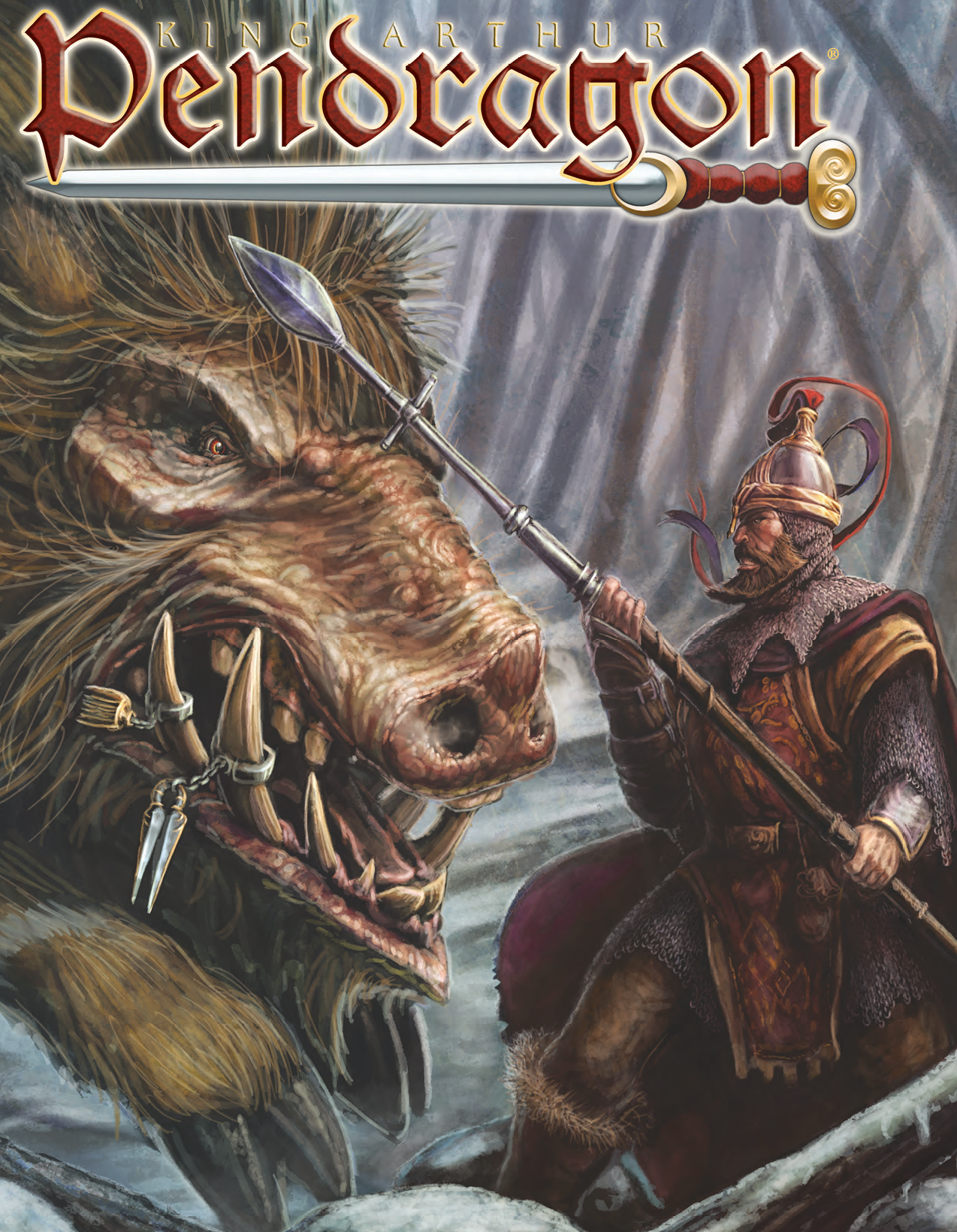
Even in that grounding, though, the game begins to run into commonplaces of treatments of the premodern: a focus on upper social strata and time-compression.6 The game flatly announces itself as focusing on knights, describing them as the chosen elite;7 while it makes some sense to do so–as I’ve noted elsewhere, “Peasant life is unattractive, particularly to those whom depictions of it might point up their own equivalent status”8 and many others have attested far more eloquently to the same–to set as of little importance the deeds and doings of a majority of people is no boon to understanding or getting things right. For a game that purports to encapsulate “brutal reality,”9 it is hardly a commendation. Nor yet is the collapsing of the Middle Ages into a short span–“fifteen years of game time approximate a hundred years of real-world medieval history,” so that the noted game-span of 485-565CE subsumes the late fifth through late fifteenth centuries,10 roughly Gildas to Malory.
Of course, it is to be expected that RPGs like Pendragon, as simulations, will necessarily reduce and compress their sources in the interests of treating them conveniently and in allowing players, most often not specialists in the source materials,11 entry into the narrative milieus in which Mackay notes the extemporaneous, collaborative, rules-assisted storytelling of RPGs operates.12 Similarly, the comment that “the rules and laws of Pendragon are generally based on the considerably more well-known laws of Europe in the 12th and 13th centuries, not those of 6th-century Britain”13 makes some sense in context; making a game accessible, and therefore playable and more likely to be fun, usually means going with what players can find. While there is substantial overlap between RPG players and people with institutional access (and the time to enjoy it!), the two groups are far from congruent; many players, perhaps even most, cannot get into the deeper details of setting that breed more accuracy and richness. In effect, they have to take what they can get.
Despite the note that “Knights are sheriff, judge, and jury for all matters of Low Justice on their own domains,”14 a comment (inaccurate as it is) that would suggest there be some substantive representation of the reams upon reams of parchment and paper that detail early English law, in Pendragon, law, as such, is reduced to some six two-column pages.15 Among that all-too-brief treatment is a short call-out that purports to present an image of Arthurian central legal dicta; it appears below as Figure 1.
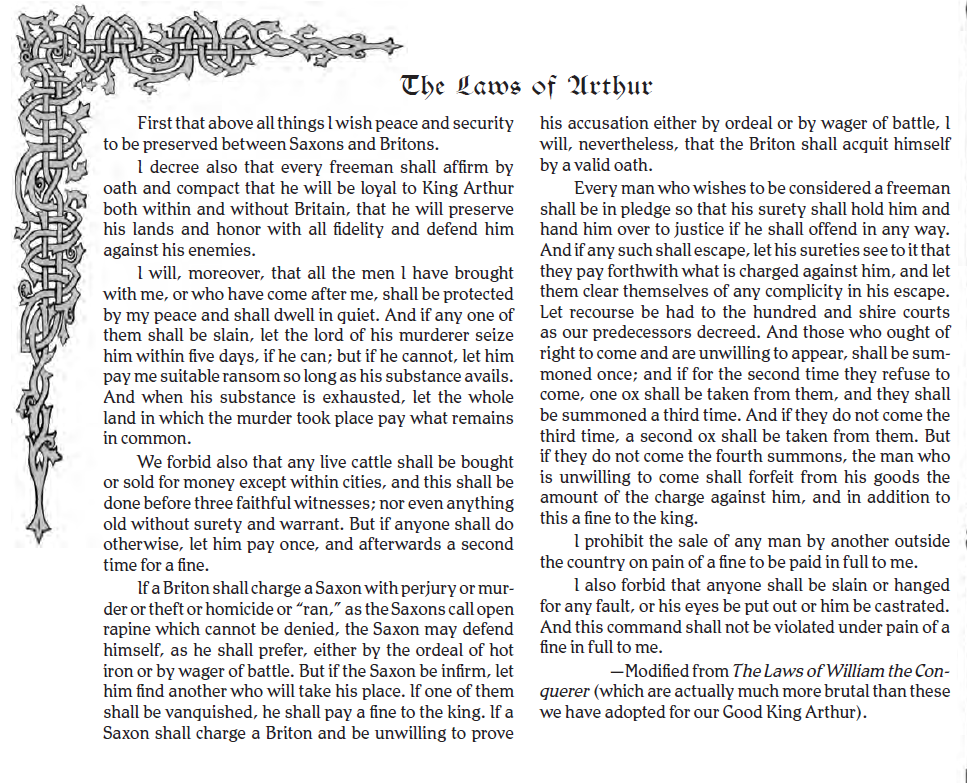
The note regarding the source from which the text is modified gives every indication of being accurate; a glance at The Statutes of William the Conqueror shows that the putative laws of Arthur do seem to emerge from it.17 But there are clear changes. For one, “Saxon” in the game-text replaces what a translation from the original calls “English,” while “Briton” replaces “Norman” or “Frenchman,” although such changes make sense in the Arthurian context. Less sensible are such omissions as the religious thrust in the first clause and the nod to the laws of Edward. The latter may perhaps be excused in the same way as the shifts in demonym, although a shift in nomenclature to something like Lex Molmutina might have been a way to preserve some sense of the thing. The former, though, is confusing, given the assertion of Christianity’s dominance within the game world,18 unless it lies perhaps in the unease with which RPGs generally regard real-world religion.19
A few other comments about law attract attention, as well. One is that “Anyone who commits violence upon the roads commits treason and incurs penalty as if having violated the sanctity of the king’s own feast hall,”20 which comment seems to place the roads under the king’s own jurisdiction–an attitude that seems to be at work in WoBT,21 among others. While not rising to the force of legal dicta, the Chaucerian Arthurian parallel does at least ground the comment in the documentary representation of medieval England; if the detail is wrong, it is wrong for the right reason. And more specifically grounded is the comment that, as in concerns of early English law, “reputation is critical in the game.”22 Indeed, the accumulation of Glory is a central mechanic, and what gets mechanical attention necessarily becomes a focus of play; “worship” is a central concern of Malory’s knights, of course, and the preoccupation with reputation evidenced in a variety of early English legal documents indicates that the game gets at least some of the general sense of its sources right–which is better than might be said of other neo/medievalist work.
There are other implications to trace, of course, but it seems on an initial glance that the things Pendragon gets right(ish) and wrong are in place to facilitate player access to the kind of agglutinated, accumulated Arthurian setting demonstrated in Malory and followed upon by no few later authors. Enough detail is “correct” to satisfy at least some desire for “accuracy” among players; certainly, enough detail is “correct” to offer the kind of verisimilitude that aids in fostering Coleridgean willingness to suspend disbelief and allow the immersive narrative performance of the RPG to occur. What is glossed seems to be glossed for conformity with context, for the simplification of simulation, for minimization of distraction, and from concerns of limited access to information. This is not to say the errors should be passed over; the game continues to be played, and more information allows for a deeper, richer immersion. Too, while “it’s just a game,” Sturtevant notes that such popular cultural products as Pendragon, as other RPGs, as the medievalist sources from which they stake out their neomedievalist positions, do much to shape public understandings of what the medieval is.23 Given the rampant misuse of the medieval by execrable groups, fixing those understandings is more and more important–and any avenue for such correction has to be pursued.
* As witness this, this, this, this, this, this, and this, as well as possibly other places.
** As a piece originally meant only for spoken delivery, the work has citations and notes to allow for response to anticipated questions and for potential future development. The accuracy of those citations to any particular style manual is not guaranteed; the accuracy as to sourcing and location, however, is as I had it at the time I wrote the remarks. Most of the links still work, or did when I checked.
- Although not “correct,” the convention of italicizing the game’s title is one the game itself uses; I follow it in reference to Pendragon in this document.
- “Arthaus Publishing, Inc.” White Wolf Wiki, accessed 15 July 2021, https://whitewolf.fandom.com/wiki/Arthaus_Publishing,_Inc.
- World of Darkness, Paradox Interactive, accessed 15 July 2021, https://www.worldofdarkness.com/.
- Lawrence Schick, Heroic Worlds: A History and Guide to Role-playing Games (Buffalo, NY: Prometheus, 1991), 18-19.
- Greg Stafford, King Arthur Pendragon, 5th ed. (Arthaus, 2005), 6.
- Geoffrey B. Elliott, “Some Notes about the Kerrville Renaissance Festival,” Travels in Genre and Medievalism, Tales after Tolkien Society, 4 February 2019, https://talesaftertolkien.blogspot.com/2019/02/some-notes-about-kerrville-renaissance.html.
- Stafford 15.
- Geoffrey B. Elliott, “About Oklahoma ScotFest,” Travels in Genre and Medievalism, Tales after Tolkien Society, 23 September 2015, https://talesaftertolkien.blogspot.com/2015/09/about-oklahoma-scotfest.html.
- Stafford 4.
- Stafford 5-6.
- Note, however, that there are no few people who get into their areas of study in part because they started studying to be able to play their RPGs better.
- Daniel Mackay, The Fantasy Role-playing Game: A New Performing Art (Jefferson, NC: McFarland & Co., 2001), 4-5.
- Stafford 17.
- Stafford 22.
- Stafford 19-24.
- Stafford 23.
- “Statutes of William The Conqueror,” The Avalon Project, Yale U., accessed 15 July 2021, https://avalon.law.yale.edu/medieval/lawwill.asp.
- Stafford 139.
- Mackay 4; Geoffrey B. Elliott, “Unchurched: On the Relative Lack of Religion in Tolkienan-Tradition Fantasy Literature” (paper presented at the International Congress on Medieval Studies; Kalamazoo, Michigan; 12 May 2022).
- Stafford 14.
- WoBT, ll. 882-98.
- Stafford 5.
- Paul B. Sturtevant, The Middle Ages in Popular Imagination: Memory, Film and Medievalism (New York: I.B. Tauris, 2018).
I am, of course, happy to carry out this kind of work for you; if you’d like me to do so, fill out the form below!


[…] good game to play that the TTRPG is useful. The genre informs some scholarship I’ve done (see this for a recently released example), and it serves as an impetus to the generation of more art than […]
LikeLike