Read the previous entry in the serieshere. Read the next entry in the serieshere.
The succeeding chapter, “Elfbark,” opens with a brief passage from an in-milieu herbal that reinforces the addictive nature of the plant. It turns then to Fitz reporting to Dutiful and Chade after a night of poor sleep, reporting the Fool’s suppositions about Civil’s erstwhile fiancée. They purpose to set up Skill-communication with Nettle at Buckkeep, and, after a tense exchange, Fitz excuses himself from his prince and his mentor.
Fitz sees to Thick and learns from him that bad dreams were broadly afoot the previous evening, such as even Nettle could not address. Fitz considers it as camp is struck and the journey up Aslevjal continues. Talk with the Fool commences, soon turning to the Elderlings and such of their nature as the Fool has been able to uncover and determine. Progress up Aslevjal is slow and tiresome, wearing on Thick, and at length, he lashes out through the Skill at Fitz. Fitz walls himself off from the Skill and realizes in short order that the magic is being used against not only him, but the whole party; Thick comes to the same realization shortly afterward. The two reach an accord and join the rest at length.
Fitz and Thick are summoned to attend on Dutiful and Chade, and Fitz reports as he is able, warning of the Skill being deployed against them. They are interrupted by Peottre arriving, offering cakes laced with elfbark–which herb Fitz is aware of too late to help himself, though he prevents Thick from taking any, and he gives a coded warning to Chade. Chade heeds it, joining Fitz in preventing Thick from eating any of the drug, and he dismissed Fitz, intimating that he should try to purge himself.
Fitz makes the attempt, with little success, and he finds his way to the Fool for aid. The Fool takes him in and is taken aback at the effects of the elfbark upon him: “It’s never affected you that way before.” The effects are detailed, including pulling at his hair and lip–and the melancholy that sets in on elfbark users begins to take hold of Fitz, to the Fool’s chagrin.
This is not the first chapter in an Elderlings novel to bear the title “Elfbark,” clearly, though Hobb can be forgiven for recycling a title more than two hundred chapters later. I can imagine that comparing the two chapters directly might make for an interesting short work–alas, that I have not Marvell’s world enough and time! I do, however, note the greater attention to the drug’s immediate effects in the present chapter than I recall being the case previously, and I am reminded of particular experience in my work at the substance use treatment center. Again, Hobb does well at putting forth the verisimilitude with the mundane she cites as necessary for effective fantasy–and I am glad of it, even if I am a bit uncomfortable at the reminder of things I have seen.
Read the previous entry in the serieshere. Read the next entry in the serieshere.
The following chapter, “Civil,” opens with a passage detailing the White Prophet Hoquin and his Catalyst, Wild Eye, before moving to Fitz calling on the Fool in the evening. He finds Swift with him, entertained by the Fool’s puppetry, and realizes he has made a gaffe by entering, but he cannot find a way to extricate himself politely or with discretion. The Fool opines on his tent and possessions, remarking at some length on Tintaglia and his need to save dragons. Swift rebels at the idea that the Fool, whom he knows as Lord Golden, would oppose Dutiful’s mission.
Conversation is interrupted by the intrusion of Civil Bresinga, who believes an unseemly assignation is soon to commence. That conversation is interrupted by the call of a guard, challenging a passer-by whom Peottre remarks is the Black Man, occasioning unease. After it is settled, Civil challenges the Fool, still upset about Golden’s earlier manipulations. The Fool is not blameless, and Fitz recognizes his own complicity in what has become the shame of Civil’s former fiancée. Melee ensues, with the Fool swiftly gaining control of the fight and restraining Civil with little evident effort. Amid his assertion that the matter is and should be closed, the Fool claims his status as White Prophet and Fitz’s as Catalyst, and Dutiful calls an end to proceedings.
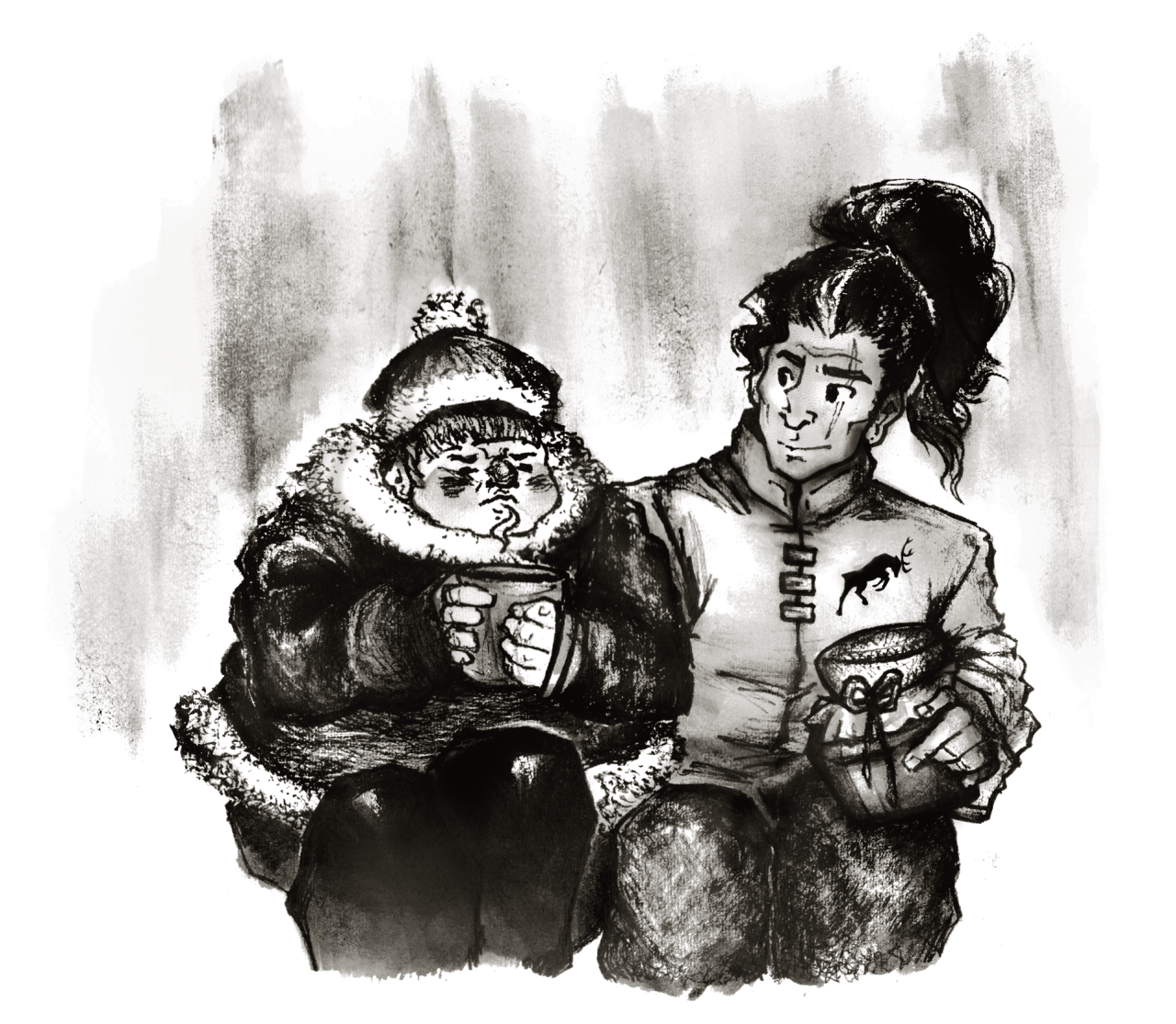
Fitz tends to the Fool after, and the two confer quietly about Civil’s former intended and Piebald entanglement. Talk turns to the Black Man, the Fool noting the pronounced portentousness about him. Talk pivots to fate, and Fitz asserts that he cannot be as he is and stand by while the Fool faces death. And, at the Fool’s request, Fitz bunks in his tent that night.
I find myself once again, yet again, still, reading affectively as I reread the current chapter. I note with some concern the accusations of grooming voiced in the chapter, given prevailing public discourse as I write this; yet another reactionary drive to boycott Disney is but one symptom of a larger problem in the world, and I admit that there is something somewhat silly about my continuing this project as if it matters in any way against the troubles of the world. But that’s been something of a concern for me for some time; it’s nothing new, really, and I should be more accustomed to it at this point than it seems I am. And in any event, the accusations are false in the book; there is that much, at least, though those in the readers’ world cannot be so easily addressed as are Civil’s against the Fool.
I am minded of one of the truisms about fantasy fiction: it is escapist. And I’m minded that there’s nothing wrong with that, in itself; I’m reminded of Tolkien asking in “On Fairy-stories” “Why should a man be scorned if, finding himself in prison, he tries to get out and go home? Or if, when he cannot do so, he thinks and talks about other topics than jailers and prison-walls?” I may not be in a prison such as eats too many people, and in the United States, disproportionately people of color, and I acknowledge that I occupy a number of positions of privilege–there’s a lot in my life that makes it easier, and a lot more that doesn’t make it harder. But that doesn’t mean there isn’t a fair bit wrong, and it is pleasant at times to see visions that, even in a fallen world and with flawed characters, a better resolution is possible.
Coming from my archives and appropriately enough for the season on this Spy Wednesday, the following, which I did in support of some of the scholarly work I was doing back when I still thought I might be able to be a professor when I grew up. (Seriously, I did the translation so I could write a conference paper–which I presented as a PhD student in 2008.) Use it in good health, and note that any errors are wholly my own.
Indeed, the best of dreams I intend to tell what I dreamt at midnight, after voice-bearers went to rest.
It seemed to me that I saw a most wonderful tree lifted on high, enwrapped in light, brightest of beams. That beacon was all covered with gold; gems stood fair at the corners of the earth; and five were there up on that shoulder-span. All beheld there the angel of the Lord, fair through the fore-ordained. Indeed there was no gallows of a felon. But holy spirits there beheld him, men upon the earth and all this great creation.
Wonderful was the wood of victory, and I stained by sins, badly wounded with sins. I saw the wood of glory, honored in clothes, to shine pleasantly, adorned with gold; gems had covered worthily the tree of the forest. Yet through that gold I was able to perceive the former struggle of wretched ones, when that it first began to bleed on the right side. I was troubled with all sorrows. I was afraid for that fair vision. I beheld that eager beacon to change in clothes and colors; at times it was with wetness moistened, drenched with the flow of blood, at other times adorned with treasure. Yet I laid there a long while beheld sorrowful the Savior’s tree, until I heard that it spoke. The best wood then began to speak a word:
“That was very long ago, (I yet remember that), that I was hewn in the end of the forest, moved from my root. Strong evil men took me away from there, where they made themselves a spectacle, commanded me to lift up their outlaws. They bore me there on the shoulders of men, until they set me on the hill, enough evil men fastened me there. I then saw the Lord of mankind to hurry with great zeal, he who intended to ascend upon me. There I dared not against the word of the Lord to bend or to break, when I saw to tremble the corners of the earth. I might all the evil men have felled, yet I stood fast.
“He stripped himself then [,] the young prince (that was God almighty), strong and resolute; he mounted on the high gallows, brave in the sight of many, when he meant to redeem mankind. I trembled then [as] the warrior embraced me; I dared not yet to bend to earth, fall to the corners of the earth. But I [was] obliged to stand fast. I was raised up the Rood. I lifted up the powerful King, Lord of heaven; I dared not bow down. They drove through me with dark nails; on me are the wounds visible, open malicious wounds. I dared not injure any of them. They mocked us both together. I was all moistened with blood, [it] poured out of the side of the man, when he had sent his ghost on.
“I had endured on the hill much of cruel fate. I saw the God of the hosts violently stretch out. With darkness had the heavens covered the Wielder’s corpse, the bright radiance; shade went forth dark under the heavens. All creation wept, lamented the fall of the King. Christ was on the cross. Nevertheless the eager then came from afar to that noble one. I beheld all that. I was sorely troubled with sorrows, yet I bent to the hands of the men, humble in great strength. They then named almighty God, removed him from the oppressive punishment. The warriors left me to stand drenched in moisture; I was all wounded badly with darts. Then they laid down the limb-weary one, they stood at the head of the body; they then beheld the Lord of heaven, and he rested a while, tired after the great conflict. They began then to make him a tomb [,] men in sight of the slayer; they carved that from bright stone, set him therein the Wielder of victory. They began then to sing him a dirge, wretched in the evening; then they desired to depart afterwards tired from the glorious lord; they rested there as a small host.
“Yet we there weeping a good while stood in the position, after the cry went up of the warriors; the corpse cooled, fair house of the spirit. Then to us the man began to fall all to the earth; that was dreadful fate! They buried us as one in the deep pit. Yet to me then the thanes of the Lord, friends heard of ……… adorned me in gold and silver.
“Now you are able to hear, oh my hero the dear one, that I have endured the work of evil men, of pains of sorrows. The time is now come that they honored me far and wide, men across the earth and all this great creation, they prayed to this standard. On me the Son of God suffered a while. Therefore glorious I now tower under the heavens, and I may heal every one of those who is in awe of me. Long ago I was become the hardest of tortures, most hateful to people, before I for him a way of life prepared right, to voice-bearers. Indeed, the Lord of splendor honored me then over the wood on the hill, Warden of the kingdom of heaven, just as he also his mother, Mary herself, almighty God for the sake of all men honored over all womankind.
“Now I bid you, my hero the dear one, that you should say this vision to men, reveal in words that it is the tree of the world, he on whom almighty God sorrowed for the many sins of mankind and Adam’s old actions. He tasted death then; yet afterwards the Lord arose with his great might as an aid to men. He then ascended into heaven. Hither afterwards comes in this middle earth to seek mankind on doomsday the Lord himself, almighty God, and with his angels, he who then desires to judge, he has the power of doom, he to each of the ones as to him earlier here in this fleeting life deserves. Then are none able to be unafraid of the word that the Wielder speaks. He will ask of the multitude then where the man should be, he who desires [,] for the name of the Lord [,] of death painful to taste, as he who died on the tree before. But they will then be afraid, and think little what they should begin to say to Christ. Then need not any be very afraid who before themselves bear in their breasts the best of beacons. But through the rood must seek the kingdom from the earthly way every soul, they who with the Wielder intend to dwell.”
A picture of the manuscript, sourced here, with license.
Then I prayed to the tree with glad spirit, with great zeal, there I alone was small in the host. The spirit was urged in going forth; in all many endured times of longing. It is to me now a joy of life that I should be able to seek the wood of victory alone more often than all men to honor [it] well. To me it is the desire for the great in spirit, and my allegiance is directed to that rood. I have not much of riches of friends on the earth. But they hence forth departed from the delights of the world, they sought the King of the world; they live now in the heavens with the High Father, they live in the world. And I hope for me in each of the days when [it is] me the rood of the Lord, which I before beheld here on earth, should fetch in this fleeting life and should bring me then where is great bliss, joy in the heavens, where the people of the Lord is seated at feast, where is everlasting bliss; and it then should place me where I will afterwards be able to live in the world, well with the holy to partake of joys. The Lord should be a friend to me, he who here on earth suffered before on that gallows-tree for the sins of man. He redeemed us and gave us life, a heavenly home. Joy was renewed with glory and with bliss for they who endured burning. The Son was triumphant in that journey, mighty and successful, when he came with many, a host of spirits, into the kingdom of God, the Lord almighty, with angels to bliss and all the holy ones in the heavens who had before dwelt in the world, when the Wielder came for them, almighty God, where his homeland was.
Read the previous entry in the serieshere. Read the next entry in the serieshere.
The next chapter, “The Black Man,” opens with a comment about Skill use from a recent Skillmaster before turning to Fitz sleeping dreamlessly and waking to consider approaching Web before he checks in on Thick and assesses his situation. He also reconnoiters more, learning from the Hetgurd delegation that an offering was not accepted, about which they are concerned. Fitz considers matters as he attends to Thick, and he notes with some interest the arrival of the Narcheska on the island, the reception for whom is detailed.
“The Narcheska weeps as she walks.” Image from Faceless Frey, here, used for commentary.
Argument ensues among the Out Islanders, leading to a formal request from the Hetgurd delegation that Elliania withdraw her challenge to Dutiful; she refuses, with clear regret. The refusal is noted formally, with claims made against future loss and accepted as valid. Fitz takes the opportunity to ask the Fool about arrival on the island, only to be told “I flew”; a brief discussion about self-determination follows before the Fool walks away. Web takes his place, and Fitz and Web confer briefly. Arrangements to continue the expedition follow, and Fitz has to chivvy Thick along with the rest of the group. Notably, the Fool strikes camp swiftly and alone, and he prompts caution from most, interest from Swift and Cockle, and ire from Civil. Fitz takes note of the attitudes on display.
Peottre outlines the challenges that face the party’s trek to the dragon, Icefyre, remarking that those who follow him should step where he steps due to the unstable and uncertain nature of glacial ice. They head out, Thick going slowly due to stature and illness and over-deliberate care with his steps. Fitz, accompanying him, chafes at the slow pace, and Chade Skills to him about the Fool and about the Narcheska, whom he notes “weeps as she walks.” Thick disrupts the Skilling, and Fitz, agitated, moves ahead. He realizes, however, that Thick is moving in time with the music that swells within him, and he tries to comfort Thick as he realizes they are being left behind. Fitz also sees a shadowy figure that he recognizes as not belonging to Dutiful’s expedition, and he Skills a report thereof. Responses to it prompt Thick along with more haste.
After Fitz and Thick arrive at the expedition’s camp, Fitz settles Thick in and notes several absences: the Fool, and Peottre and Elliania. Fitz and Chade confer quietly about the Skill and its perils for them, and Fitz notes that Thick offers them a way to contact Buckkeep. He is in contact through the Skill with Nettle, who is at the court, and Chade offers a gentle rebuke to a still-stubborn apprentice.
I am in mind of Njals Saga once again with the pseudo-legal forms used to comment on Elliania’s challenge and her insistence upon it. I am in mind, too, of the ways in which the journey up Aslevjal parallels the earlier travel along the Skill-road away from Jhaampe, towards the stone quarry, back in Assassin’s Quest. Both Fitz and the Fool had been on that journey, during which Kettle accompanied the group, albeit at a slower pace than the rest of the party; in the present chapter, the Fool keeps his own company, while Fitz seems to take the place of Kettle in the arrangement. How deliberate the parallel is, I cannot say; intent is a tricky question at best. But the intent matters less than the effect, in any event, and I am once again taken by the work to connect the novels to one another; it is something I appreciate, and greatly.
Read the previous entry in the serieshere. Read the next entry in the serieshere.
The following chapter, “Aslevjal,” begins with an in-milieu comment from Fedwren about Forging. It turns thence to the approach to the titular island and to the Fool who waits upon it for the Six Duchies’ party to arrive. Fitz is tasked with assisting Thick, Chade contriving thus to keep Fitz and the Fool apart. Ships are unloaded and camps set up, the voyagers’ arrangements described.
Remember these? Source in image and here, used for commentary.
Taking advantage of Riddle’s offer to attend to Thick for a while, Fitz, scouts out the campground, noting the presence of memory stone in the area, as well as signs of work done upon it and with it. He finds a partly-sculpted stone dragon and summons Chade and Dutiful to examine it; Akron remarks that it is not the dragon they seek, but “one of the Pale Woman’s follies,” before Peottre silences him.
After, Fitz confers with Chade and Dutiful via the Skill about the Fool, and Fitz is charged with caution as he gathers more information. The memory stone receives more examination, and Fitz perceives a number of memories contained within it, linking the work done on Aslevjal’s shores to the work Verity and others had done carving their dragons. Fitz notes the problems that would inhere in a dragon thus made, and he reports his findings to Chade, who considers a strange repatriation.
Fitz returns to Thick, who asks for honey. Fitz takes the opportunity to call on the Fool, visiting the Fool’s tent and finding it empty; he avails himself of the honey he finds there, being sure to leave clear sign of his presence so as not to present himself as attempting deceit. Returning with the honey mollifies Thick, and he notes to Fitz Nettle’s anger at him, spurred by Burrich’s departure and her own obliged relocation to Kettricken’s court. The news offers Fitz some comfort, although he frets somewhat as he muses on his daughter’s situation and his own.
From the vantage of rereading, I can affirm the foreshadowing in the present chapter; there are signs here of what is to come. Even among them, though, I find links back to earlier parts of the Realm of the Elderlings series that I appreciate; I noted to students when I had them, and I reaffirm in the lesson plans I write for contract work, that one of the things that argues in favor of artistic quality is the way a given work hangs together. It’s not much of a stretch, if any at all, to read a series of novels as a single work rather than as separate entities (particularly as concerns fantasy literature in the Tolkienian tradition, which the Realm of the Elderlings is despite making abundant use of other sources and backgrounds). As such, it is not out of line to apply the same artistic standards to a series as to an entry in it–not obligatory, certainly, and not without the caveat, for logical and other reasons (I am aware of the fallacy of composition, thank you), that some parts can be better than others, but not impossibly or even without good cause. And the work done to unify the Realm of the Elderlings novels as they proceed, although not withoutflaw, helps with that. At least for me, anyway…
I thought to tread new fields where bulldogs frolic Growling gladly as they gallop with their Jowls flinging drool at every step and Shaking their heads in mock anger that will Soon grow all too real So lush Watered by youthful sprays refreshed With every season and its new hopes and by Just as much shit spread thickly Pounded in by passing feet And I left the scrappy stands of oaks and cedars and mesquites Rising from the thin soil Perched precariously atop the limestone hills Mildewing where they have been shorn away Graves of the dead Gone so long they do not matter anymore Any names they had long since lost to themselves Never known by after-comers And I came late upon them Stalked away from where I should have bounded Four-point buck that I once was And very much in rut throughout the year Even if no one took the point I presented I meant to graze upon that green The many leaves feeding me More than I would have found where I was As I see clearly looking back And looking back And looking back Where gold limns the cerulean above and Bluebonnets below Sometimes Good times That I know I will not see again But my belly is empty now As the fawn spotted beside the flinty stream Looking up at where eagles soar Bounces dancing up to marble falls And that will have to be enough
Read the previous entry in the serieshere. Read the next entry in the serieshere.
The next chapter, “Cousins,” offers a snippet of translated in-milieu verse before moving to the continued progress of Dutiful’s errand. Political arrangements are noted, and preparations are made to depart Wuislington for Zylig. They include drugging Thick and bringing him aboard ship unconscious, which results in a substantial upset when he wakes, as well as Fitz’s shame. He reports as much and makes his recommendations regarding Thick to Chade and Dutiful when he reports to them aboard ship while they are underway. And he finds himself the object of Dutiful’s anger.
Dutiful demands from Fitz the truth about Nettle. Asked bluntly by his prince, Fitz answers as openly and honestly as he can, Chade exulting in the revelation and noting his own objection to the arrangements that had been made. Dutiful upbraids both Chade and Fitz for their parts in the deception, but he agrees that Fitz should be the one to inform Nettle of her origins. Discussion continues, Fitz and Chade falling into open and pragmatic discussions that scandalize Dutiful, and the conversation soon draws to a close.
After, Fitz checks up on Thick, finding himself subjected to the other man’s ire through the Skill, and he surveys the other passengers on their ship. Later, he tries to contact Nettle through the Skill, failing to do so and suffering for the remainder of the trip to Zylig.
Once in port, Fitz goes to work gathering information, gaining a general sense of the situation Dutiful’s party faces. The question of Thick arises again, and Fitz learns that the Six Duchies delegation that had remained in Zylig had done well for itself. He also learns the terms on which the Hetgurd agrees to allow the challenge of Aslevjal to take place as he and Chade confer. The next morning, though, sees more trouble from Thick as the party makes to depart for Aslevjal, and Web notes in an idle aside to Fitz that he has sent Swift to retrieve Thick as a sort of test of his ability in the Wit. Web offers once again, a final time, to teach Fitz, as well, and Fitz is dilatory in availing himself of it as the voyage gets underway.
At length, the party arrives at Aslevjal, which is described–and the Fool awaits them on the shore.
As I reread the chapter this time, I found Web’s comments about Fitz not finding time to learn more of the Wit resonant. I am not possessed of any magics, certainly, nor of any particular power or importance. Even so, there seems always to be some task or another to which I can devote my attention, to which I should devote it, and they all seem to get in the way of something else. I know that something else is important, certainly, and I know I ought to attend to it. At the same time, the tasks that present themselves to me are ones that need doing, and it is easy to set aside the nebulous for the concrete.
Read the previous entry in the series here. Read the next entry in the series here.
The succeeding chapter, “Wuislington,” opens with commentary about Outisland social structures from Fedwren before turning to Fitz’s gloss of Dutiful’s party’s stay in Wuislington. He notes Thick’s convalescence and displeasure with him, which Chade notes he must endure. He notes, too, his continued tutelage of Swift, as well as the omnipresence of observation, And he notes a strange camaraderie growing between himself and Peottre over their mutual work to chaperone Dutiful and Elliania.
Fitz also becomes aware of the agricultural underpinning of the Narwhal Clan’s wealth, the geography that enables it described in some detail. But as he follows Dutiful and Elliania on an excursion out into that farming country, he uncovers Henja spying on the pair, though he cannot pursue her. It informs his report to Chade later, as well as their discussion.
That night, Fitz is drawn into a dream where Nettle and Tintaglia confer. The dragon demands information from him, but Nettle manages to cast the dragon out of her dream and chides Fitz for his timorousness. Dutiful interrupts via the Skill, but he is also cast aside after a heated exchange through that magic. Nettle absents Fitz from her dream, as well, and he wakes suddenly to Dutiful’s insistent Skilling; the prince is angry at having Nettle concealed from him, and summons Fitz to account.
When Fitz, Thick trailing, answers the summons, he finds himself bidden through the Skill to stand and wait. He watches Dutiful and Elliania confer about sex until they are interrupted by Peottre. Peottre dismisses the Narcheska, and Dutiful expounds his situation to him, earning some respect from Elliania’s uncle. The exchange leaves Fitz and Thick both homesick, though Fitz knows the home he seeks no longer exists.
Dutiful’s comment that “I am a man but…I am a man” has long resonated with me. Reading it now, I acknowledge the heteronormativity in the comment, but I also note the clear tensions under which Dutiful operates. I have been an allosexual teenage boy, and though it was many years ago, it was not so many years ago that I do not recall the discomfort of its associated urges–or the tensions surrounding multiple ideas of what should be. And I have to wonder if that is not somehow an indication of the expected primary (or perhaps secondary) readership of the series, that it does depict such things as it does, and from the perspectives that it does. Yet another paper project idea that I may never develop…seems I have a lot of those, really. Too many.
I wrote about my current writing space not too long ago, and I’d noted before that that I’d done a fair bit of writing sitting in the front seat of a 2012 Ford Focus as my daughter, Ms. 8, practiced tap, jazz, and cheer. While it might have been the case that I’d not done much writing in the latter location for a while, I’d still been spending a fair bit of time in that front seat, and I’d anticipated getting to do so for a while yet, perhaps even returning to writing from there. Alas, such is not to be!
It is what it looks like. Picture is mine.
On 10 March 2022, as I was driving from Johnson City to Kerrville, I went through Fredericksburg, Texas. It’s a common enough thing, and Friendship Lane had been a road I’d often taken on that route; it was not a strange thing, then, that I did so again. Nor was it terribly unusual that there was a truck pulling a trailer along that road, nor yet that such a truck might slow down and signal that it was going to turn right onto South Milam from Friendship, moving from the through-street onto one that had a stop sign at the intersection. Nor still was it strange that a car–say, a red 2012 Ford Focus–would signal a lane-change and move into the left lane to pass the slowing vehicle, as was indeed what happened between 8 and 8:15 that morning.
It wasn’t an uncommon occurrence that a white Toyota 4Runner had been stopped at the stop sign on South Milam where it Ts into Friendship Lane, while the latter has no signs and remains a through street at that location. Nor was it uncommon that said 4Runner signaled a left turn, meaning to pull out from the stop sign onto the through street, and, its driver seeing that no traffic was coming from the right and that the truck coming from the left was slowing and signaling for its own turn, began to make that left turn. And perhaps it was not too uncommon a thing that a small car would be hidden from view by a larger vehicle pulling a trailed.
It was damned unusual, though, that the 4Runner suddenly emerged into oncoming traffic from a signed stop, and that said oncoming traffic–a red 2012 Ford Focus–could not stop in time to keep from hitting the 4Runner. The latter vehicle suffered some minor damage to its driver’s side, behind both doors on that side; it was driven off to a nearby parking lot, where its driver was cited for failure to yield the right of way. The former vehicle, however…the picture tells the story.
Its driver ended up being alright. Despite a trip to the local emergency room, the extent of injury to that driver was some minor bruising where the seatbelt had done its job. But the car…as of this writing, the insurance report is still forthcoming, but a car isn’t going to do well without a front end or a cooling system. It’s the kind of thing that prompts the word “total,” really–which is a damned shame. I’d liked not having a car payment…
Read the previous entry in the series here. Read the next entry in the series here.
The following chapter, “The Narcheska,” opens with an in-milieu discourse on social structures. It turns thence to a detailed description of the Narwhal mothershouse as Fitz and Swift are admitted. Those already in attendance are described in brief, and Fitz marks the absence of Elliania among them. An elderly woman, the Great Mother, is brought out and surveys matters before making several sharp remarks and showing the effects of age upon her. Elliania emerges at that point, taking charge of the situation and noting, after the Great Mother has been taken away, that she is newly come to menarche. Ritual greetings follow, commendations from the other Narwhal women.
The woman of the hour. Image is from here, used for commentary.
Following that ceremony, another begins that reaffirms the betrothal of Elliania and Dutiful. Dutiful betrays some confusion through the Skill as the assembled Outislanders celebrate, and a feast is brought in as a formal presentation is done, and Fitz observes, starting somewhat as something of a shivaree takes Dutiful. Fitz surreptitiously pursues and finds the event in progress, centering on Elliania rather than on Dutiful, and she acquits herself admirably. In the wake of it, FItz and Chade confer through the Skill, Dutiful being somewhat addled by his own exchange with Elliania.
At length, celebrations wind down, and Fitz makes his way back to his quarters, conferring with Swift and Web along the way. As Fitz enters, he notes Riddle in attendance on Thick, as well as a “robber-rat,” which is described. Swift evidently attempts to form a Wit-bond with the creature, earning a rare rebuke from Web and a dismissal. Riddle’s following question allows for some explication, and Fitz finds himself ill at ease with what might have been.
The “robber-rat” in the chapter is part of why I argue for the North American sourcing of the Elderlings milieu. The description seems to me nothing so much as a raccoon, an animal of North America. It’s not the only piece of evidence, of course, but it is one that comes to mind, given the chapter.
More important is the warning occasioned by Swift’s incaution. The Elderlings corpus repeatedly inveighs against the Old Blood bonding too early or too deeply with their animal companions, Fitz remarking no few times that his co-being with Nighteyes was far more thorough than that experienced by other Wit-users. It occasioned problems for him in his youth, certainly, and continues to be a source of tension in such relationships with others of the Old Blood that he has. That Swift is warned away from it–but not away from the experience of the Wit itself–is perhaps a generational marker; he receives much the same instruction as Fitz in his youth, but his later teaching is done more thoroughly and with greater understanding. I would not presume to trace out social parallels, myself; I am concerned that my doing so would suffer from my own lack of embedded knowledge (and well studied as I may or may not be, there is a value to that embedded knowledge that no amount of book-learning can replace, even as no amount of direct experience with a thing can give the kind of perspective that outside study does; both are needed). But I think it would be a useful avenue of inquiry.