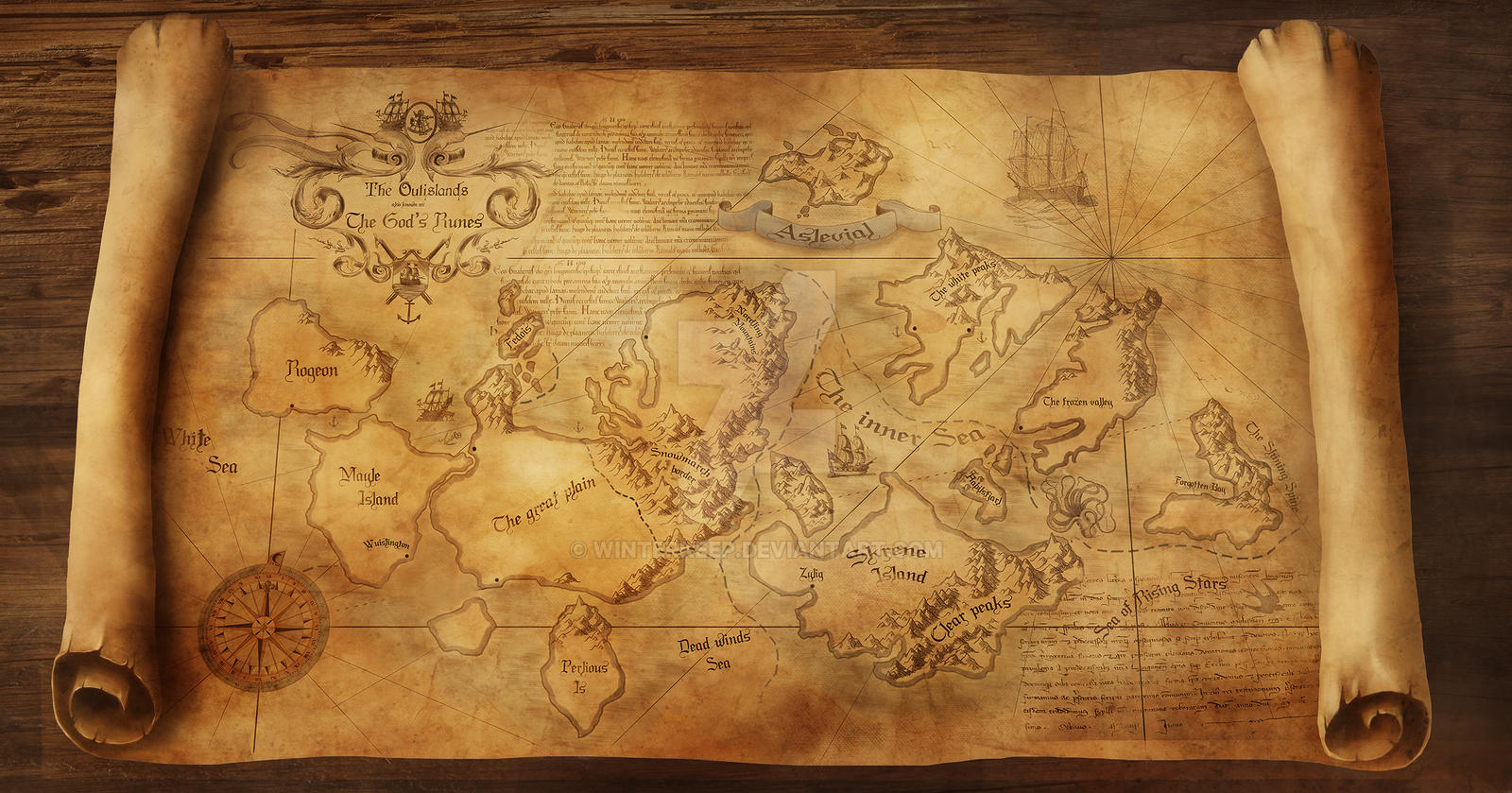
Read the previous entry in the series here. Read the next entry in the series here.
TW: Sexual assault, ableist language.
The next chapter, “Mothershouse,” opens with an in-milieu “cautionary tale” before moving to the continued progress of Dutiful’s party through the Outislands. The disentanglement from Zylig is detailed, as is the ship–the Tusker–on which Dutiful and his company will sail to Elliania’s home. So is Thick’s resistance to boarding the Outislander ship, as well as Web’s assistance with him, and Fitz marvels at Web’s use of the Wit to calm and lead Thick. Web confers with him afterward, and Fitz attempts, not entirely successfully, to deflect the older man’s questions.
A vision of Cockle, perhaps? Image from here, used for commentary.
After, Fitz attempts to comfort Thick with the Skill, finding even less success, and is greeted in that magic by Nettle. She successfully helps Thick, and she notes Burrich’s strange behavior, from which Fitz realizes his foster-father has conferred at some length with the Fool. Burrich’s reported words strike Fitz, and he admits to Nettle that he bears the name Changer.
Following the Skilling and Thick being settled, Fitz attends to Swift, bidding him join in listening to Cockle’s songs and prompting a pleasantly polite exchange between himself and the minstrel. Cockle sings several songs of which Fitz approves, and Fitz listens as one of the Outisland crew sings, roughly, in return, declaiming a song about “the Black Man of Aslevjal.” Peottre tensely quashes further entertainment from the crew, and the journey proceeds. Web and Fitz confer about Thick as the Tusker approaches Wuislington, Elliania’s home, and puts in, received by the Narwhal Clan.
Formal greetings are exchanged, with Fitz becoming aware of ritual importance behind them, and Dutiful’s party begins to be billeted. Thick and Fitz are housed together, apart from others, and Fitz notes the reasons for and difficulties surrounding the arrangement. Web, bringing Swift, assists, and Fitz has time to mull over his situation before they return with provisions. Fitz is summoned to attend on Chade and Dutiful in the mothershouse, the central fortified dwelling of the women of the Narwhal Clan, and makes to report, along with Swift.
As I reread the chapter this time, the casual ableism at play strikes me. It’s come up in regards to Thick before; his very name, if it is his name, can be read as an instantiation of it, and I’ve called attention to it once or twice before. Fitz seems to be doing better at it at present, although I do still get the idea from him that it is only because he has access to Thick through the Skill–and even that, as I think on it, bespeaks some tokenism / disability superpower mentality. It’s an uncomfortable thing, to be sure, and I’m not sure how to regard it as I read right now–though I do keep in mind that a large part of Hobb’s verisimilitude is precisely in presenting characters who are flawed, who have bad ideas, and I well recall that what a character thinks and does is not necessarily a reflection of the author. Yes, writers can only write what they know, but one can observe a belief without sharing it, and the world provides no dearth of examples of wrongheaded beliefs.
As with a couple of previous posts (here and here), the present post is lightly adapted from teaching materials I’d posted online back when I still had students. I offer it here in the hopes that some will find it useful.
The writing that typically gets labeled as “argumentative” in classrooms serves to present a central idea–a thesis–and to support that idea through the provision of explained evidence. The way in which the evidence is provided can serve to ease its acceptance by readers, helping them to understand what is being given to them and ordering it such that the individual effect of each piece of evidence is amplified. At the paragraph and whole-paper levels, then, what order materials appear matters–as does the way in which the paper moves among those materials. What follows offers some discussion of such concerns.
Organization matters, in writing as in any other task. Photo by Anna Shvets on Pexels.com
Paragraph Organization
Paragraphs are the basic organizational units of prose writing (although they are typically composite constructions), presenting and supporting ideas that further the governing concept of the piece of writing being done. In the context of an academic essay, paragraphs present ideas that inform the thesis, as well as supporting information and explanation for it. This is true whether the paragraph is introductory, in the body, or concluding.
Introductory paragraphs, as the name implies, serve to lead the reader into the essay. While longer pieces can–and should and do–have multiple-paragraph introductions, the kinds of essays asked of first-year college writing typically will not; they will usually be of such a length as will only admit of one such paragraph. One useful model for such paragraphs is
The Hook
Text
The Thesis
Essay Map
The hook is a statement or series of statements intended to command reader attention–to begin the pathos appeal necessary for effective persuasion and argument. It is, admittedly, optional; some situations create the attention and appeal through their nature. But for most argumentation, there has to be some reason for readers to keep reading, and the hook offers that initial reason. Techniques for effectively developing attention vary; which are deployed say much about the presumed audience of a piece, as well as about its expected context of use.
The text that follows the hook will tend to lead towards the central point of the paper, and it will generally do so by offering context for disucssion. That is, it will clarify the topic being treated and the angle of approach to that topic (perhaps giving a review of the most recent extant literature on the topic and/or outlining in summary form a tertiary source that informs the approach). In effect, it bridges the gap between the hook and what follows, helping readers position themselves to make sense of what is to come.
The thesis is as it is in other discussions. It is the central idea of the paper, the point of it, the thing to which the rest of the work is servant and support. Traditionally, it appears at or near the end of the introduction, where it can be seen easily and serve as a guide for the reading (and writing!) to come.
The essay map is an optional inclusion in a shorter essay such as first-year writing classes will usually request. It is what the name suggests: a map of the essay to come. That is, it lays out the major argumentative points in the order that they are made in the paper. Done well, it eases reading; readers know what to expect and when, and they can therefore follow the writing more easily. Done poorly, it undermines ethos; deviating from the map is, in effect, lying to the reader, and a writer who lies once may well do so again.
Body paragraphs serve to provide the information that supports the thesis, as well as to explain that information such that readers can make sense of it. (They are the focus of the section on paper organization, below.) They will constitute the bulk of the paper–not a simple majority, but an overwhelming proportion. They will also need to strike a balance between enough heft to be credible and enough brevity to be scannable–and how long they are therefore will vary by topic, thesis, and intended audience.
One useful model for such paragraphs is
Transition into the
Main Idea
Evidence Supporting the Main Idea
Explanation of How the Evidence Supports the Main Idea
Explanation of How the Main Idea Supports the Thesis
That is, a body paragraph will usefully open by indicating its relationship to what precedes it (about which more below). It will then do well to present its own main idea, followed by evidence that supports it informationally tagged. Something like “For example,” or “Other researchers have commented to that effect” might work. The evidence will need to be explained, however; it does not stand on its own, but must be acted upon to be of any value. And its relevance to the greater topic of the paper must be demonstrated; readers should not be asked to guess at it.
Concluding paragraphs, as the name implies, serve to lead the reader out of the essay. A commonplace method for drafting them is to return to the device of the hook–although not all such devices lend themselves to such treatment. Another, one that works far better in speech than in print (for shorter works), is to reiterate the argumentative structure. Still another, and one that works well in speech and in print, is to trace implications forward, to articulate the “so what?” that any work of research produces. How the reader can use the thesis, now that it has been validated by the paper, merits consideration–and it offers a good way to get the reader back into the wider world.
How the paragraphs in the body of the essay are laid out can serve to make the reader’s task of understanding easier, as well as to align to audience expectations and to enhance the effects of the information presented within them. Conversely, the order can serve to confuse the reader, leading from one idea to another in no pattern or one that does not make sense. Part of eliminating that confusion derives from appropriate use of transitions, as discussed below, but more of it comes from the effective ordering of paragraphs within the essay.
There are a number of orders in which paragraphs, within the body and extending outside it, can array themselves. Some of the more notable are
Chronological
Emphatic
IMRaD
Problem/Solution
There are, others, as well, the discussion of which exceeds what may be given here.
Chronological order is exactly what it sounds like; it orders points of argument by their occurrence in time. What happens first gets discussed first; second, second; and so on. It has the advantage of being easy to understand; it has the disadvantages of being somewhat flat and of not necessarily foregrounding what is best to foreground.
It also has a useful variant: reverse chronological order. It, too, is what it sounds like; it begins at the end and works back to the beginning. Its chief utility is in causal work, since cause must precede effect.
Emphatic order is the traditional rhetorical order that is taught in schools. It puts the weakest point of argument first; each successive point is stronger, until the last is the strongest. (Relative strength is usually determined by the amount of evidence available to support a point. Some exceptions will apply, but they exceed the scope of this discussion.) It has the advantages of being conventional and of promoting excellent forward momentum. It has the disadvantage of demanding that the readership remain reading for the whole paper–and not all readers will.
As such, a variant of the traditional rhetorical order is available: journalistic or executive summary order. It works in reverse of the traditional order, putting the strongest point first so that it is taken in and understood. The advantage is clear: readers get the strongest point. Those who will remain, however, may feel let down, and negotiating transitions among points can be a challenge.
Another variant, which may be called mixed emphatic order, can be applied to slightly longer papers. In it, the second-strongest point is presented first, then the weakest, and following points grow successively stronger, until the strongest is presented last. Readers who have to leave early still get a solid point; those who remain are rewarded with forward momentum and the traditionally satisfying conclusion. But the order does demand a longer paper; three points will not sustain it, and five will only barely do so.
IMRaD order is common in social and other sciences. In moving through an introduction (that lays out the topic, recent literature treating it, the gaps in that literature, and the current project), methodology (how the project seeks to do its work), results (what the methods produced), and discussion (what the results mean and what implications they have), the IMRaD model is easy to understand and applies well to reports of experiments and other empirical research. Not all interpretive work applies to such research, however, so it is not universally applicable.
Problem/Solution order is also a common pattern. Papers written in it will establish what problem is to be addressed, why it is a problem, and for whom it is a problem. Afterwards, they will address what solution is best for that group to pursue or have pursued by others, articulating why that solution is best (likely incorporating alternatives and noting why they do not work as well as might be hoped). Like IMRaD and chronology, it is easily understood, but, as with IMRaD, problem/solution patterns do not work for all inquiries.
Always, the purpose being addressed and the audience with whom it is addressed must be kept in mind. They should determine what pattern should be deployed, since it is their needs that must be met for effective argument.
It can be fun and easy to move from one thing to the next. Photo by Quang Nguyen Vinh on Pexels.com
Transitions
Moving from one point to another, and even from one sentence to another, can be jarring for readers. They are asked by the act of reading a new thing to take in and process a new idea, and if they are not moved smoothly between them, they may not be able to folow–or to follow well. It is therefore important to clearly indicate how what happens in the text’s now relates to what it follows–and that indication comes about through effective use of transitional devices.
Such devices need not be complicated; indeed, many follow predictable patterns or can be made to do so. Some examples include
Additive (indicating that a new point is added on, more useful as something to mix into other patterns than as a primary pattern in itself): One, Another, Yet another, Still another, A final; One, A further, Yet a further, Still a further, A final; One, An additional, etc.; Also; Too; In addition; Moreover
Spatial (useful more within descriptive paragraphs than as a primary organizing principle for a paper): Top to bottom, left to right / right to left, front to back, outside in / inside out, best-side to beast-side / east to west, north to south
Causal: Thus, Hence, Therefore, As a result, Consequently, Ergo, So
Contrastive (useful to introduce counter-argument and rebuttal, as well as to argue against ideas or to set up an argument): But, Yet, Rather, Instead, Divergently, In contrast, However
Emphatic: One, A stronger, A yet stronger, A still stronger, Strongest; One, More important, Yet more important, Still more important, Most important; One, A better, A yet better, A still better, Best
Others are available, of course, and it is important to keep in mind that, although pattern-building is useful, over-reliance on any one pattern of transition will bore the reader. Readerly boredom is unhelpful; break the pattern to emphasize what needs emphasis, but keep it to ease the reader along. The juxtaposition of the two could be quite productive, indeed.
Read the previous entry in the series here. Read the next entry in the series here.
The succeeding chapter, “The Hetgurd,” opens with an Outisland creation narrative. It moves on to the arrival of Dutiful’s company in Zylig, a port in the Outislands. Riddle assists Fitz in seeing to Thick and his own preparations, and their approach to the town is detailed. So is the town itself as Fitz and Thick catch up to the rest of their group while Dutiful accepts the greetings of the Hetgurd. Fitz and Thick are shown to their lodgings, their progress through the town detailed and their surroundings described.
Fitz gets food into Thick and eats, himself, then scouts out their lodgings. He slips into the initial meeting between Dutiful and the Hetgurd–a group composed of the various clans’ warleaders, or “kaempra.” Riddle briefs him on the limited happenings thus far, and Fitz turns his attentions to the ongoing discussion, in which the kaempra press Dutiful about his intended dragon-slaying, and he responds to their concerns. Dutiful, Chade, and Fitz exchange ideas via the Skill, and they use that magic to convince the kaempra to adjourn discussion, allowing them time to confer.
The conference comes swiftly, Dutiful and Fitz informing each other what they know and have figured out. Chade offers some rebuke to Fitz before they are interrupted by the arrival of Peottre Blackwater, who notes some political tensions and offers a means for resolving them. Chade takes over the conversation with Peottre, to some annoyance on Dutiful’s part, and arrangements are made at some length.
The Hetgurd and the kaempra who compose it factor heavily into the reading and interpretation I had originally had of the Out Islands (and I note the frustration of the term in the present chapter as previously) as analogous to the Vikings in popular–and some medieval–conception, one I realized at an inconvenient moment was not as accurate as the understanding that later emerged for me. They’re not the only such things, for example, but they do much, for reasons I explain. And as I reread the chapter, I am minded of other associations, having read Njal’s Saga relatively recently. I am not convinced to return back to my earlier idea, but I am, at least, satisfied that I had decent reason to think what I used to think.
There is some comfort in having been wrong for the right reason.
Read the previous entry in the series here. Read the next entry in the series here.
A chapter titled “Voyage” follows, opening with an in-milieu commentary about Out Island civic structures. It moves thence to Fitz rising reasonably well rested and returning to Thick, whom Web still attends. After an exchange that leaves Web smiling, he departs, and Fitz confers with Dutiful through the Skill about Thick, who wakes in nascent illness. Dutiful gathers him back into his cabin, although Thick goes reluctantly, and Fitz tends to Thick further as Dutiful’s “Witted coterie” attends on him.
Much better for Thick, this attitude… Photo by Pixabay on Pexels.com
After the meeting, Swift is left with Fitz, Web offering insight about him as he departs and Fitz sets Burrich’s son about errands. Matters do not go well, and Swift is dismissed at Chade’s suggestion; the assassins and the prince confer about Thick afterward, Fitz noting the assistance of Nettle, and a pattern of attention and attempted soothing settles upon them.
In a Skill-dream, Nettle vents anger at Fitz for the message he had her convey to Burrich. The words had touched him deeply, sending him toward Buckkeep. Fitz attempts to explain himself to Nettle without revealing too much, and matters proceed. Fitz continues to work with Swift and seeks without success to confer with Web, and he discusses the Wit with Dutiful and Chade. Chade bristles at the topic somewhat, but he relents.
I’m not entirely sure what to make of the chapter as I reread it this time. Part of me wants to read it as something of a commentary on age, particularly on Chade’s part–he lampshades it, certainly, and there’s other justification in it. Burrich’s reported behavior also suggests something of such a reading. The idea is foggy in my mind, though, as I write this, and I have to wonder if it is simply an issue of my needing another cup of coffee as I read again.
And there’s the possibility of narrative necessity. The present chapter does gloss a lot…
Read the previous entry in the series here. Read the next entry in the series here!
The following chapter, “Voyage of Dreams,” begins with a translation of a scroll regarding the Wit before moving into Fitz’s travails attending on the vehemently seasick Thick. The ship’s crew mocks Thick relentlessly, but nothing can be done lest worse repercussions follow, and Fitz comes to realize that Thick’s outpouring of Skill is having unintended effects for all aboard.
Fitz pleads through the Skill for aid, learning to his surprise that Swift had taken ship along with them, and Chade and Dutiful come at length to assist him with Thick and confer. Chade notes his work to hinder the Fool’s departure from Buckkeep, and Fitz muses over the machinations with some regret. And ministrations towards Thick progress to little effect.
Later, as Thick sleeps fitfully, Web joins Fitz in his vigil, the two conferring about theology for a bit before Fitz asks Web about Swift. The conversation prods Fitz, and Web withdraws, leaving Fitz to realize what he has done and finding some shame in it until he is joined by Riddle. The two confer, Riddle reporting news from the guard company; matters deteriorate among them as among the ship’s crew.
Fitz reaches out to Dutiful and Chade for assistance again, the three conferring and finding there is little they can do for their companion. Fitz grows increasingly concerned for Thick and the situation, and Web approaches him again. After a prickly exchange, Web offers to watch Thick; Fitz, authorized to do so, allows it, and he marvels at Web’s insights and fretfully considers the state of affairs aboard ship.
Settling in to sleep, Fitz finds himself again assailed by Thick’s Skilling. He is not the only one, Nettle having entered the dreamscape in which Thick has enmeshed them, and she rages against Fitz for her brother’s absence despite his promises to her. She agrees to assist with Thick, despite her anger at him, and accepts a message to convey to Burrich. Through her Skill in dream, Nettle calms Thick, dismissing Fitz’s assertion of her magical prowess.
I have noted before that Hobb makes much of verisimilitude in the mundanities of her setting, referencing her own comments to that effect. The introductory blurb on the present chapter is another instance of her doing so, and one that speaks to my medievalist self. One of the challenges that faces scholars of medieval literature is that relatively little survives. Little enough was produced, given the difficulties of making text happen. Materials fade over time, physical objects decaying with the passage of years–and then there is mischance such as the Cotton Library fire, which resulted in much loss (about which some information here). It’s not necessarily something that a general readership will consider, but it is something that many readers of fantasy literature–there’s a lot of overlap with medievalists–will have in mind. Seeing it in print adds to the authenticity of Hobb’s narrative world for me, something else I appreciate about her writing.
As with some earlier comments, what follows is lightly adapted from materials I’d generated for teaching. The institution obliged then-current APA standards, which I retain here. I continue to hope people will find it useful…
The environment in which written communication exists is a complex one, consisting of many parts that connect with one another in myriad ways. No single model can encompass all of the complexities—at least, not and remain a useful model—so that which appears below is necessarily incomplete. It does, however, usefully highlight a number of points that bear in on the kind of writing students in first-year composition classes—and others—are asked to do.
True even for this. Photo by Pixabay on Pexels.com
A Simple Model
At its simplest, the environment of written communication can be conceived of as containing three elements:
Writer
Text
Reader
That is, there are the writer, the thing written, and the recipient of what is written. It is a sensible model, one easily accessible, and one that fits the dominant motif of triplets that seems to pervade rhetorical study. It is only a starting point, however—and no advancement comes to those who remain at the beginning.
Experience teaches that matters are not so simple as they might initially appear—and one of the early complications is that things inevitable get in the way. One term that might usefully apply to such things is interference, literally “that carried in amidst” or what intrudes from outside to inhibit or hinder the easy development, transmission, and receipt of the written message.
Interference can apply at all points of juncture. That is, it can come into play wherever any of the parts of the environment of written communication touch. In that sense, it is like friction, in which all mechanical actions lose energy—and interference, indeed, interferes with the message coming to be, getting where it needs to go, and being understood.
The writing model, with the complication of interference introduced, then becomes:
Interference
Writer
Interference
Text
Interference
Reader
While it might seem strange to note interference before the writer, it is often the case that things get in the way before the writer begins to write. Perhaps the writer is hungry or thirsty, tired, or subject to other physical demands. Perhaps the writer is instead distracted by family concerns or other work that needs to be done. Perhaps the writer is experiencing the commonplace of writer’s block, daunted by what writing lore calls “the tyranny of the blank page.”
The last begins to be something that appears between the writer and the text, as well. And there are other such interfering concerns to find. Perhaps the writer seeks to type out a paper, but the keyboard does not work—or a cat walks across it or even sleeps upon it. Perhaps the pen to be used is out of ink, or the pencil’s lead breaks. Perhaps the calligraphy brush sheds its hair, or the paper tears. A cup of coffee overturned certainly keeps writing from occurring as might be desired.
Or perhaps the writer needs to find some particular word, but cannot recall it. Perhaps a turn of phrase reads awkwardly, and staring at it to figure out how it might be fixed stalls the fixture of words to the page. Or some bit of knowledge needs finding—and it eludes or else leads to the research rapture described so convincingly by Pigeon (2013). Or any number of other things could intrude between the writer and the text, no less than in between the world and the writer.
Some of the writer’s concerns will apply to the reader, too. Readers are afflicted by hunger and thirst and lust and fatigue; they are enmeshed in concerns of family and work; they are distracted by other things. Perhaps they lack contextual knowledge to make sense of what is written, whether in being unfamiliar with the intellectual underpinnings of what is written or in not knowing what words are used—and in trying to find out, they fall into their own instantiations of research rapture. Or, again, any number of other things can intrude, coming between the text and the reader.
Another set of lecture notes forecasts one of the additional complications that can intrude into a model of written communication: varying levels of readership. There are other such concerns, as well, expanding on the writer, the text, and the readership—about which more below.
Such complexity. Much wow. Photo by Suzy Hazelwood on Pexels.com
A More Complicated Writer
Clearly, without a writer, there will be no text, and so no reader, because nothing to read. Yet the writer is not a unitary entity. As other lecture notes suggest, the writer exists within a network or framework sketched out by demographic factors—and pursuing those leads to an even more complex model of written communication than can be reasonably presented here. But what can be presented here are concerns borrowed from literary study (itself a refinement and extension of writing study, to be sure), namely those of the authorial personal and the narrator.
The authorial persona is that set of attitudes, beliefs, and behaviors adopted by the writer for the purposes of undertaking the act of writing. The concept emerges from that of performativity, the idea that people take on roles as if acting when doing the various things they do, adapting or attempting to adapt to social situations in conscious or subconscious hopes of navigating them successfully. Plainly, people act differently with different sets of people in different circumstances—and all of those acts are roles played, rather than the real person playing them.
Writing is no different. When they set out to write, writers approach the task with notions about what writing is and what writers are and do, and those notions necessarily constrain them in some ways and focus their attentions in others. What those constraints and foci are depend upon the writer’s background and experience, certainly, and they act as a particular lens or filter through which the writer writes. That they come between the writer and the text may make them appear to be interference, but in that they enable to production of a coherent, cohesive work of writing, they are facilitative rather than interfering.
The narrator is, to make things simple, the voice through which the words are spoken. It is the specific perspective through which the text and its information are presented, and it will emerge from the narrative persona and its consideration of audiences, materials, and circumstances. Discussions of narration typically focus on personal perspective—that is, is the narration first person, giving an embedded account of events, or is it third person, giving a dissociated account—limitation—how much the narrator knows, and how much the narrator shows—and reliability—how much the narrator can be trusted. Scholarly writing typically seeks to deploy a mildly limited reliable narrator—it says what it knows and what it does not know, and it tries to convey its ethos.
Whether scholarly writing adopts first or third person, however, depends on the discipline and purpose. Some fields—typically those in “hard” sciences and areas that emulate them—strive for objectivity and so draft their prose in third person. Others, chiefly among the humanities, work with personal concerns in any event, and they acknowledge that much of their work comes from direct experience—so they make use of first-person perspectives.
One Textual Complexity of Many
Other lecture notes make mention of paratextual concerns. That is, they note, however briefly, that the situation of words conveys meaning no less certainly than do the words themselves. Any number of such concerns can receive attention, and for sound reasons (McLuhan, 1964). A few are likely to attract attention for first-year writers.
One such is medium, the venue through which the text is presented. Whether a text is physical or digital, whether it is a book or magazine, a newspaper or a journal, a blog or a database article, matters in terms of how it will present its ethos—as well as in other ways that can be meaningfully explored elsewhere.
Another is the quality of the page. Whether the text is physical or digital, the quality of the page on which it appears influences its ethos—as well as the access readers have to it. Both impact how its meaning will be received.
Similarly determinative of access are the characteristics of the type. Size, color, font, and other such formatting concerns call attention and dissuade it, bespeak importance and its lack, and even allow those who have visual learning differences such as dyslexia greater or lesser access to the words.
Other visual features such as pictures, diagrams, charts, and graphs also influence what meanings emerge from the text and for whom they do. Their presence or absence, as well as their quality if present, should be considered in addition to the overt information presented.
Complicated Readership
Other lecture notes also, following Johnson-Sheehan (2014), make mention of a four-fold readership: gatekeeper, primary, secondary, and tertiary. The first of these, gatekeepers, introduces several points of complication—in addition to each level of reader imposing its own, as noted above.
Any number of gatekeepers can come between the text and its expected primary and secondary readers, as well as the uncountable tertiary readers that could take a look at the text. One such might be a translator, who work to bring the text from its original language into a target language—and the translator’s background will influence what words and phrases are used to render what, changing the words presented and therefore the text as a whole. Also, the translator will possibly have advisors, whose advice might well also change the words given.
Another gatekeeper, more common than the translator, will be the legal advisors associated with the production of text. The intervention of lawyers is amply attested; little can be added here, save to note that they do come into the matter.
Also more common, and more needed, is the editor of a text. Whether the writer serves to edit her or his own text—and many do—or another editor entirely looks at the piece, someone will (or ought to) look at the text to ensure that it conforms to expected usage standards—whatever those may be.
Additionally, there is the publisher to consider—as well as the publisher’s advisors. They decide what gets out and how, and even self-published works will have such decisions made about them. The decision to permit or bar access is a mighty one, and it must also be considered.
And then, of course, what happens for the primary reader once the gatekeepers have let the text through, as with any other juncture, can interfere.
A Working Model
At the end of such discussion, then, but not at the end of what can be considered, a model of written communication can be looked at thus:
Read the previous entry in the series here. Read the next entry in the series here.
The next chapter, “Departures,” opens with in-milieu commentary from an older Skillmaster before moving into Fitz’s conference with Chade in advance of their departure regarding Web’s knowledge of Fitz’s identity. They talk of Web and the formation of a de facto Witted coterie in Dutiful’s service–including Web, Civil Bresinga, and the minstrel Cockle, all of whom are set to accompany the Prince to the Out Islands, to Chade’s vexation.
Unfortunately not available to Fitz…but available at HEB, whence this image used for commentary; thank you for supporting the Kerrville economy.
Fitz calls on Hap, finding him hard at work in his apprenticeship and applying himself diligently, if in the hopes of renewing his relationship with Svanja. That done, Fitz secures his sea-chest aboard the ship on which he will sail, the Maiden’s Chance, and emerges to find Lord Golden attempting without success to take ship. Fitz is spotted by Golden and is chagrined at his part in the deception that has led to Golden being barred from accompanying Dutiful to the Out Islands. He also muses on its effects as he makes his final few preparations for departure before finding his bunk for the night.
Asleep, Fitz encounters Nettle in dream again, and they confer about Swift’s promised return and about Tintaglia. He wakes from a nightmare soon after and prepares himself for the day, not long afterwards being made to stand and wait as the various departure ceremonies take place. The party making the trip to the Out Islands is described in some detail, as is the billeting of said party. Thick’s discomfort at the travel soon manifests in others via the Skill that pours forth from the little man, and Dutiful soon Skills to him that he will be assigned to attend Thick. Reporting to that duty, he muses bitterly on “The adventure of travel by sea.”
As I reread the chapter this time, I was minded of a change in nomenclature from the Farseer Trilogy to the Tawny Man. The former uses the term “Outislands” where the latter uses “Out Islands”; similarly, “Outislanders” and “Out Islanders.” Words matter, not only in novels, and not only in this part of Hobb’s work, and I have to wonder what it is the shift in term, small and subtle as it is, signifies. There has to be something–despite the claims of some who would argue that the curtains are blue always and only because the curtains are blue; each word in the text is chosen, placed deliberately, and adjusted by consideration between author and editor, and both respond to the situations in which they have lived and do live. The curtains could easily be red or white or absent, so that even if the author is not consciously aware of a reason to make them blue, the author is responding to a context in which a curtain is or ought to be blue. Similarly, for the nomenclature to change indicates a context in which it ought to change the way it changes. Understanding it is not necessary to enjoy the story, of course, but it does not necessarily preclude that enjoyment, either–at least, not when it is done well.
Read the previous entry in the series here. Read the next entry in the series here.
And happy Sousa Day!
The following chapter, “An Exchange of Weapons,” opens with a passage ostensibly written by Fedwren of Hod, Weaponsmaster at Buckkeep late in Shrewd’s reign. It turns to Fitz’s consideration of his possessions and work to secure them against his absence and his trip to the Outislands as part of Dutiful’s guard. He is interrupted in the work by Dutiful, to whom he gives the sword that Verity had wielded and given him just before entering his dragon. At the gift, Dutiful bids Fitz wait; he departs and returns with Chivalry’s sword, and Fitz considers the blades as he and Dutiful handle them. To Dutiful he remarks that he appreciates the gesture of being given his father’s sword, but he cannot bear it, noting the reasons why he cannot. Dutiful accepts the reasoning but makes a substantial gesture in reply that moves Fitz.
Some of this kind of thing… Image from the Oakeshott Institute, used for commentary.
In the wake of the exchange, Fitz reaches for some connection to his late father, but finds none. Sleeping, he finds himself drawn to Nettle again in dream, and the two confer about a dilemma she has, having illicitly helped Swift come to court against his parents’ wishes. Tintaglia intrudes into the dream, assailing Fitz until dismissed by Nettle, and Fitz wakes.
In the morning, Fitz breakfasts in one of the castle gardens, where he is approached by Starling. She suspects that her husband is unfaithful, and the two commiserate for a time. After, Fitz heads to the Queen’s Garden, where Swift awaits him; he rebukes the boy for his deceit and sharply sends him home.
I am taken, as might be thought, by the titular exchange of weapons. Sentimental as I am, I cannot help but be moved by Dutiful’s assertion to Fitz that “when I take your father’s sword from you, I will return my father’s sword to you”; it is a boyish thing, perhaps, but it is one that bespeaks a shared experience of growing up cared for but without a parent (although, as in many things, Dutiful has a far easier time of it than Fitz–but then, he isn’t the protagonist, really). And it may be that I remain boy enough to appreciate such things boyishly, though that might come as a surprise to many.
It is not a secret to everybody that I live in Texas–or, indeed, that I grew up in the midst of the Lone Star State. I’ve made much in my online life of being Texan, even if I wasn’t born in the state, and so it should come as no surprise that I mark Texas Independence Day–today, in the event, y’all.
The banner of the republic state in question. Honor it. Image from the Texas House, and so public domain.
The thing is, growing up in Texas, living in Texas, and being the person I am, my feelings on the matter are…complicated. Having attended school in the Hill Country in the 1980s and 1990s, and not in one of the major cities it claims–Austin and San Antonio, even if neither one of them is all the way in the area–I was steeped in the “traditional” lore of the Republic of Texas, that it broke away from Mexico in response to the tyrannies of Antonio López de Santa Anna, working to ensure the freedom of the brave settlers who had come into the region to make their fortunes through the sweat of their brows and the work of their hands, and that it later joined the Union as a peer out of recognition that the promise it shared with the United States was best served by confraternity between it and the several states.
(No, the rhetoric isn’t an exaggeration. Nor is the usage; Texan English admits of such terms as “confraternity” and “tump” in equal succession and measure, the juxtaposition being one of the typifying features of the dialect / accent.)
As I got older and had occasion to learn more, to speak with more people, to read more deeply and thoroughly–and not seldom in the hands of those who were writing then or in the pages that were printed then–I became aware of the amply-attested problems of the revolutionary impetus (the freedom was for white colonizers, rather than indigenous peoples already suffering or African-American populations yet enslaved because of ongoing evil), as well as the faltering socioeconomics of the nascent republic. And, of course, living in other parts of the United States as I have, and interacting online with a great many people whom I respect and admire, I have been exposed more directly to the disregard in which many hold the Lone Star State.
Certainly, there are problems–a lot of them, and large ones, several of which are in Austin and in Washington, DC (if they’re not heading to Cancun when Uri visits or encouraging book-burnings in rural communities)–in the state and with the state. There’s a lot of bass-ackward thinking here, and a lot of it’s belligerent in several senses of the term. It exerts an outsized influence on the rest of the United States, rather than being willing to leave well enough alone; Texas’s purchases do a lot to determine what textbooks are available, after all, and bills its legislature passes get used as models for other places, usually for ill.
There is good here, though. The Lone Star State makes a lot of good, influential art and culture–and no, not only in Austin, although I (begrudgingly) concede that a lot does come from there. And even the stereotypes of the state–into which many, many people lean, and lean hard–are often durned good things. A willingness to work hard and hazard the self, an insistence on honesty in word and deed, a sense that you oughta be polite all the time and friendly as much of the time as you can, an appreciation for the beauty of the natural world and for the arts, the underlying belief that we are something and that we can do it–they’re part and parcel of it, and they’re of value.
Read the previous entry in the series here. Read the next entry in the series here.
The next chapter, “Trepidation,” begins with an in-milieu vignette regarding the White Prophet Hoquin before glossing more of Fitz’s preparations for travel. He reviews the information he has about the itinerary he faces, which will include a visit to the port city of Zylig, where the Hetgurd–“a loose alliance of Outislander headmen”–sits, before a call in at Wuislington on Mayle and thence to Aslevjal. Fitz also frets about those who will remain when he is away. And he is disturbed from his reverie by the quiet, unexpected entrance of the Fool.
Lots of this going on… Photo by Eva Elijas on Pexels.com
Fitz and the Fool talk together, Fitz noting his concerns for Hap and the two finding themselves at ease with one another until Fitz recalls his plan to keep the Fool from taking ship for Aslevjal. Their talk turns to performativity, the Fool noting that he is not merely one thing, but that each role he plays is simply a revelation of a part of himself. The subject to the Fool’s impending death is treated, as well, and Fitz rails against it as the Fool lays out his bequests.
After the conversation with the Fool, Fitz gives his lesson to Swift, the boy once again nearly belligerent about his magic. The lessons go awkwardly, as does Fitz’s self-castigation afterward. And he finds himself calling on the Fool again, summoning him to the Skill lesson with Dutiful, Thick, and Chade. He finds him drunk and maudlin, but he drags him along through the secret passages anyway, surprising his students with the visitor’s presence. But the Fool is welcomed in and joins the practice as best he can–which is not much, in the event, until the Fool applies his Skill-silvered fingers to where they had touched Fitz before. Fitz is rocked by the experience, and Chade dismisses most from the lesson to confer with Fitz and the Fool. The talk does not go well, with Chade and the Fool exchanging sharp words about the need for dragons in the world.
The Fool makes his courtesies and departs, and Chade rails about him to Fitz in his absence. For his part, Fitz, observes that he has hardly been consulted about the choice the Fool and Chade seem set to have him make and makes his own exit, back to the hidden workroom. There, he finds a gift from the Fool, and it gives him pause.
The bit about the Fool’s roles being parts of himself put on display brings to mind Whitman’s Song of Myself: “Do I contradict myself? / Very well then I contradict myself. / (I am large. I contain multitudes.)” I’ve noted before, several times, that others write of performativity in Hobb’s Elderlings novels more eloquently than I can; as before, I recommend the sources on it in the Fedwren Project. But, thinking about it, the Fool’s assertion makes sense. I am not quite the same in person as I am online, after all, and even online, I show different parts of myself to different communities in which I participate. Similarly, I do not show to my daughter the same parts of myself that I show to my mother, nor to my mother all the same parts I show my daughter, and I show neither of them so much of myself as I do my wife. And that is as it should be. The Fool simply does it…more. But that is part of the purpose of fantasy fiction (and other forms, to be fair), to enhance things to as to show them more fully and allow their deeper exploration.