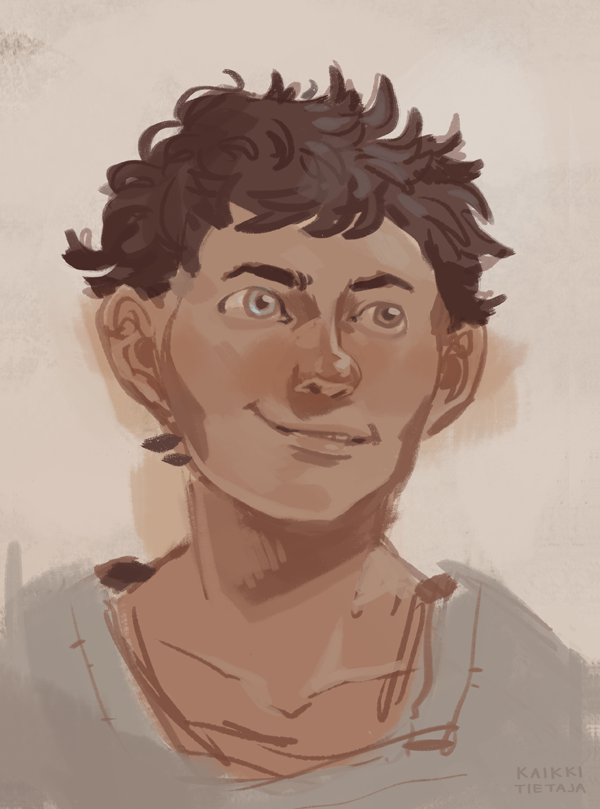
A Robin Hobb Rereading Series: Entry 229: Fool’s Errand, Chapter 9

Read the previous entry in the series here.
Read the next entry in the series here.


The following chapter, “Dead Man’s Regrets,” starts with an in-milieu musing on the decline of instruction in the Skill in the Six Duchies in the generations leading up to King Shrewd and the Red Ships War. It turns to Fitz waking in the night, concerned with the Fool’s horse, Malta. He rises to bring her in, finds her without difficulty, and takes his time in leading her back to shelter. He reaches out with and muses on his Wit-sense, considering his communion with the broader world as he does so.
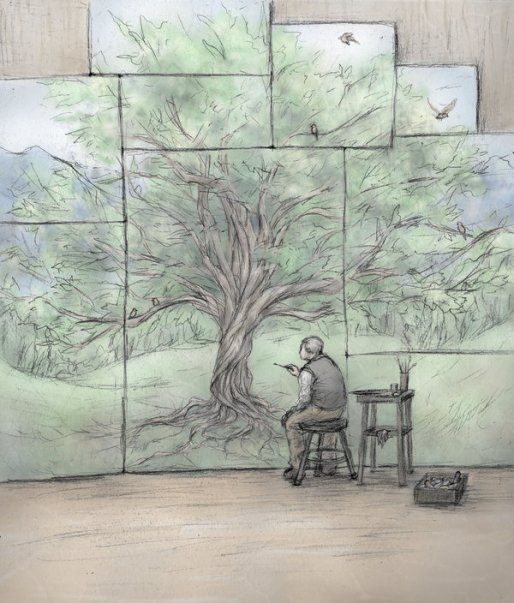
leaf_by_niggle_by_ejbeachy-d73mqau
An inspiration?
Image retrieved hence, used for commentary.

As he reaches out, he becomes aware of another Wit-communion, one shared between a boy and a cat. He sets the images aside, takes Malta back in, and retires again for the night.

The next morning, Fitz wakes refreshed; Nighteyes continues to rest and heal, and the Fool attends to some morning chores, marking Fitz’s appearance. They confer about Fitz’s life and circumstances, Fitz musing on the absent Hap and the Fool grousing about Starling, whom he dislikes. He lapses into his fey prophetic mood, and Fitz busies himself with tasks that bring him pleasure. So does the Fool, and Fitz finds himself waxing pensive again as he is prompted to resume his accounts.

His travels took him and Nighteyes to Bingtown and the Rain Wild River, and his Skilling took him to Burrich and Molly and Nettle. Driven by what he sees, he rushes to them, finding them well but older when he arrives, and stopping short of presenting himself to them. He also balks at considering Dutiful, who is the son of his body. The Fool prods him some more, and he begrudgingly acknowledges possibilities before they begin to make their way in to dinner.

I note with some interest that Fitz ascribes a sentient Wit-sense even to some of the trees around him. In that, I read an echo of the Tolkien whom Hobb is on record as prizing. The Prince of Fantasists’ fascination with and appreciation for trees is amply attested by many scholars of far more skill and erudition than I–Luke Shelton among them; for Hobb to point out the Wit-presence of a solid tree, when throughout the previous novels she had not done so, stands out, and the marked occasion invites attention. But it is not to be wondered at that an English-language fantasy author would echo Tolkien; there is a reason the Tales after Tolkien Society has its name, after all…
Help me keep going?

A Robin Hobb Rereading Series: Entry 228: Fool’s Errand, Chapter 8

Read the previous entry in the series here.
Read the next entry in the series here.


The next chapter, “Old Blood,” begins with a letter from Burrich to his counterpart in a lesser court, reporting on a particular charge of his. It pivots thence to Fitz, the Fool, and Nighteyes reaching Fitz’s cabin, exhausted by their efforts and wracked by the pain of Skilling. Nighteyes falls swiftly asleep; Fitz prepares doses of elfbark, availing himself of it before the preparations begin. As the two dose themselves with the plant, Fitz resumes his account of his and Nighteyes’s travels after the Mountain Kingdom, relating their experience with Black Rolf and Holly among the Old Blood community they had encountered previously.

image
Not quite so cheery at this point, no…
Image is facelessfrey’s Tumblr, here, used for commentary.

The community is glossed, and Fitz emphasizes his difficulties in keeping hidden among them what he needed–still needs–to keep hidden about himself and his past. That Black Rolf and Holly know his identity, he realizes, but he also notes that they helped maintain his ruse with the others. Fitz and the Fool eat as the former continues to talk about his experiences. He notes that his utter ignorance of Old Blood ways and customs grated on Rolf, as well as disturbing many others in the community; Fitz also muses on Burrich’s passive use of the Wit to oversee his own use of it in his childhood. He continues relating his difficult acculturation to Old Blood ways as he rehearses what he learned from the experience.

Among the things he sees is a joined pair, Delayna and Parela, a Wit-bonded woman and deer. The woman had died and had attached herself to the deer, denying either of them a full life in an attempt to preserve herself. Fitz notes his unease with seeing such a thing and with having done such a thing himself, although he notes that he does not fully understand the choice to do such a thing. And he returns to his narration around the discomfort of that consideration.

Fitz notes that the Old Blood community knowing his identity, as seemed certain, was a threat to him, and he and Nighteyes moved on when they could. The depressing effects of the elfbark begin to be felt, and conversation continues into the night, with the Fool turning to self-doubt and lamentation.

Given the continuing reading of the Wit as metaphor for homosexuality, I have to wonder at parallels with gay culture, though I am far from an expert in that culture; I wonder only, knowing I do not know enough to be able to make any meaningful comment about those parallels. Given the specifically communicative nature of the Wit, I also find myself wondering at parallels with interactions with and among Deaf communities–although I know with them, too, I do not know enough to make any meaningful comments. I can only hope that those among my friends and readers who are members of or more closely aligned with those communities than I will help redeem my ignorance in such things.

I do know, though, that the addictive perils of the elfbark come up once again, and that matters do not seem to be eased with the addition of alcohol to the night’s libations. It’s the kind of thing I saw no few times while I was working at the substance abuse treatment center, people trying to use one drug to blunt the effects of another, itself taken despite its known peril and effects because it works to address pain endured in the process of keeping body and soul together. I recall feeling pity for Fitz before; knowing what I know now, I feel it more.

I can always use more support.

A Robin Hobb Rereading Series: Entry 227: Fool’s Errand, Chapter 7

Read the previous entry in the series here.
Read the next entry in the series here.


The next chapter, “Heart of a Wolf,” begins with an in-milieu discussion of the Old Blood from Badgerlock’s “Old Blood Tales” before moving on to Fitz relating waking the next morning, taking in what seems to him a more vivid world. He regards himself, realizing he has been disguising himself from the world, and he and Nighteyes decide to discuss more of their past travels and experiences with the Fool. The wolf runs off, and Fitz returns to his cottage, its chores, and breakfast with the Fool.

Something like this, perhaps?
Photo by stein egil liland on Pexels.com

Fitz and the Fool confer about the former’s arrival at the cottage and the nearby ruined town of Forge. Talk turns to the work of Queen Kettricken to secure peace with the Outislands who had raided and ravaged the Six Duchies years before via a marriage of her son, Prince Dutiful, to a narcheska–“A sort of princess,” as the Fool relates, or “At the very least, a daughter of some powerful noble”–from that region. As they go on, Fitz feels pain from Nighteyes and rushes off to aid him, the Fool following. Fitz finds the wolf choking on fish and frees the obstruction, only to feel pain emerging in the wolf’s body from another source. Failing to reach the wolf with the Wit, he Skills into him, becoming suddenly and strangely aware of the wolf and compelling the old animal’s body to work. The wolf protests, and Fitz has trouble returning to his body again, struggling to do so and eventually succeeding with some help from the Fool. The experience upsets all three, and it takes some time for them all to begin recovering from the inadvertent hurts inflicted upon one another. Raggedly, slowly, they three return to Fitz’s cabin.

The present chapter raises an important point regarding consent for medical attention–even lifesaving medical attention. Both Fitz and the Fool plunge recklessly into another to save their life; Fitz delves into Nighteyes, and the Fool into Fitz. Both who receive the treatment resent it, even as they recognize it saved them to receive it. The Fool claims a higher purpose, needing Fitz to effect positive change in the world; Fitz is, frankly, selfish, although a kind of selfish that evokes some sympathy. After all, even a beloved pet commands no small devotion, and Nighteyes is more than a pet to Fitz; the two are more a hybrid being than two separate entities, and it makes sense for people to try to save parts of themselves as well as those whom they love. Even so, the acts do deprive those who receive them of some of their agency, making for some complicated ethical implications and calling for some deeper thinking. As good reading should.

Care to send me some support?

A Robin Hobb Rereading Series: Entry 226: Fool’s Errand, Chapter 6

Read the previous entry in the series here.
Read the next entry in the series here.


A chapter titled “The Quiet Years” follows, opening with a reminiscence from Fitz about his birth and upbringing, his efforts at creating a coherent history of his nation. He follows by glossing over the next days with the Fool, who seems to seamlessly reintegrate himself into Fitz’s and Nighteyes’s lives. At length, they exchange more reports of their time apart, Fitz relating his life since the Fool left him at the dragon garden in bits and pieces, keeping himself from relating some of his deeds and losses. He does, however, dwell upon having visited Verity-as-Dragon, as well as a place where he saw a vision surrounding the Fool.

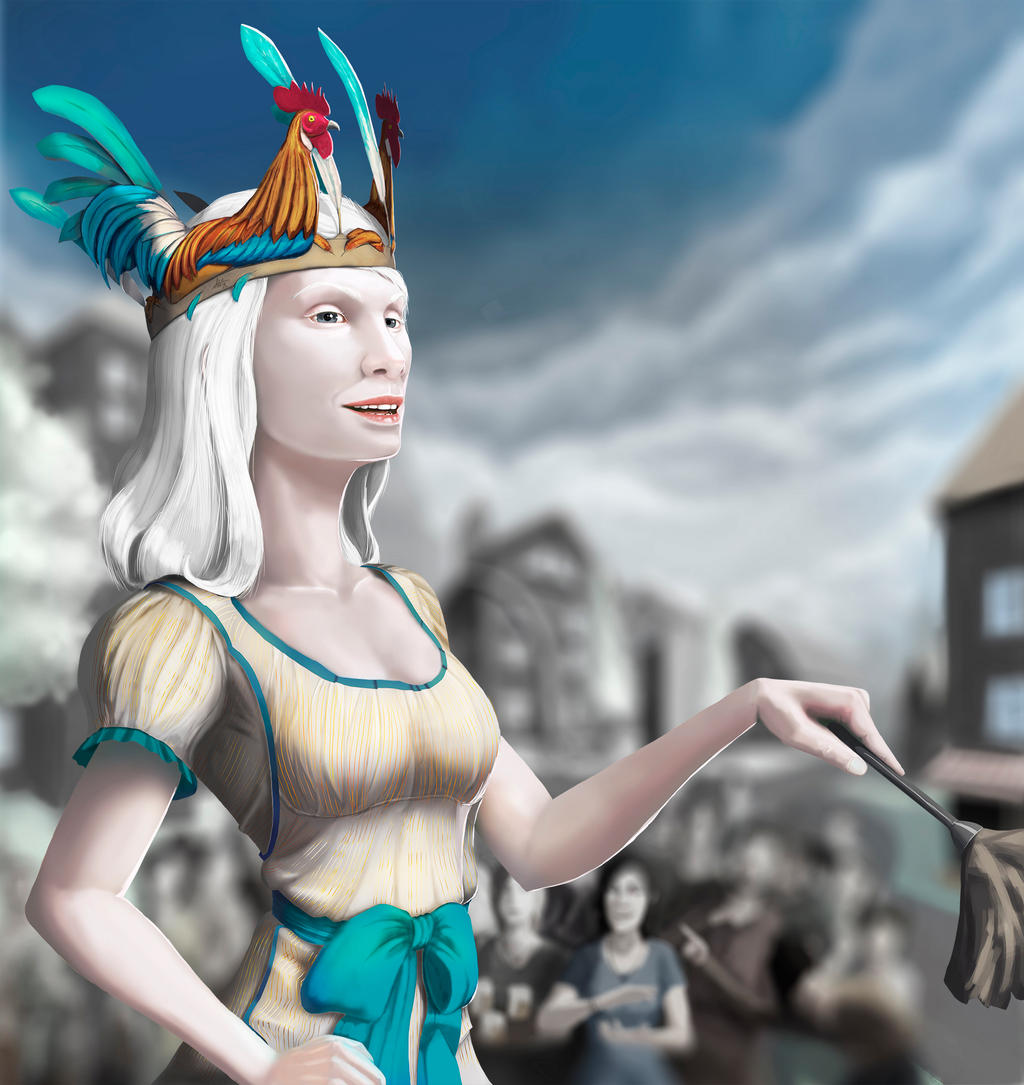
The Rooster Crown
This came up again…
The Rooster Crown by AreyMA on DeviantArt, here, used for commentary

The Fool presents the crown worn in the vision and places it upon his head. Nothing happens, surprising both of them. Fatigue and drink overtake them, and Fitz retires for the evening.

I am taken by the reminiscence with which the chapter opens. I’ve noted before the Asimovian move of grounding chapters in in-milieu reference materials, something I appreciate, being a scholar prone to grounding my own work in reference materials from my own milieu no less than a long-time reader of the Good Doctor. Accordingly, the device attracts my attention readily, and I am all too happy to pay that coin. And in the present case, the opening passage is particularly compelling, the piecing-together of disparate and not always complete sources being something with which, as a medievalist, I am familiar. Similarly the concern about possibly perpetuating the errors of others–intended or inadvertent–is one with which I struggle; I work from sources, cited and remembered and internalized to the extent that I do not always know where they end and I begin anymore, and like all things human, they are subject to error and to being superseded, to having their mistakes and failings pushed forward by my work and made, in part, my own.

Too, there is the metaphor at the end: “A child sees the acorn of his daily life, but a man looks back on the oak.” Aside from the somewhat problematic nature of gendering–Hobb is on record as affirming her continued use of the masculine as the default neutral, a practice with which I disagree, and I am far from alone in it–there is a lot to unpack. It is, of course, inexact; a child and an acorn are not at the same stages in their respective developments, for one thing. And, as a Texan, I am aware of many uses of good oak wood; it makes for tasty smoked foods, among others. Too, an oak is more prone to break than to bend, even if it can endure a damned lot before it does; I have to wonder, as I think on it some more to write this, if that doesn’t actually justify the masculine pronoun, an unwillingness to adapt being often taken as a hallmark of toxic masculinity. It’ll bear more consideration, I think.

And, yes, this ties in. It’s the same crown.

I can always use your help!

So, I’m Back in the Classroom Again

It is no secret at this point, as this and this make clear, that I have returned to classroom teaching. I’m still considering how to go about the work again, as I am aware that what I did in the college classroom is not always appropriate for a high school classroom. (Some of it wasn’t appropriate for a college classroom, either, really.) I can’t just translate it directly over, so I have to review practices individually to determine what will work as is, what will work with modifications, and what has to be dropped entirely. At least for now.

Something like this, yeah.
Photo by Pixabay on Pexels.com

One of the things I did while I was teaching college was post class reports in this webspace or its predecessor. I don’t think I’ll be doing that with the high school classes. There’re a few reasons. One is that I think I need to keep some separation between this space, which will follow me if I move again, and my classroom-bound teaching. I mean, yes, I’ll draft materials here that I use there, but direct linking…is probably not advisable.

Another reason is the simple one of overload. I’ll be teaching seven classes this year. It’s a lot. I’ll have all the grading to do, too. Consequently, a lot of my mental energy will be taken up with working on, well, work; it won’t leave quite as much as I would like for classroom reports to populate to this space.

And there is this, too: the school website. I’ll be teaching with resources, and I’ll be putting things into those resources as much as anything else. There may be copies elsewhere–here–that get used as resources for other things, but there’s only so much duplication I can stand to make happen. The class reports for the daily class meetings will be a casualty of that.

I do still mean to compose end-of-year reports, though. Those, I should be able to do…

I remain appreciative of support?

Another Rumination on Labor Day

A year ago, I had a piece about Labor Day post. In it, I voice something of a polemic about the strained regard in which workers are held. Now, a year later, with support structures falling away and complaints about “nobody wants to work” echoing more and more loudly, I know that I would be apt to more…emphasis and urgency if I were to return to such a thing in earnest.

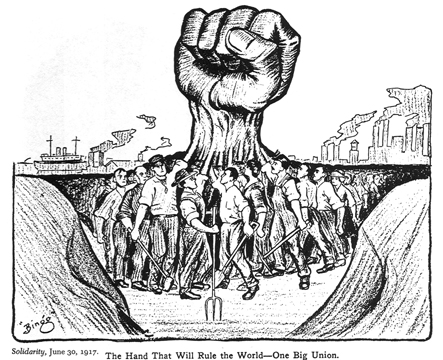
A promise, amended and yet to be fulfilled.
Source in image, used for commentary.

My building anger is fanned somewhat by my looming return to the classroom–I start back teaching tomorrow. Ostensibly, there is some organization to the labor of teaching, although Texas being Texas–I know, believe me–the power of that labor is…limited. Sharply.

Yet this year, I can raise my fist in solidarity once again, being no longer management or administration. I can raise my voice in support of the workers of the world, of which I am one once again, and gladly. And I can continue to work towards a world in which the work a person does, any person, rewards them fairly and offers them the chance to support themself and their family.

We certainly still have a long way to go.

Support this worker?

A Robin Hobb Rereading Series: Entry 225: Fool’s Errand, Chapter 5

Read the previous entry in the series here.
Read the next entry in the series here.


The next chapter, “The Tawny Man,” opens with what seem to be Fitz’s later recorded musings on the Old Blood and its presence in the lands claimed by the Six Duchies. It turns to Fitz rehearsing the passage of time while Hap is away, things going generally well despite Fitz longing for something else, for which Nighteyes chides him.

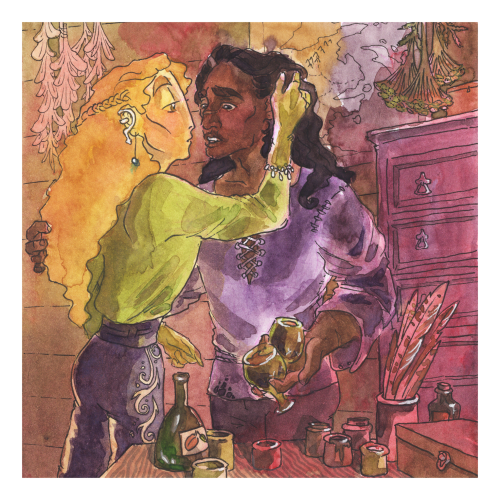
Reunion
Illustration series for the Fool’s Errand by Robin Hobb
Always good to pull from here…
Image is Reunion on Katrin Sapranova’s Tumblr, here, used for commentary

They are interrupted by the sudden arrival of a mounted visitor, whom they are surprised and elated to see is the Fool, almost unrecognizable for his golden hue. They begin reconnecting almost immediately, returning swiftly to their old friendship, and the Fool makes a brief loan of his fine horse, Malta, to Fitz, who delights in the brief ride he takes upon her and returns to his home to find the Fool preparing dinner. They sit to eat and confer, the Fool noting that he has returned to Fitz to employ him again towards creating a better future. The Fool also notes being exceedingly wealthy from adventures near Bingtown amid their conversations, and they give each other broad information about their years apart. The Fool presses for more, noting that he will be staying, and they go to bed, the Fool offering his old teasing once again as they do.

I do note with some amusement that the Fool named his horse Malta. It’s another clue about something that emerges, as memory serves, more fully and explicitly in the text of the present novel; the book’s old enough that spoiler warnings don’t really apply, but I’ll still hold off on the discussion–even if it should be pretty obvious at this point.

I’m taken more by the depiction of the friendship between Fitz and the Fool that presents itself in the present chapter. It seems to me an enviable thing, even if I am not entirely sure how I ought to read it. After all, it is a work of fiction, and fiction focuses and accentuates by its very nature; done well, it gives the appearance of truth without pretending to be the truth, denying that it is the truth in its very name, but that does force the question of whether any or all of what it depicts is, in fact, a lie. Can such friendships only exist between such as the Fool and Fitz, neither of them beings that could exist in the readers’ world? Or is the friendship one of the most human things about them, the impossible characters made to seem more true because they have something which some share and to which others aspire? It goes to the very value of fiction as a practice; it is a question with which I grappled and will soon help others to grapple with as I continue to ponder what focus my classes will have, generally and in this instructional year…

My teaching starts again next week; kick in to help?

A Rumination on the Ending Job

I noted not long ago that I am soon to take up a new position, teaching high school English in Burnet, Texas. As I write this, as it is published, I remain where I have been these past four years–and it is just over four years–the Hill Country Council on Alcohol & Drug Abuse, Inc. (HCCADA), a substance use disorder treatment center in Kerrville, Texas. I am grateful to the organization for having afforded me the opportunities it did, for giving me a chance to make a living or myself and my family, and while my exit has been quicker than I’d like–I was recruited with some urgency–I wish the organization and its employees, my coworkers, all the best as they move forward.

Still here, but not for long.
Image from hccada.org, used for commentary.
Donations are tax-deductible.

I’m leaving more or less as a new fiscal year for the organization gets underway; it begins today, in fact, although I will be on site through 3 September 2021. I like to think I’ve left the organization in a good position–I know I have financially, having brought in more money during the just-ended fiscal year than I had any right to do, and building maintenance ought to be caught up for a good long while, now. I’m confident that my successor in the leadership role will be able to make good use of the situation, helping HCCADA to make it through at least another thirty years.

It’s true that I have some mixed feelings about the whole thing. I’ve been in leadership at HCCADA for some years, now, and I’ve had a great degree of autonomy in that time. I’m familiar with the rhythms and the needs of the organization, and I’ve got a good working relationship with the people the organization needs to have on its side; it’s a good place and a comfortable one, and there’s always some regret in leaving such a situation behind. Again, it’s been a good job, and it’s been good for a while; I’m not being chased out or undercut, so I have only appreciation for what I’ve had here.

That said, as I noted in my initial announcement, the classroom calls, the Crystal to my Skeksis. I have wanted to teach for longer than I now remember, and even my willing departure from the classroom at the end of 2019 was…a loss, as those closest to me know. No, I am going back home in a significant way, and while my visit (?) to the “real” world has been a pleasant one, all visits have to end sometime.

Once again, the work will begin.

New fiscal year, new plea for aid.

A Robin Hobb Rereading Series: Entry 224: Fool’s Errand, Chapter 4

Read the previous entry in the series here.
Read the next entry in the series here.


The next chapter, “The Hedge-Witch,” opens with a discussion of a hedge-witch and her magic’s efficacy before pivoting to Fitz and Hap moving through their summer together, Fitz considering apprenticing the boy in or near Buckkeep and denying that he postponed to avoid the pain of parting from him. He also mulls over the effects his most recent meeting with Starling has had on him, as well as on the passage of time’s effects on Nighteyes.

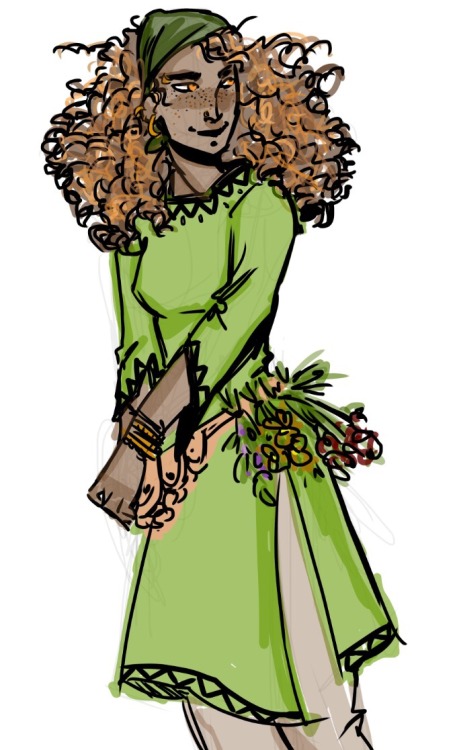
meidiama:
“Ok, so I’m only a few chapters in, but I had to draw something, so here’s Jinna the hedge-witch
”
The titular Jinna.
Image from Talking about the Weather, used for commentary.

When Fitz, under his alias of Tom Badgerlock, and Hap visit a nearby market town, they meet a hedge-witch Hap had first met in Buckkeep: Jinna. Introductions are made and characters are described, and Fitz is distracted as Hap invites Jinna to stay with them when she passes that way. Fitz rehearses what he knows of hedge-witches as he observes Jinna peddle her wares until a neighboring farmer, Baylor, arrives. Baylor insinuates that Fitz or Nighteyes has taken some piglets he had had, and Fitz braces for a fight with the man, citing his traumas as impetus for his tendency towards violence; the attitude cows the man and intimidates many onlookers, and conversation swiftly shifts to perceived depredations of the Old Blood. The rest of the day passes uneventfully; Jinna sells much, while Fitz and Hap do not, and they fret over the apprenticeship fee to come.

Later, as they head home, Hap asks Fitz about his origins. Fitz is moved to sympathy, and they make their way to their cottage. Along the way, Nighteyes queries Fitz about the decision to send Hap to an apprenticeship and travel, regarding both ideas as foolhardy. At the cottage, Hap and Fitz confer about the apprenticeship fee, Hap offering to hire himself out to raise the money, and Fitz takes inordinate pride in the young man.

That night, Fitz dreams a Skill-dream, communing unknowingly with a young man at Buckkeep and with a cat. The latter attracts Nighteyes’s attention, and both settle back into sleep. The next day sees Hap strike out to raise money, and Fitz somewhat listlessly attends to domestic tasks, drawn to Skill and resisting it. A not-much-later evening sees Jinna call on him, availing herself of the offer of hospitality made at the market; she reports having met Hap on the road, and the two pass a convivial evening together. They confer about reading and education, disagreeing on some particulars but agreeing on several points.

The next morning sees Jinna and Fitz make a trade of goods. As they do, Jinna susses out that Fitz is of the Old Blood, and Fitz is convinced of the efficacy of Jinna’s hedge-magic as well as unsettled by her insights. But they part amicably with something of a promise to meet again.

Interestingly, while there’s some mention of other magics in the Six Duchies than the Skill and the Wit, there’s not much explication of them prior to the present chapter. Hobb doesn’t do as a number of other fantasy authors do and lay out a system of magic (I recall Lyndon Hardy for some reason), but I have to wonder if it’s not precisely in the elision of systemic detail that Hobb is able to achieve the verisimilitude for which she attests striving. Getting mired in details offers opportunities for getting the details wrong, or in running into contradictions with them–plot holes that annoy no few readers (among them me, when I notice them). Glossing minutiae avoids that problem, even if it does force the writer to strike a careful balance. Enough has to be depicted to be distinct, but not so much can be depicted as to run into the aforementioned problems. Hobb manages it well in the present chapter, which helped me read the book the first time–and has helped me reread it once again.

I’m about to start back up in the classroom; help support my teaching?

A Robin Hobb Rereading Series: Entry 223: Fool’s Errand, Chapter 3

Read the previous entry in the series here.
Read the next entry in the series here.


The following chapter, “Partings,” begins with “cited” commentary on the Wit before moving to Fitz watching as Hap falls asleep at the fireside. Leaving Nighteyes with the boy, Fitz returns to his cottage, musing over his arrival at his present life from the Cleansing of Buck and the reintroduction of Starling into it amid assignations. He contemplates the looming finality of their relationship, as his own codes will not permit him to knowingly cuckold another. Starling does not take the news well, seeing rebuke–to some degree rightly–in it.

kaikkitietaja:
“A quick painting of Hap because I really want to draw some pre Tawny Man art of him and Tom later c:
”
Hap…
Image from Prophets become Catalysts, used for commentary.

Starling also lets slip that she had known Chade had visited, and Fitz pieces together that she has been an informant for his old mentor for some years. She also lets slip that tensions between the Six Duchies at large and the Old Blood population within it are rising, with a partisan group among the latter–the Piebalds–presenting trouble. The story underlying the group’s name is explicated, and Starling notes that there is some suggestion that Fitz yet lives. She also relates more news and rumor concerning the Old Blood in the kingdom, as well as actions taken against them. Involvement in such matters by Kettricken and Chade is noted, too, just before the hurt between Starling and Fitz is reawakened. Hap ventures in at about that moment and receives the brunt of the minstrel’s tongue, and Fitz rather flatly sends Starling away. A sense of something new coming prickles Fitz as she departs.

That something else is coming is clear, of course, from it being only the third chapter of the novel. That so much of the chapter is taken up with explication doesn’t hurt that, either–and there’s some value in putting that explication in the mouth of a minstrel, a sort of traveling memorial in the Six Duchies; it makes sense for such a person to hold forth on events throughout an area. (I’ll note, too, that some of the commentary looks ahead to another of Hobb’s works; I’ll end up treating it in the reread, I’m pretty sure, if not for a long while.) So that much reads as authentic, organic, consonant with experience and observation; it’s a good thing.

Less good, although not dissimilar from events in the readerly world, is the continued treatment of the Wit magic as metaphor for homosexuality. Again, the metaphor will be substantially frustrated, and in the present series, but, as in the Farseer novels, the magic–an inborn quality–is still linked with depravity. It remains…uncomfortable, but my comments about discomfort continue to apply. And what is my discomfort reading against that of those who do suffer under such an onus? It’s something to keep in mind…

Help me round out the month the right way?