They talk so often of Not being sheep Not wanting to blindly follow along But then themselves Run to the bell that rings And eagerly look To be grabbed by the crook
Not so seasonal… Photo by Polina Tankilevitch on Pexels.com
Possessed as I am of A curving horn I’d Gladly oppose to Some other’s head or butting I’ve no desire to be shorn
Too often The cutter comes too close Taking more than what grows back easily
I am happy to write to order, whether that’s verse for your use or lesson plans for your students at home or in the classroom, or something else entirely. If you’d like to place your order, fill out the form below and get the information you need to make your best decision!
Read the previous entry in the series here. Read the next entry in the series here.
Following a brief missive that warns of illness among the cotes, “Dragon Dreams” opens with Sintara dreaming of easy flight and a full belly as she returns to Kelsingra. The dream consists of ancestral memories, tantalizingly incomplete, from which she wakes amid a storm, cramped and cold and hungry. Grousing about Thymara and the other keepers, and the arrangements they have made, she reviews the current situation and stalks out into a nearby meadow. There, she reflects further, and she begrudgingly attempts to practice flight in the pre-dawn dark.
Not quite… Image from Universal Music Group, here, used for commentary
Meanwhile, Alise huddles against the inclement weather, reflecting on her situation (taken regularly to Kelsingra by Heeby) and the likely whereabouts of Leftrin (aboard the Tarman, nearing Cassarick), mourning for the changes she know will come. She determines to wander and take in all she can of the city, and her progress through it is described. Exploring, she finds a room carved in figures of jesters and performers, which she accidentally activates with a touch upon a vein of magic in the stone. It startles her momentarily, and she soon mourns for what she knows will be lost.
Alise leaves the room, finding the weather cleared and herself recalling Leftrin’s words to her upon his parting a month previously. She settles in to eat lunch, forcing herself away from thoughts of material comforts that intrude upon her, and her continued survey of Kelsingra is detailed. Proceeding further, Alise finds herself surrounded by the memories embedded in the stones of the city, losing some time amid them. As she goes yet further, though, she finds a room that seems to have been despoiled already, which revelation angers her, and she blames Rapskal for it. She does realize, however, that the room in which she finds herself shows a map of Kelsingra, which revelation brings her hope, and she makes her way out to where Heeby awaits her.
The present chapter reflects at some length on the likelihood of destruction in the interest of moneymaking. I cannot help but see a number of parallels at work, both to the early United States (to which I have long held the Traders are akin) and to contemporary events. Alise’s lament that the statues of Kelsingra will be pillaged, the worked materials separated from their contexts and auctioned off a piece at a time, is one that echoes comments about older (and still too-current) museum and antiquary practices, such things as have led to bits and pieces of grave offerings and monuments being taken across countries and continents, displayed as showcases for passers-by to gawk at them or hoarded in collections so that dragon-like collectors can gaze upon them in greedy delight, taking them as evidence of their superiority. And they also seem to ring to me of the kind of comment I hear from folks who’ve lived in the Hill Country longer or more continuously than I have, that people coming in and building up what had previously been rolling hills of oak and cedar and mesquite that echoed flatly in the still heat of summer air ruins the very thing that they seek who come here.
It is a mark of good artwork in any medium that it speaks both to contexts of composition and contexts of reception clearly.
It is of some interest to me that, for all the work that the Rain Wilders did to harvest the leavings of the Elderlings’s other settlements, they seem to have little understanding of what those things harvested do. Admittedly, the Skill seems to be largely a thing of the Six Duchies, but, given broader contexts, it does seem bound up with the Elderlings, and it is strange that the calling-ritual conducted in the Six Duchies would have found no respondents among the Rain Wilders and Bingtowners, especially given that those touched by the Rain Wilds are suggested to have some sensitivity to the Skill. It’s another instance, to my eye, of problems attendant upon canon-welding, but, while I might note that a thing is there and causes some issue, I acknowledge that I have not the insight or ability to offer any advice. And it would be presumptuous as all hell to think that I ought to, anyway.
Need some writing done to order–all human-done, no AI? Let me know with the form below!
The burn bans are back on Sensibly enough Red-lettered signs standing at the edge of each precinct Prayers that some random spark will not become A conflagration that will consume all it touches
The question I have is How long will it be until Somebody thinking himself– And it’s not every man But it’s always a man As the saying goes– Some kind of pitmaster Skilled beyond the ken of those who Do the work day in and out And know better than to light up their grills In the dry heat and stiff breezes Will determine that his right to a well-done steak Trumps the rights of other not to be cooked
I remain happy to write hot stanzas for you–in any season! Let me know what you need via the form below, and we’ll get started!
I‘ve long since learned the lines prescribed, Measured the mind-ways that must be observed, Rituals recalled, planted by rote, Formulas falling, foals from their dams, And often recited them. Each has its aim, Purpose for the people it presses its way.
They make up a mask I must wear in the world, Face-saving façade of fluid appearance, Selected for scenes whose steps are determined By directors long dead and gone into dust. Heavy their hands are, hard on the shoulders, Firm in their grip as Grendel’s grim ending.
If you like how I write and want me to write for you, please fill out the form below!
Read the previous entry in the series here. Read the next entry in the series here.
After a missive noting formal complaint of message tampering and advising caution and documentation, “Marked by the Rain Wilds” opens with Malta and Jani Khuprus conferring together about the former’s plans. Malta notes her intent to accompany Reyn to Cassarick, hoping for news of the Tarman. The relationship between mother- and daughter-in-law is glossed, along with the history of the Rain Wilds Traders and the tree-cities they built. Jani advises Malta to dress to impress, and the two talk frankly of pregnancies and miscarraiges. Business partners’ labor practices are discussed as matters of concern, as well, as are concerns of integration of the Tattooed into Rain Wild society.
Talk returns to Malta’s pregnancy and the difficulties attendant upon it, not only those for pregnancies in general, but also the specific concerns that the Rain Wilds impose. The stark choices that face Malta–and all mothers in the Rain Wilds–are noted, and Malta’s reactions to them are glossed as she tries to distract herself with necessary tasks. She also reflects on her personal history following her reception by the Satrap. The reverie and discussion are interrupted by Reyn’s arrival and jesting with his wife and mother. Jani excuses herself, and Reyn conducts his wife to their waiting transport, the pair joining Reyn’s sister, Tillamon, along the way. Some tension with Tillamon is noted, and the group proceeds.
As they make for their ship, the River Snake, developments in shipbuilding and the implications for Rain Wild trade are discussed. The trio boards and is scarcely settled in before the ship gets underway, and Malta finds herself considering herself and her sister-in-law, and talk turns to that end briefly before going to concerns of pregnancy and midwifery. The dragon keepers are cited as beacons of hope for children who would otherwise be discarded, and Malta and Reyn determine to leave the fate of their coming child in divine hands.
There are several clear parallels that arise for me as I reread the present chapter. I’ve noted before my interpretation of Bingtown and the Rain Wilds as a gloss on the early United States. In keeping with that, I have to read the discussion of the Tattooed as a parallel to those surrounding enslaved populations in the United States and the ongoing effects of that ancestral wrong that persist into the present day. I’ve also noted having long lived in central Texas, and so I cannot help but read in the present chapter echoes of discussions surrounding immigration that I have heard and still hear, and not always gladly. Both sociohistorical items are heavily racially charged, and in the novel, the parallels are also based around what might well be termed racial or ethnic divisions (largely but not exclusively indicated by skin, in the event). There is the usual frustration of the parallels by Hobb; the Tattooed are marked as such, rather than born as such, and the Rain Wilds Traders are not the icons of “purity” upon which the wrong-headed racist / ethnocentric / supremacist discourses Hobb obliquely references (deliberately or otherwise does not matter) rely. They yet remain clear enough to be issues of discussion, however, both in themselves and in how they reinforce ideas of the sourcing for the Elderlings novels.
Another that comes across to me is the parallel between the discussion of Malta’s pregnancy and discussions of abortion and other reproductive rights. When the novel was published, in 2012, arguments surrounding abortion rights were particularly heated in legislatures, with a remarkably high number of restrictions on those rights put into place. I reread the chapter now and write in the wake of the 2022 Dobbs decision. Other, lower-profile, pieces of legislation addressing other reproductive rights has crowded in between, much of it conducing to strip from those who must bear the burdens of reproduction control of that reproduction. “Just keep your legs closed” is not good advice (though “keep your pecker in your pants” is). It’s a concern that emerges repeatedly in Hobb’s work, the Realm of the Elderlings and elsewhere (as noted here, among others), and it’s one with which people still too much grapple, usually to the detriment of those affected.
I’m happy to write to order for you; fill out the form below to let me know what you need!
Summer is in full session in the part of the world in which I live, the Texas Hill Country. Already, there have been days with high temperatures above 100ºF / 37ºC, whose lows were themselves quite high; already, the ground begins to crack from thirst, and some creeks are running dry that had flowed far more freely. Nor is this the worst of it; August has yet to arrive, and it is August that treats this part of the world as a blast furnace. Bodies exhaust themselves trying to shed heat into the heat, and, fatiguing, people feel their tempers fray faster than in fall or winter or spring. It is likely the case that the heat has killed some here already this year; it is a certainty that more will die from it than have, as any who have lived here and listened or looked will know and as any who do for any length of time will find.
Matters are somewhat improved. Photo by Dominika Roseclay on Pexels.com
It is a beautiful place, but it is not necessarily a kind one.
Even sitting comfortably where someone else has to pay the power bill to keep the air conditioning running, I find myself battered by the brightness outside, laboring under the feeling of heat that inescapably rises from seeing the rippling rising from the pavement, warping the images of the fading green leaves beyond. Something not water seems to coruscate upon the pale ribbons that tie our towns together, glitter bedecking the gift that is this part of the world, however hot it is and will be for the coming weeks.
Because, again, it is going to get worse before it gets better. And although I have lived through this swelling cycle many times, and although many have done so more times than I and with less support than I enjoy in my indolence and ease, there will be no few who suffer for nothing that they have done other than to be where they are, bitten badly by the dogs of these days.
I can only hope they’ve had their shots.
Do you like how I write? Do you want me to write for you? Fill out the form below, and we’ll get started!
Screaming into the open air until My throat is torn and still Screaming up the bloody hunks Hoping that having to stop and Scrape some part of me off of their faces will Make them pause long enough to look at The world they are helping make Tinted red by something not a sunset And stop in horror at how the hue Ruins all the views they had thought to have
Oh, no, there’s no metaphor here; why would you think so? Photo by Lisa Fotios on Pexels.com
They do not listen Of course And why should they when They bathe so gladly Drink so deeply Of the wine of which I am a fountain But one more small faucet pouring out upon them And stay drunk on the spirits they ingest ?
When the time comes that They must sober up And they see what covers them And the long line of those who Wounded Have yielded it Who will then have the axe in hand And swing it one more time?
I am pleased to offer custom writing–all by human effort, with no AI! Want to know more? Fill out the form below!
Read the previous entry in the series here. Read the next entry in the series here.
Following advice of a reward for information about Sedric and Alise from their families and an accompanying brief message to Detozi that notes questions of transmission integrity, “A Bingtown Trader” begins with Hest surveying Alise’s chambers in his home. He muses in annoyance on the chambers and their erstwhile occupant, and he fumes at the expense of having taken Alise as a wife and the pretense that his doing so enacts. The implications that Alise and Sedric have run off together, though Hest knows them to be false, rankle and affect his business dealings, annoying him yet further. His steps against his lover and his wife are rehearsed, and his reverie is interrupted by a visitor from Chalced.
Oh, right. This guy. Image for commentary, of course.
Hest seeks to rebuke the visitor and is assailed for his troubles, soon pressed hard for information he does not have about Sedric’s dealings with Chalcedean agents. He is also conscripted into Chalced’s mission to acquire dragon-parts for their ruler’s health, given grim reminders of the importance of that mission to deliver.
It would seem to have been a while since Hest last appeared “in the flesh” in the narrative, as such; he is referenced and recalled, but to have him present in the narrative present is not something that happens often. And that is likely for the best; he is, as has been remarked on more than one occasion by more than one character, an unpleasant person with few, if any, redeeming qualities. Admittedly, Hobb has dwelt on such characters more than once before; depictions of Will and Regal in the Farseer novels come to mind, as do depictions of Kyle Haven in the Liveship Traders novels. Still, that Hest has only this brief direct part in the narrative after so long outside it seems marked, suggesting to my mind that he is functioning as a place-holder and character-type rather than as an actual character. That is, Hest is not important to the narrative in himself so much as he is important to the narrative for his interactions with other characters.
The potential problem that arises with this is that characters who are treated in such ways tend towards enacting and reinforcing stereotypes. Used for their narrative functions rather than having their development presented and explored, such characters do not invite the level of craft and attention that more focal figures receive, and it becomes easy to present them via a kind of short-hand, evoking or outright presenting types likely to be taken in and understood by broader readerships–and, all too often, those types are unflattering representations of classes of people. That they are so easily accessible is the result of long years of infelicity and worse, problems likely to continue because they continue to be used with minimal critique in the media people take in.
If you like the writing I do and would like some done for you, fill out the form below, and we’ll get started!
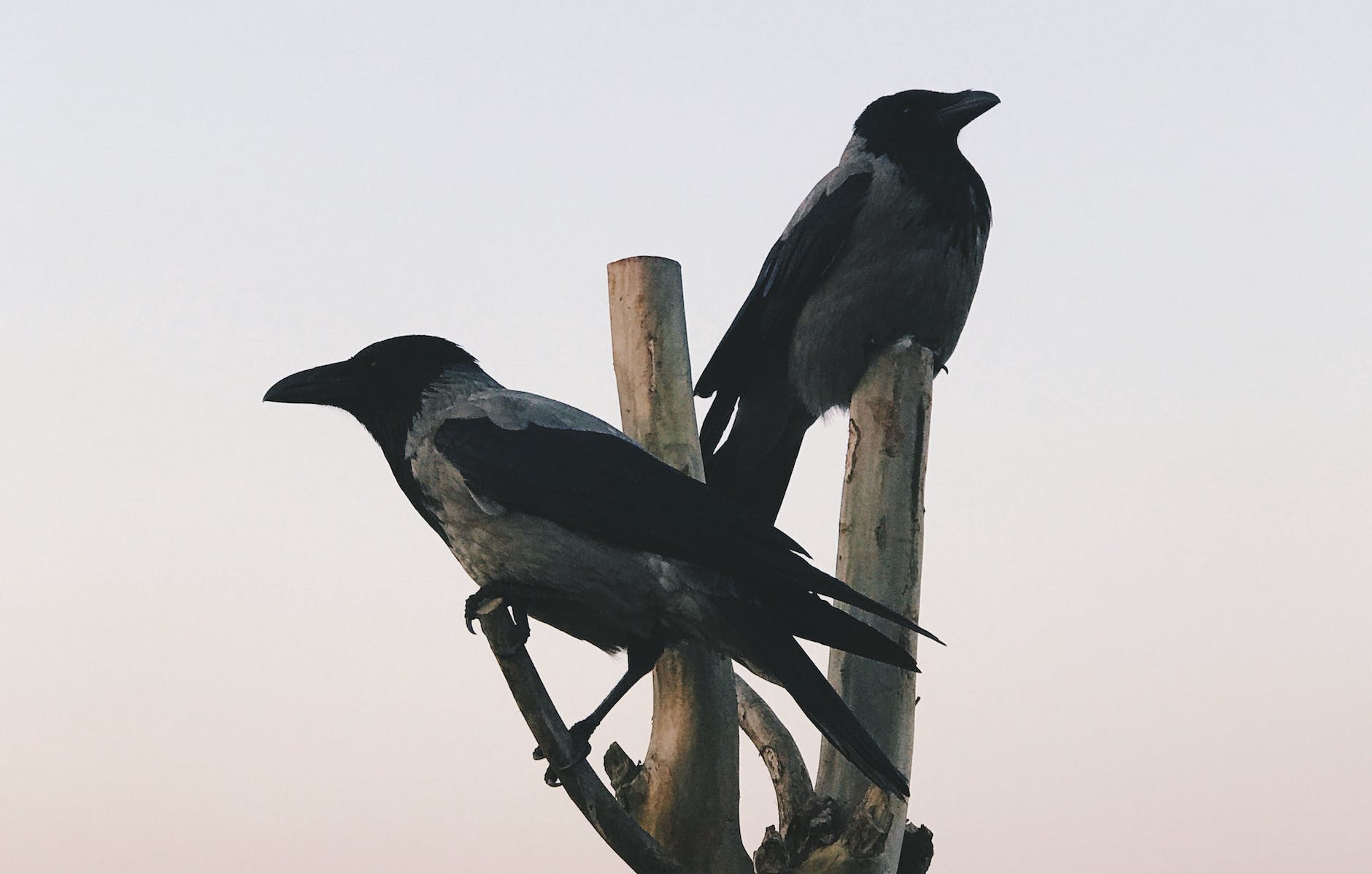
I had been hoping to hear Wilson, Ballard, and McGlown Harmonize over sweet horn-work But I am stuck with lesser writers than they had Who pen far poorer songs for singers who should Not so much as audition for the frogs’ parts Or the crows’
There can’t be any deeper meaning here, can there? Photo by Sami Aksu on Pexels.com
The latter Of course Got many auditions And are amply cast Richly costumed And if there are a few who play the ravens’ parts Thought and memory perching on the shoulders of the mighty Whispering what is needful to hear There are more who croak out corpse-breath with glee Before bending their beaks to feast again
Maybe you need some help with your song lyrics? I can provide that help–at reasonable rates and with no AI hiccups! Curious? Fill out the form below for details!
Last week It was clear that Notus Servant of Aeolus and son of Astraeus Stopped off for a bite to eat along the way
Oh, yes! One of many images of good eating from a Hill Country restaurant, used here for commentary
He had the migas plate I am sure Possibly the chilaquiles Definitely several cups of coffee Maybe another side of refrieds or Extra el charro Which he shared with us only later If in abundance
I’m pleased to offer focused, to-order compositions, all person-written–no AI! If you’d like one (or more!) for yourself, fill out the form below!





 Elliott RWI