I used to drive a lot Threading my way through the byways And speeding along the highways Knowing where I was going and Skipping the scenery along the way as I Made sure that I got there
I might be over on the sidewalk… Photo by Pixabay on Pexels.com
But the car I drove then has gone away Sold to cover one debt or another And I’ve lost track of how much I owe to how many people And I managed to get by on buses and trains for a time Since I lived where they run And still knew where I was going And hurried along to get there Focusing on how and how quickly Not thinking about why
I had to buy another car When I moved away from there Not because I’d stumbled upon Texas tea Not because I moved to Beverly But because I still thought I knew where I was going And thought I’d found a shortcut to get there And I was wrong on both counts
Here, I’ve bought another car And I putter along the local roads where I learned to drive Again Moving more slowly as others race by me Remembering when I was one of the ones who sped on Having somewhere worth being Being someone worth having
Like the writing that I do? Reach out, and I can do some for you!
Read the previous entry in the serieshere. Read the next entry in the serieshere.
Following a message between bird-keepers, the final chapter of the novel, “Decisions,” begins with Leftrin glossing days of the journey upriver. His increasing infatuation with Alise receives some attention, and he notes the changes to both dragons and keepers that have occurred. To his eyes, the keepers are becoming a community, and he finds himself wondering whether he must enforce the Rain Wilds’ customs regarding romance.
For a little extra variety… Photo by JJ Jordan on Pexels.com
Leftrin’s reverie is broken by Sedric’s approach, and his appearance is detailed. Sedric berates Leftrin for his conduct towards Alise, which accusations Leftrin denies, but Sedric’s explications of the social consequences takes him aback. Sedric presses on Leftrin to send him and Alise back downriver in haste, but their conversation is interrupted by a cry from shore, where the keeper Sylve notes the rapid decline of the copper dragon she had tended.
The other keepers attempt to comfort Sylve, and Mercor asserts the claim of the other dragons to the flesh of the soon-to-be dead copper. He urges the keepers other than Sylve to depart, and he tells Thymara Sintara’s true name. Sintara is displeased, but Mercor presses ahead.
Alise considers her situation in some distress, mulling over possibilities and her own growing infatuation with Leftrin. The paucity of her relationship with Hest contrasts with those possibilities, but she is shaken from her reverie by the tumult ashore. Setting aside Sedric’s protests, she makes to observe the proceedings, and Sedric is left to mull over his own fading possibilities. His continued attempts to take pieces of dragon for sale are noted, amid which, he tastes the dragon’s blood. Its effects begin to show upon him.
A frantic missive from Alise’s father and comments between bird-keepers about the same conclude the novel.
The romance novel tropes–at least, those of them I remember from my grandmother’s voluminous readings in the genre and the comments she made about them to me as I grew up–are out in full force in the present chapter, most notably the pull to act on forbidden loves and the distancing between love and higher social strata. Hest, as recalled by both Alise and Sedric, becomes less a stand-in for homosexuality, generally, and more an embodiment of the wealthy elite–although the associations between the two remain in place, certainly. I’m still not entirely sure what to make of it, honestly; it needs more time for thought than I have been able to give it of late.
As I continue reading, though, moving into the next novel in the series, I imagine I’ll find more to say.
Read the previous entry in the serieshere. Read the next entry in the serieshere.
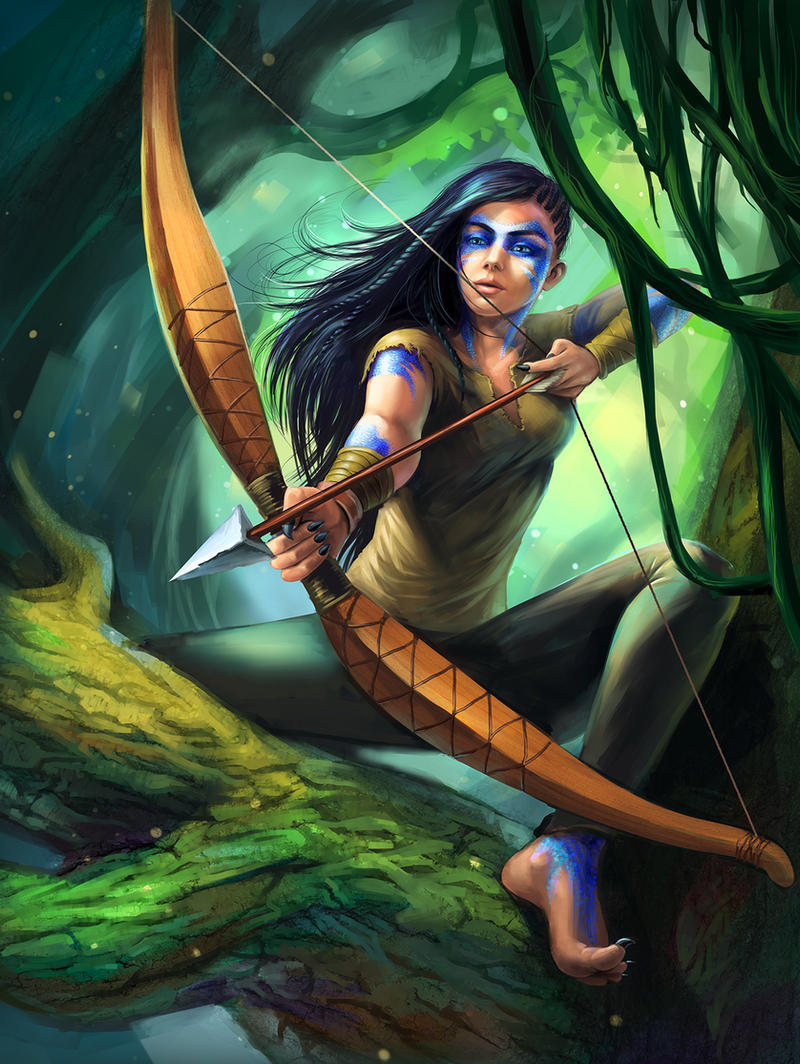
Ater a message being sent from Jess to Sinad Arich, the penultimate chapter of the novel, “Community,” starts with the dragon expedition at rest for the evening. The keepers confer quietly aboard the Tarman, and Thymara considers their progress and the various groups forming among the keepers. Thymara also considers her infatuation with “Skymaw,” and she mulls over what she has been learning of dragons from accompanying so many at such length. Greft and Kalo present themselves to her as being something of a threat to the rest, and Thymara takes herself off into the tree canopy to hunt, taking a marsh elk and struggling to bring the meat back to camp. As she labors to that end, she is confronted by Greft, who contrives to assist her.
The mighty huntress… Thymara by Daria-Ts on DeviantArt, used for commentary
Alise reflects on what she has been able to learn from “Skymaw” and is interrupted by an anxious Rapskal who searches for Thymara. Aided by Sedric, Alise continues her documentary work, and mention is made that Rapskal has ridden Heeby. “Skymaw” rails at the news, offended, and Alise works to calm the dragon as Rapskal escapes.
Greft presses upon Thymara despite her unease and rejection, and Thymara hastens back to camp to deliver the first batch of elk. She finds Tats engaged in treating the injured dragon, and she enlists help to retrieve the remaining meat. The group she assembles finds Greft and his companions carrying it back already, and a tense exchange follows that is defused only by the need for haste. Confusion and factionalism begin to arise among the keepers, and discussion of the threat Greft represents continues. The need to adjust their social rules to their new situation also arises.
Thymara’s group returns to the dragons, distributing meat. One dragon, a copper, is weak and has to be persuaded to eat; the dragon’s condition improves upon doing so, and matters seem better for the group.
Ah, factionalism, inevitable consequence of human association and plague of all! But it is not as if the divisions among the keepers was not foreshadowed; Greft has been a fractious presence since his introduction, and he made no secret of his selfishness and willingness to manipulate others even then. I find myself wanting once again to read the novel against current events, to look for parallels to his character, which I know is not an ideal reading but does suggest to me that 1) the cultural moment in which Hobb writes is not ended and 2) the presence of the kind of people on whom Greft appears to my eye to be modeled argues in favor of the continuing value of Hobb’s writing.
Read the previous entry in the serieshere. Read the next entry in the serieshere.
A brief missive regarding payment for peas precedes “Currents” beginning with the continued progress upriver of the dragons, their keepers, and the Tarman. Thymara chafes somewhat at Tats having accompanied Jerd and being constrained to accompany Rapskal, and she notes the disposition of the other keepers. Thymara and Rapskal confer about events, and she begins to warm to him.
Charming young man, this… Rapskal by FloorSteinz on DeviantArt, used for commentary.
Leftrin considers shifts to plans as the Tarman and others shove off to follow the dragons upstream. He is interrupted in his preparations by the appearance of hunters and their gear on his decks: Carson, Davvie, and Jess. The former is an old associate of Leftrin’s, and he is introduced to Alise. Alise takes to her cabin to get out of the way and considers her earlier rebuke of Sedric and its implications, and they end up conferring about events and their mutual situation. After, Sedric considers his own relationship with Hest, rehearsing its beginning in some detail.
Sintara struggles upstream with the other dragons, some of whom fare worse than she does. Old memories rise within her, and she and the other dragons confer about what they recall. They are disturbed from their reverie by the emergence of riverpig, and a hunt for the creatures begins, Sintara killing one and devouring it in joy. Emboldened by their successful hunts, the dragons press on, Mercor leading them.
I remain troubled by the ways in which Sedric and Hest seem to be playing into stereotypes of homosexual behavior. It calls to mind depictions of Oscar Wilde, as well as more general negative presentations of male-male sexual relationships. There are several scholars who have addressed homosexuality–and queerness, more generally–in Hobb, as I have noted; their works are far better to consult on the matter than anything I might add. But I will note that I know Hobb knows better than to rely upon the stereotypes; same-sex intimacy is addressed earlier in the Elderlings corpus than the present novel, and with far greater nuance and authenticity. So there has to be a purpose here; it escapes me at the moment, but that does not mean it cannot be found…
When you have Time and time again Seen the same thing happen and Not bothered to lift a hand to stop it happening again And again And again Because you profit from the reoccurrence Claim you have to Make us safer Save our children
When have your children been the ones in harm’s way? When have your children been the ones not to come home After you kissed them goodbye that one last time If you ever did to start with And I don’t think I’m alone in having doubts about that
Even a pitviper cares for its children Cold-blooded venomous thing that it is And in its worst things does but its kind While you have a choice to do other than you have done And other than you mean to do again Because there is no sign from you that things will be different this time No semblance of suggestion that you will actually take some step that will work And it is clear why
You feast upon the suffering of others Find delight in the tears that you yourself will never shed Drinking it as nectar of the gods And feel yourself to be above us What matter if the people suffer? The people do not matter Only you To you And we damned fools keep letting it happen again and again and again and again Despite any Jeremiah preaching in the hills
Those who regularly read my blog–and thank you, by the way–will likely have noted a shift in pattern in the past couple of weeks. I haven’t been posting my usual updates to the Robin Hobb Reread, and I have been waxing verbose on other topics. This follows a broader tendency in my writing–namely that I have been fairly snowed under, despite the still-summer heat of the central Texas where I live.
Out of season, but still purty. Photo by nagaraju gajula on Pexels.com
I’m alright, as far as all that goes, but I’ve been busy handling some other things, is all. I’m not intending to give up on the projects I’ve been discussing. Just need to get a few other things taken care of first, is all. So I’ll get back on all that soon.
Until then, thanks for following along! I really do appreciate it!
Schools have started up again, and that means assignments are starting again, too. Even down into elementary school, students are being asked to write–and writing is hard. It takes work. It takes attention to detail. And it takes time to do well.
This is the kind of thing I can help you overcome… Photo by Jessica Lewis Creative on Pexels.com
Classroom teachers do their best, of course, but with twenty to forty students in a room, there is only so much time they can give to any one student–and when there’s one or two acting out, it’s clear where the teachers’ attention will go. The quiet student who sits and tries to get things done gets left out–not because of anything they did or anything their teachers have done, but because there’s only so much time in the class, and there’re so many other things that teachers have to do.
That’s where I come in.
I’ve been writing for years, and I’ve taught writing in the classroom and in individual settings for almost as long. My students have ranged from middle- and high-schoolers through graduate students; my clients have ranged from high-schoolers through PhD candidates and established scholars. Each has seen a marked improvement in performance after working with me–and you and yours can have the same success!
I’d be thrilled to put my time and talents to work for you. Let me know what you need help writing, and we’ll talk about what we can do together!
I have written before about Labor Day, here and here in this webspace, and as the observance comes around once again, I find myself in much less secure a position to write anything than in previous years. It’s my own fault, really; I shifted jobs without thinking things through, and I was hindered in the latter by not having joined the union. But that’s not why I’m returning to the topic now.
Solidarity! Image is the Freelancers Union emblem, from their website, used for commentary
Recently, approval of unions reached some 71% of those polled, per Gallup. It’s not an unequivocal thing, as the report makes clear, but it is of some note–and some importance. My own experience as a union man–less presently than previously, when I was in a heavily unionized and union-integrated workplace and a member of UAW Local 2110–bears out the good of unions. Yes, it was the case that some members of the union were skating by, trusting in their collective contracts to cover their own inadequacies and stagnation. And it was the case that the specifics of the contract did not do as much to encourage innovation and development as could or should have been the case. But it was also the case that demonstrated expertise was explicitly and meaningfully rewarded; I got a 10% hourly raise upon completing my doctorate, for one thing, and guaranteed cost-of-living increases. I also had fully covered medical, dental, and vision, and I had access to retirement plans. (I did not invest in them, which worked out for the best, in the event, but that’s a different matter.) And it wasn’t just me; it was all of the working folk at the school, from department- and program-chair faculty through teaching staff and administrative support to the janitors and maintenance technicians.
I recognize that unionization is not something that everybody wants for themselves. I also recognize that there are some occupations where it ought not to happen–even some where it has. I also certainly understand why those who are driven to find profit–not earn, because “earn” does not really apply with them–oppose unionization. For me, though, it was a good and it is a good, and I delight in the increasing solidarity to be seen.
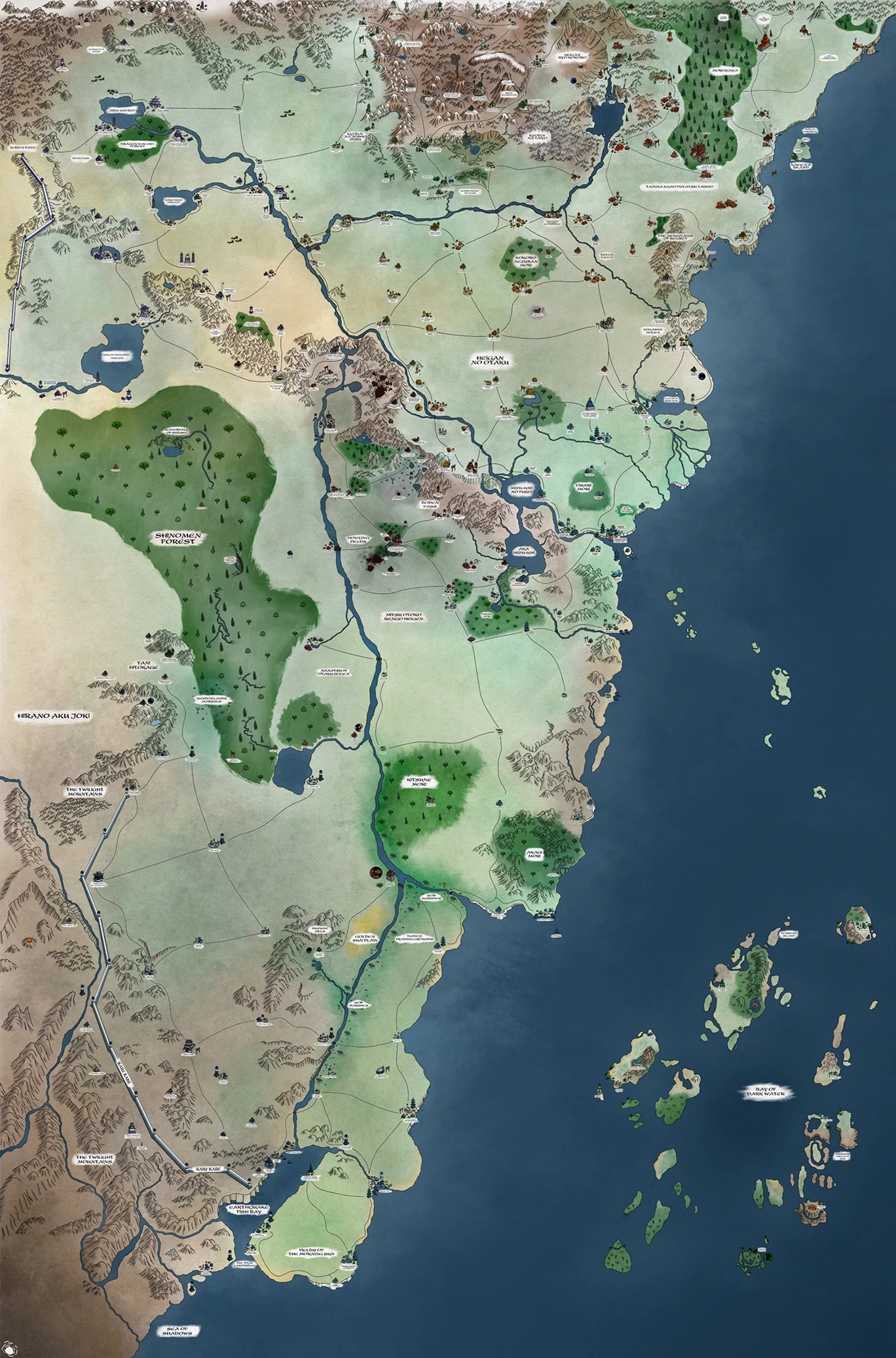
I noted in my previous post to this webspace that I am working on a Legend of the Five Rings (L5R) roleplaying game (RPG) campaign. Development continues on it, as might be imagined; I work on money-making jobs, after all, which take up time, and generating materials requires its own efforts and does not always go quickly. I expected as much, certainly, as I undertook to work on it. What I did not so much expect, however, was running into how much I have lost in the years since I last thought to do this kind of thing. I am running into…gaps in my knowledge, but I remember knowing a lot, and the…gaps are frustrating.
There’s a lot to work with… Image is from the Atlas of Rokugan, used here for commentary.
Admittedly, I’ve noted this kind of thing before, about having been able to immerse myself in things that I can no longer, given the different demands upon my time and attention and the many, many rewards that associate therewith. And I am not saying I would trade what I have to gain back what I had. It’s not like I actually sold it away, anyway; it’s less produce vended at the stand than fields that have been left alone, and while there are still fruits growing from that untended soil, there are a lot of weeds that have gotten in the way, and trees that promise yet better have sprung up amid the once-plowed rows.
A large part of what I’m having to do, therefore, is refamiliarize myself with the way things once were. It’s complicated somewhat by the advance of time; resources that once were available no longer are, and the resources that remain rely in large part upon what is now gone. It’s something similar to some of what I faced as a medievalist, really, and which others encounter in other places; we know there was stuff, because we have other commentaries on that stuff, but we do not have the stuff itself. So we have to reconstruct what we can, how we can.
I’m fortunate, though, that the game is as it is. For one, I’m moving a fair bit ahead of a particular point in the game’s canon, and avowedly doing so in a way that avoids a major, climactic event. It makes sense, therefore, that what comes after would also be different. That is, I am largely freed from constraints of the existing narrative–but I still need to address what happens with the major players in the game’s canon up to the point of departure. Were I playing in the game, I’d have questions about it; I have to expect that my players, for whom I am making the setting, would have similar questions.
Again, this ain’t happening. It’s still Drew Baker’s Second Day of Thunder, and it’s still used for commentary.
I’m making my way through things, slowly, certainly, in the moments between tasks. And I am glad to be doing such a thing again; there’s a peace to it that I appreciate and that I often need…
So here I am, writing again about roleplaying games in my own small, nerdy way. I am once again working on putting together a campaign for the Legend of the Five Rings (L5R) Roleplaying game, something I’ve done before. While I’m not (yet?) returning to that particular idea (who knows; it might go that way), the work does afford another opportunity for reflection and consideration.
Now, one of the things that the L5R property made much of, particularly in its earlier incarnations, was the player-driven nature of its storyline. From its origins as a collectible card game, it used player performance to drive the narrative represented in updates and new releases of cards and sets–and, eventually, the roleplaying game through which I was introduced to the property while still enmeshed in the mistake of thinking that I’d be a band director when I grew up. As I’ve played over the years, I’ve done as much as I could to remain abreast of the storyline and its developments, following even when the story reset itself as L5R switched hands. (Though I may be pilloried for it, I think the new version does some things much better than the older one–much better, in a few cases.)
Roleplaying games are, fundamentally, storytelling exercises, collaborative in ways that others aren’t (as Daniel Mackay asserts in The Fantasy Role-Playing Game: A New Performing Art), and such things do much to build community and fellowship, as Gary Alan Fine finds in several studies across decades. This is true for L5R perhaps more than other properties, given its explicit orientation. More importantly, though, it encourages motion beyond the “canon” of the game–it has to, really, since without the willingness to move beyond that canon, the players participating have decided limits on what they can be and can do. And while it may be the case that a lot of play-groups look for the gaps in the story that they can fill, it is also the case that cleaving to canon too closely means the surprise of a good story…isn’t.
Consequently, as I thought about setting up my own game, my own campaign, and got started working on it, I decided I’d…move away from things. It’s something of a fanfiction move, I suppose, or it seems to fit with that descriptor–I’ve not done a lot with fanfiction, as such, although I am aware of the (sensible) assertions that much classic Western literature is, itself, fanfiction. (The Arthuriana I study certainly fits the model, Malory having refined works that expanded on Geoffrey of Monmouth as he expanded substantially from Nennius and Gildas–and then add Spenser to the mix!) I’m taking my point of departure from before the climactic events of the “canon” in either older or newer (as of this writing, at least) L5R; the milieu-shaping event simply does not happen.
Yet, anyway.
Nope. Not happening. Image is Drew Baker’s Second Day of Thunder, used here for commentary.
I am, as might be imagined, still in the process of development. I’m still working out how the setting will differ from the “standard” one–as it necessarily will, even before the players get to play in it. I have to know where they start to see where they can go, after all. I don’t know that I’m going to do the kind of thing I did in West of Rokugan, so many years ago; I don’t know if it’ll be needed or advisable. But it’s nice to have this kind of project again–among the many others I get to do.









 Elliott RWI