Read the previous entry in the series here.
Read the next entry in the series here.
The fourth chapter of Shaman’s Crossing, “Crossing the Bridge,” begins the day after the third ends, with Nevare waking in a silent night. Realizing that Dewara is present, he rises and assumes a defensive stance he recognizes as somewhat silly, and Dewara taunts him. Melee ensues, and while Dewara handily beats Nevare, he also feeds him, leaving Nevare aware of being humbled. He recalls lessons from Duril and, as he eats, speaks hateful words to the Kidona, who responds calmly if with sarcasm, telling him that he will make of him in the coming days. Nevare settles in for an uncomfortable night, noting in retrospect how neatly he had been handled.
The next day, Nevare rises to find Dewara regarding him amiably, praising him for his surly, teenage attempts to remain angry with him. He also begins to show Nevare how to live off of the land, as well as to teach him some of the ways of the Kidona in the following days. Dewara also speaks at some length about the Specks, whom he calls the Dappled People, what he says clashing in Nevare’s mind with what he had previously been taught.
Nevare’s training proceeds, and its effects on him are noted. Information about Dewara’s experiences with Nevare’s father is related, and Nevare begins to be aware that he might well follow other scouts and become as much Plainsman as Gernian or more, which is an uncomfortable prospect for him as he recalls Halloran. Yet Nevare still finds himself drawn more and more towards the Kidona as Dewara takes him closer and closer to his own home.
One evening, Dewara tells Nevare a story of the god Reshamel and offers him a test of worth in the god’s eyes. Nevare inquires further and is drawn into a strange ceremony, following Dewara into the night. He steps off of the edge of a cliff, falling but landing safely. Dewara feeds him something strange, a dried gore frog, and Nevare finds his senses overwhelmed. Amid the confusion, he sees Dewara as a figure of great stature and with a hawk’s head, Dewara urges him onward; Nevare notes that his recollection of events is disjointed, mourning his inability to recall them fully.
At length, Dewara brings Nevare to a series of bridges, noting that they lead to the spiritual center of the Kidona and relating the experience of hostility between the Kidona and the Dappled People, including the infliction by the latter of a plague upon the Kidona. Dewara warns Nevare about the Dappled People, urging him to have the Gernians conquer them. He also cites his own failures to restore his people’s connection to their spiritual home, regarding Nevare as a means to restore that connection, and he urges Nevare to make the attempt.
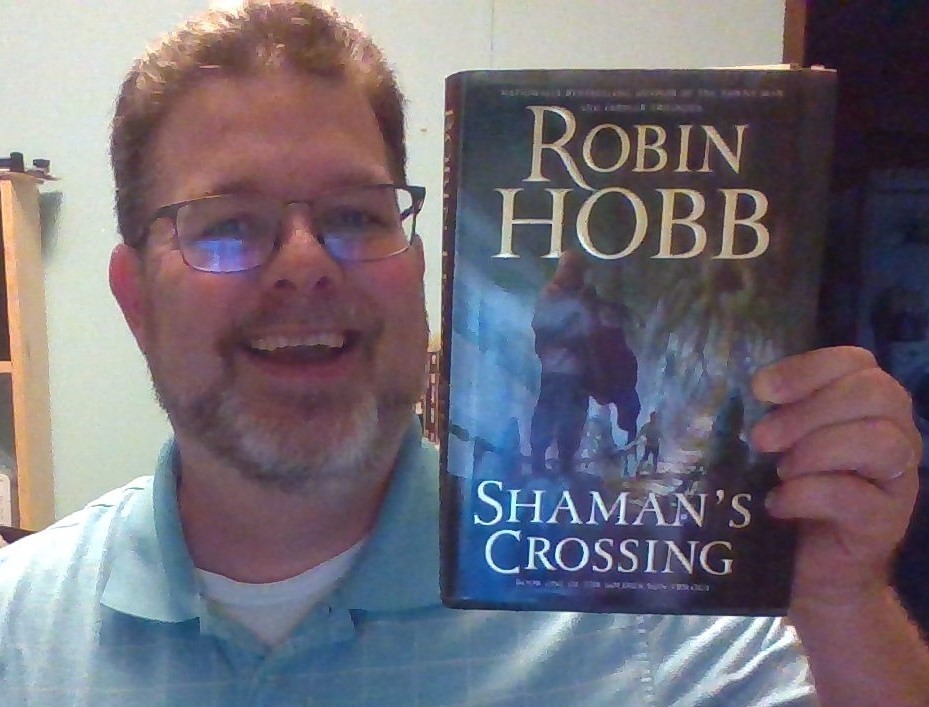
Nevare presses ahead, following Dewara’s direction and facing the series of challenges that present themselves to him, crossing such bridges as provide the inspiration for the cover of the novel as I have it. Symbolism presents itself to him that he acknowledges failing to understand, but Nevare becomes aware of the lost history of the Kidona as a people who built. And at length Nevare finds himself confronting a tree that transforms into an immensely heavyset old woman, one of the Dappled People. Confused, Nevare approaches cautiously, and the woman challenges him, first for his name and then for his purpose. She perceives Dewara’s intentions and attempts to persuade Nevare to her thinking; Dewara protests, bidding Nevare fight against her and resist her attempt to suborn him. She attempts to force a choice on Nevare that he fails to understand, and he falls as she opens the ground beneath him.
He cries for help, and he accepts her offer of the same, at which Dewara bewails their doom. The woman takes up Nevare, mocking Dewara for his reliance upon him and noting to Nevare the bond that is forming between them. She takes something from Nevare that he does not understand, and he loses consciousness.
To address the chapter-length issue: the present chapter, in the edition of the novel I’m rereading, runs 37 pages in length, approximately 6.27% of the novel. If length is to be taken as an indicator of narrative importance–and I’ll admit it’s a big if, although there is something to say about an author spending more time and attention on a particular passage–then the present chapter is the most important one yet. Certainly, in terms of content, it seems singularly important, offering a pivot both in the story and away from a flat iteration of particular tropes; to follow Freytag’s model, the rising action would seem to have begun.
Also, for indexing purposes, the following: Barrier Mountains, Cavalla, Dappled People (Specks), Dedem, Dewara, Gore frogs, Halloran, Hawk, Hoodoo, Jindobe, Keeksha, Keft Burvelle, Nevare Burvelle, Pheasant, Plague, Plateau bear, Prairie grouse, Reshamel, Scouts, Sergeant Erib Duril, Sling, Swanneck, Taldi, Tefa River, Tree woman, Troven, Widevale. Despite the greater length, there are fewer unique items of significance in the present chapter.
Less…mechanically, there is a bit of confusion early in the chapter. When squaring up against Dewara, Nevare remarks on his “gangly fifteen years pitted against the mature and solidly muscled warrior” (73); early in the previous chapter, when leading up to his introduction to Dewara, Nevare remarks that his experience with Dewara was in his sixteenth year (51). While it is technically the case that passing one’s fifteenth birthday opens one’s sixteenth year–being a Millennial, I well remember the discourse about the first year of the new century being 2001 rather than 2000, and this is a similar thing, so recall of that might be at work in the composition of the present chapter–it is not common to make such a comment. Admittedly, Nevare does have some penchant towards exactitude, although the degree to which he exhibits that penchant is limited in the present chapter by being yet early in the narrative; I am not at this point in my rereading certain what kind of coding he exhibits or to what degree. (I did note it’s been a while since I was in this series, and I’ve slept once or twice since last time.) But I find the framing peculiar in context, and so it stands out to me.
As it does so, I am reminded of Hobb’s major narrating protagonist, FitzChivalry Farseer,* and find some points of contrast between the two. Nevare is nobler than his literary predecessor in several traditional senses, being a legitimate child explicitly schooled in a strict pattern of “being good.” Even at a comparable age, Fitz had undertaken assassin’s work; it is hard to conceive of Nevare even thinking in such a way. Indeed, Nevare avers that he “would never have stooped to such a dastardly act” as killing a man in his sleep (76). Fitz was also already blooded in more “normal” fighting than Nevare at a comparable age; even if Fitz is a nuanced warrior-hero, he had already proven himself earlier in his life than Nevare had even had a chance to start. It is a curious juxtaposition; Nevare is a more “normal” instance of a noble figure than Fitz,** but he is also decidedly less competent. There are implications that might be read into that; perhaps another scholarly someday might treat one or more of them.
A point of comparison between Nevare and Fitz from the present chapter is their mutual confusion when immersed in magic. Notably, Fitz suffers quite a bit of it on his initial approaches to Kelsingra and the Skill-stone quarry (witness this, this, this, and this, with the last showing comments that it’s not just me who had a time with Fitz’s journey). Nevare, in the present chapter, remarks upon the brokenness of his memories of his ritual with Dewara (87), although I note an easier time following his narration of events than I did Fitz’s. Perhaps it is only because I am in a better headspace rereading now than I was then; perhaps it is because the Skill is more remote than intoxication. (I did go to college, after all.)
In the present chapter, the fact of the Kidona as something of a pastiche of Native American plains-dwellers and others presents itself again. The cultural virtues related by Dewara to Nevare ring of traditional stories of Coyote, and the ritual experience through which Dewara guides him echo depictions of vision quests and similar intoxicant-driven religious / spiritual practices. The former practices of the Kidona that Dewara relates trace similarly echo seminomadic people such as the Caddo and Karankawa, at least to a cursory reading; those with greater knowledge of indigenous history and culture than I have could doubtlessly say more, and more eloquently. Still, even from what I do know,† the Kidona are borrowing from multiple peoples; they function therefore as a stand-in for the many peoples who were subjected to the colonialist practice of European settlement of the Americas and who still suffer the effects of the same…which makes the attempted reliance upon Nevare as a figure of hope for them read as an iteration of the white savior complex (and its suborning an interesting twist). Again, Helen Young’s comments would seem apt.
*He counts as the major one because he narrates more books than the others. Simple as that.
**This leaves aside, of course, the entanglements of colonialist practice. For all the problems of the Six Duchies, they are not actively colonizing the neighboring peoples. Even the interactions with the Mountain Kingdom are being conducted diplomatically, and the Chyurda are in position to be able to refuse the Duchies. Gernia is not so innocent as that.
†That I know only what I know is my issue, not that of the knowledge. There is much worth knowing that I do not know; it is for me to learn it more than for others to teach it.
I remain indeed happy to write for you! Fill out the form below to get your piece started!


[…] Read the previous entry in the series here.Read the next entry in the series here. […]
LikeLike
[…] the previous entry in the series here.Read the next entry in the series […]
LikeLike
[…] making the idea of reading the characters against each other more attractive a prospect. While I’ve already gestured towards that scholarly someday, it may need to move up the […]
LikeLike
[…] rereading, runs 39 pages in length, approximately 6.76% of the novel. It is the longest yet; if, as has been motioned toward previously, the amount of text bespeaks importance, then the present chapter would seem to be the most […]
LikeLike
[…] king, Troven, whose name appears before even that of Nevare’s mother, in “Crossing the Bridge.” It is, I think, another indication of the prevailing sexism at work in Gernia, something […]
LikeLike
[…] an indicator of narrative importance; the if mentioned in earlier discussions of the point (such as this one) is clearly not in place. Were I still working at the front of the classroom, or were I yet writing […]
LikeLike
[…] For disjointedness in Nevare’s experience, “Crossing the Bridge” is a useful reference. That the earlier chapter is the fourth of, and the present chapter leaves […]
LikeLike
[…] dying at one point, joining the parade of Gernian souls across the bridge that he had erected (see “Crossing the Bridge”). He recoginzes a number of figures amid it, and he is beginning to cross, himself, and observes […]
LikeLike
[…] experiences not only with the magics of the Plainsfolk (see Shaman’s Crossing‘s “Crossing the Bridge,” for example), but also of the Dappled People (see not only “Crossing the […]
LikeLike
[…] argument erupts between father and son, and Nevare relates his experience of Dewara’s magic only to find his father turning further against him. Outwardly, Nevare agrees to his father’s […]
LikeLike
[…] such as I’ve noted in Shaman’s Crossing‘s “Magic and Iron,” “Journey,” “Crossing the Bridge,” “Sword and Pen,” “Carnival,” and “Plague.” The scene in the present chapter […]
LikeLike