Read the previous entry in the series here.
Read the next entry in the series here.
The third chapter of Shaman’s Crossing, “Dewara,” starts some three years after the second, Nevare glossing the passage of time to his fifteenth year. New tutors are found for him, Rorton and Leibsen, and he studies ancient languages as well as military arts. In the spring of his sixteenth year, he is also introduced to Dewara, a Kidona whom Duril distrusts and who is described as Nevare and his father make their approach. Nevare reflects on what he knows of the Kidona people and the members thereof he sees as Dewara and Nevare’s father negotiate the fee for his training, as well as the terms and conditions of the same. Nevare notes, in particular, the swanneck (a formidable bronze knife) Dewara carries and the Kidona’s appreciation for sugar.
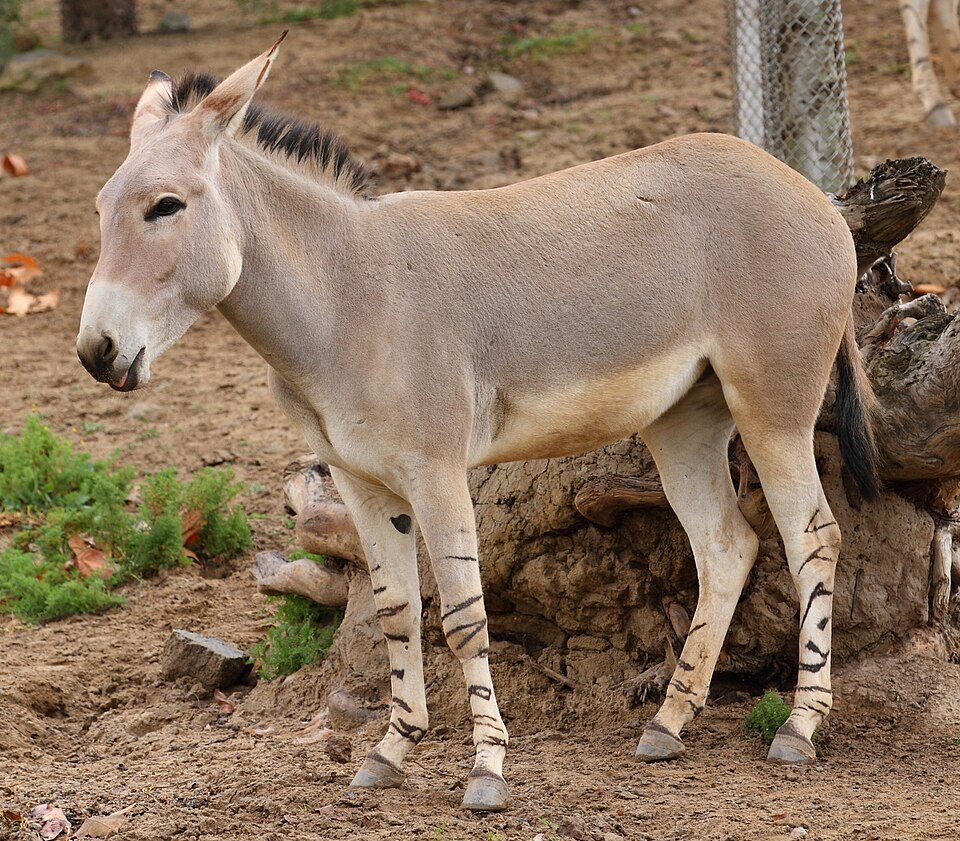
Image is Ericj’s on Wikipedia, here, used under CC BY-SA 3.0
The agreement between Dewara and Nevare’s father completed, Dewara demands his own agreement, which Nevare gives. He is then obliged to disarm himself to accompany Dewara, and he muses on his father’s earlier interactions with Dewara; Keft had fought and imprisoned the Kidona. But Nevare’s father nonetheless leaves him in Dewara’s care, the Kidona bidding him mount one of his beasts, a taldi that initially proves difficult to handle. Dewara calls the taldi by its name, Keeksha, and informs Nevare how it is to be handled only briefly before galloping off on his own taldi, Dedem.
Nevare struggles to catch up as the terrain worsens, only doing so when Dewara stops and dismounts, showing an attitude towards the taldi that takes Nevare aback. Nevare is himself wearied, but Dewara rebukes him for his complaints about the same, bidding him to silence. Dewara uses that silence to locate Duril, whom he notes has gotten himself lost. After some time passes, Dewara mounts again, bidding Nevare follow, which he does through the remainder of the day.
Camp that night is bare, and Nevare sleeps poorly, waking thrice. Two are in the night; the third is in the morning, and he perceives Dewara sneaking up on him. He rises, and Dewara greets him flatly before bidding them depart again. It is another dry ride, and Nevare begins to suffer the effects of his thirst. He also suffers from another rough campsite, although he comes to believe Dewara has provisions that he declines to share, and he rebukes himself for doubting his father’s judgment. His dreams are unpleasant.
The next morning, Nevare demands water from Dewara and is refused. He then attempts to depart Dewara, fleeing on Keeksha and, after some chase, is caught and his ear notched, to his shame. But Dewara lets him ride on after inflicting the injury, and Nevare sullenly considers himself against events. Keeksha eventually finds water, and Nevare drinks, but he remains ashamed and knows that how he is marked will carry with him. But he sees to his mount nonetheless, and he arms himself as he can amid desolate surroundings.
To address the chapter-length issue: the present chapter, in the edition of the novel I’m rereading, runs 22 pages in length, only approximately 3.73% of the novel. Reading the chapter, I did not feel it shorter, although I’ll admit three pages isn’t much; even so, the present chapter felt a longer read than either of the preceding two, despite the slightly lesser length. I have to wonder if it inheres in the presentation of less familiar things; the Burvelles, while fictional, clearly partake not only of the real, but of real with which I am familiar, as noted, but the Kidona, although described in terms reminiscent of Native American peoples, are far more remote from me. I can understand how the difference would affect the perception of narrative heft; there is more to do to understand the less proximal than the more, and the greater effort involved comes off as heavier writing. Maybe.
Also, for indexing purposes, the following: Bronze, Dedem, Dewara, Gore frog, Hoodoos, Humpdeer, Iron, Jindobe, Keeksha, Keft Burvelle, Kidona, Lead, Leibsen, Nevare Burvelle, Rew, Rorton, Salt, Sergeant Erib Duril, Sirlofty, Steelshanks, Sugar, Swanneck, Taldi, Tobacco, Varnian. There are fewer new names in the chapter, although the presence of trade goods and identification of creatures stand out.
On the subject of trade goods: I note with some interest the offerings of salt, sugar, and tobacco by the Gernian Keft Burvelle to the Kidona Dewara. I note, too, that the previous chapter reports the Burvelle holdings as generating cotton (with attendant agricultural challenges). Such offerings evoke, at least to my reading, both the cash-crop system that underlay much of the antebellum economy of the United States and the disparate trading arrangements through which many Native American peoples were dispossessed (although it might well be noted that the inclusion of tobacco as a significant trade good also does come up in Tolkien; again, Hobb does have cause to stay close to the Tolkienian fantasy tradition even as she moves away from it in many ways). As such, the colonialist underpinnings of the Gernian setting are reinforced.
On the subject of creatures: the taldi and the gore frog attract attention. The latter is mentioned briefly at the end of the chapter, a poisonous creature and hazard of the local environment. The former is the specific type of animal the Kidona use as horses. Described as “black-muzzled, round-bellied striped-legged mounts” with stiff manes and almost bovine tails (52), such as “did not whinny, but squealed” (57), they evoke such animals as the Somali wild ass, the grullo/grulla, and the takhi (and note the relative similarity of name). Notable is that the evoked animals are distinctly Old World, an interesting motion against the largely US-Western setting of the novel, even as the depiction of their use and their users in the chapter accords with traditional depictions of such peoples as the Nʉmʉnʉʉ and Łibaį́ Ndé and their practices.
The matter of religion comes up again, as well, Nevare contrasting his remote and benevolent “good god” with Dewara’s present but fickle spirits of the land. It becomes clear from comments made that Nevare feels strongly about his faith, that it is not for him a thing of lip-service observance, even if it is perhaps not closely considered. Already, the comment has been made in the novel that a good soldier follows orders, and Nevare, it seems, very much wants to be a good soldier.
I’m pretty much always happy to write for you! Fill out the form below to get your piece started!


[…] Read the previous entry in the series here.Read the next entry in the series here. […]
LikeLike
[…] the previous entry in the series here.Read the next entry in the series […]
LikeLike
[…] the novel I’m rereading, runs 22 pages in length, approximately 3.81% of the novel. As with an earlier chapter of similar length, however, the shorter page-span felt a longer read. Some of that is addressed by the indexing noted […]
LikeLike
[…] amont other examples, “Harbinger,” early in the novel, offers a fair bit, as does “Dewara,” and the previous chapter makes its own explication of a priestly title repeated in the present. […]
LikeLike
[…] Son novels (see, for examples, Shaman’s Crossing‘s “Harbinger,” “Dewara,” “Bessom Gord,” “Cousin Epiny,” and “Vindication“), and […]
LikeLike
[…] is to contrast the present chapter with the previous chapter in the series with the same title, the third chapter of Shaman’s Crossing. This is not the first time that Hobb has reused chapter titles across novels; my rereading of the […]
LikeLike