A Robin Hobb Rereading Series: Entry 41: Royal Assassin, Chapter 16

Read the previous entry in the series here.
Read the next entry in the series here.


Coming after, “Verity’s Ships” opens with a gloss of early military actions against the Red-Ship Raiders. It moves on to Fitz glossing the shape of his days for the rest of the season, which keep him quite busy. They also begin to include postings to the Rurisk, the first of Verity’s warships, where he learns seacraft and some of the language of the Outislanders.

Image result for longship
The ship’d be something like this image from Britannica.com, which is used for commentary.

At length, Fitz is able to find a private moment with Shrewd, during which he broaches the topic of marrying, thinking to wed Molly. Shrewd, however, has been approached by Celerity of Bearns and her father, Duke Brawndy, whom Fitz met earlier in the novel and seems to have impressed. Fitz attempts to speak out, but Shrewd harshly rebukes him, conflating him with his father for a moment.

Noting his heartsickness, Fitz continues relating the passage of the season, laying out the disposition of the Skilled with whom he had trained under Galen and their arrangement on the warships of the chapter’s title. It ranges to a training exercise that is ostensibly Skill-assisted, and that is interrupted by Skilled orders from Verity that direct the Rurisk to Antler Island, where a Red-Ship raid is in progress. The crew of the Rurisk joins the melee, and Fitz makes quite a showing for himself in a berserk rage that falls upon him. He does not comport himself as well in the wake of the battle as in the midst of it, and he has little time to rest; more fights follow in the succeeding days and weeks. During one such, Fitz glimpses a white-hulled ship that affects him oddly. It is not present after the battle, and others do not recall seeing it, but it remains disquieting.

Fitz continues to work the Skill with Verity, and he learns him in doing so. He also has something of a sour patch with Molly, and not because he relates Shrewd’s words to her; he does not. And when he calls on Kettricken, he finds he mulling over some thought to bring an end to the realm’s troubles.

I’ve argued before that there is a tendency, owing to Tolkien, to read fantasy novels as borrowing largely from the European medieval–particularly Celtic and Germanic Europe, and that tendency ranges to Hobb’s Elderlings novels. Such chapters as the present one help prompt reading Hobb as European medievalist fantasy, with the single-sailed clinker-built ships and some of the geographical descriptions, as well as other such tropes long present in the series.

It may be the case that the Realm of the Elderlings moves away from the European in the author’s mind as more work gets done on it. Hobb notes her own grounding in Tolkien, and Tolkien’s influence is…substantial, as many, including Luke Shelton, argue and attest. And it makes sense that earlier compositions will cleave more clearly to established patterns, both for the author’s own ease (deliberate or not) and for the audience’s. So there is some cause, even if other interpretations come out better as the series goes on.
Stand me a cup of coffee?

A Robin Hobb Rereading Series: Entry 40: Royal Assassin, Chapter 15

Read the previous entry in the series here.
Read the next entry in the series here.


The next chapter, “Secrets,” opens with the commissioning of the warships Verity has had built. It moves to Fitz’s minimally successful hunt with Nighteyes, after which Fitz finds himself confronted by the Fool. Fitz asks the Fool after his origins, and the Fool replies as plainly as he can, noting his prophetic powers and the system that allows them to flourish. As Fitz turns the ideas over in his mind, he is taken by the damage done by the poisoning at the end of the previous novel, and he collapses.

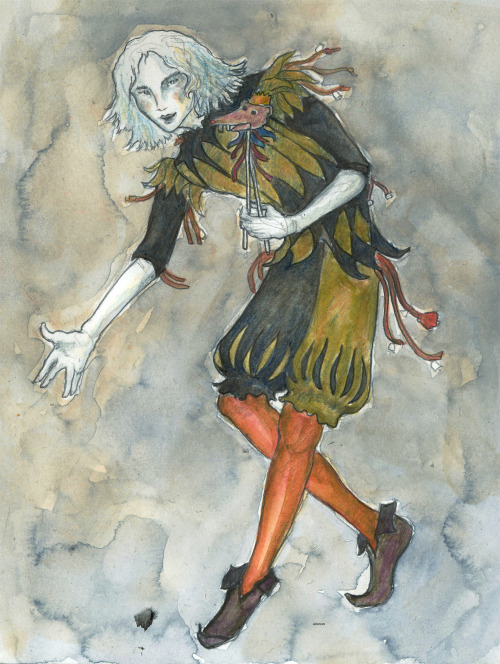
anaryawe:“I finally got my reserved library copy of the Fools Assassin, just in time for holiday reading! Here’s a festive Fool to celebrate. ”
I found this on ambersapricotbrandy’s Tumblr page, here. I’m not sure of any earlier sourcing, but I’m using it for commentary.

Amid his fit, Fitz wanders Buckkeep as if drunk or fevered. Patience manages to extricate him from a potentially awkward social moment, and, later, Chade quizzes him–as well as noting another source of Fitz’s malady. Chade also lays out assignments for Fitz to carry out before dismissing him back to his bed. Fitz enjoys an assignation with Molly, instead.

The next morning sees Burrich summon Fitz for more training. It does not go well to start, fatigue telling on Fitz. But at a point in it, something clicks for Fitz, and he seems to catch the knack of what it is he needs to do.

The (partial) revelation of the Fool’s origins in the present chapter has long-reaching ramifications in the Realm of the Elderlings novels as a whole, such as will receive comment in later installments of this rereading series. For now, though, a few points worth considering come up in the Fool’s explication of himself to Fitz:

  • The Fool openly acknowledging himself as a prophet confirms things that had been suggested earlier in the series. Positioning himself as such, with Fitz as the agent through which he will work change, reinforces the already-noted status of Fitz as the protagonist of the series–he can hardly not be, even without the Fool’s revelation–and puts the Fool in a seemingly similar position, if uncomfortably. It also introduces to the novel a stronger element of the fate/free will discussion that continues to pervade many, many systems of thought.
  • The comments about philosophy being necessary to everyday life are, perhaps, to be expected from someone who makes a living writing; writing and reading demand thinking, which is the source and substance of philosophy. But that there is some self-interest in an author commending reading and contemplation through the voice of a protagonistic character–which the Fool is, clearly–does not mean that the advice is not good. And it is always dangerous to assume authorial intent in characters’ speech, in any event; even if Hobb does not believe what her Fool says, it remains a good thing to note.
  • The comments about the value of the individual function similarly. Each of us is a part of a future recollection; each of us can affect what will come, and in ways we cannot necessarily foresee. That does not mean what we do is without value, and that is a hopeful thing to think upon.

Help me keep this going!

A Rumination on Dance and Cheer

This marks 800 posts to this webspace. Yay!

While I was in high school, I was a bandsman, marching a saxophone on the football field in the fall or slinging it in songs through the rest of the year. And I admit to being jealous of the football players in the glory they accrued even when they lost game after game after game, when an award-winning band could hardly get noticed, and a state-qualifying volleyball team got only passing mention. And I admit, too, to no small disdain at the time for the other common accompaniments to the football team: the cheerleaders and the dance team.

The varsity cheerleaders at the local high school at the time of writing
Image from Kerrville ISD, used for commentary

I’ll admit, too, that my opinion did not improve while I was an undergrad or a grad student; if anything, it soured further in graduate school, when I was a teaching assistant and got to field complaints from such students, their coaches, and their parents that I graded their papers with the same intensity that I graded any others. (The grade distribution I reported most recently is perhaps less generous than my earliest college teaching, though it occasioned fewer complaints. The first class I taught at college saw more than a quarter earn As and 65% earn Bs, while the first time I taught an equivalent of the session’s class saw more than a fifth earn As and more than a quarter earn each of Bs and Cs.) And in the years after graduate school, while I was making a go of being a full-time academic, I was…less sanguine yet.

Image result for tivy high school cheerleaders
The varsity dance team at the local high school at the time of writing
Image from Kerrville ISD, used for commentary

As happens with a great many people, having a child changed my outlook. My wife and I enrolled our daughter in dance classes early on, and our daughter, Ms. 8, thrived. She did so even more when we switched her dance school to one that has operated in my hometown–Kerrville, Texas–for decades. Ms. 8 enjoys the classes, even if she is still not at a point to have the discipline to practice the way she’ll need to do to more with it. (And I am aware of the problems in such a worldview as would push a five-year-old towards that kind of discipline, thank you. I am also aware of a number of other applicable circumstances, and I have to consider them, as well.) So when there was an opportunity for us to get her a little bit more work and a bit of a different perspective on it, courtesy of the local high school’s cheer and dance programs, my wife and I took it on Ms. 8’s behalf.

Our girl seemed to do pretty well, and I was gratified to see it. There are things she’s learning in her cheer and dance classes that I will never be able to teach her, and I am aware of the benefits of her knowing them. Ms. 8 gets good exercise, and she is making more friends through the classes. They do her no harm, so far as I can see. And I cannot hold them to fault when they are doing for my beloved daughter what they are.

Help support Ms. 8 in doing what she loves?

A Robin Hobb Rereading Series: Entry 39: Royal Assassin, Chapter 14

Read the previous entry in the series here.
Read the next entry in the series here.


The chapter that follows, “Winterfest,” opens with a description of how the holiday of the chapter’s title is marked at Buckkeep. It moves to Fitz’s continued work on the tasks assigned him and his ruminations on the current state of Skilled practice in the Six Duchies. He soon falls asleep, though, his exertions and the medication given him overtaking him.

Banquet menus consisted of many types of food
Certainly something worth attention…
Image from Medieval Recipes, used for commentary

Nighteyes’ announcement of Molly’s arrival wakes Fitz from sleep, though. She asks him after going to see Shrewd about their nuptials and broaches the topic of rumors about his recent actions in the field. Fitz turns the questions aside, and the two enjoy another night together.

Molly leaves in the early morning, and Fitz falls asleep again, only to be roused by Burrich summoning him to his training appointment in Verity’s tower. After Burrich stalks off, the Fool calls upon Fitz, offering an apology for his earlier misdirection. He also urges Fitz to call upon Shrewd again, floating the idea that they may be united in their opposition to Regal. They confer, and Fitz reports for training.

His progress in that training is sketched in, and, once it is done, Fitz attends to his many other duties. The first of them is to call on Shrewd, as he had intended. Verity accompanies him through the Skill, noting oddities in his father’s conduct as he does so. Fitz forces his way past a putative attendant and works to set Shrewd’s chambers to rights. The attendant fetches Regal, who interferes–to an extent, before Shrewd issues his orders. Fitz departs, his mind reeling at what he has seen.

I think Hobb does well, overall, at capturing the throes of teenage romance. Fitz’s conduct and thoughts in the present chapter–and several preceding it–bear it out; the propensity towards grandiosity and dramatic declarations rings true for me, as I think has been the case for many other people. (I am not entirely pleased with how I acted in my younger days. Those who know me can probably guess why. And I do not think I am alone in it.) Looking back, both on my teenage years and their “romances” and on a series of novels I have read before, I cannot help but cringe, knowing as I do that what is coming is. For while there are some adolescent loves that linger and deepen, most teenage amorousness leads to other ends than might be desired, and it is not the case that an assassin is like to have a happy ending…at least, not in the short term.

The passage of decades can change quite a bit, however.

Care to fund my holiday events?

A Robin Hobb Rereading Series: Entry 38: Royal Assassin, Chapter 13

Read the previous entry in the series here.
Read the next entry in the series here.


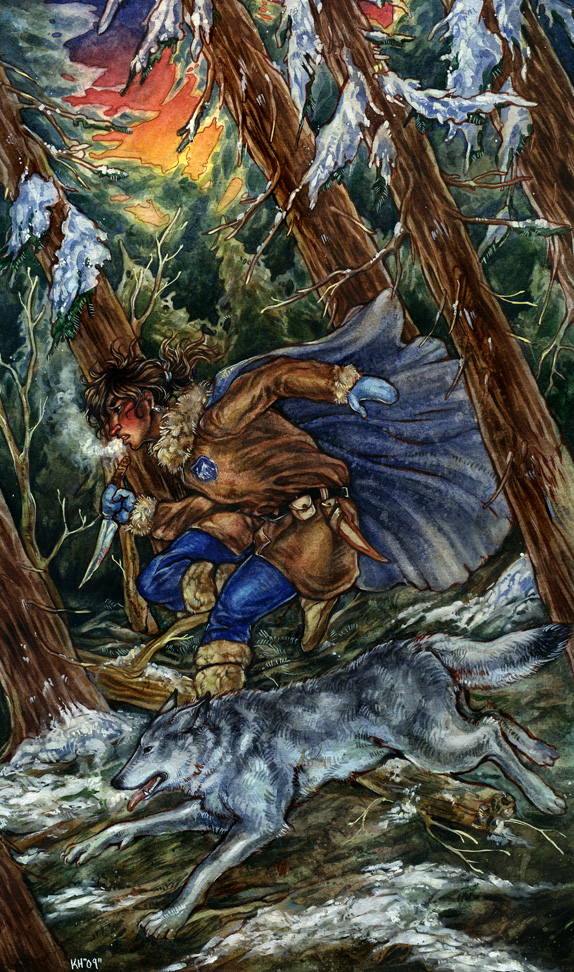
The chapter that follows, “Hunting,” opens with Fitz musing on the different teaching styles of the then-last two Skill Masters at Buckkeep. It turns then to the morning after Fitz’s assignation with Molly, when he reports to Verity. Verity gifts Fitz with a sword and reminds him that he, himself, is still but a servant, chiding Fitz for not warding his mind as he had been taught.

all senses keen by katya-h on DeviantArt, image used for commentary

Verity also tasks Fitz with refining further his control over the Skill, even as he works on exterminating the nearby Forged Ones. The exercise is something of a strain for Fitz, as he works to keep his mind focused on the needed tasks and not to dwell on other matters, particularly Molly and Nighteyes

While taken with his thoughts, Fitz hears a scream and moves to investigate. He finds Forged Ones fighting over a child they have taken, with one having begun to eat her before she dies in the hands of the others. Fitz falls into a rage and attacks, Nighteyes helping him. They prevail with difficulty, and Nighteyes departs moment before riders reach Fitz.

The riders try to make sense of events, and Burrich, who is among them, tends Fitz’s wounds–with clear questions that Fitz does not answer. As Fitz debriefs afterward, Verity ruminates on Fitz’s survival and tasks Burrich to teach him fighting with an axe. Burrich agrees, but he expresses reservations about sending Fitz to do more of the work he has been doing. Verity reminds Burrich that Fitz has little choice in the matter–that none of them do. Fitz surprises both by asserting his willingness to continue.

I’ve noted before that foresight is a dominant theme in the series, making foreshadowing a common device. Having read the books before, I note with some amusement the gesture towards such foreshadowing Hobb makes in Verity’s Skilled comments to Fitz about the child Verity’s mother had used to gather information. Without spoiling too much (insofar as a novel in print for decades as I write can be spoiled), I can note that something similar happens, and more than once, to Fitz–even as he, himself, was formerly positioned to be such an actor.

I’ve also noted that I tend to read Hobb affectively. The present chapter is not an exception to that. Having a daughter who is not much older than the child described…it was not an easy read this time around. (Not that it ever has been; I’ve long been more sentimental than it’s good for me to be, and it’s gotten me into trouble more than once.) I do not find fault with Hobb for refusing to indulge in what TV Tropes describes as “Improbable Infant Survival,” but that does not mean it was comfortable for me to read it. I’m not sure what all it says about me, and I’m not sure I’m eager to find out. I am, though, eager to read on.

Care to send something my way, support my still working on this?

Initial Comments on the November 2019 Session at DeVry University

I have been offered and have signed a contract to teach a class at DeVry University for the November 2019 instructional session, a section of ENGL 135: Advanced Composition. It is wholly online, with the session spanning 28 October 2019 to 5 January 2020; consequently, instruction will be almost wholly asynchronous, though I will hold a regular office hour, likely on Wednesday evening, given other scheduling concerns I have at the moment.

An IStock image by Jaroslav Frank appearing on Robert Ubell’s 13 December 2016 Inside Higher Ed article “Why Faculty Still Don’t Want to Teach Online,” used for commentary

The redesign I mentioned previously seems still to be in place, but they seem to tend to less grading than I recall from earlier experiences teaching ENGL 135. I will have to generate new examples, of course, but I need to be doing more writing, anyway, and students continue to benefit from having the models to follow. Given broader events, I am not sure how I can produce ethically sound examples that will still do what I need them to do; I am not the master of my own curriculum, here, but am obliged to follow a prescribed sequence once again. I knew that going in, though; my comments from more than a year ago still seem to hold.

For all the problems that are in place with the kind of teaching I will be doing, I am still glad to have the opportunity to do so once again. Though I presently need the funding less than I have in the past–the regular job I work treats me pretty well in that regard and in several others–it is still welcome. More welcome is the chance to once again put to work the skills I spent so long developing; I hope they have not atrophied such that they will no longer serve me or the students enrolled in my class.

A Robin Hobb Rereading Series: Entry 37: Royal Assassin, Chapter 12

Read the previous entry in the series here.
Read the next entry in the series here.


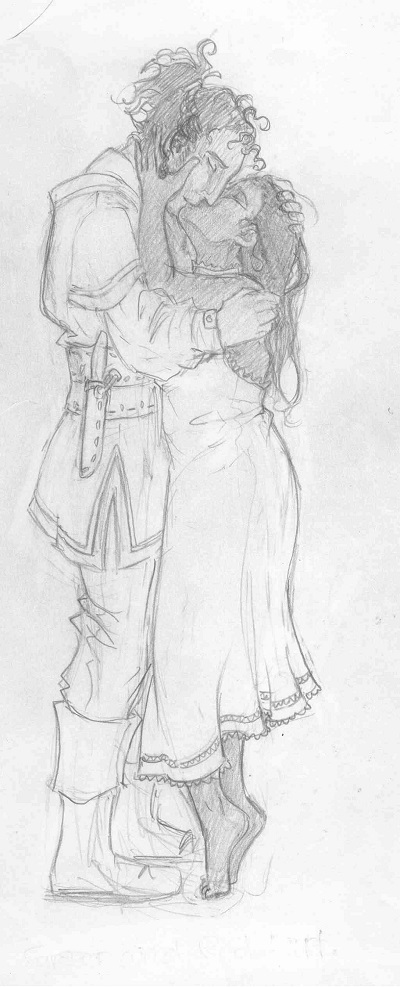
The next chapter, “Tasks,” opens with Fitz’s later musings on the winter and the state of the Six Duchies during it–not good, in the event. It moves to Fitz departing Verity’s chambers and reporting to Kettricken with Verity’s message for her to take the Queen’s Gardens. Kettricken leaps eagerly to the task, her ladies following her despite the cold, and Fitz muses on the quiet deception he is facilitating in the event.

Fitz and Molly by Mirre-Kala
Fitz and Molly by Mirre-Kala on DeviantArt,
used for commentary

After, Fitz takes a meal in strange solitude and goes out to Nighteyes. He proceeds thence to review the documents with which Verity had entrusted him, regarding them amid his chamber for a time in frustration before calling on Patience. There, he encounters Molly and makes something of a fool of himself to her–in front of Patience and Lacey. Patience chides him gently for the outburst after Molly makes her excuses and departs, and Fitz unburdens himself of some of his cares to her. He also conveys to her that she might go to Kettricken and help her with the Queen’s Garden.

Once he leaves Patience, he purposes to call upon Molly once again, doing so by climbing down to her window. She reluctantly admits him into her chambers as tells him that Regal has pressed upon her that a relationship would be ill-advised. In something of a rush, they consummate their love, and they part in the throes of teenaged romance the next morning.

I’m not sure, at this point, how to read the intimate interlude. Hobb does well to elide the more salacious details, certainly; a passage of erotica or outright pornography would seem out of place against the rest of the narrative. And it is the case that there has been motion throughout the series to have Fitz and Molly come together; it is not necessarily a sudden thing that they do. But Fitz does seem to force the issue a bit, which seems…squicky to my reading, anymore. (And, no, I did not always find the passage problematic. I am still not the person I should be, but I am better than I was, and I keep trying to be better, thanks.) Fitz is hardly an honorable character–being an assassin more or less precludes that, and I’ve discussed the topic at some length elsewhere–so a less-than-upright action may be in character, but I do not want to defend even a fictional offender. So there is that.

I suppose my…unease with the passage now is a sign of the ways in which I *have* changed, partly as a result of getting older, partly as a result of having had the exposures I had in graduate school and in life after. I’ll not deny there is a certain ironic orthodoxy that affected me (ironic in that it is predictably heterodoxical), but having the time to think about things that higher education offers did much to help make me more humane. Carrying that into the world outside the ivory tower is not always an easy thing, to be sure, but it does little enough good staying inside it–especially in the windowless basement rooms thereof that I shared with many, many others.

I continue to welcome your contributions.

A Robin Hobb Rereading Series: Entry 36: Royal Assassin, Chapter 11

Read the previous entry in the series here.
Read the next entry in the series here.


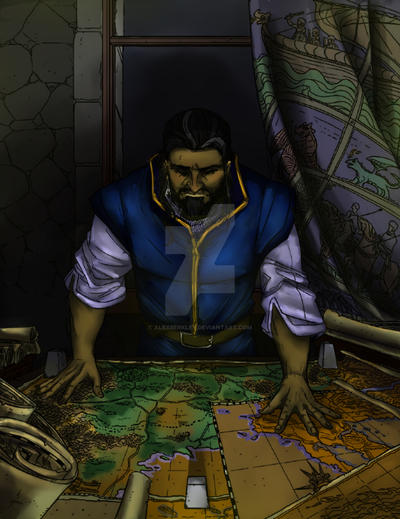
The next chapter, “Lone Wolves,” opens with a brief musing on the Fool before turning to a hunting scene, with Fitz guiding the wolf cub in a failed attempt to take a white rabbit in the snow. After, Fitz guides the cub to an abandoned shack that mice have taken over, purposing to leave him there. He attempts to do so, forcefully and with regret against which he tries to steel himself.

Drawing 2: Fitz and Fool Coloring Book by Alex Berkley on DeviantArt, used for commentary

Lost among his thoughts, Fitz is attacked by Forged Ones who purpose to eat him. He fights them, faring poorly until the wolf cub arrives and turns matters. When Fitz wakes from his exertions, the wolf cub reveals his name, Nighteyes, and their bond reasserts itself with greater intensity.

After, Fitz returns to Buckkeep and reports to Verity, whom he finds Skilling with greater intensity than is to his good. Verity, with some apology, directs Fitz to resume exterminating the arriving Forged Ones. The two also confer about Kettricken, and Verity notes the consuming passion for the Skill. Verity also asks about Fitz’s injuries before bidding him be careful. They eat together, and Fitz considers what is likely to come. They also confer about the Fool and the dearth of Skilled people who should be present but are not. Verity assigns Fitz a mapping task and bids him report early the next morning.

As I read the chapter again, I found myself annoyed by the continued treatment of Kettricken as a childish figure who has to be given tasks to distract her. The fight against the Forged Ones she led, among many others, should have served to Verity as an indication that she is a woman of her own volition and no mean leader, not some idle arm-ornament. And while some allowance might be made to Verity for the thought-disrupting effects of any addiction–and the Skill is repeatedly asserted to be addictive–it still rankles that he looks on the leader his wife is as in need of distraction.

Fitz, too, ought to know better. Indeed, in the chapter, he notes knowing Kettricken better than her husband does. Too, he has demonstrated in the text that he has no small degree of political acumen; his specific suggestion speaks to that acumen, in fact, as well as serving as a bit of revenge for wrongs done him in the previous novel. And while it may be the case that the power difference between him and Verity accounts for some of his behavior, Fitz has proven willing to talk back to power before; he seems to have forgotten things he has already learned, no less so than Verity. It’s something that vexes me as I read again, though I will concede it may be me reading with more affect than I ought to once again.

Fall is coming; help me lay in supplies for the rest of the year.

A Rumination on Writing Series

It should not be a secret at this point that I do a fair bit of work that emerges from earlier work I’ve done or that calls back to it. The Robin Hobb Reread on which I’m working now is perhaps the most put-together example, but it’s not the only one, even in this webspace; the abortive Pronghorn Project and Points of Departure are others, as are the several responses to Erin Bartram I’ve made here, as well as the many sample assignments I’ve posted. This is not to say that I always think of things as being series when I start them, but even when I do not set out to put together some kind of continuous narrative or set of essays, I do often look back at what I have already done to find something else to do.

 how writing seor assignment GIF
Image from Giphy.com

That I am often able to do so, though, does not mean I am always able to do so. There are many occasions that see me finding some idea I’ve had in passing, often made in some footnote, that I’ve pursued further; I’ve gotten several conference papers out of doing that very thing, and I tend to write with a lot of footnotes when I do my academic writing. (One professor commented that I tend to make my better points in my footnotes. I’m still not sure what I should think of that.) But I write less academic stuff at this point than I used to (sensibly, given that I am much less involved in academe than I used to be–which is likely to my benefit and others’), so I have far fewer footnotes from which to work.

Between that and being between teaching sessions at the moment–I expect to have a class in each of the next two upcoming sessions, which will be good, but I don’t have access to course materials to work on sample assignments and the like–I find that I have been struggling for things to write between the entries in the current writing series, and I am not able to work on that series enough at any one time to get away with making three or more entries into it each week. I would love to, of course, but there are enough other things going on that I have not been able to make the time for it.

Even with the challenges to composition, though, I am glad to have the writing series to work on. I do better having direction than not, and working on series gives me that direction or some semblance of it. I could wish to have such direction in other ways, as well, but I am no longer in a place where I’ve got a lot of people telling me what I need to do to be able to get what I want–nor yet any such clear idea of what I want as I have had at points in the past.

Any support would still be appreciated.

A Robin Hobb Rereading Series: Entry 35: Royal Assassin, Chapter 10

Read the previous entry in the series here.
Read the next entry in the series here.


The chapter that follows, “Fool’s Errand,” opens with a discussion of the state of Skill practice leading up to Verity’s time. It moves to Fitz recounting his Wit experiences with the wolf cub and his waning denial of their growing bond.

Canis lupus occidentalis.jpg
Standing Wolf by Ellie Attebery on Flickr, image used for commentary

Of a morning, Fitz is asked by some of the guards at Buckkeep to put to Verity an idea that they had had to form an independent guard unit for Kettricken. Fitz presses them for a bit before agreeing to carry the idea to the king- and queen-in-waiting. Fitz also rehearses his continued longings for Molly, as well as the state of affairs in Buckkeep following the funeral proceedings. As he makes to attend on Kettricken, he is greeted by the Fool, who poses to him questions about the dearth of Skilled in the Six Duchies. Fitz contemplates the matter, finding difficulty in interpreting the Fool’s words; the Fool presses on, making mockery of Fitz and leaving him much to consider as he reaches Kettricken’s chambers.

When Fitz reaches them, Regal greets and insults him, provoking him to a rage that morphs into impolitic delight at seeing Molly. She excuses herself, and Fitz enters Kettricken’s chambers, finding her centered and more at ease than he has seen her for long. She notes that she has returned to herself, offering philosophical discussion and meditation. Fitz realizes, with some astonishment, that Kettricken is possessed of the Wit, and the wolf cub through him connects to her, exulting in it. Fitz, however, is wary; knowing that his own Wit-work can be detected by others, he realizes that others’ might, as well.

The chapter offers a bit more to support the idea that the Wit, at least in the Farseer novels, is a metaphor for homosexuality. That Kettricken is possessed of it, marking her as even more Other to the mainstream Six Duchies than her ethnic identity already does, poses the same kind of threat that being a closeted member of a minority population in the United States in the mid-1990s did; the revelation, even then and there, could well be fatal, as is noted here, here, and elsewhere. And Fitz already knows he has enemies that would not scruple to use a perceived usurping outsider as an avenue of attack against him.

There is also an interesting bit about meditation in the chapter. The philosophical approach Kettricken voices is somewhat fatalistic, something of a “the world will happen as it happens, despite what you do,” and the machinations of fate do form a major motif in the series, filled as it is with prophecy and the like. But the meditative aspect of Kettricken’s approach to life, juxtaposed with Fitz’s inability to participate in it, seems it could be read as a comment about the accessibility of such practice. Fitz, while not exactly among the lower classes, is not among the elite; he has to work, and abundantly, while Kettricken sees herself as unoccupied in her role as queen-in-waiting. For her to meditate, when Fitz cannot, could be taken as a rebuke of the practice as something set aside from the working world. But that might be going further than can be sustained by the text as a whole; in the Mountain Kindgom, it is asserted, Kettricken would have had and did have much work to do. She is not depicted as having meditated there, though she seems to report it in the present chapter, so…

I shall still thank you for your support.