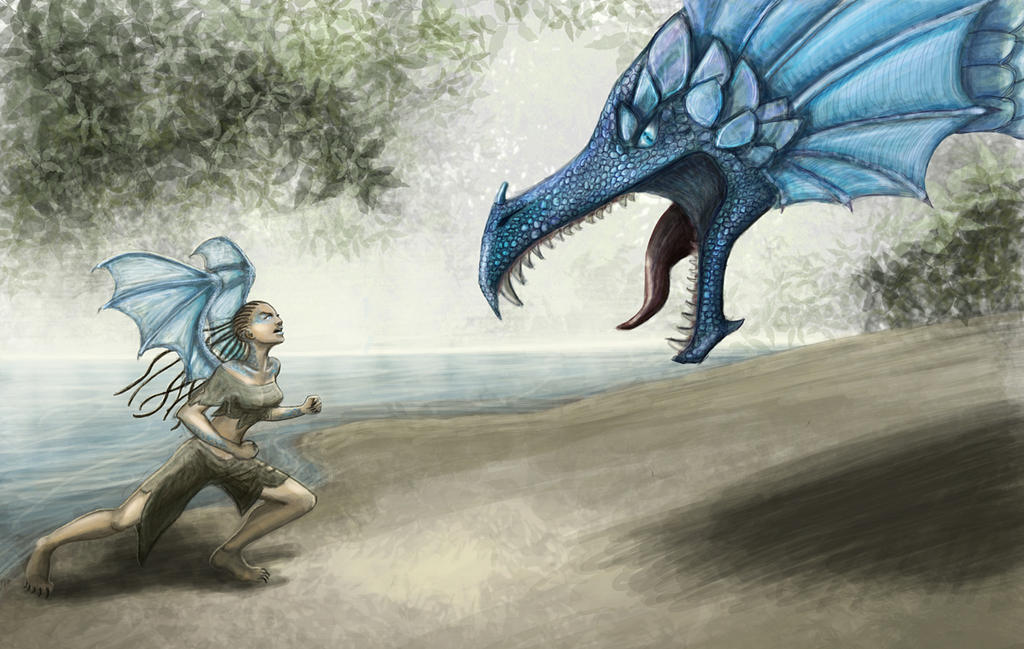
A Robin Hobb Rereading Series: Entry 356: City of Dragons, Chapter 6

Read the previous entry in the series here.
Read the next entry in the series here.


After a missive noting formal complaint of message tampering and advising caution and documentation, “Marked by the Rain Wilds” opens with Malta and Jani Khuprus conferring together about the former’s plans. Malta notes her intent to accompany Reyn to Cassarick, hoping for news of the Tarman. The relationship between mother- and daughter-in-law is glossed, along with the history of the Rain Wilds Traders and the tree-cities they built. Jani advises Malta to dress to impress, and the two talk frankly of pregnancies and miscarraiges. Business partners’ labor practices are discussed as matters of concern, as well, as are concerns of integration of the Tattooed into Rain Wild society.

Progress…
Malta Vestrit, From Entitled Brat to an Elderling Queen on vrgo.tumblr.com, used for commentary

Talk returns to Malta’s pregnancy and the difficulties attendant upon it, not only those for pregnancies in general, but also the specific concerns that the Rain Wilds impose. The stark choices that face Malta–and all mothers in the Rain Wilds–are noted, and Malta’s reactions to them are glossed as she tries to distract herself with necessary tasks. She also reflects on her personal history following her reception by the Satrap. The reverie and discussion are interrupted by Reyn’s arrival and jesting with his wife and mother. Jani excuses herself, and Reyn conducts his wife to their waiting transport, the pair joining Reyn’s sister, Tillamon, along the way. Some tension with Tillamon is noted, and the group proceeds.

As they make for their ship, the River Snake, developments in shipbuilding and the implications for Rain Wild trade are discussed. The trio boards and is scarcely settled in before the ship gets underway, and Malta finds herself considering herself and her sister-in-law, and talk turns to that end briefly before going to concerns of pregnancy and midwifery. The dragon keepers are cited as beacons of hope for children who would otherwise be discarded, and Malta and Reyn determine to leave the fate of their coming child in divine hands.

There are several clear parallels that arise for me as I reread the present chapter. I’ve noted before my interpretation of Bingtown and the Rain Wilds as a gloss on the early United States. In keeping with that, I have to read the discussion of the Tattooed as a parallel to those surrounding enslaved populations in the United States and the ongoing effects of that ancestral wrong that persist into the present day. I’ve also noted having long lived in central Texas, and so I cannot help but read in the present chapter echoes of discussions surrounding immigration that I have heard and still hear, and not always gladly. Both sociohistorical items are heavily racially charged, and in the novel, the parallels are also based around what might well be termed racial or ethnic divisions (largely but not exclusively indicated by skin, in the event). There is the usual frustration of the parallels by Hobb; the Tattooed are marked as such, rather than born as such, and the Rain Wilds Traders are not the icons of “purity” upon which the wrong-headed racist / ethnocentric / supremacist discourses Hobb obliquely references (deliberately or otherwise does not matter) rely. They yet remain clear enough to be issues of discussion, however, both in themselves and in how they reinforce ideas of the sourcing for the Elderlings novels.

Another that comes across to me is the parallel between the discussion of Malta’s pregnancy and discussions of abortion and other reproductive rights. When the novel was published, in 2012, arguments surrounding abortion rights were particularly heated in legislatures, with a remarkably high number of restrictions on those rights put into place. I reread the chapter now and write in the wake of the 2022 Dobbs decision. Other, lower-profile, pieces of legislation addressing other reproductive rights has crowded in between, much of it conducing to strip from those who must bear the burdens of reproduction control of that reproduction. “Just keep your legs closed” is not good advice (though “keep your pecker in your pants” is). It’s a concern that emerges repeatedly in Hobb’s work, the Realm of the Elderlings and elsewhere (as noted here, among others), and it’s one with which people still too much grapple, usually to the detriment of those affected.

I’m happy to write to order for you; fill out the form below to let me know what you need!

← Back

Thank you for your response. ✨

Or simply send along your support!

A Robin Hobb Rereading Series: Entry 355: City of Dragons, Chapter 5

Read the previous entry in the series here.
Read the next entry in the series here.


Following advice of a reward for information about Sedric and Alise from their families and an accompanying brief message to Detozi that notes questions of transmission integrity, “A Bingtown Trader” begins with Hest surveying Alise’s chambers in his home. He muses in annoyance on the chambers and their erstwhile occupant, and he fumes at the expense of having taken Alise as a wife and the pretense that his doing so enacts. The implications that Alise and Sedric have run off together, though Hest knows them to be false, rankle and affect his business dealings, annoying him yet further. His steps against his lover and his wife are rehearsed, and his reverie is interrupted by a visitor from Chalced.

Oh, right. This guy.
Image for commentary, of course.

Hest seeks to rebuke the visitor and is assailed for his troubles, soon pressed hard for information he does not have about Sedric’s dealings with Chalcedean agents. He is also conscripted into Chalced’s mission to acquire dragon-parts for their ruler’s health, given grim reminders of the importance of that mission to deliver.

It would seem to have been a while since Hest last appeared “in the flesh” in the narrative, as such; he is referenced and recalled, but to have him present in the narrative present is not something that happens often. And that is likely for the best; he is, as has been remarked on more than one occasion by more than one character, an unpleasant person with few, if any, redeeming qualities. Admittedly, Hobb has dwelt on such characters more than once before; depictions of Will and Regal in the Farseer novels come to mind, as do depictions of Kyle Haven in the Liveship Traders novels. Still, that Hest has only this brief direct part in the narrative after so long outside it seems marked, suggesting to my mind that he is functioning as a place-holder and character-type rather than as an actual character. That is, Hest is not important to the narrative in himself so much as he is important to the narrative for his interactions with other characters.

The potential problem that arises with this is that characters who are treated in such ways tend towards enacting and reinforcing stereotypes. Used for their narrative functions rather than having their development presented and explored, such characters do not invite the level of craft and attention that more focal figures receive, and it becomes easy to present them via a kind of short-hand, evoking or outright presenting types likely to be taken in and understood by broader readerships–and, all too often, those types are unflattering representations of classes of people. That they are so easily accessible is the result of long years of infelicity and worse, problems likely to continue because they continue to be used with minimal critique in the media people take in.

If you like the writing I do and would like some done for you, fill out the form below, and we’ll get started!

← Back

Thank you for your response. ✨

You can also always offer direct support!

A Robin Hobb Rereading Series: Entry 354: City of Dragons, Chapter 4

Read the previous entry in the series here.
Read the next entry in the series here.


After a seemingly clandestine message from Kim in Cassarick to Hest Finbok that affirms concerns raised earlier, “Kelsingra” begins with Alise stalking through the streets of the ruined city, mentally categorizing and interpreting what she sees in something like an exercise in amateur archaeology. The strange condition of the buildings and the occasional echoes earlier presentations of the city, and Alise muses on matters at some length as she surveys the site. With thoughts turning to possible futures, Alise confers with Leftrin, who notes the problems that face the expedition despite best efforts being made by all members of the party. Alise offers a solution to at least part of their problem, but Leftrin argues against it, citing the reasons it would not work and that they should not attempt it. Leftrin’s own proposal receives similar treatment from Alise in turn, and the two make to return to the Tarman together. They are interrupted in their progress by an encounter with an agitated Heeby and a stricken Rapskal, to whom they attend. Reviving him from strange visions, they proceed.

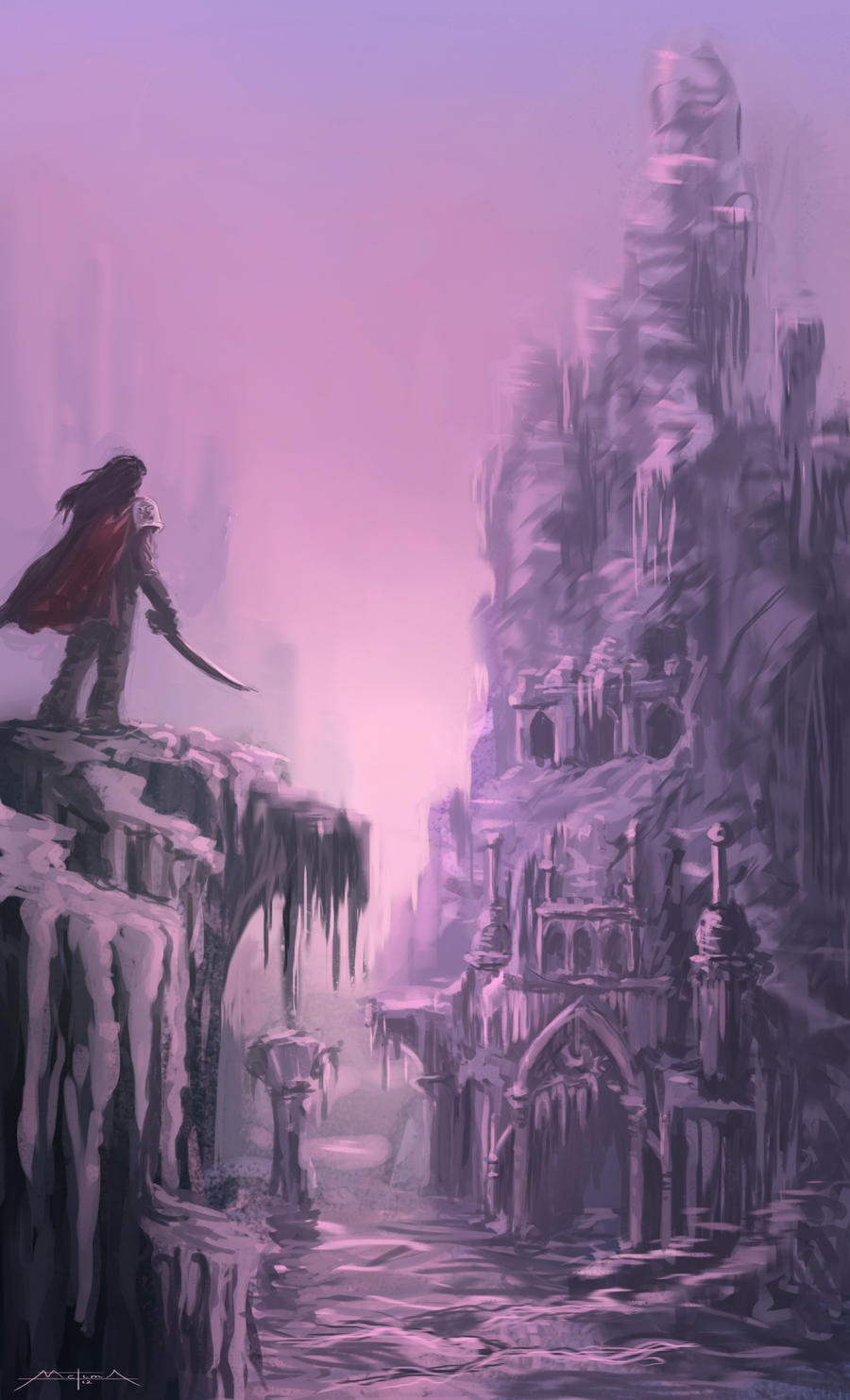
It returns!
Once again, Frozen History by MeetV on DeviantArt, here, used for commentary.

Heeby bears Alise and Leftrin back to the Tarman in turn. Alise considers the experience as she is taken aloft. Leftrin watches anxiously as she goes, Rapskal offering some cold comfort as the two confer about Rapskal’s experience with the carved stones of the city. Leftrin presses Rapskal for details and receives cryptic answers about the purposes of the memories embedded in the stones. Given the responses, Leftrin opts to send Rapskal on ahead, awaiting a later turn to cross the river back to his ship and crew.

Before getting into discussion of the main chapter, I have to note once again my appreciation for the prefatory materials for each chapter–and their integration. I enjoy getting the sense that the narratives I take in take place in a world that exists outside the context of those narratives, and while this sometimes must mean that such indicators only tangentially affect the main narrative, it is also a pleasure to see them tie into themselves. It’s a bit of storytelling craft I like seeing at play.

As to the main chapter: I appreciate that Alise, even in the act of surveying what is present in Kelsingra, begins to move from simple recording into interpretation of data. It’s something of a popular misconception, I find, that the work of those who look to the past–be it in formal histories, in archaeology, or in older literatures–is a matter of rote memorization, a “these-are-the-facts-and-you-have-to-know-them” approach to the echoes of lives lived (sometimes not-so-) long ago. But it is not, or it is, at least, not only that. Yes, the available information has to be recorded, but the record has no meaning until it is acted upon; meaning and understanding are necessarily matters of interpretation. Indeed, even the selection of what merits inclusion in any kind of formal record is an interpretive act. (Consider: there is no way to take in and put down all of the possible data, so only what’s “important” gets noted. But how does a person know what’s “important” in a given context? By making an interpretation, hopefully based on an empathetic understanding deriving from intensive training and study, but always necessarily reflecting the inherent and ingrained biases present in the person making the record.) And, as Leftrin motions towards, the earlier interpretations will necessarily influence those that come later on–something with which my own trained field grapples, not always well.

Clearly, there is more work to do.

I continue to offer bespoke, human-crafted writing with no AI!
Need more details? Fill out the form below!

← Back

Thank you for your response. ✨

I’d be happy to have your support!

A Robin Hobb Rereading Series: Entry 353: City of Dragons, Chapter 3

Read the previous entry in the series here.
Read the next entry in the series here.


A message from Detozi to her new relation, Erek, commending him and advising him precedes “Pathways,” which begins with Thymara considering her upbringing in the Rain Wilds and the disjunction from it to her present circumstances near Kelsingra. Local geographical features, described, intrigue her. The difficulties imposed on her by inclement weather and degraded equipment are noted as she is joined by Tats. As they proceed together, the two talk about the likely permanence of their relocation, and Thymara finds herself assessing her long-time friend again. The gain and loss involved in the relocation receives attention, as well, and Thymara carefully considers the options available to her–including in terms of relationships, returning to the ideas of social sexual taboos that she had been raised to respect.

Nice rack.
Photo by Pixabay on Pexels.com

The conversation between Thymara and Tats is interrupted by her sighting game, which is described. Before the hunters can seize upon it, however, Heeby falls upon it, fouling Thymara’s shot and taking the meat. The hunters move on, getting distance from the feeding dragon and the smell of death that will drive other quarry away, and they talk about their relationships with their dragons–and hers with her family. They are interrupted again by the arrival of Rapskal, who apologizes for Heeby’s interference in their hunt before annoying Tats into stalking off. Rapskal asks Thymara to go to Kelsingra with him to show her something.

Thymara reflects on her one sojourn to the ruined city, which is described in some detail. The strange juxtaposition of desolation and preservation receives attention, and the sound of wolves drives most of the keepers away. Rapskal, however, carried by Heeby, visits frequently.

Rapskal reiterates his plea to Thymara, which she refuses, citing the need to feed Sintara. He grudgingly offers to help her hunt, and she similarly accepts his offer.

Elsewhere, Selden is rousted brusquely and in some confusion, roughly assessed by his enslaver and a potential buyer. Selden protests the treatment proposed of him, but the enslaver and the potential buyer reach an accord, and terrible proceedings begin.

The description of the game sighted by Thymara and taken by Heeby reads to me as nothing so much as a moose, which could “have slung a sleeping net between the branches of his two flat-pronged antlers….His shoulders were immense, and a large hummock of meaty flesh rode them” (49). While moose do occur in Eurasia, they are most commonly associated with the subarctic regions of North America, another suggestion that the Realm of the Elderlings is well read as borrowing more from the New World than the Old. (Someday, perhaps, I will return to the project in a more sustained way; I do not know if I have another chapter in me on the subject, but perhaps I do.)

Less fortunate a parallel is in the enslavement of Selden. The degradations and desecrations involved in slavery in the Realm of the Elderlings novels are attested early on and in detail, and matters have not improved. Indeed, Selden fares worse than his brother did, not indentured against debt but flatly treated as butcherable livestock despite the acknowledgement by his enslavers of his sentience and, indeed, humanity. I cannot help but perceive the echoes of the system of chattel slavery that marks the early history of the United States, the effects of which remain all too present in the lives of all too many. This is not to say that other times and places did not have their own barbarities; of course they did. But that others have done wrong does not excuse the wrongs one does; whataboutism is a distraction, and tu quoque is long identified as a fallacy for good reason.

As I consider the matter of parallels further, I find myself somewhat stymied. If it is the case, as I have argued, that the Realm of the Elderlings should be read as a fantastical gloss on the Americas (not so much as Gernia in the Soldier Son novels, as I have had recent cause to reflect upon, but still), then I have to wonder what Kelsingra ought to be heard as echoing. Should the ruined streets and broken towers be regarded as some refiguration of X̱á:ytem, perhaps, or Cahokia? Do the cyclopean remains of Chichen Itza offer an antecedent, or does Teotihuacan, or Copán, or Tenochtitlán? Or is this, instead, a case where the fantastic emerges from the mundane, the miraculous from the quotidian?

I confess to not being adequately informed about any of them to offer any kind of useful answer to such questions–only just barely enough to be able to ask them. But perhaps others, more knowledgeable, can offer those answers.

I shall read and learn eagerly from those who do.

I remain happy to write to order, eschewing AI; get more details by filling out the form below!

← Back

Thank you for your response. ✨

Your kind support remains greatly appreciated!

A Robin Hobb Rereading Series: Entry 352: City of Dragons, Chapter 2

Read the previous entry in the series here.
Read the next entry in the series here.


Following an extended acerbic commentary from Kim in Cassarick rebutting allegations made, “Dragon Battle” begins with Sintara assessing the situation in which the dragons find themselves., pining over the loss of what she and they should have been. She muses on flight and upon mating, growing annoyed, and thinks about Thymara until interrupted by the awkwardly-landing Kalo. Kalo prods her to attempt flight again, and she reacts harshly, provoking a fight among the males present. Mercor interrupts the fight, defeating Kalo and rebuking Sintara. She stalks off, where Thymara confronts her as she begins to tend to her injuries, and Sintara begins to soften slightly toward her keeper as she returns to the other dragons, assessing events. But only slightly; their continued conversation about flight annoys the dragon, and she sends her keeper hunting as her thoughts turn again to Kelsingra.

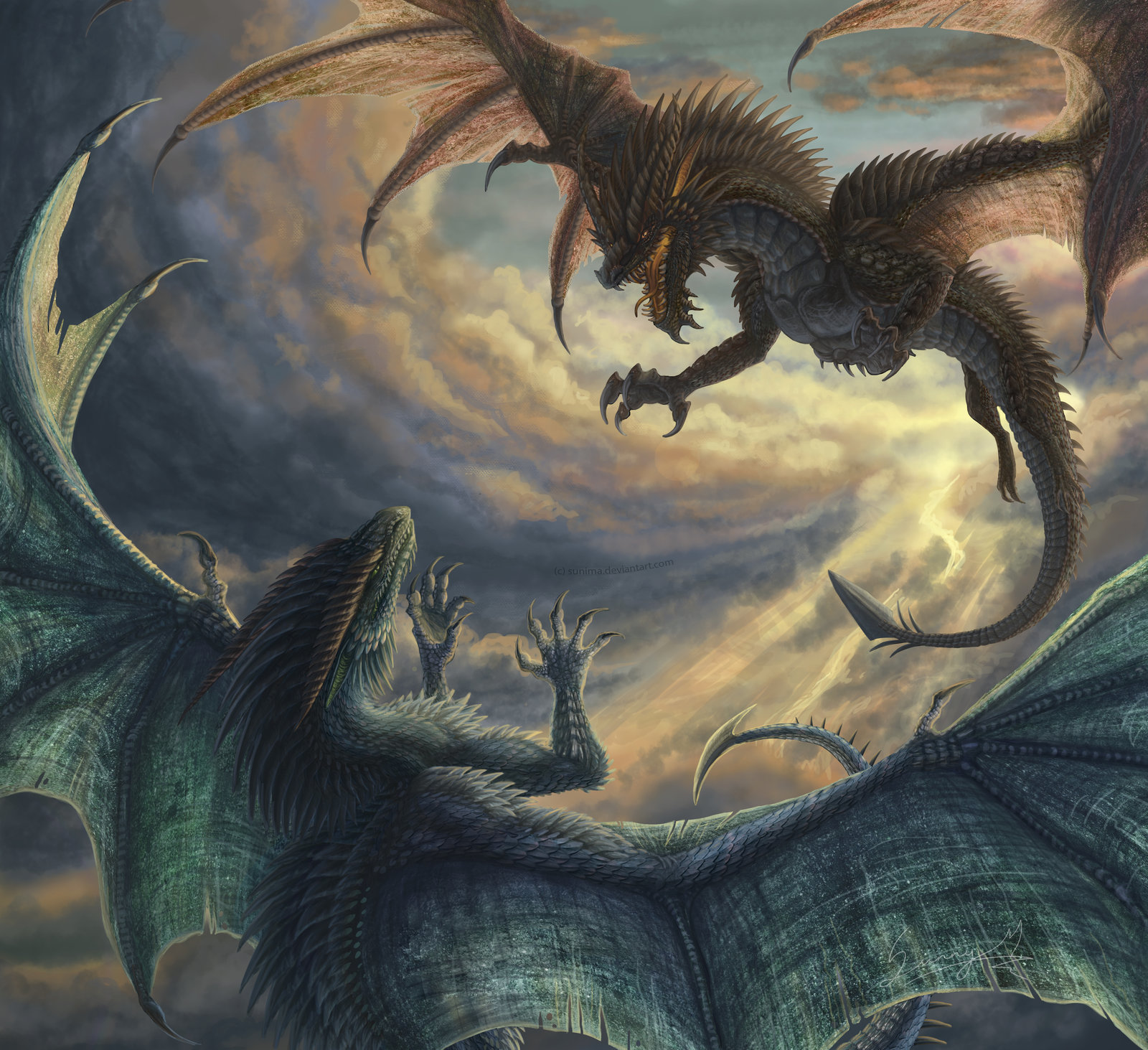
Not far off, in the event.
Sunniva Myster’s Dragons about to Fight on ArtStation, used for commentary

Sedric calls to Carson as the latter faces Kalo, urging him to calm as his own keeper is retrieved. Said keeper and another, Davvie and Lecter, have been irresponsible in their affections, provoking comment from Carson about his nephew. Sedric finds himself thinking about dislocation and of his lover, and Carson extends amiable gestures that please the Bingtowner. Sedric marks the ways in which Carson is changing under the influence of his dragon, and his mind turns to Hest. Carson marks it and asks after it, praising Sedric for the ways in which he has changed in the Rain Wilds. The possibilities of the future, good and bad, ring through Sedric’s mind, and he and Carson confer as they work together. Carson notes Sedric’s increasing capabilities, sparking pride in the man.

Once again, I find myself reading with affect as I reread the present chapter. I’ve not made any secret of growing up in a family of tradespeople; I’ve also not made any secret of growing up and living again in the central Texas Hill Country. Both push towards physical labor as a means of making a way in the world. I, however, have always been…brainier than I am brawny. While I carry more weight than is good for me, more of it is flab than muscle-slab, and while I am a willing hand to many things, I am not as able of one as would be best. A recent experience of doing some work around my house reminded me of it, pointedly and unpleasantly. (I’m fine, thanks. Just clearly not used to doing much physical work anymore, if I ever was.) So I find that I feel for Sedric in the present chapter, not because I am a long-closeted man who is finally able to be open with an understanding, non-abusive lover, but because I am a bookish sort among hand-working folk, and I am aware of the lack in myself.

I read the section focusing on Sintara and Thymara with less affect, to be sure–I do not have much, if anything, in the way of shared experience there–but not with less attention. I find it of interest that Thymara’s choice to abstain is so poorly regarded by other characters in the text as it is; while it is the case that some of Thymara’s choice is culturally driven, some of it is wariness of likely consequences (the observance of which seems like it ought to be lauded), and, in either case, the decision on whether or not to have sex is and should be hers to make. Yes, Thymara is somewhat naïve to think that things can always remain as they once were–a naïveté to which I think many fall victim, myself not excepted–and she might well be questioned, in character and by her readers, for it. But for deciding, as her culture dictates, as her presumed readership’s culture presumably dictates (because even more than a decade after the novel’s publication, there remains an expectation of chastity on the part of young women that is not applied to other populations), to withhold her intimate affections, knowing the consequences of indulging them in an unsettled environment and as a member of a population with a low rate of successful births, she should not be.

And, really, none of her readers’ choices in that regard should be questioned, either. Just in case you think I’m more worried about the page than people.

I continue to be happy to offer my writing services–all human-done, with no AI involvement–at reasonable rates. Fill out the form below for details!

← Back

Thank you for your response. ✨

I also appreciate gifts and sponsorships!

A Robin Hobb Rereading Series: Entry 351: City of Dragons, Chapter 1

Read the previous entry in the series here.
Read the next entry in the series here.


Following an extended message between bird-keepers treating concerns of information security, the first chapter of the novel, “The Duke and the Captive,” begins with a messenger reporting to the Duke of Chalced in fear or reprisal for the ill news he carries. The messenger is escorted away, and the ducal palace is described in some detail as the Duke is tended and receives a fuller report on actions in the Rain Wilds. His own situation is described in some detail, both his failing health and dearth of legal heirs, and his anxiousness to consume dragon-blood and -flesh to assuage both. The Duke lashes out, feebly but pointedly, at those around him.

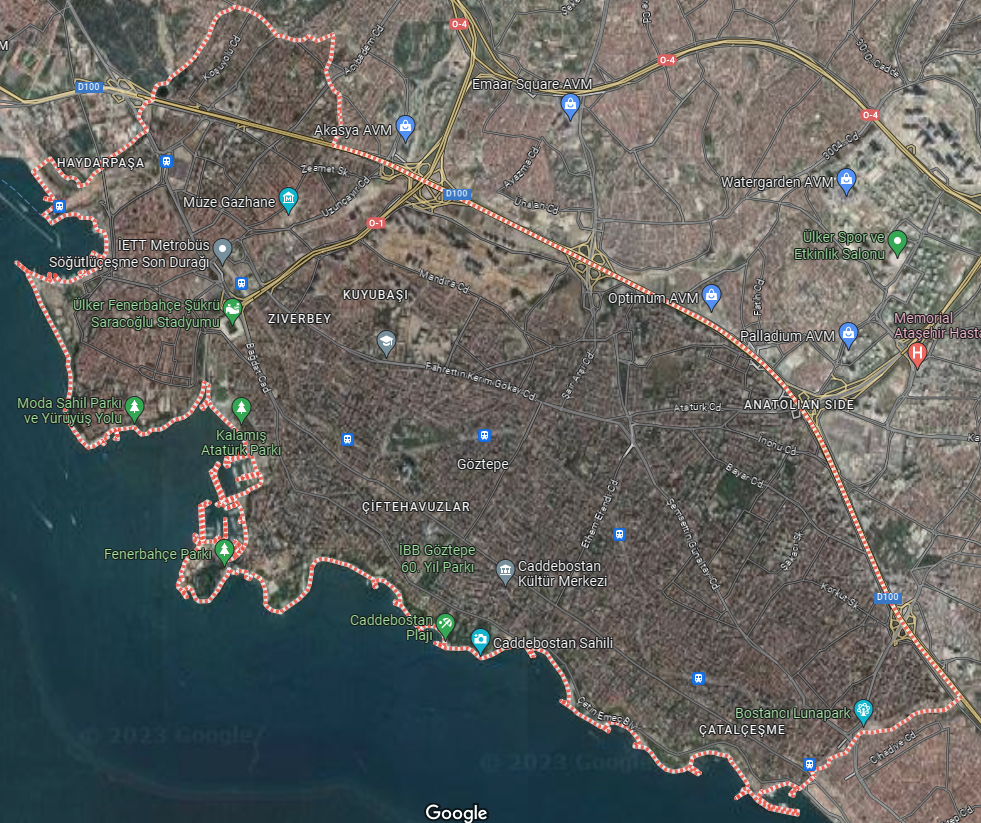
Something of an antecedent?
Image from Google Maps, used for commentary

Selden Vestrit, captive, ruminates on his situation as Chalcedeans view him, an oddity among a collection of oddities. The onlookers discuss selling him, ignoring his pleas. As they leave, Selden is wracked by coughing, his situation worsening as he longs for Tintaglia and freedom both.

The question occurs to me again as I reread the present chapter: To what, if anything, is Chalced an analogy? As I’ve remarked, there are analogues for other nation-states in the Realm of the Elderlings series. Bingtown and the Rain Wilds echo the United States, making Jamaillia something like Hanoverian England. The Six Duchies and the Out Islands are not unlike the indigenous American peoples, if with other influences visible and at play, so that “parallel” would be too strong a term. It is the case that the Duchies and Bingtown are or have been in position to ally against Chalced, being both vexed thereby; the analogue of Chalced would therefore be some state vexatious to multiple populations, heavily autocratic, and with a (relatively) poor human rights record.

I admit to getting somewhat outside my remaining areas of expertise, here, but colonial Spain somehow comes to mind. I am not a Hispanist; I did grow up in an area marked by Spanish colonialism, and there is something of that in even popular and public-school accounts of the local and regional histories, but I am far from a specialist in such things. I do, however, think there might be something to investigate in that line for an intrepid student who is more attuned to such concerns than I can be. (Please be sure to cite me if your papers take you in such a direction; I shall thank you.)

Similarly outside my expertise but similarly suggestive is the parallel of the names. Chalced seems to work from Chalcedon, an ancient town of Classical Asia Minor now part of the Istanbul district in Turkey. Site of some important early Christian councils and the namesake of chalcedony, it exerts some historical and religious influence…but, again, my noting that there is some interest to follow does not mean I am equipped to follow that interest in what has to be a short(ish) blog post such as this one. Again, a student of more related concerns looking at this might well have more to say. (Again, too, kindly throw me a citation if you investigate that way; I shall still thank you.)

Like what I write?
Want me to write for you?
Fill out the form below to get started!
All human-made; no AI!

← Back

Thank you for your response. ✨

Or extend your patronage directly!

A Robin Hobb Rereading Series: Entry 350: City of Dragons, Front Matter

Read the previous entry in the series here.
Read the next entry in the series here.


The third volume of the Rain Wilds Chronicles begins, as do the first and second, with a cast of characters–the keepers and their dragons, people from Bingtown, the crew of the Tarman, and assorted others–before presenting a prologue. Said prologue, titled “Tintaglia and Icefyre,” focuses on the eponymous dragons as they fly and hunt together. Tintaglia assesses Icefyre as they return to a familiar landing-place, and they are ambushed as they alight. The attack fails, although it startles the younger dragon and injures her.

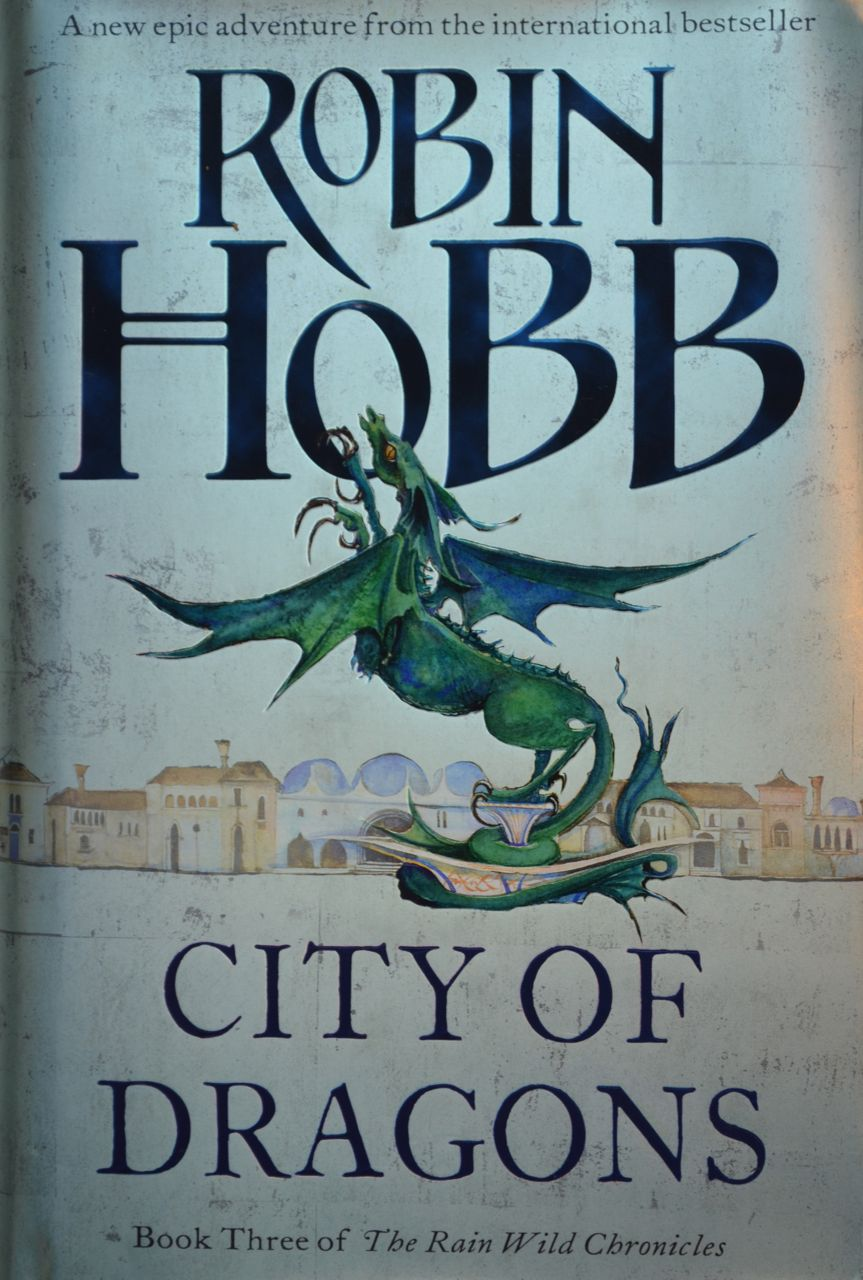
More or less the cover I have…
Image from Jackie Morris’s website, here, used for commentary

In the wake of the attack, the dragons confer, Tintaglia noting her inexperience with assault from humans. Icefyre opines on previous experiences and ancestral memories of such attacks and their effects, and he notes that he and Tintaglia will have to depart the area for a time–but not until they have eaten their fill from among their slain attackers. Tintaglia initially balks, and she questions one survivor. From him, she learns that the Duke of Chalced has prompted the attack, and Icefyre eats him for his trouble.

This will not be the first time I’ve written about City of Dragons, of course. In addition to occasional references in papers I’ve written for presentation, I reviewed the novel (for what all that’s worth) in another webspace I formerly maintained (find the review here), not long after it hit print, back when I had time to sit and chew through a novel in a day and write about it with daylight to spare. Certainly, there are things I miss about that part of my life, even if I did not recognize at the time the privilege I had then. That said, I am in a better place now than I was then, although it’s not the place I thought that I would be when I thought then about where I might be now.

I am struck once again by Hobb’s ability to write non-human intelligences sensibly, something that features throughout the Elderlings corpus. Admittedly, there are limits; Hobb is, to the extent of my knowledge and the public disclosures I have seen, human, and so there will be only so much of the nonhuman that she can depict. But the fact of presentation is something that continues to stand out to me, as does the believability of the same.

I note, too, that the prologue pivots into something that has been glancingly addressed in the earlier volumes of the Realm of the Elderlings corpus: Chalced. The repeated comment that “Sooner or later, there is always war with Chalced” comes to mind; the war seems to be coming. That the Chalcedean ruler is styled Duke speaks to it, as well as presenting an interesting implication for the Six Duchies; “duke,” of course, derives from dux, a Latin term for a high-ranking military leader, but in the Six Duchies, the Dukes are subordinate to a crowned King…

There will be a lot to do with this book. I look forward to doing it.

That school is out of session for many does not mean there’s not more writing to do–
writing with which I can help!
All human-written; no AI! Fill out the form below for details!

← Back

Thank you for your response. ✨

And I appreciate your patronage!

A Robin Hobb Rereading Series: Entry 349: Dragon Haven, Chapter 20

Read the previous entry in the series here.
Read the next entry in the series here.


Following a message-exchange in which the topic of marriage appears to be broached between Erek and Detozi, the final chapter of the novel, “Kelsingra,” begins with Alise taking dictation from the returned Rapskal and assessing the youth as she does so. That the party has come near to Kelsingra is noted.

It returns from before and before!
It’s still Frozen History by MeetV on DeviantArt, here, used for commentary.

The progress of the dragons, their keepers, the Tarman, and the crew of the same from the meeting with Rapskal to the outskirts of Kelsingra is glossed, being a laborious process of several days. Weather and darkness hindered the beginning of the resumed journey, but Heeby and Rapskal urge the others onwards, and the group comes to the opposite bank of a river across from Kelsingra.

Alise notes her motives for writing Rapskal’s report, and she assesses the changes that have occurred in the youth along with the party’s situation. Alise prompts Rapskal for more details, which he gives, elucidating his time from his loss to his rejoining the group. Her also notes, briefly, some of the status of the city, exciting Alise and frustrating her, as she cannot yet reach the city. After Rapskal rejoins the other keepers, Alise and Leftrin confer about him and the implications of their arrival at Kelsingra. They plan for their futures together, short-term and longer, and Leftrin’s mind reels with possibility.

Elsewhere, Carson and Sedric confer after having attended to their dragons. Carson purposes to teach Sedric to hunt, but Sedric demurs and distracts Carson with other matters. Meanwhile, Thymara muses on her situation and confers with Tats about how matters stand. Tats voices some dissatisfaction with that status, and he asks to see Thymara’s nascent wings. She reluctantly accedes to his requests, amid which Rapskal joins them. Tats attempts to deflect Rapskal, but the latter persists in urging Thymara to develop her wings as Heeby had done, offering to help her with them. And Sintara makes a test of her own wings, surveying them and taking to the air.

Formal announcement of the betrothal of Erek and Detozi concludes the novel.

It is always a pleasure to revisit such things as the image above and the references in its caption. In a sense, it is like calling on an old friend after a time away, both having changed and both taking the time to catch up. Indeed, one of the pleasures of working on this rereading series, even if haphazardly and intermittently as has been the case for me, is in that revisiting. I see different things, I think, in each reading, and the differences in what I see are a way for me to track the differences in myself from myself. I like to think that I continue to grow in more ways than the horizontal across the years, and I believe that I can look in my journals for some of how I viewed the novel when first I read it, more than ten years ago. I do recall the delight in seeing the novel on the bookstore shelves, calling to me from between hard covers. And that much remains a pleasure, when I find it again.

Less pleasant are the overtones of the interactions among Thymara, Tats, and Rapskal in the chapter. Again, I know the latter two are adolescents, and it is inappropriate to expect adult thoughts from those whose brains are presumably not fully formed–both because of the continued development of the brain into the 20s and because of the changes being effected by the dragons on their keepers. But that does not make Tats’s impositions less impositions, and it does not make the discussion between Tats and Rapskal about Thymara less insulting, as if she is not there herself and not at least as much in command of herself as they are of themselves. Once again, Thymara is treated in a proprietary way, something that has been a problem throughout the text–and which, unfortunately, contributes to its versimilitude.

For it is the case, often, that the bodies of girls and women are not considered to be fully their own, but to be governed and in some ways owned by the boys and men with whom they must interact. Even when, as Thymara, they make such efforts toward modesty as circumstances allow, and when they make clear and explicit that they are not entertaining romantic or intimate interest, they are overridden, overruled, overborne. Such interactions as are on display in the final chapter of the novel may seem innocent enough; I certainly remember a time in my life that I would have regarded them as such. But, again, I like to think that I have grown, and part of that growth is a recognition that such things–such things as I might well have done in my younger years, perhaps, had I had the chance to do so, rather than having been stymied by my own situations–only seem innocent to the guilty.

I know that a variation on Bellisario’s Maxim or the MST3K Mantra will likely be trotted out in response to such comments. (Yes, I cite such sources. Why not?) It is “just a fantasy novel,” after all, and despite my abortive attempts to make a career of compiling insightful commentaries on it and its like, there is something silly about getting up in arms over such a work. It is a remarkable position of privilege that lets me spend my time on this kind of thing rather than having to scramble to gather together enough calories in a day that I and my family don’t die, or gathering in enough money that we have a decent place to live. I know that, and better than a great many.

But.

The art we make reflects who and what we are. What gets put into the world reflects the artist; what gets distributed reflects understandings of broader cultures; what gets read and re-read reflects the reader. (And if it doesn’t get read or re-read, it still offers a reflection.) The novel is a novel, but the novel exists, the series exists, the very genre of novel exists because it says something to us about us and the world in which we live, even as it portrays a world distinctly not our own. Just as many will lean in towards a mirror to see if that is, in fact, a pimple beside their nose or some other blemish spreading across their cheek, I can look more closely at the text to see what flaws of mine it shows me, to see the ways in which the thing reflected is marred–or, as the case may well be and often is, to see the beauty that is there to be found.

Reading Dragon Haven again has helped recall as much to me.

Hopefully, it won’t take me so long to get through the next one!

I’m happy to write to order for you–a genuine human product with no AI involvement.
Fill out the form below for details!

← Back

Thank you for your response. ✨

And I appreciate your patronage!

A Robin Hobb Rereading Series: Entry 349: Dragon Haven, Chapter 19

Read the previous entry in the series here.
Read the next entry in the series here.


After more expressed concern from Bingtown about Sedric and Alise, as well as the ongoing exchange between Detozi and Erek, the penultimate chapter of the novel, “Mud and Wings,” begins with the Tarman running aground, the waters grown too shallow to float the old liveship and no clear current emerging from searches for the same. Leftrin sourly surveys the situation, discussing things with Alise as he reviews events. Reports of Greft’s death diminish morale, and Alise notes changes in the dragons. Leftrin announces that he will make a decision in the morning, and the crew tucks in for the night.

I believe this goes here…
ThereseoftheNorth’s Thymara and Sintara on DeviantArt, used for commentary

In Alise’s quarters, Thymara and Sylvie confer, the former asking the latter to examine and tend her back. The state of Thymara’s nascent wings is detailed, and Thymara urges Sylvie to keep quiet what she has seen. Sylvie agrees to wait only a day before taking it to Bellin.

Sedric calls upon Alise as she cooks dinner and reviews her notes, asking to speak with her. Alise rehearses her reassessment of her life in Bingtown with Hest, and she brusquely agrees to hear him out. Sedric confesses more of his perfidy with Hest and the Chalcedean dragon-parts traders. Alise commiserates with Sedric about Hest, and the two reconcile.

Thymara muses over the changes going on in her body once Sylvie leaves, and she makes to confront Sintara about them. The dragon exults in the process at work in Thymara, noting that she is being made into an Elderling–and admitting that the changes were not initially intended. Some of Sintara’s insecurities emerge as she rails at Thymara, and the commotion attracts the attention of the other dragons. Mercor urges calm, Spit violence, and further upset is interrupted by the unexpected return of Heeby and Rapskal, aloft, announcing the proximity of Kelsingra.

There is much I might point out in the present chapter. It is possible, if perhaps something of a strain, to read them as mimetic of transitioning, although I am assuredly not informed enough about such things to offer any kind of insightful commentary thereabout. (I might note, however, that it seems to run athwart of other parts of the author’s work, as Roberts attests.) It is also possible, and probably a stronger argument, to read the changes the keepers are undergoing as allegories or analogies to puberty, especially given the ages of many of the keepers and the pregnancy remarked upon among them.

The puberty-reading works well in part because of structural concerns. I’ve noted before, here, that the novel has somewhat of the Bildungsoman about it; I’ve commented, also, that other parts of Hobb’s corpus have spoken to such concerns (here and here, for example). There are possibly other places I have, and there are definitely other places I likely ought to have, made such notes–and that they were available for making at other points in the corpus and in the novel means they are possible, if not likely, in the present chapter.

It has been a while since my own pubescence, as might well be imagined, and, as also might be imagined, my memories of the experience will be somewhat occluded by that time. But I do recall that much of my experience was determined by things other than my choice. Forces beyond my control acted upon me to occasion changes in my body that were confusing and distressing at the time, and I am given to understand that the process is more…intense in that regard for those born with ovaries / uteri. (Having not directly experienced as much, I must rely upon the reports others who have have made to me, but I trust those who have made such reports to me.) Teasing out any metaphor is, of course, conjectural and conditional; all metaphors fail at some point (which is good; I’ve used that failure repeatedly in the freelance work I have done). But I think I may be on some solid ground with this one.

It’s not the only reading, of course. But it is a reading, and that is good enough to get started again.

Remember, I’m here to provide you made-to-order, hand-crafted, non-machined writing!
Fill out the form below for details!

← Back

Thank you for your response. ✨

Or help support ongoing efforts to keep the arts human!

A Robin Hobb Rereading Series: Entry 348: Dragon Haven, Chapter 18

Read the previous entry in the series here.
Read the next entry in the series here.


Following additional messages in the ongoing exchange between Erek and Detozi, these detailing the openings of formal marriage proceedings, “Gone Astray” begins with Thymara rousing on the deck of the Tarman to find herself and the ship out of the woods, somewhat disconcertingly for someone who had grown up in a tree-borne city. Process towards Kelsingra and the current state of the dragons and their keepers are rehearsed, and changes to Sintara are detailed. Thymara’s own aches, pains, and changes also receive attention. Several keepers approach Greft for the use of his gear, which he denies, though to no avail. After a tense exchange, Thymara retires.

Not too far off, I think…
Coastal Wetlands by U.S. Fish and Wildlife Service is licensed under CC-CC0 1.0

Leftrin considers the increasing peril for the Tarman and his crew as the group proceeds past what can properly be called a river, and he guesses at the geography that has led to the creation of the region in which he now travels. More of the local environment is described, and the dwindling supplies available receive attention. Alise joins him, and they confer about their situation. The pair affirm their mutual love, and their conversation turns awkward afterward, taking in Greft and his situation.

Leftrin and Alise walk the deck together, and Alise muses on the changes that have occurred in her. It is noted that Greft has taken his boat, as well as much of the hunting gear and no small part of the ship’s supplies. Given the theft from ship’s stores, Leftrin dispatches Carson to retrieve Greft. Carson asks Sedric to accompany him, confusing the latter, who muses on the shifting shape of their relationship. Carson and Sedric confer about their mission and the situation that obliges it, and they reaffirm their affections.

Meanwhile, Jerd experiences some difficulties with her pregnancy, occasioning some concern from the Tarman as blood hits the deck. Consultation with women on the crew notes that Jerd is likely experiencing a miscarriage and that those who have been engaging in sexual escapades are fools for doing so without the assurance that those who can get them pregnant will stand by them when hardships come. The rebuke is lengthy and detailed, and Jerd is delivered prematurely of a stillborn baby who is taken swiftly away and put overboard. Thymara considers the warning given, and Jerd’s dragon consumes the dead child.

Carson and Sedric proceed in their pursuit of Greft, backtracking under Carson’s honed skills. Gallators think to make meals of them, only to be eaten in turn by Spit. They find that Greft has not fared so well, but has been attacked by the gallators and left to die. Carson eases his passing, and Spit eats the body after it has been relieved of what few valuables are upon it. Sedric is confronted by evidence of his perfidy, purloined by Greft and found by Carson, and he confesses himself to his lover. Discussion turns pointed between the two, and Carson urges Sedric to confess to Alise.

The present chapter opens in another passage that serves to affirm, at least for me, that the setting of the Elderlings novels is more North America than Europe. The “gallators” Thymara and other keepers note encountering are reminiscent of alligators in name and described behavior, for one; the regions through which the Tarman passes call to mind such places as the Florida Everglades and the Louisiana wetlands (hence the image for this post). Other novels have, of course, offered other clues–the presence of raccoons is one that comes to mind–but as I was rereading this chapter, I was struck by it once again. There’s a comfort in being reminded that ideas you had were good ones.

That recognition brings to mind what seems to me to be a strange thought. The Traders were, as is noted early on in the Liveship Traders series, effectively exiles from their former homes in Jamailllia. (There’s more about that in some supplementary materials I will address in time, but I need to get through the “main” rereading first.) The Rain Wild Traders from whom the keepers are drawn are very nearly exiles from even the rest of the Traders. I have to wonder if there is some attempt at mirroring or borrowing from the history of the Cajuns in the United States; to my inexpert eye, exposed only cursorily in my few short years of study at the University of Louisiana at Lafayette, there seem to be some parallels, though I am well aware that my opinion is not the most informed that could be found. Still, I wonder if any of the future alumni at the school might be able to explicate that further. (I’d love it if you did and let me know!)

The discussion of the consequences of sex–more for women than for men–also provokes thoughts in me. I know that some of the discussion is entirely true to life; there’s a reason “Mama’s baby, Papa’s maybe” is a current phrase, and I have seen all too many children abandoned or worse by one or more of those who made them, all too many women who became pregnant and remained pregnant and were not aided in it by those who made them pregnant. (And that leaves aside questions of consent, which are many and almost certainly beyond what it is fit for me to address.) It is the case that people who can act as adults–and the keepers, having entered into contracts, seem to be in that place by the standards of the society in which they were reared, so there is at least that much to say–should act with thoughts towards the consequences of their actions. But it is also the case that consequences fall unevenly upon those who act, unfair as it is (and as the narrative, to its credit, makes explicit).

Too, as I continue to read with affect, I cannot help but note that my own daughter approaches the time in her life where such concerns will be hers to consider. She is not there yet, but she grows closer to it, some of it at her own insistence. I hope that, when the time comes, she will not need such harsh reminders. I fear, though, that she will, or that circumstances will conspire to strip that agency from her. The world is as it is, as is the part of it in which we live, and while there is much to commend that place, there is also much of pronounced concern, especially as regards such things…

I do not think I am wrong to worry about my (still-) little girl.

Like how I write? Want me to write for you? Fill out the form below!

← Back

Thank you for your response. ✨

Or simply send some patronage!