A Robin Hobb Rereading Series: Entry 289: Fool’s Fate, Chapter 12

Read the previous entry in the series here.
Read the next entry in the series
here.


The next chapter, “Cousins,” offers a snippet of translated in-milieu verse before moving to the continued progress of Dutiful’s errand. Political arrangements are noted, and preparations are made to depart Wuislington for Zylig. They include drugging Thick and bringing him aboard ship unconscious, which results in a substantial upset when he wakes, as well as Fitz’s shame. He reports as much and makes his recommendations regarding Thick to Chade and Dutiful when he reports to them aboard ship while they are underway. And he finds himself the object of Dutiful’s anger.

Dutiful demands from Fitz the truth about Nettle. Asked bluntly by his prince, Fitz answers as openly and honestly as he can, Chade exulting in the revelation and noting his own objection to the arrangements that had been made. Dutiful upbraids both Chade and Fitz for their parts in the deception, but he agrees that Fitz should be the one to inform Nettle of her origins. Discussion continues, Fitz and Chade falling into open and pragmatic discussions that scandalize Dutiful, and the conversation soon draws to a close.

After, Fitz checks up on Thick, finding himself subjected to the other man’s ire through the Skill, and he surveys the other passengers on their ship. Later, he tries to contact Nettle through the Skill, failing to do so and suffering for the remainder of the trip to Zylig.

Once in port, Fitz goes to work gathering information, gaining a general sense of the situation Dutiful’s party faces. The question of Thick arises again, and Fitz learns that the Six Duchies delegation that had remained in Zylig had done well for itself. He also learns the terms on which the Hetgurd agrees to allow the challenge of Aslevjal to take place as he and Chade confer. The next morning, though, sees more trouble from Thick as the party makes to depart for Aslevjal, and Web notes in an idle aside to Fitz that he has sent Swift to retrieve Thick as a sort of test of his ability in the Wit. Web offers once again, a final time, to teach Fitz, as well, and Fitz is dilatory in availing himself of it as the voyage gets underway.

At length, the party arrives at Aslevjal, which is described–and the Fool awaits them on the shore.

As I reread the chapter this time, I found Web’s comments about Fitz not finding time to learn more of the Wit resonant. I am not possessed of any magics, certainly, nor of any particular power or importance. Even so, there seems always to be some task or another to which I can devote my attention, to which I should devote it, and they all seem to get in the way of something else. I know that something else is important, certainly, and I know I ought to attend to it. At the same time, the tasks that present themselves to me are ones that need doing, and it is easy to set aside the nebulous for the concrete.

All too easy, in fact.

Care to send a little something my way?

A Robin Hobb Rereading Series: Entry 288: Fool’s Fate, Chapter 11

Read the previous entry in the series here.
Read the next entry in the series here.


The succeeding chapter, “Wuislington,” opens with commentary about Outisland social structures from Fedwren before turning to Fitz’s gloss of Dutiful’s party’s stay in Wuislington. He notes Thick’s convalescence and displeasure with him, which Chade notes he must endure. He notes, too, his continued tutelage of Swift, as well as the omnipresence of observation, And he notes a strange camaraderie growing between himself and Peottre over their mutual work to chaperone Dutiful and Elliania.

Something not unlike this…
Coniston Water by Mick Garratt is licensed under CC-BY-SA 2.0

Fitz also becomes aware of the agricultural underpinning of the Narwhal Clan’s wealth, the geography that enables it described in some detail. But as he follows Dutiful and Elliania on an excursion out into that farming country, he uncovers Henja spying on the pair, though he cannot pursue her. It informs his report to Chade later, as well as their discussion.

That night, Fitz is drawn into a dream where Nettle and Tintaglia confer. The dragon demands information from him, but Nettle manages to cast the dragon out of her dream and chides Fitz for his timorousness. Dutiful interrupts via the Skill, but he is also cast aside after a heated exchange through that magic. Nettle absents Fitz from her dream, as well, and he wakes suddenly to Dutiful’s insistent Skilling; the prince is angry at having Nettle concealed from him, and summons Fitz to account.

When Fitz, Thick trailing, answers the summons, he finds himself bidden through the Skill to stand and wait. He watches Dutiful and Elliania confer about sex until they are interrupted by Peottre. Peottre dismisses the Narcheska, and Dutiful expounds his situation to him, earning some respect from Elliania’s uncle. The exchange leaves Fitz and Thick both homesick, though Fitz knows the home he seeks no longer exists.

Dutiful’s comment that “I am a man but…I am a man” has long resonated with me. Reading it now, I acknowledge the heteronormativity in the comment, but I also note the clear tensions under which Dutiful operates. I have been an allosexual teenage boy, and though it was many years ago, it was not so many years ago that I do not recall the discomfort of its associated urges–or the tensions surrounding multiple ideas of what should be. And I have to wonder if that is not somehow an indication of the expected primary (or perhaps secondary) readership of the series, that it does depict such things as it does, and from the perspectives that it does. Yet another paper project idea that I may never develop…seems I have a lot of those, really. Too many.

I’d appreciate your support–no fooling!

A Robin Hobb Rereading Series: Entry 287: Fool’s Fate, Chapter 10

Read the previous entry in the series here.
Read the next entry in the series here.


The following chapter, “The Narcheska,” opens with an in-milieu discourse on social structures. It turns thence to a detailed description of the Narwhal mothershouse as Fitz and Swift are admitted. Those already in attendance are described in brief, and Fitz marks the absence of Elliania among them. An elderly woman, the Great Mother, is brought out and surveys matters before making several sharp remarks and showing the effects of age upon her. Elliania emerges at that point, taking charge of the situation and noting, after the Great Mother has been taken away, that she is newly come to menarche. Ritual greetings follow, commendations from the other Narwhal women.

The woman of the hour.
Image is from here, used for commentary.

Following that ceremony, another begins that reaffirms the betrothal of Elliania and Dutiful. Dutiful betrays some confusion through the Skill as the assembled Outislanders celebrate, and a feast is brought in as a formal presentation is done, and Fitz observes, starting somewhat as something of a shivaree takes Dutiful. Fitz surreptitiously pursues and finds the event in progress, centering on Elliania rather than on Dutiful, and she acquits herself admirably. In the wake of it, FItz and Chade confer through the Skill, Dutiful being somewhat addled by his own exchange with Elliania.

At length, celebrations wind down, and Fitz makes his way back to his quarters, conferring with Swift and Web along the way. As Fitz enters, he notes Riddle in attendance on Thick, as well as a “robber-rat,” which is described. Swift evidently attempts to form a Wit-bond with the creature, earning a rare rebuke from Web and a dismissal. Riddle’s following question allows for some explication, and Fitz finds himself ill at ease with what might have been.

The “robber-rat” in the chapter is part of why I argue for the North American sourcing of the Elderlings milieu. The description seems to me nothing so much as a raccoon, an animal of North America. It’s not the only piece of evidence, of course, but it is one that comes to mind, given the chapter.

More important is the warning occasioned by Swift’s incaution. The Elderlings corpus repeatedly inveighs against the Old Blood bonding too early or too deeply with their animal companions, Fitz remarking no few times that his co-being with Nighteyes was far more thorough than that experienced by other Wit-users. It occasioned problems for him in his youth, certainly, and continues to be a source of tension in such relationships with others of the Old Blood that he has. That Swift is warned away from it–but not away from the experience of the Wit itself–is perhaps a generational marker; he receives much the same instruction as Fitz in his youth, but his later teaching is done more thoroughly and with greater understanding. I would not presume to trace out social parallels, myself; I am concerned that my doing so would suffer from my own lack of embedded knowledge (and well studied as I may or may not be, there is a value to that embedded knowledge that no amount of book-learning can replace, even as no amount of direct experience with a thing can give the kind of perspective that outside study does; both are needed). But I think it would be a useful avenue of inquiry.

I’d be happy to have your sponsorship and support!

A Robin Hobb Rereading Series: Entry 286: Fool’s Fate, Chapter 9

Read the previous entry in the series here.
Read the next entry in the series here.

TW: Sexual assault, ableist language.


The next chapter, “Mothershouse,” opens with an in-milieu “cautionary tale” before moving to the continued progress of Dutiful’s party through the Outislands. The disentanglement from Zylig is detailed, as is the ship–the Tusker–on which Dutiful and his company will sail to Elliania’s home. So is Thick’s resistance to boarding the Outislander ship, as well as Web’s assistance with him, and Fitz marvels at Web’s use of the Wit to calm and lead Thick. Web confers with him afterward, and Fitz attempts, not entirely successfully, to deflect the older man’s questions.

A vision of Cockle, perhaps?
Image from here, used for commentary.

After, Fitz attempts to comfort Thick with the Skill, finding even less success, and is greeted in that magic by Nettle. She successfully helps Thick, and she notes Burrich’s strange behavior, from which Fitz realizes his foster-father has conferred at some length with the Fool. Burrich’s reported words strike Fitz, and he admits to Nettle that he bears the name Changer.

Following the Skilling and Thick being settled, Fitz attends to Swift, bidding him join in listening to Cockle’s songs and prompting a pleasantly polite exchange between himself and the minstrel. Cockle sings several songs of which Fitz approves, and Fitz listens as one of the Outisland crew sings, roughly, in return, declaiming a song about “the Black Man of Aslevjal.” Peottre tensely quashes further entertainment from the crew, and the journey proceeds. Web and Fitz confer about Thick as the Tusker approaches Wuislington, Elliania’s home, and puts in, received by the Narwhal Clan.

Formal greetings are exchanged, with Fitz becoming aware of ritual importance behind them, and Dutiful’s party begins to be billeted. Thick and Fitz are housed together, apart from others, and Fitz notes the reasons for and difficulties surrounding the arrangement. Web, bringing Swift, assists, and Fitz has time to mull over his situation before they return with provisions. Fitz is summoned to attend on Chade and Dutiful in the mothershouse, the central fortified dwelling of the women of the Narwhal Clan, and makes to report, along with Swift.

As I reread the chapter this time, the casual ableism at play strikes me. It’s come up in regards to Thick before; his very name, if it is his name, can be read as an instantiation of it, and I’ve called attention to it once or twice before. Fitz seems to be doing better at it at present, although I do still get the idea from him that it is only because he has access to Thick through the Skill–and even that, as I think on it, bespeaks some tokenism / disability superpower mentality. It’s an uncomfortable thing, to be sure, and I’m not sure how to regard it as I read right now–though I do keep in mind that a large part of Hobb’s verisimilitude is precisely in presenting characters who are flawed, who have bad ideas, and I well recall that what a character thinks and does is not necessarily a reflection of the author. Yes, writers can only write what they know, but one can observe a belief without sharing it, and the world provides no dearth of examples of wrongheaded beliefs.

More’s the pity.

Any support you can send my way will be welcome!

A Robin Hobb Rereading Series: Entry 285: Fool’s Fate, Chapter 8

Read the previous entry in the series here.
Read the next entry in the series here.


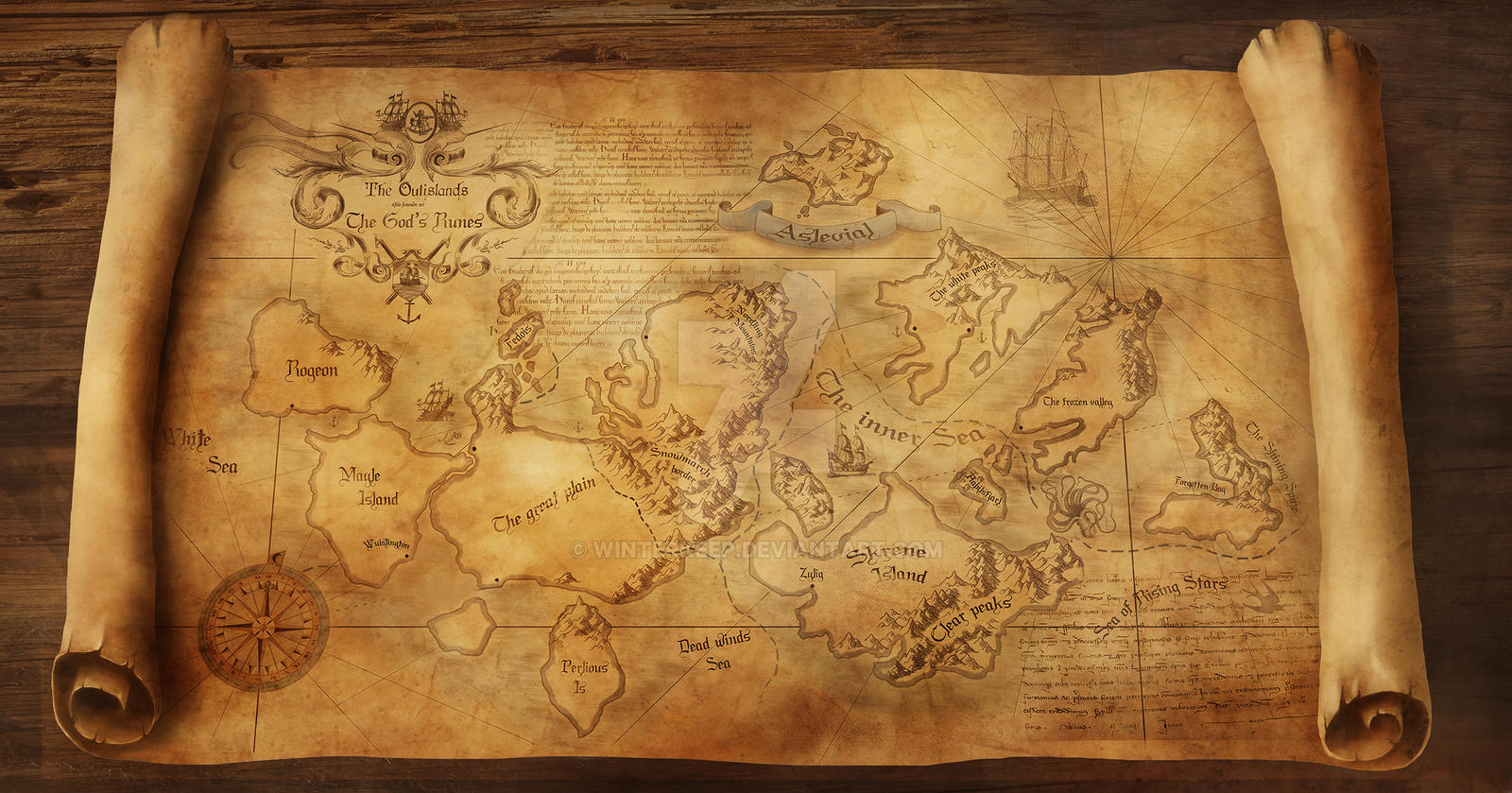
The succeeding chapter, “The Hetgurd,” opens with an Outisland creation narrative. It moves on to the arrival of Dutiful’s company in Zylig, a port in the Outislands. Riddle assists Fitz in seeing to Thick and his own preparations, and their approach to the town is detailed. So is the town itself as Fitz and Thick catch up to the rest of their group while Dutiful accepts the greetings of the Hetgurd. Fitz and Thick are shown to their lodgings, their progress through the town detailed and their surroundings described.

The current scene…
Winterkeep’s Map of the Outislands, from Hobb’s universe on DeviantArt, used for commentary.

Fitz gets food into Thick and eats, himself, then scouts out their lodgings. He slips into the initial meeting between Dutiful and the Hetgurd–a group composed of the various clans’ warleaders, or “kaempra.” Riddle briefs him on the limited happenings thus far, and Fitz turns his attentions to the ongoing discussion, in which the kaempra press Dutiful about his intended dragon-slaying, and he responds to their concerns. Dutiful, Chade, and Fitz exchange ideas via the Skill, and they use that magic to convince the kaempra to adjourn discussion, allowing them time to confer.

The conference comes swiftly, Dutiful and Fitz informing each other what they know and have figured out. Chade offers some rebuke to Fitz before they are interrupted by the arrival of Peottre Blackwater, who notes some political tensions and offers a means for resolving them. Chade takes over the conversation with Peottre, to some annoyance on Dutiful’s part, and arrangements are made at some length.

The Hetgurd and the kaempra who compose it factor heavily into the reading and interpretation I had originally had of the Out Islands (and I note the frustration of the term in the present chapter as previously) as analogous to the Vikings in popular–and some medieval–conception, one I realized at an inconvenient moment was not as accurate as the understanding that later emerged for me. They’re not the only such things, for example, but they do much, for reasons I explain. And as I reread the chapter, I am minded of other associations, having read Njal’s Saga relatively recently. I am not convinced to return back to my earlier idea, but I am, at least, satisfied that I had decent reason to think what I used to think.

There is some comfort in having been wrong for the right reason.

I continue to appreciate your support!

A Robin Hobb Rereading Series: Entry 284: Fool’s Fate, Chapter 7

Read the previous entry in the series here.
Read the next entry in the series here.


A chapter titled “Voyage” follows, opening with an in-milieu commentary about Out Island civic structures. It moves thence to Fitz rising reasonably well rested and returning to Thick, whom Web still attends. After an exchange that leaves Web smiling, he departs, and Fitz confers with Dutiful through the Skill about Thick, who wakes in nascent illness. Dutiful gathers him back into his cabin, although Thick goes reluctantly, and Fitz tends to Thick further as Dutiful’s “Witted coterie” attends on him.

Much better for Thick, this attitude…
Photo by Pixabay on Pexels.com

After the meeting, Swift is left with Fitz, Web offering insight about him as he departs and Fitz sets Burrich’s son about errands. Matters do not go well, and Swift is dismissed at Chade’s suggestion; the assassins and the prince confer about Thick afterward, Fitz noting the assistance of Nettle, and a pattern of attention and attempted soothing settles upon them.

In a Skill-dream, Nettle vents anger at Fitz for the message he had her convey to Burrich. The words had touched him deeply, sending him toward Buckkeep. Fitz attempts to explain himself to Nettle without revealing too much, and matters proceed. Fitz continues to work with Swift and seeks without success to confer with Web, and he discusses the Wit with Dutiful and Chade. Chade bristles at the topic somewhat, but he relents.

I’m not entirely sure what to make of the chapter as I reread it this time. Part of me wants to read it as something of a commentary on age, particularly on Chade’s part–he lampshades it, certainly, and there’s other justification in it. Burrich’s reported behavior also suggests something of such a reading. The idea is foggy in my mind, though, as I write this, and I have to wonder if it is simply an issue of my needing another cup of coffee as I read again.

And there’s the possibility of narrative necessity. The present chapter does gloss a lot…

Care to send a bit my way?

A Robin Hobb Rereading Series: Entry 283: Fool’s Fate, Chapter 6

Read the previous entry in the series here.
Read the next entry in the series here!


The following chapter, “Voyage of Dreams,” begins with a translation of a scroll regarding the Wit before moving into Fitz’s travails attending on the vehemently seasick Thick. The ship’s crew mocks Thick relentlessly, but nothing can be done lest worse repercussions follow, and Fitz comes to realize that Thick’s outpouring of Skill is having unintended effects for all aboard.

Sadly true…
Cotton Vitellius A XV, f 200 v, at the British Library, used for commentary.

Fitz pleads through the Skill for aid, learning to his surprise that Swift had taken ship along with them, and Chade and Dutiful come at length to assist him with Thick and confer. Chade notes his work to hinder the Fool’s departure from Buckkeep, and Fitz muses over the machinations with some regret. And ministrations towards Thick progress to little effect.

Later, as Thick sleeps fitfully, Web joins Fitz in his vigil, the two conferring about theology for a bit before Fitz asks Web about Swift. The conversation prods Fitz, and Web withdraws, leaving Fitz to realize what he has done and finding some shame in it until he is joined by Riddle. The two confer, Riddle reporting news from the guard company; matters deteriorate among them as among the ship’s crew.

Fitz reaches out to Dutiful and Chade for assistance again, the three conferring and finding there is little they can do for their companion. Fitz grows increasingly concerned for Thick and the situation, and Web approaches him again. After a prickly exchange, Web offers to watch Thick; Fitz, authorized to do so, allows it, and he marvels at Web’s insights and fretfully considers the state of affairs aboard ship.

Settling in to sleep, Fitz finds himself again assailed by Thick’s Skilling. He is not the only one, Nettle having entered the dreamscape in which Thick has enmeshed them, and she rages against Fitz for her brother’s absence despite his promises to her. She agrees to assist with Thick, despite her anger at him, and accepts a message to convey to Burrich. Through her Skill in dream, Nettle calms Thick, dismissing Fitz’s assertion of her magical prowess.

I have noted before that Hobb makes much of verisimilitude in the mundanities of her setting, referencing her own comments to that effect. The introductory blurb on the present chapter is another instance of her doing so, and one that speaks to my medievalist self. One of the challenges that faces scholars of medieval literature is that relatively little survives. Little enough was produced, given the difficulties of making text happen. Materials fade over time, physical objects decaying with the passage of years–and then there is mischance such as the Cotton Library fire, which resulted in much loss (about which some information here). It’s not necessarily something that a general readership will consider, but it is something that many readers of fantasy literature–there’s a lot of overlap with medievalists–will have in mind. Seeing it in print adds to the authenticity of Hobb’s narrative world for me, something else I appreciate about her writing.

Can I count on your support?

A Robin Hobb Rereading Series: Entry 282: Fool’s Fate, Chapter 5

Read the previous entry in the series here.
Read the next entry in the series here.


The next chapter, “Departures,” opens with in-milieu commentary from an older Skillmaster before moving into Fitz’s conference with Chade in advance of their departure regarding Web’s knowledge of Fitz’s identity. They talk of Web and the formation of a de facto Witted coterie in Dutiful’s service–including Web, Civil Bresinga, and the minstrel Cockle, all of whom are set to accompany the Prince to the Out Islands, to Chade’s vexation.

Unfortunately not available to Fitz…but available at HEB, whence this image used for commentary; thank you for supporting the Kerrville economy.

Fitz calls on Hap, finding him hard at work in his apprenticeship and applying himself diligently, if in the hopes of renewing his relationship with Svanja. That done, Fitz secures his sea-chest aboard the ship on which he will sail, the Maiden’s Chance, and emerges to find Lord Golden attempting without success to take ship. Fitz is spotted by Golden and is chagrined at his part in the deception that has led to Golden being barred from accompanying Dutiful to the Out Islands. He also muses on its effects as he makes his final few preparations for departure before finding his bunk for the night.

Asleep, Fitz encounters Nettle in dream again, and they confer about Swift’s promised return and about Tintaglia. He wakes from a nightmare soon after and prepares himself for the day, not long afterwards being made to stand and wait as the various departure ceremonies take place. The party making the trip to the Out Islands is described in some detail, as is the billeting of said party. Thick’s discomfort at the travel soon manifests in others via the Skill that pours forth from the little man, and Dutiful soon Skills to him that he will be assigned to attend Thick. Reporting to that duty, he muses bitterly on “The adventure of travel by sea.”

As I reread the chapter this time, I was minded of a change in nomenclature from the Farseer Trilogy to the Tawny Man. The former uses the term “Outislands” where the latter uses “Out Islands”; similarly, “Outislanders” and “Out Islanders.” Words matter, not only in novels, and not only in this part of Hobb’s work, and I have to wonder what it is the shift in term, small and subtle as it is, signifies. There has to be something–despite the claims of some who would argue that the curtains are blue always and only because the curtains are blue; each word in the text is chosen, placed deliberately, and adjusted by consideration between author and editor, and both respond to the situations in which they have lived and do live. The curtains could easily be red or white or absent, so that even if the author is not consciously aware of a reason to make them blue, the author is responding to a context in which a curtain is or ought to be blue. Similarly, for the nomenclature to change indicates a context in which it ought to change the way it changes. Understanding it is not necessary to enjoy the story, of course, but it does not necessarily preclude that enjoyment, either–at least, not when it is done well.

So there’s that, at least.

I always appreciate your patronage!

A Robin Hobb Rereading Series: Entry 281: Fool’s Fate, Chapter 4

Read the previous entry in the series here.
Read the next entry in the series here.

And happy Sousa Day!


The following chapter, “An Exchange of Weapons,” opens with a passage ostensibly written by Fedwren of Hod, Weaponsmaster at Buckkeep late in Shrewd’s reign. It turns to Fitz’s consideration of his possessions and work to secure them against his absence and his trip to the Outislands as part of Dutiful’s guard. He is interrupted in the work by Dutiful, to whom he gives the sword that Verity had wielded and given him just before entering his dragon. At the gift, Dutiful bids Fitz wait; he departs and returns with Chivalry’s sword, and Fitz considers the blades as he and Dutiful handle them. To Dutiful he remarks that he appreciates the gesture of being given his father’s sword, but he cannot bear it, noting the reasons why he cannot. Dutiful accepts the reasoning but makes a substantial gesture in reply that moves Fitz.

Some of this kind of thing…
Image from the Oakeshott Institute, used for commentary.

In the wake of the exchange, Fitz reaches for some connection to his late father, but finds none. Sleeping, he finds himself drawn to Nettle again in dream, and the two confer about a dilemma she has, having illicitly helped Swift come to court against his parents’ wishes. Tintaglia intrudes into the dream, assailing Fitz until dismissed by Nettle, and Fitz wakes.

In the morning, Fitz breakfasts in one of the castle gardens, where he is approached by Starling. She suspects that her husband is unfaithful, and the two commiserate for a time. After, Fitz heads to the Queen’s Garden, where Swift awaits him; he rebukes the boy for his deceit and sharply sends him home.

I am taken, as might be thought, by the titular exchange of weapons. Sentimental as I am, I cannot help but be moved by Dutiful’s assertion to Fitz that “when I take your father’s sword from you, I will return my father’s sword to you”; it is a boyish thing, perhaps, but it is one that bespeaks a shared experience of growing up cared for but without a parent (although, as in many things, Dutiful has a far easier time of it than Fitz–but then, he isn’t the protagonist, really). And it may be that I remain boy enough to appreciate such things boyishly, though that might come as a surprise to many.

Please help support your friendly online writer!

A Robin Hobb Rereading Series: Entry 280: Fool’s Fate, Chapter 3

Read the previous entry in the series here.
Read the next entry in the series here.


The next chapter, “Trepidation,” begins with an in-milieu vignette regarding the White Prophet Hoquin before glossing more of Fitz’s preparations for travel. He reviews the information he has about the itinerary he faces, which will include a visit to the port city of Zylig, where the Hetgurd–“a loose alliance of Outislander headmen”–sits, before a call in at Wuislington on Mayle and thence to Aslevjal. Fitz also frets about those who will remain when he is away. And he is disturbed from his reverie by the quiet, unexpected entrance of the Fool.

Lots of this going on…
Photo by Eva Elijas on Pexels.com

Fitz and the Fool talk together, Fitz noting his concerns for Hap and the two finding themselves at ease with one another until Fitz recalls his plan to keep the Fool from taking ship for Aslevjal. Their talk turns to performativity, the Fool noting that he is not merely one thing, but that each role he plays is simply a revelation of a part of himself. The subject to the Fool’s impending death is treated, as well, and Fitz rails against it as the Fool lays out his bequests.

After the conversation with the Fool, Fitz gives his lesson to Swift, the boy once again nearly belligerent about his magic. The lessons go awkwardly, as does Fitz’s self-castigation afterward. And he finds himself calling on the Fool again, summoning him to the Skill lesson with Dutiful, Thick, and Chade. He finds him drunk and maudlin, but he drags him along through the secret passages anyway, surprising his students with the visitor’s presence. But the Fool is welcomed in and joins the practice as best he can–which is not much, in the event, until the Fool applies his Skill-silvered fingers to where they had touched Fitz before. Fitz is rocked by the experience, and Chade dismisses most from the lesson to confer with Fitz and the Fool. The talk does not go well, with Chade and the Fool exchanging sharp words about the need for dragons in the world.

The Fool makes his courtesies and departs, and Chade rails about him to Fitz in his absence. For his part, Fitz, observes that he has hardly been consulted about the choice the Fool and Chade seem set to have him make and makes his own exit, back to the hidden workroom. There, he finds a gift from the Fool, and it gives him pause.

The bit about the Fool’s roles being parts of himself put on display brings to mind Whitman’s Song of Myself: “Do I contradict myself? / Very well then I contradict myself. / (I am large. I contain multitudes.)” I’ve noted before, several times, that others write of performativity in Hobb’s Elderlings novels more eloquently than I can; as before, I recommend the sources on it in the Fedwren Project. But, thinking about it, the Fool’s assertion makes sense. I am not quite the same in person as I am online, after all, and even online, I show different parts of myself to different communities in which I participate. Similarly, I do not show to my daughter the same parts of myself that I show to my mother, nor to my mother all the same parts I show my daughter, and I show neither of them so much of myself as I do my wife. And that is as it should be. The Fool simply does it…more. But that is part of the purpose of fantasy fiction (and other forms, to be fair), to enhance things to as to show them more fully and allow their deeper exploration.

And there is always more to know.

Help me close out the month right!