Read the previous entry in the series here. Read the next entry in the series here.
A chapter titled “The Stone Garden” follows. It begins with a note about a lost keep in the Six Duchies. It moves then to the party’s continued travel–off of the Skill road and onto a normal, now-overgrown track that occasions complaint from all save Fitz and Nighteyes. Fitz puts the matter of Starling to the Fool; the Fool, in turn, deflects the conversation with accustomed mockery. It does not help matters.
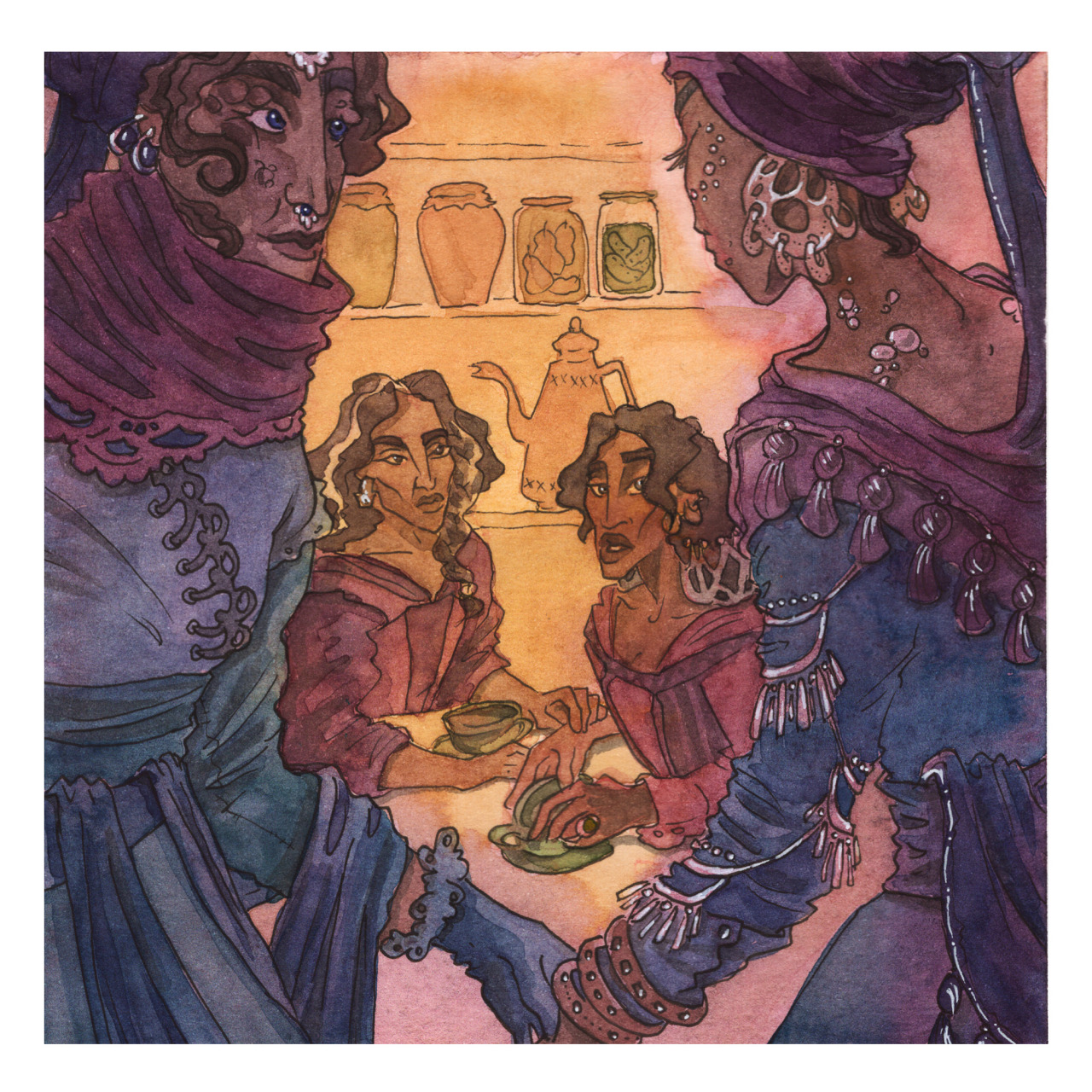
Yep. There it is. Dimple or Dangle by MoriMann on DeviantArt, here, used for commentary
As they press on, Fitz ruminates about Molly and Burrich. And, as a surprise, they come to a statue of a dragon. Described in detail, it unnerves Fitz; his Wit reads it and the other dragon statues as living. His warnings do not dissuade the other members of the party from investigating the statues further. Fitz and Kettricken confer about their surroundings, and Kettricken purposes to search for Verity in the one place shown on their map that they have yet to reach.
As they make camp, Fitz purposes to go off hunting. Starling offers to accompany him, which surprises him, but he does not refuse her. She proves something of a distraction to Fitz as he works with the wolf, the more so as she tries to explain herself and her stance to him. Fitz is taken aback by it, and they confer with unaccustomed frankness. In the wake of the talk, Starling offers herself to Fitz; he ineptly deflects the offer. And that night, he dreams strange dreams once again.
As I read the chapter again, I remembered that the text is presented as if composed by Fitz many years after the events being depicted. I do not question the character’s recall; enough things are glossed over, and enough is made of his training in various mental disciplines, that it does not pass credulity. But I am struck by the degree to which he recalls his dreams; I rarely if ever do, and certainly not for long after I have them. That is, I occasionally remember that I have dreamt, and I remember waking with the memory of a dream in mind, but I almost never remember the content of my dreams with any detail. I know I am not necessarily representative in this; a lot of people remember their dreams vividly. But it is something that stands out to me.
Too, Fitz’s sudden insight into Starling’s situation resonated with me. It is clear to me that part of the way in which Fitz subverts expectations of common fantasy protagonists (about which I write somewhat ineptly here) is in treating such concerns; protagonists typically either need not treat them or never know they need to do so. Fitz may belatedly realize others have the perspectives that they do, but he does come to realize so much, and that marks him as rare among his kindred–both in the milieu and in the genre.
Read the previous entry in the series here. Read the next entry in the series here.
The next chapter, “The Rooster Crown,” starts with a brief description of a Mountain Kindgom game before moving into Fitz and Kettle’s return from their sortie. Kettricken notes that the Fool seems to be improving, and Fitz considers both the presence of Regal’s coterie and his own actions. He very nearly falls back into a Skill-reverie, but Kettle calls him out of it before he can slip in, but after the night passes, he is pulled into the Skill Regal plies through his coterie.
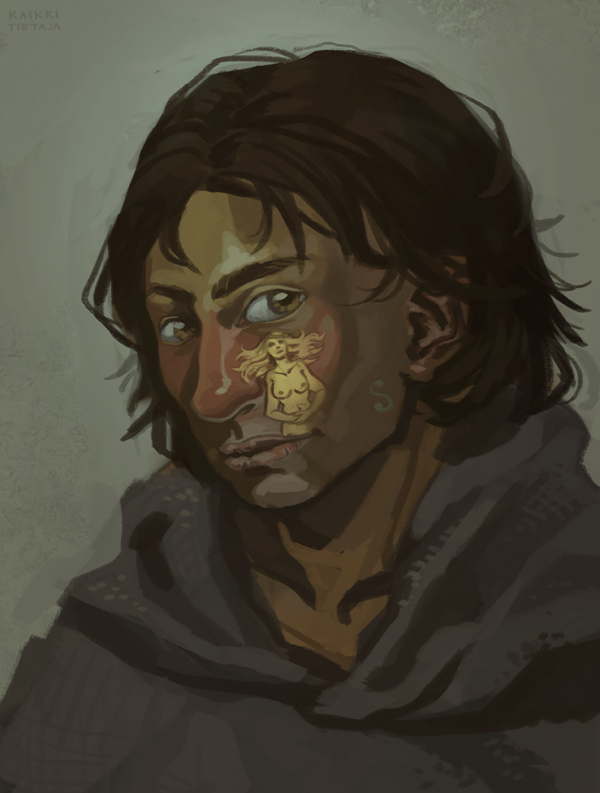
A key scene that will matter more later The Rooster Crown by AreyMA on DeviantArt, here, used for commentary
Fitz is understandably shaken by the vision, and Kettricken and Kettle make to ease and redirect him. The party proceeds uneasily, but doggedly, and the Fool notes that his present illness seems to be a natural occurrence for his kind. He also elaborates on that kind to Fitz as they proceed, as well as laying out more of the scope of his prophetic powers and his purpose in plying them.
The next morning, the party sets out with more vigor. Nighteyes offers to have the Fool accompany him and Fitz on the hunt; the Fool accepts, surprising Fitz. As they proceed, they come to a place where once a village stood; Fitz and the Fool are both swept into the place’s history and visions. The rest of the party is able to pull them out of it, and Kettle berates them both, but the Fool exults in renewed confidence, and they press ahead with something very much like joy.
Later, that joy is somewhat blunted when Kettricken points out Starling’s affections and evident jealousy to Fitz. Fitz denies the allegations made against him, and Kettricken notes some attraction to him before leaving him alone.
The action in the present chapter was easier for me to follow on this re-reading, which pleases me; I had been worried about my ability to follow a narrative anymore. The discussion of the Fool’s upbringing and abilities, too, seemed to make sense to me, and it seems to me, too, that there is something of a parallel between what the White Prophets are described as doing and the work of humanistic study.
The chapter describes the brand of prophecy the Fool practices as being more of a backward look than a forward one. That is, there are omens and portents and visions, but it is only after events have come to pass that those prophecies can be understood for their full meaning. (Connecting back to earlier comments about the series and its evocation of Asimov’s Foundation novels, I am reminded of the equations displayed by the Prime Radiant in the later-in-milieu books; psychohistory can predict to some degree, but events as they happen occasion adjustments to and recalibrations of the mathematics.) Similarly, the remarks those who study the humanities make, using the works of human minds and hands to help understand the human conditions (and, yes, there’s a reason I’m using the plural), can only be understood fully in retrospect–and even then, as with the Fool’s visions, the interpretations change as new information comes to light.
The paper below was the first one I had published (in the now-defunct Studies in Fantasy Literature); it was written early on in my graduate schooling. Since it’s out of print–and has been for a while–and I was looking back over old work, I figured, eh, what the hell.
Mind the changes, which include use of a now-outdated citation style. And please let me know in comments what all you think of them (though note that comments are moderated in this webspace).
I do not remember a time in my life when I have not been reading fantasy literature. Over my years of readings I have encountered fantasies well- and poorly-written, those that make sense and those that do not, those that try to cloak their otherworldliness and those that flaunt it. Not until I reached the end of my undergraduate work in college, however, did I begin to look at the scholarly criticism of that genre in which I had and have so long delighted; when I looked, I was surprised to learn that aside from the works of J.R.R. Tolkien, C.S. Lewis, and, more recently, J.K. Rowling (and I do not mean to imply that the works of these authors do not merit study), almost no academic criticism of fantasy literature exists.
This finding was at once a source of annoyance and a source of encouragement for me. The annoyance stemmed (and stems) from the implication of a lack of scholarly criticism: unworthiness; I have been reading fantasy literature for many years, and to imply that the activity on which I have spent so much time is worthless is insulting to me. The general dearth of scholarly treatment of the genre means, however, that the field for working with that genre is wide open, hence the sense of encouragement; if others have not or do not treat fantasy literature seriously, then I have a great deal of space in which to so do, and I can be on the “ground floor” of a body of critical work on the genre if such a thing ever comes to be (as it should).
This paper rises from that sense of encouragement, and is an attempt to begin, if only in a small way, to create the body of fantasy criticism that is the natural outgrowth of Tolkien’s assertion (made in “On Fairy-stories” and with which I agree) that fantasy literature has the same intrinsic value as any other mode of literature and should be treated similarly. In it I intend to analyze how Robin Hobb nuances in her Farseer trilogy one of the central tropes of fantasy literature: the warrior-hero. This will require a brief discussion of the nature of the warrior-hero in fantasy literature, and contextualization of Hobb’s work within the genre of fantasy literature.
I. The Importance and Definition of the Warrior-Hero in Fantasy Literature
Fantasy literature cannot function without the warrior-hero. From its earliest incarnations to its most recent manifestations, fantasy literature concerns itself almost exclusively with the interactions of warrior-heroes with the worlds in which they exist, whether those interactions are those of a student coming into adulthood or those of a tried and proven combatant asserting power or those of a past master passing on a lifetime of experience to the next generation.
Here’s a typical image. Oberon by GENZOMAN on DeviantArt, here, used for commentary
The epics, which are the earliest examples of fantasy literature (that being literature which employs a significant element of non-human or non-humane beings or non-technological abilities, usually evidenced in “races” such as elves or in powers commonly called “magic”), center around the dealings of warrior-heroes; the Iliad recounts the conflict between Achilles and Agamemnon, both warriors of renown, at Troy; Beowulf the exploits of its eponymous character whose hand-grip employs the strength of thirty men and whose fame comes chiefly from his displays of combat prowess. Later works that can easily be called fantasy or which certainly have fantastical elements also center around the doings of warrior-heroes; Book 1 of Spenser’s Faerie Queene relies on the fighting of the Redcrosse Knight and Prince (not yet a king, acting not as the “standard” legend states but as a young nobleman of the Middle Ages “ought to” and performing errantry) Arthur, and Le Morte D’Arthur is nothing but a series of actions of warrior-heroes. Moreover, the plot of The Lord of the Rings, that lynchpin of fantasy literature, would not have been able to occur without Aragorn or Éomer, warrior-heroes both.
These fantastical warrior-heroes, and many others like them, exhibit certain common qualities. Principal among these is martial prowess; one cannot be a warrior-hero without being a warrior, and one cannot be a warrior without knowing how to fight and fight well—victory in the fight contributes in no small way to becoming a warrior-hero. Additionally, the warrior-hero is nearly always sworn to something greater than him- or herself; Gilgamesh is obligated to the realm he rules, the heroes of the Greek epics are at Troy to answer a vow, Beowulf is described as the “thane of Hygelac” (Beo. line 192), and though both Aragorn and Éomer become the rulers of their respective nations (which positions are in some respects positions of servitude and require swearing to the realms and to one other’s realms) they both also explicitly serve others, most notably Théoden, during the course of the narrative in addition to showing Gandalf no small amount of deference.
Martial prowess and deference to higher authority are not enough, however, to create the warrior-hero; many competent fighters honorably discharge their sworn duties to their nations and are not warrior-heroes in the sense of the fantasy trope. A fantasy warrior-hero is in a position of command; Gilgamesh is “called a god and man” (15), Agamemnon and Odysseus are both the kings of their respective nation-states, Beowulf is in the royal line and becomes king of the Geats, and knighthood such as held by the Knights of the Round Table is often a position involving governance—many of Arthur’s comrades are lords over their own territories. Further, a warrior-hero does not govern from a place of safety, but hazards him- or herself alongside his or her fellow warriors; Achilles (when he fights) is perpetually at the center of the battle, the Redcrosse Knight and the Knights of the Round Table engage in repeated single combat, and Aragorn and Éomer meet “in the midst of the battle” for the Pelennor Fields after literally having cut their ways there (Tolkien, Lord of the Rings V.6.135). Additionally, the fantasy warrior-hero is from his or her earliest incarnations directly connected to the otherworldly, and typically in a “good” way, by descent or equipment or friendship or a combination of them; Achilles’ descent from Thetis and arms from Hephaistos (Il. 1.276-79, 18.330-616), Odysseus’ enjoyment of the favor of Athena (Od. 1.51-55), Arthur’s Excalibur and his advisor Merlin, and Aragorn’s descent from all the major houses of both Elves and Men—which include a being who existed before the world (Tolkien, Silmarillion 379-382, 390, 423)—all exemplify this.
From these examples, a workable definition of the fantasy warrior-hero can be created; the fantasy warrior-hero is a figure of authority “blessed” by that which exists beyond the normal bounds of reality and who possesses significant martial prowess which is directed toward “greater” ends than him- or herself. The protagonist of Robin Hobb’s Farseer trilogy does in many respects meet this definition, albeit not in the way the examples from which the definition is formed do. This is perhaps related to the fairly nuanced place Hobb herself occupies in the field of fantasy writers.
II. Hobb’s Position in the Genre of Fantasy
In many respects, Hobb’s writing is typical of the fantasy genre; her works occur primarily in a loosely Western feudal society in which a sovereign king holds the allegiance of lesser nobles (all of whom field their own military forces) and in which, though there is a definite division between social strata, even the lowest-born have certain rights and prerogatives upon which even the king cannot tread—“The welfare of the people belongs to the people, and they have the right to object to it if their duke stewards it poorly” (Hobb, Apprentice 1, 65, 83-84, 139, 271; Quest 205, 332, etc; Royal 97, 231, etc). She also, as do a number of other fantasy writers, invokes decidedly non-Western societies, some of which are wholly of her own invention rather than allegories of other cultures in the “real” world (Hobb, Apprentice 70, 344+; Quest 120-134, 198, 381, 530). The primary society in her work, that of the Six Duchies, follows in the tradition established by Tolkien and boasts technology roughly equivalent to that available in Western Europe between the Second and Third Crusades, utilizing axe, sword, bow, mail, and boiled leather in warfare, dwelling in fairly large—and clean—stone castles, and utilizing both oar and sail in their ships (Hobb, Royal; Tolkien, Lord of the Rings V). Hobb also echoes Tolkien in portraying a war where the primary society is beleaguered the consequences of which will reach far beyond the realms directly involved in the fighting, though Hobb diverges from Tolkien’s model in that the Duchies display a far greater equality of genders than does Middle-earth (Hobb, Apprentice 58-62, 83-84; Royal 117-18, 153, 304, 499-506; Quest 389-93, 739; Tolkien, Lord of the Rings V.61-62). Hobb’s writing further treats magic liberally, much more so than does Tolkien’s, noting as is common with fantasy writers high and low forms of that otherworldly power (Royal 1-2; Quest 2-3, etc.).
Hobb, however, utilizes in the Farseer trilogy the technique, unusual to fantasy literature, of a first-person retrospective narrative interspersed with notes almost editorial in their form; fantasy literature typically employs a third-person omniscient narrator, while Hobb’s protagonist provides the details of the action in the text, freely intermixing simple recountings of events with bouts of nostalgia. With this technique, she portrays her protagonist, FitzChivalry Farseer, as an older man, scarred by battles, addicted to the use of magic and a drug that eases the first addiction, removed from the fellowship of most other people, and honored in only the most covert ways for the deeds he narrates, similar to the way in which Tolkien depicts Frodo Baggins at the end of The Lord of the Rings (Hobb, Apprentice 1-3; Quest 754-57; Tolkien, Lord of the Rings VI.341). While Frodo is not strictly a warrior-hero, FitzChivalry Farseer, about whose combat exploits songs are sung—his “deeds sung of as noble and now near legendary” by a minstrel—and who literally dies—“confined to dungeon and then coffin”—in the process of serving the royal line of the Six Duchies, certainly is one, and it is his warrior-heroism that Hobb deftly nuances (Hobb, Royal 332-34, 510; Quest 2-3, 236-37).
III. How Hobb Nuances the Warrior-Hero
As stated above, in fantasy literature the warrior-hero is a figure of authority “blessed” by that which exists beyond the normal bounds of reality and who possesses significant martial prowess which is directed toward “greater” ends than him- or herself. Discussing how FitzChivalry Farseer incorporates each part of that definition will demonstrate how Hobb nuances that fantasy trope.
Throughout the Farseer trilogy, FitzChivalry holds a position of authority, though that authority is never absolute and shifts dramatically based on the situation in which he finds himself. From the opening of the first book, when the first-person narrative begins, he assumes some authority over even the reader; he is the mediator through which the reader experiences the Six Duchies and the events of the Red Ship War. Shortly thereafter, FitzChivalry begins to relate his own experiences rather than presenting his musings on the nature of history, and the reason for his peculiar name is made plain; he is the bastard son (hence the “Fitz,” which is quickly applied to him) of the heir apparent to the throne of the Six Duchies, a man named Chivalry (Hobb, Apprentice 5-11). While bastardy is not the most auspicious origin for a warrior-hero, it does have certain advantages; soon after FitzChivalry is brought to the capital of the Six Duchies, his grandfather, King Shrewd, lines these out to the youngest of his own three sons. Being “a diplomat no foreign ruler will dare to turn away” or the potential foundation of “[marital] alliances” is certainly more in line with the traditional warrior-hero concept than illegitimate origin, though even this is nuanced by the king’s mention of the utility of having a bastard to work “the diplomacy of the knife” (49-51).
The authority FitzChivalry holds is invoked and evoked at several later points in the trilogy. He is at one point sent along with his uncle, Verity, to investigate and correct a deficiency in one major nobleman’s execution of his defense duties; while on this trip, he ostensibly serves as a dog-boy to his uncle, but is bidden to be ready to execute the King’s Justice in the form of assassination should it be needed—both positions of authority, albeit dubious—and in the former guise sharply issues orders to the wife of the major nobleman in question before counseling her to steer her husband to a better course of action (127-62). Later, he represents Verity—who awarded him a heraldic emblem of his own—to his fiancée in a politically-based marriage, a position of honor if of mixed intent, for FitzChivalry is bidden to kill the heir to another realm while on that journey (355-426). Some time later in the trilogy, FitzChivalry is offered lands and a title although he rejects them, and still later serves as a formal witness to a ceremonial request made of the king by a prince of the realm, again a post of honor though an inactive and minor one (Hobb, Royal 323-25, 374-81, 595-96). Partly as a result of the request he witnessed, FitzChivalry is offered a chance at regency of the Six Duchies, which would be an exceedingly elevated position save that the offering skirts the very edge of treason—“not treason, quite, and yet…” (591-98). In each instance of FitzChivalry being offered or exercising power, there is a taint or a twist that shades it.
FitzChivalry’s magic is similarly nuanced; in him are combined the “highest” and “lowest” of mystical disciplines, the royal Farseer Skill—which allows human minds to touch one another and speak and can allow a greater dominance by one over another than does any physical force—and the much feared and hated animal-magic of the Wit—which fosters a sense of the life of the world and a permits a sharing of being, not dominance but union in mind and heart and spirit, between human and animal—respectively (Hobb, Royal 1-3). The former, in which he is trained at the king’s express command and—“the Skill is not taught to bastards”—against all tradition (Hobb, Apprentice 248, 254, 262), allows him to lend mental strength to his prince for the defense and maintenance of the Six Duchies (Hobb, Apprentice 287-88, 332-33, 425-26; Royal 326-27; Quest 697, 699, 711-17). The latter, the Wit, is reviled in the Six Duchies, a foulness considered curable only by hanging, drawing and quartering, and burning its practitioners—“it was never accounted a crime, in the old days, to hunt them down and burn” users of the Wit—though to point up a nuance, all people have a measure of it (Hobb, Apprentice 38-43, 263; Royal 652-55, 674-75; Quest 606, 673-76). FitzChivalry uses both Skill and Wit throughout the Farseer trilogy, sometimes to good ends and sometimes to bad, but they ultimately operate in juxtaposition to their “popular” perceptions; FitzChivalry and his prince are betrayed almost to the point of ruin through the Skill, and FitzChivalry wakens the salvation of the Six Duchies through the Wit—“Blood and the Wit…can wake the dragons” in which Verity places his hopes for the salvation of the Six Duchies (Quest 480, 610-58, 738). The noble becomes a device of treachery and the base saves all; magic becomes nuanced.
Nuanced, yes. Squeal like a pig by baccanal on DeviantArt, here, used for commentary
More nuanced than the supernatural aspect of the character of FitzChivalry Farseer is his martial prowess. That he excels at killing other human beings is not an open question; he is trained from a very early age to work “the diplomacy of the knife” and excels in his work as an assassin—his teacher notes his “gift for this,” FitzChivalry notes that “over three months [he] killed seventeen times for the King,” and he is able to manipulate circumstances to inflict a shame worse than simple death (Hobb, Apprentice 50, 71-78, 84-89, 323-24; Royal 114-21, 256-67; Quest 174-87). Sneaking about in silence and stealth to slip blades between the ribs of the sleeping or slipping poisons into food and drink and other things are not, however, typically named the activities of warriors; Hobb acknowledges this in the titling the Farseer books “Assassin,” a term with few, if any, pleasant associations. Yet FitzChivalry also acts as a warrior in a more traditional sense of the term. As was mentioned earlier, his warrior exploits are set into song, as befits one who charges headlong into a fight to defend besieged comrades or his queen (Hobb, Royal 144-45, 332-34, 499-509; Quest 236-37). As was also mentioned earlier, he is acknowledged to be of royal blood even through his bastardy; he is, accordingly, trained to make war (Hobb, Apprentice 58-62, 68, 306; Royal 270-73, 312-21). Even so, he does not have the best of luck in direct combat; he suffers considerable injury nearly every time he engages in an open fight—Verity notes that “the most distinctive part of [FitzChivalry’s] fighting style is the incredible way [he has] of surviving it” (Hobb, Apprentice 257-63, 406, 422-23; Royal 265-70, 284-85, 618-20; Quest 374-80, 729-39). FitzChivalry fights, but instead of a warrior’s clarity, he finds confusion and nuance.
Martial prowess, though, can be directed against right, magic against the wise, and authority against those who grant it unless those who have those things hold fast to their devotion to powers greater than themselves. For the most part, FitzChivalry is loyal to the Farseer dynasty; in his youth, he is claimed for the dynasty by his grandfather—though in purchase, which nuances what might have been normal filial piety; in his upbringing, he comes to love and trust his mentor; in his manhood, he comes through love to follow Verity and Verity’s queen (Hobb, Apprentice 50-52, 56, 86, 89-101, 147; Royal 6-7, 15, 53, 60, 84, 124-30, etc.). Yet even this loyalty, this devotion to duty that impels FitzChivalry to drug himself—knowing the risks of so doing—and set out in a berserker rage while Verity’s queen, Kettricken, escapes from danger by a route he plans—an action that ends in his own death—is shaded away from purity (Hobb, Royal 557+). From his childhood, FitzChivalry dislikes and mistrusts the youngest son of King Shrewd, one Regal, to whom he does owe loyalty as a member of the Farseer dynasty—though the dislike and mistrust are justified in part because of Regal’s childhood mistreatment of him and later attempt to have him killed as part of a plan to overthrow Verity, providing further nuance (Hobb, Apprentice 15-18, 47, 405-423). The antagonism between the two continues throughout the trilogy, and is in its repeated manifestations justified, imbedding greater complexity in the relationship between FitzChivalry and his legitimate relatives; Regal orders that FitzChivalry be tortured and later hires a hunter specifically to pursue him, while FitzChivalry in turn attempts to kill Regal and eventually uses his Farseer magic to brainwash Regal into zealous, if short-lived, loyalty to Kettricken and her child—he notes that “[the] fanatical loyalty [he] had imprinted on him would be [his] best memorial…Queen Kettricken and her child would have no more loyal subject” (Hobb, Royal 647-52, 661-66; Quest 49, 185-89, 374-80, 751). The FitzChivalry/Regal antagonism leads also to a complication of other devotions FitzChivalry holds; after his aborted attempt to kill Regal, Verity, the Farseer to which FitzChivalry is most loyal, lays FitzChivalry under a geas that does not let him rest until he comes, after a not inconsiderable and quite dangerous journey, to stand in Verity’s presence (Hobb, Quest 192+). Devotion to a greater power, which should be a thing unmarred and easily defined, becomes nuanced in FitzChivalry as do the other traits of a fantasy warrior-hero.
IV. Conclusion
The fantasy warrior-hero is a figure of authority “blessed” by that which exists beyond the normal bounds of reality and who possesses significant martial prowess which is directed toward “greater” ends than him- or herself. FitzChivalry Farseer is a figure of authority, possesses abilities that transcend “normal” reality, is a capable combatant, and devotes himself to the kingdom of his upbringing. He is also reviled, cursed, repeatedly injured, and provoked to treason and to a sundering of his active service. He is a warrior-hero, and he is also a man much like any other; no happy ending is guaranteed to him, but he ends up doing as well for himself as anyone can truly expect to do, if not far better. Given that his warrior-heroism is as nuanced as Hobb makes it, his leaving it behind at the end of the Farseer trilogy is no tragedy, adding one final nuance to the many shades of steel-gray of his life.
Works Cited
Beowulf. Eds. C.L. Wrenn and W.F. Bolton. 1953. Exeter, England: Univ. of Exeter Press, 1996.
Gilgamesh: A Verse Narrative. Trans. Herbert Mason. 1970. New York, NY: Mentor, 1972.
Hobb, Robin. The Farseer: Assassin’s Apprentice. 1995. New York, NY: Bantam Spectra, 1996.
—. The Farseer: Assassin’s Quest. 1997. New York, NY: Bantam Spectra, 1998.
—. The Farseer: Royal Assassin. 1996. New York, NY: Bantam Spectra, 1997.
Homer. Iliad. Trans. Robert Fitzgerald. Garden City, NY: Doubleday, 1974.
Homer. Odyssey. Trans. Robert Fitzgerald. Garden City, NY: Doubleday, 1961.
Malory, Thomas. Le Morte D’Arthur. Ed. John Matthews. New York, NY: Barnes & Noble, 2004.
Spenser, Edmund. The Faerie Queene. Book 1. The Norton Anthology of English Literature. Eds. M.H. Abrams et al. 7th Ed. Vol. 1. New York, NY: W.W. Norton, 2000. 628-771.
Tolkien, J.R.R. The Lord of the Rings. 1955. New York, NY: Ballantine Books, 1983.
—. “On Fairy-stories.” The Tolkien Reader. New York, NY: Ballantine Books, 1966.
—. The Silmarillion. 1977. New York, NY: Ballantine Books, 1982.
Read the previous entry in the series here. Read the next entry in the series here.
The next chapter, “The Coterie,” starts by musing on the strange dearth of depictions of the Elderlings in the Six Duchies. It proceeds then to Fitz’s debriefing–punctuated by angry commentary from Kettle. Nighteyes expresses his concerns to Fitz through the Wit, and Kettricken examines the map Fitz has brought back from the strange city. With that information, they make to rest and ready for further travel to Verity, and Fitz becomes concerned for the Fool, who seems to be fevered. Fitz prepares elfbark for him, raising some mutterings from Kettle, and the two talk of the Fool’s health and physical nature.
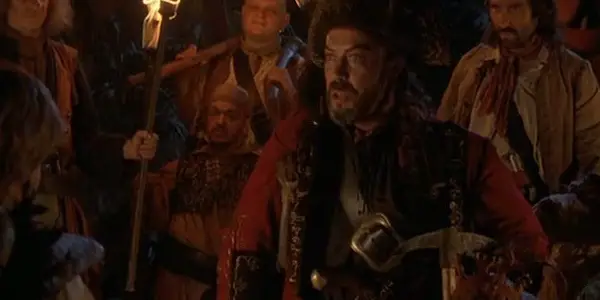
Arming up, indeed. Royal Assassin by MImi-Evelyn on DeviantArt, here, used for commentary.
Fitz wakes early the next morning, and Nighteyes stalks out to scout. The two determine that there are approaching riders, and the party makes for an armed withdrawal. They proceed until they encounter a rockslide they must cross; Nighteyes provides intelligence on their pursuit as they make to pass. The crossing is made with difficulty, and the illness that has taken the Fool is painfully evident as Fitz assists him.
In its wake, the party considers the intelligence relayed by Nighteyes and tries to puzzle out their pursuit’s intent. It becomes clear that Regal has sent pursuit to follow Verity and Fitz; surely, their work must have led to some end? Fitz purposes to backtrack and, with Nighteyes’s aid, ambush their pursuit; the rest of the party presses on, save Kettle, who surprises Fitz by volunteering to assist him. Their sortie is successful, eliminating half of their pursuers and acquiring their provisions. In its wake, Kettle asks Fitz about his assassin’s work and reveals to him that she had been exiled for killing a member of her own coterie through the Skill.
Among other things, the chapter offers a useful reminder that FitzChivalry Farseer is not a nice person; he is, in fact, rather the opposite, a by-blow acknowledged as necessary even as he carries out markedly distasteful duties. Early on in the rereading series, I remarked on the emblematic nature of his name; events in the succeeding books have not always reinforced the fundamental nature of the work for which Fitz is trained and at which, when he is thinking clearly and paying attention, he excels. The present chapter, however, does so, and it reminds readers through Starling’s reaction to Fitz’s open statement of his planning that Fitz is not a traditional hero, even if he partakes of that tradition in some ways.
The revelation about Kettle, though set up in previous chapters, does seem to be somewhat convenient, bordering on a deus ex machina. I’ve commented on the phenomenon before, and my comments remain in place; the presence of the device does not mean the writing is bad. But it does seem somewhat jarring in the present circumstance.
Read the previous entry in the series here. Read the next entry in the series here.
The following chapter, “The City,” opens with comments about a reported old road in the Mountain Kingdom. It moves thence to Fitz’s addled stumblings through a strange city that befuddles his senses–mundane and otherwise. It takes him some time to regain his bearings and begin to puzzle out what surrounds him, and even then, what he encounters confuses him.
This would seem to be the kind of thing Fitz faces. Frozen History by MeetV on DeviantArt, here, used for commentary.
The day draws on, and Fitz finds himself growing chill; he builds a fire to warm himself, and its light reveals the decrepitude of his actual surroundings, different from the bustling city that presents itself to him from the past in images excited by his touch. At length, he begins to sleep and to dream in the Skill; he first sees Molly and Nettle, their daughter. He then sees Chade conferring with a lover and ally about Regal’s actions against the Mountain Kingdom; they seem to make little sense.
When morning comes, Fitz begins to explore again, moving through the recollected city in some awe. Among the images are dragons, and Fitz proceeds to find a position to survey his surroundings more thoroughly. The survey reveals the aftereffects of a cataclysm, as well as a map that Fitz realizes Verity will have used and copied. He scrambles to make his own copy before falling into Skill-visions again. Bewildered and frantic, he staggers back to where he had entered the city: a stone pillar. Passing through it, he emerges to find Nighteyes happily greeting his return.
This was another chapter where I found myself having difficulty following along. I begin to worry about it; I am supposed to be a damned good reader, and having challenges in rereading something I have read several times before–more than several times, really–does not suggest itself as a good thing. Admittedly, the action in the chapter is described as being confusing in itself, with Fitz shifting frames of perception from his present circumstances to those recorded and re-presented by the construction of the city without much obvious transition; my earlier comments that the reading should follow the action still obtain. I’m just taken a bit aback that I’m not used to it again by this point, is all.
Maybe that is more revelatory of me than of the text. I’ve noted, perhaps too often, that I am out of academe, moving from trying to earn citizenship in that strange country to being an expatriate from it to being now only an occasional vacationer therein. (I do still list as an “academic expatriate” in conference registrations, though perhaps “intellectual vacationer” might be a better label to use henceforth.) As I am farther and farther removed from daily work of reading and thinking and writing, it makes sense that my abilities to do such things fade. I am less than I was in those ways; I wonder what I have earned from the exchange.
A different portrait of Chaucer, again from Luminarium.org, here, and used for commentary
A year ago, I wrote about the words with which the Canterbury Tales begin, as well as about the celebration of the day that focuses on the enjoyment of older languages and literatures. The comments I made then still largely hold true; there remains much of value in what was written before and what was said, even if such things are too often ignored and too often put to the purposes of too often obstinately wilful evil.
As I reflect on those comments now and on the words that spurred them, I do so from a far different place (mentally and emotionally; the physical location remains the same). I am more removed from academe than I was then; I had given up the search for tenure-line work, but I still taught part-time and did some small work to incorporate the medieval into that teaching. Now, though, even that work is set aside, even if I still present a conference paper now and again, and I still look at how various properties refigure and borrow from the medieval. (Insofar as there is “the” medieval, of course, but this is not an academic treatment and the level of nuance and detail appropriate to such is not necessarily fitting here.) Working outside academe and vacationing there (for want of a better term), I better understand why thoughts about the older world are often set aside; I am not so far removed from scrambling for things that I do not recall the efforts involved therewith and the level of exhaustion that accompanies those efforts–even for someone trained to the strange disciplines of the mind that academia imposes. Nor yet am I unmindful that there is much of value in the newer world, as well; indeed, my focus is increasingly on that world, even if I still attend to what it keeps of its predecessors.
Too, I understand better why there is so much resistance to enhancement and alteration of the views commonly held about the medieval as there is. Some is the already amply identified elitism that inheres in the classification of things as medieval; there are various execrable ideologies that have held sway and still do, if fortunately less now, that benefit from and have therefore propagated such classifications. They are embedded in institutions, and inertia alone would make change challenging even without the active reinforcement that still persists. Too, there is still an association of medieval/ist work with children; it is still regarded as a thing appropriate to assign to developing minds, and the things learned early tend to remain in place long. And, again, doing the work of learning is hard, and many people simply do not have the resources available to them to do it–even if they know where to find them–and even if they can get around the unfortunate discourses that often surround those who push for more authentic, nuanced, and ultimately accurate views of things.
I still celebrate, and I still work to spread better information, even if I am not as well positioned to do the latter as before. But I despair that any knowing rain can ease the drought that has seized the shared plain.
Read the previous entry in the series here. Read the next entry in the series here.
The following chapter, “Signposts,” opens with comments about relative valuation before moving into the party’s continued travels. Kettricken notes to Fitz that the way will become harder and may force him onto the road; he replies that he can but go forward. Fitz continues to ponder the stone-game puzzle Kettle had put before him, and Starling continues to press Fitz for details about the Fool before asserting the belief that the Fool is a woman enamored of him.
A scene like this is near, perhaps Robin Hobb by Billou343 on DeviantArt, here, and used for commentary
Fitz rejects the idea. He also finds himself forced back to the road by a sudden shift in the terrain; Nighteyes helps anchor him in himself, noting some of the distinctions between wild and domesticated animals. Kettle then starts to accompany Fitz, and she sets him to considering the seeming nursery rhyme she had recited at an earlier camp. He realizes that it discusses Skilled ones, and Kettle offers little more before returning to stone-game puzzles. It makes for a slow march through the rest of the day–until Fitz makes to follow a road he sees but that no longer exists, and the rest of the party must save him from himself again.
Kettle frets in the discussion that follows, but the Fool, acting the part of the White Prophet, offers some words of comfort. Kettle allows Fitz to indulge his habit for elfbark, though not nearly so much as he would prepare for himself. As he takes the drug, Kettricken solicits his opinion regarding Verity’s likely course; Kettricken purposes to split the group to search for him, but Fitz persuades her otherwise, aided by Nighteyes. Verity reaches out to him with the Skill, and Fitz once again comforts Kettricken before he is distracted by the call of the Skill once again.
Once again, I found myself having trouble reading and keeping straight in my mind what all happens in the chapter–my earlier comments about such seem still to apply here. And it occurs to me as I think about what I have just read again that there might be some comment to be found in the chapter about the perils of making too close a return to a past that is not a person’s own. Such a comment suggests itself to me, given my training as a medievalist; the whole of the work such folks do is in approaching a past to which we might be heirs but which is not our own. There is always a threat of becoming too lost in the work, as old tropes of absent-minded professors and the partial home lives of many, many scholars can attest. Even now, even after I have left off academe almost entirely, I feel a pull when I do look back into scholarship, and I know that I may still find myself stepping off into space when it seems to me a road still stretches before me–though I trust that there will be hands to pull me back from it.
Too, there is something to be found in Kettle’s grudging permission for Fitz to take a small bit of elfbark. Allowing someone who is addicted to a substance to partake of that substance is a perilous thing; relapses happen, and there is always peril in making chemical modifications to a body. At the same time, there are effects of withdrawal that sometimes make such needed. I have seen clients come into the treatment center where I work who could not simply stop drinking; doing so would kill them. And there are concerns, too, usually associated with painkillers in the real world, that dosing as (should be) prescribed is fine–but the medicines lend themselves to dangerous overindulgence. How much can be taken from the text about such matters is unclear, but there is clearly something there to consider…
Read the previous entry in the series here. Read the next entry in the series here.
The next chapter, “Strategy,” begins with what seems a nursery rhyme before turning to continued efforts to keep Fitz centered and attentive. The efforts are not entirely successful, and they seem less so because Fitz uses the Wit. That the road they travel is to blame is clear, and that it is a strange and powerful road is also clear. Strangely, amid the discussion of Fitz’s situation, the Fool and Starling arrive at some rapproachement. Nighteyes brings meat with him when he returns, which also helps.
An interesting thing, this. kettles stone game by AlexBerkley on DeviantArt, here, used for commentary
With bellies full and needing to keep Fitz focused, the party takes turns singing and reciting through the evening. Kettle dislikes Fitz’s selection and seems to aim hers at him, though he does not understand why. Kettricken confesses her feelings of failure, and Fitz begins to learn a strange game under Kettle’s tutelage. Kettle avers that it is a game from Buck, though Fitz does not know it. She sets a puzzle in it for Fitz that he takes to sleep with him; Nighteyes gives him the answer to the puzzle, equating the puzzle to a hunting pack.
When Fitz presents the solution, Kettle is surprised at it. She asks him after his Wit-bond with Nighteyes. Starling and the Fool comment after Fitz answers, and the party slowly breaks camp. Fitz is bidden walk, accompanied, beside the road rather than upon it; the Fool goes with him, taking the opportunity to confer about Kettle and try to puzzle her out. That afternoon, Starling succeeds the Fool and inquires about the Fool’s history–particularly the romantic history. That evening, Kettle puts Fitz to another puzzle; he does not come to an answer before joining Nighteyes in a nighttime romp and sleeping deeply until morning.
The stone game Kettle presents to Fitz is a point of particular interest, not only in the chapter (where it occupies a fair bit of the text, as well as of the narrating protagonist’s attention), but also in terms of worldbuilding. All fiction depends for its effectiveness on what Coleridge calls the “willing suspension of disbelief,” the audience’s gracious acceptance that, within the fictional milieu presented, the actions presented can happen as they are shown and should happen as they are shown. In “On Fairy-stories,” Tolkien can be paraphrased as asserting that the willingness to suspend disbelief is aided by the closer correspondence of the fictional world to that of the audience; Hobb herself reaffirms such an opinion, noting in “5000 Words about Myself” that “I think the best way to convince a reader that I know what I’m talking about when I recount the habits of dragons is to know what I’m talking about when I recount the details of raising chickens or putting a roof on a house.” And while it is the case that the rules of the stone-game are glossed over in the text, the mere presence of that game is itself a detail enhancing the text’s verisimilitude.
It does so in that it points out the presence of recreational activities among the people of the Six Duchies. Admittedly, Hobb motions to such things earlier in the series; there are scenes of drinking and various kinds of gambling, as well as the depravities of Regal’s gladiatorial contests. But having someone take a table game along on an expedition into mountains bespeaks an attachment to such things that does not often feature in Tolkienian-tradition fantasy literature; it is difficult to imagine hobbits carrying dice or cards with them as they traipse about Endor, for example. But people in the real world often do so, perhaps more easily in the era of smartphones than previously, but not without earlier parallels.
Too, the stone-game is a valorization of play, more generally. More than anything else the traveling party has available to it, the game serves to keep Fitz grounded in the real and present, rather than being swept away by the magic that surrounds them. It may seem somewhat paradoxical to have a game–inherently a distraction from immediate concerns–serve as an anchor in the real, but there are no few who note the utility of play to daily life and work. (This bit comes to mind. There are others.) And maybe more folks could stand to have a little more enjoyment of such things.
I do not often write in this webspace–or, indeed, many others–on Tolkien. Though I read The Hobbit and Lord of the Rings early on in my life, and though I have read a fair bit of the supplementary materials and criticism (not least in support of my abortive academic efforts, such as this), I know better than to call myself an expert on the matter. I am happy to contribute from time to time, happy to be of some help, but more than that generally exceeds me.
Not something I want to approach, even on this anniversary of their fall The Gates of Barad Dur by CurtissShaffer on DeviantArt, here, used for commentary
From time to time, however, I do feel obliged to comment, and commemorations of events suggest themselves as such times. And it remains true that a lot of what I do has its basis in Tolkien. The Fedwren Project (which I know I need to update) has its origins in an annotated bibliography I did on Tolkien scholarship early in my graduate study; it was through that project that I became convinced I could do annotative work such as I have done for the New Chaucer Society. The Tales after Tolkien Society is particularly overt in its grounding in Middle-earth, I think, and if its focus is generally on appropriations of the medieval, it does not seldom turn to medievalism for its references–and that often means going back to or through Tolkien.
None of that means I ignore the problems that are in the texts (and about which I make some comment to Luke Shelton in a piece linked above) or in the person who wrote them. Tolkien is one of many problematic writers–even Hobb, about whom I do most, has issues with which I take issue–and it would be irresponsible of me to ignore the areas in which he–they all–we all–can do better. I know I do not do enough to address them, either, and I do wonder at times if I ought to stop entirely, to divest myself of my copies of the relevant texts and expunge overt and intentionally covert references to them from my writing and speech moving forward. I know it would be an impossible overreaction, given the perniciousness of flaw and wrongness in the world–but there are many ways in which I remain far less than I ought to be.
For all those problems, though, there is much to commend. At one level, Tolkien has gotten a lot of people to read a lot of words from a lot of pages, and getting people to read is good, in the aggregate. His works have also shown people or reaffirmed to them that it is okay to do “weird” things, to step outside of expectation, at least a bit–and that, too, is good in the aggregate. And they seem to have become canon or to have moved toward that status, insofar as such a thing can be anymore, and in forming the basis of a system of commonly understood reference, they serve to bring together people who might otherwise not have interacted–not always pleasantly, to be certain, but often well and usefully and joyfully, and that is far from without merit.
Read the previous entry in the series here. Read the next entry in the series here.
The next chapter, “The Skill Road,” begins with a brief musing on the source of magic before turning to the slow progress of Kettricken’s party as it tries to reach Verity. Despite a lack of sign, they press on until Nighteyes reports a road to Fitz through the Wit. Nighteyes mislikes the road, and Fitz finds himself strangely reluctant to step upon it; there is something clearly uncanny about it.
Something like this, perhaps? Forest Road Winter Wallpaper from Wallpaper Stream, here, and used for commentary
When Fitz does take to the road, despite Nighteyes’s warnings, he finds himself drifting amid the Skill, proceeding slowly enough for the elderly Kettle to keep up with him. She tries to retain his attention, not entirely successfully, and she objects strenuously when the party thinks to make camp in the long-abandoned path. The objection is heeded, and the group camps off of the road–but the road continues to command Fitz’s attention, distracting him even from his bond with Nighteyes. It is evidently made with the Skill, and it tells upon Fitz more than upon all the rest of the party.
Conversation reveals that Kettle knows more than she tells, and the party adjusts its routine as a storm encompasses them. The Skill continues to encompass Fitz, and he sees visions of those he loves–focusing on Molly and Burrich most. Verity intercedes with him, then, forcing him back to himself and leaving him despondent.
I admit to having a bit of trouble reading the chapter as I reread it for this write-up. I found my own attention drifting away from the page. Whether that is a result of overly affective reading or outside concerns producing distractions is not clear–but the confusion I felt could well mark a bit of particularly good writing amid the consistently fine work in the novel. Fitz is distracted, and it is Fitz’s perspective that drives the novel, so leading the reader into the same kind of confusion that besets Fitz as he confronts, unexpectedly, something made of and seething with the power with which he has struggled for some time is a good move to make.
That has been one of the things I have prized about Hobb’s writing since I began reading it some decades ago, now. (It remains strange to me to be able to say such a thing honestly. I guess I am not yet quite as old as I often feel.) I have been able to lose myself in Hobb’s writing no few times, and, even now, I can be swept up in it as surely as if it were a Skill-road. I may not make the kind of open reference to it that I do to Tolkien or Asimov or Roddenberry’s work, largely because I know it is not as widely known and so not as useful as a means to get a point across, but that does not mean I do not value it, now no less than before.