A Robin Hobb Rereading Series: Entry 386: Blood of Dragons, Chapter 20

Read the previous entry in the series here.
Read the next entry in the series
here.


Following an announcement from the Bird Keepers’ Guild that Kim has been stripped of authority and dismissed, with others possibly to follow, “Dragon Decisions” opens with Thymara considering the work and accoutrements necessary to handle Silver. Progress on Kelsingra in the absence of the dragons is related, and she, accompanied, makes trial of the Silver, and rediscoveries of lost techniques begin, but only barely begin.

Oddly enough, something like this…
Photo by Pixabay on Pexels.com

Later, Malta muses on the departed dragons and keepers, considering Phron as she tends idle gardens. She and a keeper, Alum, confer, their talk turning to Trader life and the possibility of the creation of other Elderlings. Some of the events of the Liveship Traders novels are glossed, and Malta thinks wistfully on her family. She offers such counsel as she can to the younger keeper, and, gifted with seeds, makes a new start to the gardens.

Thymara repairs to the map room, considering it and the work that has been done on it. Tats joins her there, and the two confer, largely about Rapskal and their own relationship. They walk through Kelsingra, considering it further, and Thymara leads them to the quarters her memory-self, Amarinda, had had. There, she puts the memories to rest.

Approaching Cassarick, Alise and Leftrin confer, their progress downriver noted. Tillamon joins them and notes her plans. An upset among the Chalcedean captives is also related, and the Tarman ties up and begins to disgorge cargo and passengers. The Chalcedeans opt to choose their own deaths in the caustic water of the Rain Wild rather than face what will come, and the attack by dragons on Chalced is reported.

The end of the book is approaching, and along with it, the end of the Rain Wilds Chronicles. It makes sense, then, that Hobb would work in the present chapter to address a number of plot threads and work to bring them towards conclusion. The resolution of the trouble among the Bird Keepers noted in the opening missive is one such thing; the various reflections on relationships among the Kelsingrans and Traders offer other examples. Not all of the plot threads are addressed, of course, but there are yet pages in the text to treat, and it isn’t the case in any event that all plot threads have to be tied off. Indeed, a more verisimilitudinous novel will deliberately leave matters unfinished, as it is rare in real life that matters are completed, let alone completed neatly–and even a less “realistic” one may well leave space from which sequels can emerge, especially when it is itself such a sequel.

I do appreciate the motion in the earlier sections of the chapter towards the idea of work to be done. It is often the case in fantasy fiction, not least in cases where old realms are restored, that the work of that restoration is glossed over, if it is mentioned at all. Consider Lord of the Rings, where the work of rebuilding the Shire is passed over in fits and starts (and the hobbits from whose work the book is “translated” would, as they are described in prefatory materials, likely be at least as concerned with the rebuilding as they would have been with the quest that preceded it), and the restoration of Gondor is relegated to appendices whose composer lamented them. Hobb admittedly has the leisure of more time in the Realm of the Elderlings than many authors; there are years between series that take place in the same areas of the milieu, but it is also clear that things are not hand-waved as restored to their full former status even in those years. In the present chapter, the slow work of manipulating Silver and the bare beginnings of gardens under Malta’s care both point to the efforts to be expended, and not all in one burst.

I have to note, too, the resignation of the Chalcedean prisoners at the end of the chapter. The parallels to historical events should be clear. The reminder that there is pain and misery at the foundation of things is one that needs making; there are certainly enough people who try to forget it again and again…

If you’ve liked the series so far and would like me to write for you, fill out the form below! It’ll only take you a minute, and you could get so much from it!

← Back

Thank you for your response. ✨

Or you can send your support along directly!

A Robin Hobb Rereading Series: Entry 385: Blood of Dragons, Chapter 19

Read the previous entry in the series here.
Read the next entry in the series
here.


A brief message from Erek and Detozi to Reyall notes upcoming action from the Bird Keepers’ Guild before “Icefyre” begins. As the chapter opens, the keepers in Kelsingra assess Icefyre, wary of him and noting his injuries. Debate about how to approach the elder dragon ensues, and Rapskal steps forward. Icefyre responds, reporting his situation; he calls upon the dragons of Kelsingra to aid him in exacting revenge. As many of the dragons move off to tend to Icefyre and hold counsel, Tintaglia notes acidly that Icefyre’s concern was absent when she was injured, and the keepers and Alise note that the revenge must be taken for the attacks. Chalced is identified as the likely culprit, and it is determined that the dragons will assail it. Preparations begin in haste.

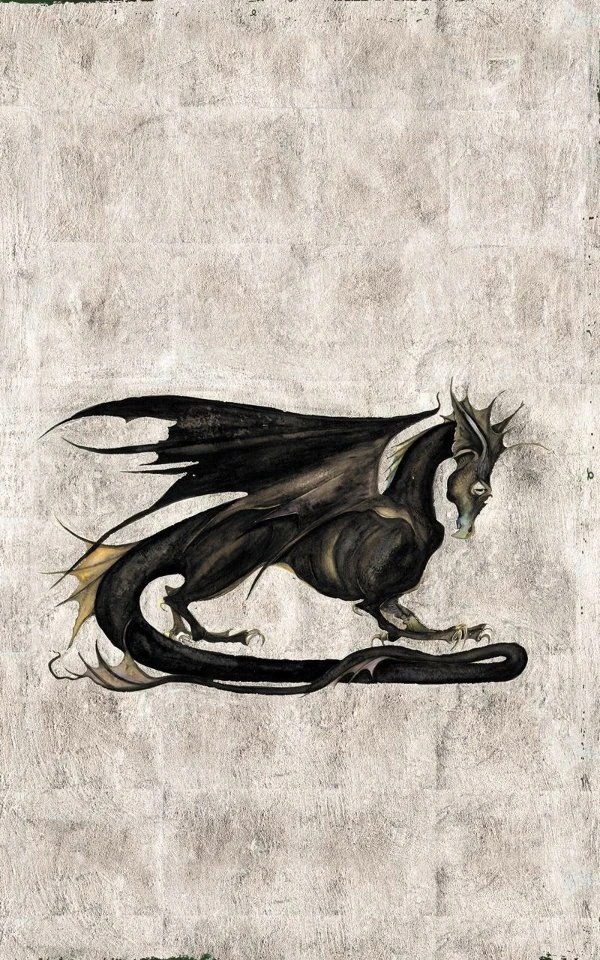
Dragon of the hour…
Jackie Morris’s Icefyre, hosted on Realm of the Elderlings and used for commentary

The dragons’ conference is related, Sintara and Tintaglia assessing the males among the Kelsingra dragons. Methods and the lack of memory are noted, and concerns of unintended consequences are raised. The indignity of attack prevails, however, though talk of effects does not end.

Leftrin and Alise confer, Leftrin noting that the Tarman must sail for Cassarick to inform the Traders of the dragons’ intent and possible blowback from it. Alise assesses the rapid changes that have befallen, and memories of the attack of Chalced on Bingtown rise up around her. She determines to accompany Leftrin, and she voices her concern about Hest, only to learn that he is missing. The pair put the matter of Hest aside, and preparations for departure continue.

Thymara returns to her room to find Rapskal awaiting her, acting more out of his inherited memories than from himself. She refuses him, and the two part in anger.

The next morning, the dragons as Kelsingra mass to fly against Chalced. Thymara and Tats confer about proceedings, and the arrayed host is described as it makes ready. Not all are eager who will sally forth, and goodbyes are said as the dragons and their company begin to depart. Current statuses are noted, as well, and work on Kelsingra resumes.

The present chapter, near the end of the novel and of the tetralogy, has something of a rushed feeling to it, something I’ve noted about several of the Realm of the Elderlings novels in this rereading series, as well as about this novel in another place. I continue to be somewhat put off by it, although that may well be nothing more than a matter of my personal tastes at work; there is always a concern in offering critique about how much is merely individual preference and how much is broader assessment of literary craft. As it might well be argued that I have literary pretensions at best, I can understand that my own comments on such matters could well tolerate more than one of proverbial grain of salt. But then, there’re many folks who like a lot of salt in what they eat.

As I reread the chapter, particularly the passage in which the dragons and some of their keepers make ready to depart Kelsingra and do so, I found myself in mind of scenes from Peter Jackson’s Lord of the Rings movies, namely those in which the people of Rohan ready themselves at Helm’s Deep. The depiction of such of the keepers as Sylve seems to me reminiscent of that of the children of Rohan, plodding forward fearfully in armor too big for them–but it’s a common enough thing, not only in Tolkienian-tradition fantasy literature, that it might simply be dipping at the same well rather than filling a cup from a bucket already pulled up.

As I reread my review of the book, though, close to eleven years on, I note there’s been some consistency in my approach to the text across time. I’m not necessarily sure how to regard it; was I more or less right all that time ago, or have I stagnated in the more-than-a-decade since? I’m gratified that the gender- and queer-studies approaches I’d noted as being open have been followed up on–indeed, so far as I can tell, they’re among the dominant threads of scholarly work done on Hobb’s writing. (Translation studies has a lot to do with her work, as well.) It’s clear, then, that I got at least something right in my early assessment of the novel; I don’t know, though, and wouldn’t much hazard to guess if I was (or am) quite right in looking at antecedents / sourcing (among others, for reasons noted in the paragraph above). I think I was (and am), of course, or I’d not’ve written as I did (then or more recently), but I’d really like some outside confirmation…

If you’d like me to write for you, fill out the form below!

← Back

Thank you for your response. ✨

Or you can send your support along directly!

A Robin Hobb Rereading Series: Entry 384: Blood of Dragons, Chapter 18

Read the previous entry in the series here.
Read the next entry in the series
here.


Following an announcement from the Trehaug bird-keepers to those in Bingtown calling into question Kim’s good standing among the bird-keepers, “Seductions” opens with Hest attempting to persuade one of Leftrin’s crew to allow him the run of Kelsingra. Hest reflects on similar attempts with others in Kelsingra and his lack of success with them. When Davvie happens by, Hest turns his attentions to him, plying the inexperienced boy with some initial success.

Our hero?
Image from Hirundine’s Tumblr, used for commentary

In Chalced, Sedric continues to suffer at the hands of the Duke, tended by Chassim. The pair of them commiserate about their respective situations, assessing them coolly and considering their prospects. They begrudgingly move forward.

In Kelsingra, Leftrin and Alise confer about developments, noting the clear potential for Kelsingra’s growth. How the development will be managed receives comment, as do Rapskal’s increasing instability and the dragons’ desire for vengeance upon Chalced. Amid the discussion, Leftrin suddenly proposes an entirely unorthodox marriage, and, after some consideration, Alise agrees.

Hest continues to ply Davvie, surveying Kelsingra and calculating his potential profits from it. And he makes a sudden advance on the youth.

Carson begins to grow anxious about Davvie, and Sedric follows as he searches him out. He finds Davvie in Hest’s hands, and Sedric interposes himself. Hest attempts to seduce Sedric once again, but fails.

Sedric recognizes Hest’s attempt for what it is and rebuffs him forcefully. He returns to Carson to find him conferring with his nephew, and the three make to head off. They espy the approach of Icefyre as they do.

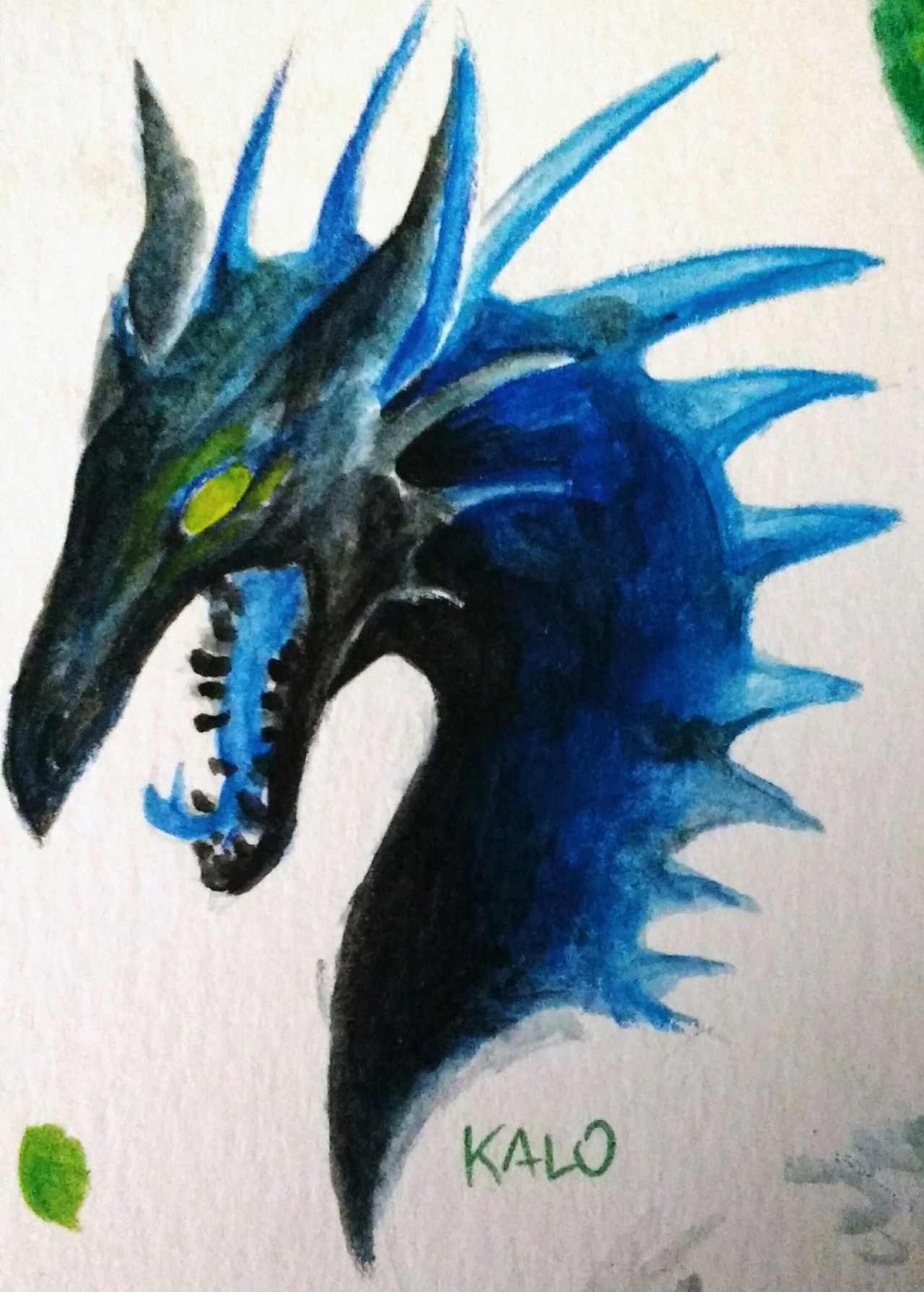
Hest, staggered by Sedric’s refusal, chases after him briefly before the approach of dragons frightens him. He seeks a bath to restore himself, in which he finds Kalo. Hest attempts to dominate Kalo, failing utterly, and being eaten for his arrogance.

In Hest’s death, I note a(nother?) parallel to Kennit. Both of them find themselves short of a leg (Kennit here). Although it would be a wonderfully tidy bit of writing to have the serpent that took Kennit’s leg be the one who became Kalo, it does not appear to be the case; even so, the amputation does put something of a neat little bow on the parallels between the two characters. Aside from their endings, both come from Trader stock, both have unfortunate relationships with their parents, and both have narcissistic and masochistic tendencies; they both speak to something of a type in Hobb’s writing (which extends to Regal Farseer, as I’ve remarked–here and here, for example). I’ve not done the updating on the Fedwren Project that I ought, certainly, so I am not as aware of whether others have explored the type as I ought to be, but if they’ve not, it seems a useful line of inquiry to follow.

Another thought occurs as I reread the chapter. If it is the case that the Traders are mimetic of the early US, absent some (but far from all) of the perversities that accompanied the settlement efforts, and if it is the case that the progress towards and into Kelsingra mimics the further colonization of the Americas (as I’ve suggested, here and elsewhere), what does the nascent Elderling civilization in and around the renewing city become? In some ways, it seems Kelsingra is moving towards something of a utopia; the romantic aspects of the present chapter and Sedric’s discourse seem to further comments made earlier, and the notion Alise voices of Kelsingra offering many the opportunity to simply start their lives anew, if at the cost of significant work, is certainly an attractive one. Indeed, as I think on it further, I am put in mind of the “city on a hill” rhetoric that is so often espoused. How “true” that rhetoric is in the real world is an ongoing question whose answer is almost always some nuance of “not so much,” but in the Realm of the Elderlings, is it perhaps being set up to be more true than in the historical and contemporary antecedents? It would not be the first work to present what might be taken as an idealized society, of course, although for whom it would be ideal, both in milieu and outside, would still take more than a little untangling.

I remain available and happy to write to order for you;
Fill out the form below to get started!

← Back

Thank you for your response. ✨

Or you can send your support along directly!

A Robin Hobb Rereading Series: Entry 383: Blood of Dragons, Chapter 17

Read the previous entry in the series here.
Read the next entry in the series
here.


Another letter from Erek to his old master, Kerig, provides an update from the previous before “The Well” begins. As the chapter opens, Rapskal pleads with Thymara to accompany him after she and Tats have taken him aside. Thymara considers recent events, conferring mentally with Sintara as Rapskal continues to plead, his words not entirely his own. At length, Thymara is persuaded, and the pair walk Kelsingra, Rapskal speaking from memories he has taken in from it and plying Thymara further. He urges her to reach into her own ancient memories for the secret of restoring Silver.

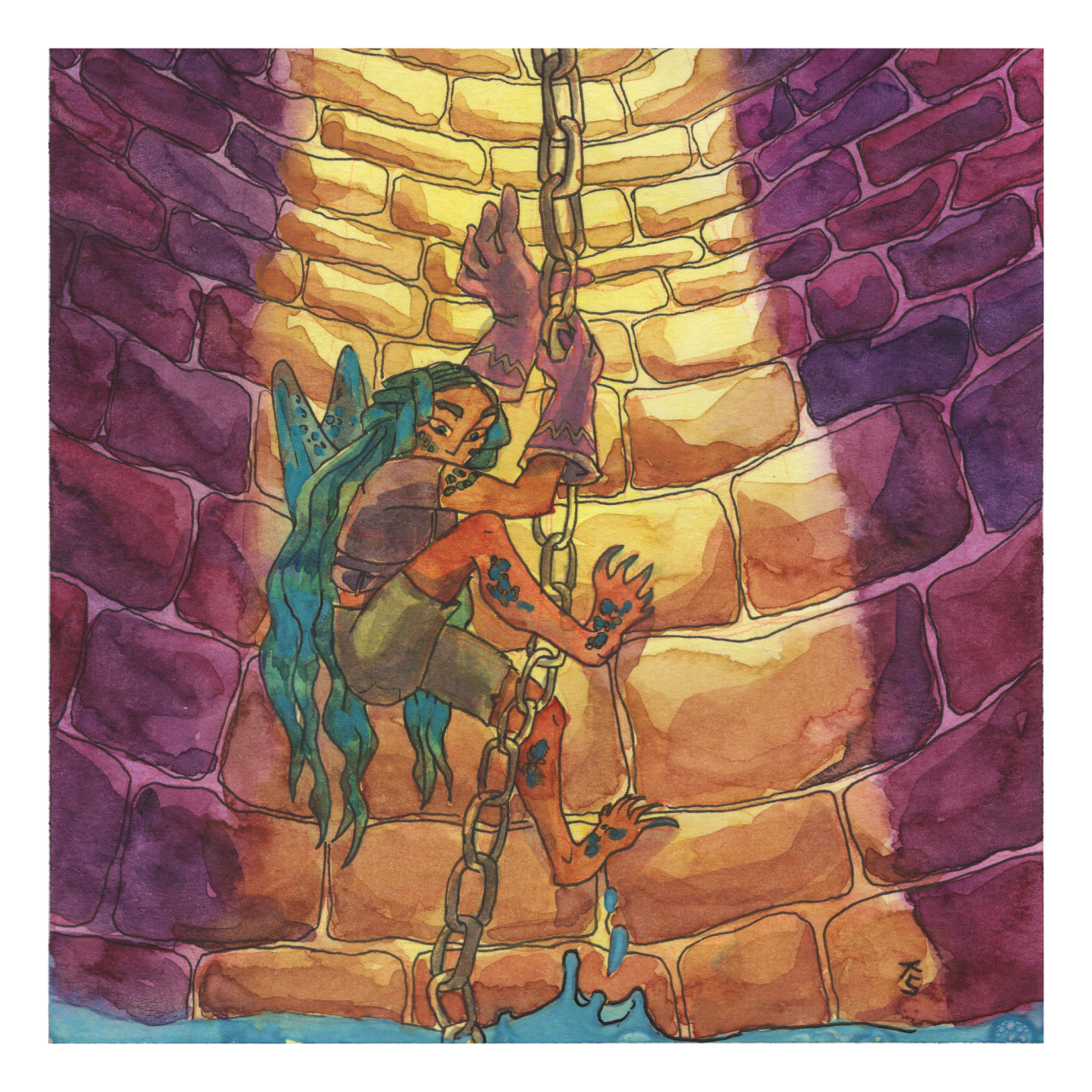
I do enjoy Katrin Sapranova’s work–here, Silver Well from her Tumblr page, used for commentary.

Elsewhere in the city, Reyn and Malta confer about their fortunes and those of their family and of Tintaglia. Malta places Phron’s hand upon the dragon and offers something not unlike a prayer.

Thymara resists the call to dive into memory, and she rejects Rapskal’s insistence harshly. Sintara pleads with Thymara, however, and she reluctantly descends into the well along with Rapskal. As she does, she feels the memories rising around her, and at the bottom of the shaft, she finds the remains of her past self. More memories rise within her, and she releases a hidden reservoir of Silver from which the dragons begin to drink.

Phron cries and Malta moves to feed him from her breast, the child’s parents exulting in the evidence of changes worked by Tintaglia upon him. Other dragons approach Tintaglia, shunting the Khuphruses aside as they bring Silver to Tintaglia, treating her. The elder dragon rises, hungry, and moves to hunt amid the joy of those surrounding her.

I remain pleased to see the chapter-prefaces used not only in the Asimovian style of providing greater context for the world and the events depicted in the pages of the chapters, but also to trace ongoing outside narratives. I know I’ve commented on the device before, but as it continues to be a source of delight for me, I feel I ought to remark upon it now and again. And it really is a treat to have the short little snippets–because the letters are rarely of any length, sensibly to them being carried by pigeons–do so much to illustrate what else is going on. More formally, by pointing towards events outside the main narrative, the letters assist Coleridgean willing suspension of disbelief by gesturing towards Tolkienian unexplored vistas that authenticate the act of sub-creation; more briefly, by making the presence of outside context within the milieu explicit, the letters deepen the verisimilitude of the main narrative. That is, they make the world in which the main narrative takes place “more real” than a work centering on metamorphosing dragons and their effects upon the world would otherwise be.

The depiction of the Silver in the present chapter continues to reaffirm for me the link between it and the Skill plied in the Six Duchies. I’ve commented on the perceived link a few times (such as here, here, and here), so I was already quite confident in the interpretation. Reading again of the manner in which the Silver-treatment occasions Tintaglia’s recovery offers more to bolster the interpretation; compare, for example, the dragon’s recuperation to that Fitz endures in his Skill-healing (see Golden Fool, chapters 20 and 21). The continued effort to “normalize” things across series taking place in the same milieu, relatively contemporaneously, is clear in the present chapter; it works better here than in some other places in the tetralogy, which is a pleasure to see.

The depiction of the Silver in the present chapter also continues to remind me of the EarthBlood in Donaldson’s Chronicles of Thomas Covenant the Unbeliever. (I write about it a bit here.) The tension between destructive force and creative power embodied in a markedly colored outflow from within the earth is telling, although I’d need to do some additional rereading to pull out the parallels more fully. Doing a bit of source-study remains tantalizing, of course, but that would require more of an investment of time, and I am not sure how much of it I am likely to have in the near future.

It’s for good reason, or reason good for me, at least. But I would still love to attend to the project, along with a great many others…

I’m still going; if you’d like to help me keep going by writing to order for you, please fill out the form below!

← Back

Thank you for your response. ✨

Or you can send your support along directly!

A Robin Hobb Rereading Series: Entry 382: Blood of Dragons, Chapter 16

Read the previous entry in the series here.
Read the next entry in the series
here.


Following a missive from Reyall to Erek and Detozi in which he announces his engagement, “Expectations” opens with Alise asking to move inside as she rapidly assesses events and her place in them. Carson begins to take charge of the situation with the captives that have been brought to Kelsingra, and Hest presents himself before Alise. Alise considers the implications of his appearance against the events of the past months, pleading with her as Reyn and others rebuke him. Alise upbraids him for his deceit of her, disclaiming their marriage publicly, and when Hest protests, Sedric interjects, testifying to Hest’s perfidy. Carson commends Sedric for his declaration, and the group departs from a stunned Hest.

The man of the hour.
Carson by dianna-art, from Realm of the Elderlings, here, and used for commentary.

Later, Reyn rejoins Malta as those assembled in Kelsingra confer. The pair discuss Phron and his progress, noting the still-poor prognosis for their son. Reyn also comments on the proceedings regarding the captives and the relative youth of most of those involved in them. Various testimonies and perfidies are summarized, and Reyn and Malta consider their status among the new Elderlings. Their thoughts turn to Tintaglia, and Malta avers feeling her slow approach. Reyn tries to believe but cannot quite do so.

Within eyeshot of the city, Kalo urges Tintaglia along. She reaches the city, losing consciousness as she does so and the new Elderlings flock to her.

In Kelsingra, Tintaglia’s condition is assessed. Reyn and Malta plead with the dragon to drink what Silver is available, administering it to no obvious effect. Thinking they have failed, they ask for privacy for themselves, Phron, and the dragon, and they are given it–including by Leftrin, whose thoughts turn once again to Alise.

I note with some attention the comment Carson makes as he begins to take charge of the captives brought to Kelsingra: “let us act as befits who we are, rather than who we think they might be” (278). Being the age that I am and with my adult life therefore shaped by the events that have occurred, I have heard much in the line of “We have to do X, because those people are going to do it.” My response, when I have offered one (which I don’t much do anymore; it does me no good, and I rarely get traction with it), has been much in the line of Carson’s comment. It doesn’t matter what those people, whoever those people are (and it shifts; oh, does it ever shift!); what does matter is what we do–or what I do, because that is the only thing that falls under my control. With others, I can advise. I can argue. I can cajole. I can command. I can punish (perhaps). But I cannot compel; the choice always exists for others to do other than I would have done. For me, though, the only choice is what I would do; what I do is necessarily what I have chosen to do. That does not mean the choice is always what I would prefer, or that it is a good one; there are sometimes no good choices, which I believe Hobb comments (among many others). But only I can make the choice for me, and I can make the choice for only me. So I find I appreciate Carson’s remark, affective as my doing so might be.

I note, too, Sedric’s public testimony against Hest. Although it is the case that Kelsingra is a far more sexually permissive place than the other Traders’ settlements, that he is willing to out himself in the way he is is something that comes off as commendable; the abused rising against their abusers is a thing worth seeing. Not all real-life victims of abuse are so fortunate as to have situations in which they can do such things, of course; many who attempt something like Sedric does find themselves much less well off than he does in the present chapter. But then, one of the things that fiction can do is show what can be, more than what is.

If you’d like me to write for you,
the form’s below; you know what to do!

← Back

Thank you for your response. ✨

Or you can send your support along directly!

A Robin Hobb Rereading Series: Entry 381: Blood of Dragons, Chapter 15

Read the previous entry in the series here.
Read the next entry in the series
here.


Following a message from Sealia Finbok to Hest, one meant to be held against his return, “Hostages” begins with Skelly conferring with her captain and uncle, Leftrin, about the unlikelihood of success retrieving Silver from the well the keepers have reopened in Kelsingra. She pleads to be tasked with the retrieval, but Leftrin refuses, and further conversation is cut off by the return of the dragons, whose needs must be addressed. Thymara finds herself considering her relationship with Tats once again as the dragons beckon and their quirks are noted, as are ongoing changes in Rapskal, and she joins the others in rushing to tend the dragons.

The dragon of the hour?
Heeby by gryphonic19 on DeviantArt, used for commentary

The dragons return to Kelsingra, delighting in the actions they took against the Chalcedeans and asking for reports on progress towards the Silver. Soon after, the ship being escorted arrives.

Leftrin chafes at the arrival of the new vessel as his crew helps to bring it into port. The captives are brought ashore, and Leftrin notes with some surprise the presence of Traders among them as Alise joins him. Calls for executions ring out, and Leftrin argues against them, Alise recognizing that Rapskal has been largely swallowed by the memories embedded in Kelsingra. Amid the confusion, some of the captive Chalcedeans attempt escape and are thwarted, leaving the issue unresolved.

Hest, for his own part, assesses the changes in his situation as he is also brought under guard to Kelsingra. He marvels at what he finds there and begins contemplating what treasures it holds, and then he recognizes Alise among the throng, bristling as she accepts Leftrin’s attentions. He swiftly perceives that the pair have grown intimate, and he begins to plot how he will take control of things. Scanning the crowd for a likely target, he is shocked to see Sedric among the Elderlings and wounded to see his clear affection with Carson. And so he begins to plot revenge.

I note something of a parallel between one of the keepers and the Fool in the present chapter. The note is made that one of the keepers, Kase, came into contact with a small bit of the scant Silver retrieved from the well. A lack of pain and the presence of oddness of sensation are attested. Something similar comes to mind for the incidental contact the Fool had with the Skill-imbued Verity and the subsequent uses of power that resulted from it. Again, I’m nerd enough to appreciate the call-backs and echoes of older texts in the more recent, even if I’m not always skilled enough in the moment to notice them directly.

I note, too, the disparity of textual treatment of characters in the present chapter. The summary above does not entirely reflect it, but the section of the chapter that focuses on Hest and his thoughts is the single longest and most coherent in the chapter; it spans some six pages, while the other sections are three, five, and five pages, so while Hest does not receive a majority of attention, he does have a plurality of it. (A word-count would give more accurate information, of course, but such exceeds the scope of a post to a weblog such as this one.) It’s not necessarily a surprise; he has been figured throughout the Rain Wilds Chronicles as a significant antagonist, petty as he is presented as being, specifically as an impediment both Alise (one of the primary protagonists) and Sedric (a clear secondary, but a strong secondary protagonist) must overcome. Nor is it surprising that the presentation rather heavily foreshadows the coming conflict between him and those he had formerly controlled, although it might have been hoped that his own experiences in servitude and abjection might make him more sympathetic to them and contrite for his own misdeeds. Instead, he seems to be following in the footsteps of Regal Farseer once again, and while it is the case that neither Alise nor Sedric is as capable of ironic cruelty as Fitz or a certain mustelid, there are no few in Kelsingra who are…

If you like the way I write and would like me to write for you,
Fill out the form that’s just below, and see what we can do!

← Back

Thank you for your response. ✨

Or you can send your support along directly!

A Robin Hobb Rereading Series: Entry 380: Blood of Dragons, Chapter 14

Read the previous entry in the series here.
Read the next entry in the series
here.


A message from Erek to the head birdkeeper for the Traders noting evidence of perfidy precedes “Blood Price.” The chapter opens with Selden waking suddenly as Chalcedean soldiers barge into Chassim’s rooms. They are tasked with retrieving Selden for the Duke, and Selden accompanies them rather than allowing Chassim to fight and likely be injured. Once brought before the Duke, Selden is bled for the Duke’s sustenance, and he loses consciousness.

I wonder why this came to mind…
Image is of Orlok from the 1922 Nosferatu, pulled from Wikipedia here and reported as public domain.

Eilik looks on in disgust at the actions of the Duke and urges him to release his hold on Selden. The Duke relents and bids that Selden be tended in advance of another feeding. Eilik finds his situation altered and begins plotting to improve it.

Andronicus has himself taken to Chassim’s chambers. There, he confers with her openly about her attempts to take power, commending her attempts and offering to make her his heir outright in exchange for her continued compliance.

Later, Selden wakes as Chassim tends him. The two confer about their respective situations, Chassim urging him to endurance. And the two begin to plot together.

I think it might be of interest to conduct some kind of rhetorical analysis on the messages that appear at the beginnings of chapters; that preceding “Blood Price” seems particularly apt for such an exercise. Were I teaching the Elderlings novels again, I think it might be a useful exercise for students to untangle the ethos, logos, and pathos appeals in Erek’s message to Kerig, here; I can also think that it would be a good example to provide to students before having them select a message of their own to analyze similarly.

I find that I am once again taken by Chassim’s seeming acceptance of her abuse and constraints. The present chapter does make mention of her resistance, notably in the throwing of heavy objects (explicit) and in flight (implicit from the exhortation to lock her door again), and the fact that it is an ongoing thing is strangely hopeful. That it has to be an ongoing thing, that it is one that is reported to be long ongoing, is less so. But perhaps that is me once again reading affectively and reading an earlier text against present circumstances and social trends. I am not alone in looking at the world and seeing that it is going ways that may not be to its benefit, and I doubt I am alone in seeing those ways presaged in the fictions of (not too many) years past. I do not ascribe any particular set of political positions to an author based upon a work of fiction; yes, writers write what they know, but it is possible for people to know what they don’t believe and to write that. I am not aware of any overt statement from Hobb in that line (which does not mean there isn’t one, just that I don’t know about it). But that a given author may or may not believe in one way or another doesn’t mean that such belief doesn’t show up in the work, reflecting the “now” of composition or underlying cultural currents that still flow and bubble up.

Like the work I do? Maybe see what I can do for you; contact me at the form below, and we’ll talk!

I’m happy to write to order for you; fill out the form below to get your piece started!

← Back

Thank you for your response. ✨

Or you can send your support along directly!

A Robin Hobb Rereading Series: Entry 379: Blood of Dragons, Chapter 13

Read the previous entry in the series here.
Read the next entry in the series
here.


Following a somewhat threatening message from Kim to Hest’s father, “Final Chances” begins with the Chalcedeans pursuing Tintaglia continue their search for her. Hest looks on as the search continues, considering his increasing precarity and the likely prospects of Selden and Alise. The Chalcedeans espy a group of dragons come in search of Tintaglia and make ready to attack, and Hest assesses the likely outcome grimly.

Were it only so easy…
Photo by Omer Faruq Khan on Pexels.com

The progress of the dragons and Rapskal along their search for Tintaglia is detailed. Sintara regards Rapskal with some annoyance and suspicion and considers the relationship between human and dragon. The attack begins.

Hest reels as the Chalcedean vessels come under assault. The order to abandon the ships is given, and Hest happily heeds it, fleeing into the trees. He notes the effect of the dragons briefly as he does.

Sintara and the other dragons continue their assault, delighting in it. Sintara continues to regard Rapskal with suspicion as he steps forth to call the Chalcedeans to judgment.

Hest heeds the command and, after being questioned briefly, is taken into custody and servitude, to be transported to Kelsingra. Dargen refuses to be taken captive, attacking; he is summarily eaten for his troubles. Hest and most of the others do not repeat the error.

Elsewhere, Mercor finds a flagging Tintaglia and reports that she has been avenged upon her attackers. In her mind, Tintaglia reaches for Selden and thinks she perceives his response from afar.

In Kelsingra, the keepers note the absence of their dragons, and they confer about the events and about the changes overtaking Rapskal. Work to clear the well begins anew, proceeding decently.

Leftrin takes a turn at the work, noting the progress and the increasing efforts necessary to maintain it. When he takes a break from the work, he notes the status of Malta, Reyn, and Phron. Alise’s arrival disrupts his reverie, and she reports her failure to find aid for the Khupruses. Leftrin issues orders for Alise’s care and returns to the work.

At length, the assembled keepers and crew are able to raise a bucket of Silver. The behavior of the material is described as the assembled witness it. And with that success, Leftrin sends the group off to rest.

Tintaglia continues to fade, considering her looming death. One of the dragons, Kalo, presents her with food before returning to the hunt for himself. She eats, strengthening and in pain, and resumes her progress towards Kelsingra. Kalo’s odd behavior strikes her, but she accepts it.

There is a bit of interest for me in a comment made by the Chalcedeans early in the chapter: “Dragons! A flock of dragons!” (225). One of the more entertaining quirks of modern Englishes is the hold-over from centuries past–and, indeed, earlier Englishes–of collective nouns, such as “a murder of crows,” “a pride of lions,” or “a murmuration of starlings.” It’s a small bit of delight in what is, for many, a tedious study, and one that has provoked no few jokes, some of which Melissa Gronlund points out here. Dragons, though, don’t necessarily have a stable collective noun; they’re not real, after all, and many of those found in English-language literature prior to Tolkien are solitary things. Even in Tolkien, most dragons are presented in isolation from one another; Glaurung doesn’t have much company, nor yet does Smaug, and Scatha the Worm is not presented, to my recollection, as being part of a group. (The assault of Ancalagon the Black and the other winged dragons in the War of Wrath is a marked event, to be sure, but it is marked.)

Admittedly, there have been some authors who have addressed the issue. McCaffrey, as memory serves (it’s been a while since I read Pern), tends towards “weyr.” Yarros, recently popular as of this writing, tends toward “riot.” Paolini is pointed about calling his dragon-group a “thunder.” I am certain there are others; there are limits to what I have read, and I wonder what D&D uses at this point (I’ve yet to play in Fifth Edition). What the “appropriate” collective for dragons “should” be, then, is not entirely clear. I do think, however, that the term used is indicative; the Chalcedeans regarding it as a “flock,” linking dragons with birds, says something about them. I can easily imagine the people of the Six Duchies calling a group of dragons a garden, and the Elderlings that are emerging will likely stumble into other, more ornate, terms if and as they develop a new culture in and around Kelsingra.

I note, too, the many divisions of the present chapter, most of which are quite brief. (Each paragraph in the summary reflects such a division, a practice common to this rereading series.) I am aware that the commonplace for such chapter-divisions is that they are roughly contemporaneous unless otherwise specified; that is, the short sections shifting focus between two groups or among more are to be read as happening more or less at the same time, with successive sections focusing on one group proceeding in chronological order. (Again, unless otherwise specified; I’ve read enough to know that authors sometimes like to screw with in-milieu time as they present events, and that doesn’t even factor explicit time-travel into things.) It seems a strange thing to my eye that Hobb accelerates action in the present chapter in such a way; yes, there’s a lot going on, but the interleaving at work is somewhat marked. I’m not at all sure why.

Maybe I’ll figure it out as I continue to reread on.

I’m happy to write to order for you; fill out the form below to get your piece started!

← Back

Thank you for your response. ✨

Or you can send your support along directly!

A Robin Hobb Rereading Series: Entry 378: Blood of Dragons, Chapter 12

Read the previous entry in the series here.
Read the next entry in the series
here.


Following a reply from Jani to Keffria (the earlier message being here), “Dragon Warrior” begins with Hest continuing to languish as the Chalcedeans pursue Tintaglia, whom they assailed. Hest’s own condition and that of Tintaglia are detailed as pursuit continues.

What awaits…
Photo by Pixabay on Pexels.com

For her own part, Tintaglia presses ahead, fuming at her pursuit and avowing that she will not be butchered as if livestock. She determines to assail her pursuers in the night, meaning to wreck them and flee with the eggs growing inside her.

Dargen has Hest escort him to the ship’s railing that he might relieve himself. As he does so, Hest spies Tintaglia, who attacks.

In Kelsingra, Rapskal and Thymara continue their explorations, joined by the rest of the expedition. Work to restore the well of Silver is in progress, that work detailed. Updates to the statuses of various keepers and crew of the Tarman are made. Spit gets a small taste of Silver while the work goes on, and the keepers note the change that comes upon him as he does, wondering what a greater, steady supply will do for the dragons. At length, enough of the well is cleared that the keepers can drop lights to check the level of Silver in the well, but the results are not promising. The dragons grow angry at the report, and Thymara, calling on embedded memories, explains more of the dragons’ need for the substance and Kelsingra’s rise to prominence among the Elderlings. Given the importance of the Silver, Reyn vows to find it for Phron.

In the wake of her assault on her Chalcedean pursuers, Tintaglia languishes. Further injuries beset her, and she calls out in what she believes will be her final battle.

In Kelsingra, Carson notes that the Silver may yet be accessible, and the keepers prepare to retire for the evening. As they do, however, Tintaglia’s call reaches them, and Malta calls for aid from the dragons and keepers about her. Rapskal begins to be overtaken by the memories of an ancient warrior, Tellator, and Thymara works to return him to himself as he makes ready to rush to Tintaglia’s aid.

The present chapter takes an interesting tack, I think, in presenting Hest’s increasing accommodation to his fallen status. And it is not that being a servant, as such, is demeaning; there is nobility in work of all sorts. The fall, rather, is that Hest is effectively enslaved, although he is not yet tattooed in accord with Chalcedean and Jamaillian practice, and he is adjusting to that status, even as he recognizes with some horror the changes occurring in him as he does so. Given the resonances between the Traders and the early United States, I find it hard not to see some proposed parallels at work, though I acknowledge I am not the person who ought to explicate them in any great detail.

I note, too, a return to descriptions echoing addiction in the attitudes the dragons, particularly Spit, voice towards the Silver. As a commonplace in the Realm of the Elderlings novels, addiction is something I’ve noted repeatedly throughout the rereading; I have to think it is among the most prevalent themes in the novels, and it seems the kind of thing that those more inclined to biographical criticism would want to pursue. (For my part, I know better than to look. HIPAA is in place for damned good reasons.) And, as I reread, I find myself in mind of the spice mélange from Arrakis in Dune and the following novels–itself addictive and enhancing; I am not at all up on literary scholarship treating Frank Herbert, so I cannot speak with any certainty to its own references, but I have to think that those at work in it are also at work with the Silver in Kelsingra, if at some remove.

Of more importance for the Realm of the Elderlings corpus is Mercor’s report of the powers associated with Silver for Elderlings–the strange features of Kelsingra, as well as the Skill-roads and the stone garden with which so much of the Farseer novels are concerned, and the Skill-pillars that feature prominently in the Tawny Man novels. Mercor’s remark on the peril of contact with Silver by humans is somewhat telling; Verity fairly bathes in it, and while he does meet his end, it is because of his quest rather than the direct effect of the Silver, itself. In effect, Hobb confirms in the present chapter that the Skill is itself a legacy of the Elderlings, something that puts me in mind of Tolkien (the “blood of Westernesse” notable in Denethor and Faramir but not in Boromir presents itself), although being put in such mind while reading Hobb is not a surprise.

(Another thought occurs, as well. The Silver, in its unadulterated form, offers power and mastery. Water that flows through it, however, becomes…problematic. The Earthblood that wells up under Melenkurion Skyweir in Donaldson’s Chronicles of Thomas Covenant novels seems antecedent. The source-studies implications of the present chapter are somewhat dizzying; I find myself once again longing for the time and resources to undertake such traceries. Perhaps another can work on such projects?)

If you like the kind of work you see and would like some done for you, fill out the form below! Reasonable rates and no AI plagiarism!

← Back

Thank you for your response. ✨

Or you can send your support along directly!

A Robin Hobb Rereading Series: Entry 377: Blood of Dragons, Chapter 11

Read the previous entry in the series here.
Read the next entry in the series here.

This chapter presents and discusses sexual assault.


A brief formal commendation for Erek precedes “Silver,” which begins with Sedric and Carson conferring about a place to settle and how they should prepare for the coming times. Carson finds himself somewhat confused at Sedric’s desires for material comfort and appreciative of his lover’s appearance. As they walk Kelsingra together, Carson opens himself cautiously to the memories embedded in the stones, and he and Sedric recognize themselves as having entered an older part of the city. Exploring further, the pair find an open plaza that attracts the attentions of the dragons with which they are bonded, and they stumble upon the well of Silver that the dragons covet. The two arrive at some understanding of the importance of the site, and the dragons begin to join them.

Such a cute couple!
Katrin Sapranova’s Carson and Sedric, used for commentary

Elsewhere in the city, Thymara starts awake from sleeping next to Tats. The two confer, touching on the need to fill the years of their expectedly lengthening lives and the issue of Rapskal, whose reliance on others’ memories is cited as becoming a problem. Tats reports the conversation in some detail, and considerations of the changes to social structures that extended lifetimes would necessitate are mentioned. The two grow increasingly comfortable together until they are summoned by their dragons to the well of Silver.

In Chalced, Selden wakes to hear Chassim‘s protests. He moves to investigate and finds her under assault by Eilik. Selden attempts unsuccessfully to intercede, and Eilik leaves him unconscious.

Later, Chassim shakes Selden awake, reporting her sexual assault and noting it as a recurring event for her. Selden reports his own experience of sexual assault, and Chassim offers only cold comfort. She turns their conversation to the changes Tintaglia has effected upon Selden, staying only briefly upon it before departing.

I‘ve noted before (here, for example) my impression that Hobb is borrowing from or working with the same tropes as Asimov at points in the Elderlings corpus. I think something similar is at work in the present chapter in the discussion between Thymara and Tats. When I was really introduced to Asimov’s writings more than thirty years ago–I remember being ten at the time, though I have dim recollections of my mother having a boxed set of the Foundation novels released just after the publication of Foundation’s Edge–it was by way of his Robot novels. Said novels make much of the Spacers, a subset of humanity that has achieved greatly extended lifespans due to medical and other technological advances and freedom from the prevalence of diseases on Earth. While Asimov does not necessarily delve deeply into the sociological implications of centuries-long lives, he does point out some changes among the Spacer worlds from how the more “normal” Earthpeople live, most notably in terms of sexual politics. (Yes, I am aware that it’s problematic. I’m also aware that I’m not up on the relevant scholarship–and I never really was; my focus was otherwise, for all my nerdiness.) The discussion between Thymara and Tats that comprises the second section of the chapter seems very much in that line; I don’t know that it’s enough to suggest explicit borrowing, but, given other factors at work in Hobb’s writing, I have to entertain the possibility–though I have to acknowledge, also, that it might simply be a matter of having been influenced by earlier reading or even a reasonable thinking-through of implications of the reality in which Hobb’s characters exist.

I’ve noted, too, the presentation of sexual assault in Hobb’s work. It’s to be expected, admittedly, given the prevalence of such acts in the readers’ world and in other works of fantasy literature. (Some revel in the presentation, as is readily seen.) Chassim’s frank discussion of it strikes me somewhat strangely, although I recognize that as being partly an artifact of my privilege. Selden’s confession of the same also strikes me, though differently, and I have to wonder what kind of internalized double standards remain at work in me that I perceive such a difference. I do note, though, that Hobb appears to give more space to Selden’s discussion than Chassim’s. There is doubtlessly something to find in that disparity, but, as I have noted, I am not up on the research I would need to be able to pull out any such thing.

I sometimes miss having ready access to reports of research. I more often miss having the time to spend familiarizing myself with those reports. Sometimes, though, I wonder if I am not better off now for not giving so much of myself to taking in those discussions as I used to do; there is no comfort in reading what others write about the many horrors of the world that have happened and that continue to happen, especially when the reader can do little or nothing to affect them.

I’m happy to write to order for you; fill out the form below to get your piece started!

← Back

Thank you for your response. ✨

Or you can send your support along directly!