A Robin Hobb Rereading Series, Entry 514: Shaman’s Crossing, Chapter 4

Read the previous entry in the series here.
Read the next entry in the series
here.


The fourth chapter of Shaman’s Crossing, “Crossing the Bridge,” begins the day after the third ends, with Nevare waking in a silent night. Realizing that Dewara is present, he rises and assumes a defensive stance he recognizes as somewhat silly, and Dewara taunts him. Melee ensues, and while Dewara handily beats Nevare, he also feeds him, leaving Nevare aware of being humbled. He recalls lessons from Duril and, as he eats, speaks hateful words to the Kidona, who responds calmly if with sarcasm, telling him that he will make of him in the coming days. Nevare settles in for an uncomfortable night, noting in retrospect how neatly he had been handled.
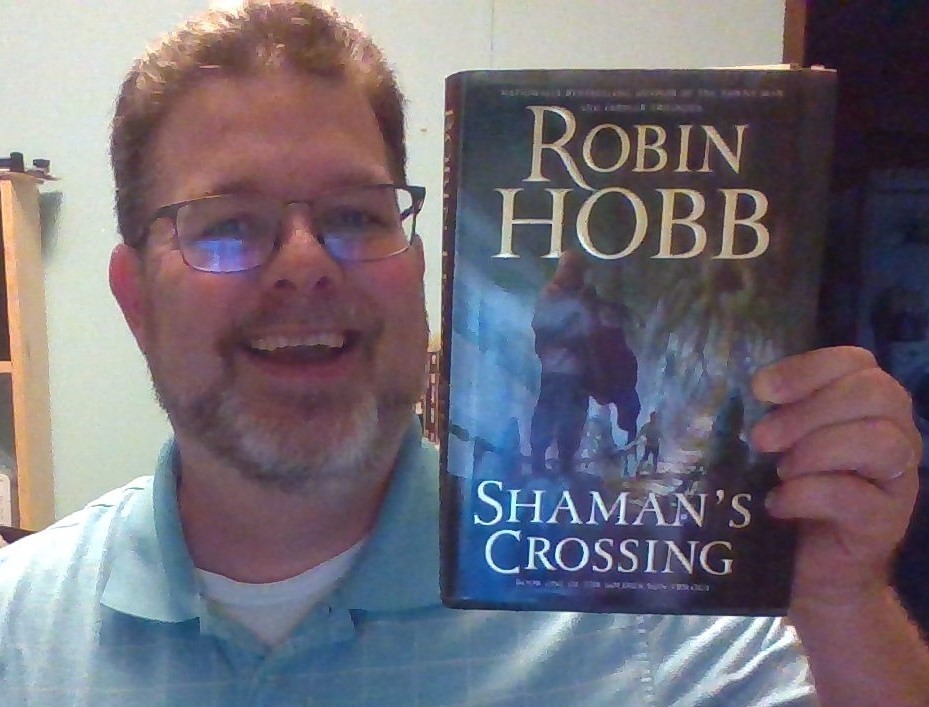
There’s a reason I’m repeating this image of mine from before. And it’s not because I’m so pretty…

The next day, Nevare rises to find Dewara regarding him amiably, praising him for his surly, teenage attempts to remain angry with him. He also begins to show Nevare how to live off of the land, as well as to teach him some of the ways of the Kidona in the following days. Dewara also speaks at some length about the Specks, whom he calls the Dappled People, what he says clashing in Nevare’s mind with what he had previously been taught.

Nevare’s training proceeds, and its effects on him are noted. Information about Dewara’s experiences with Nevare’s father is related, and Nevare begins to be aware that he might well follow other scouts and become as much Plainsman as Gernian or more, which is an uncomfortable prospect for him as he recalls Halloran. Yet Nevare still finds himself drawn more and more towards the Kidona as Dewara takes him closer and closer to his own home.

One evening, Dewara tells Nevare a story of the god Reshamel and offers him a test of worth in the god’s eyes. Nevare inquires further and is drawn into a strange ceremony, following Dewara into the night. He steps off of the edge of a cliff, falling but landing safely. Dewara feeds him something strange, a dried gore frog, and Nevare finds his senses overwhelmed. Amid the confusion, he sees Dewara as a figure of great stature and with a hawk’s head, Dewara urges him onward; Nevare notes that his recollection of events is disjointed, mourning his inability to recall them fully.

At length, Dewara brings Nevare to a series of bridges, noting that they lead to the spiritual center of the Kidona and relating the experience of hostility between the Kidona and the Dappled People, including the infliction by the latter of a plague upon the Kidona. Dewara warns Nevare about the Dappled People, urging him to have the Gernians conquer them. He also cites his own failures to restore his people’s connection to their spiritual home, regarding Nevare as a means to restore that connection, and he urges Nevare to make the attempt.

Nevare presses ahead, following Dewara’s direction and facing the series of challenges that present themselves to him, crossing such bridges as provide the inspiration for the cover of the novel as I have it. Symbolism presents itself to him that he acknowledges failing to understand, but Nevare becomes aware of the lost history of the Kidona as a people who built. And at length Nevare finds himself confronting a tree that transforms into an immensely heavyset old woman, one of the Dappled People. Confused, Nevare approaches cautiously, and the woman challenges him, first for his name and then for his purpose. She perceives Dewara’s intentions and attempts to persuade Nevare to her thinking; Dewara protests, bidding Nevare fight against her and resist her attempt to suborn him. She attempts to force a choice on Nevare that he fails to understand, and he falls as she opens the ground beneath him.

He cries for help, and he accepts her offer of the same, at which Dewara bewails their doom. The woman takes up Nevare, mocking Dewara for his reliance upon him and noting to Nevare the bond that is forming between them. She takes something from Nevare that he does not understand, and he loses consciousness.

To address the chapter-length issue: the present chapter, in the edition of the novel I’m rereading, runs 36 pages in length, approximately 6.24% of the novel. If length is to be taken as an indicator of narrative importance–and I’ll admit it’s a big if, although there is something to say about an author spending more time and attention on a particular passage–then the present chapter is the most important one yet. Certainly, in terms of content, it seems singularly important, offering a pivot both in the story and away from a flat iteration of particular tropes; to follow Freytag’s model, the rising action would seem to have begun.

Also, for indexing purposes, the following: Barrier Mountains, Cavalla, Dappled People (Specks), Dedem, Dewara, Duril, Gore frogs, Halloran, Hawk, Hoodoo, Jindobe, Keeksha, Keft Burvelle, Nevare Burvelle, Pheasant, Plague, Plateau bear, Prairie grouse, Reshamel, Scouts, Sling, Swanneck, Taldi, Tefa River, Tree woman, Troven, Widevale. Despite the greater length, there are fewer unique items of significance in the present chapter.

Less…mechanically, there is a bit of confusion early in the chapter. When squaring up against Dewara, Nevare remarks on his “gangly fifteen years pitted against the mature and solidly muscled warrior” (73); early in the previous chapter, when leading up to his introduction to Dewara, Nevare remarks that his experience with Dewara was in his sixteenth year (51). While it is technically the case that passing one’s fifteenth birthday opens one’s sixteenth year–being a Millennial, I well remember the discourse about the first year of the new century being 2001 rather than 2000, and this is a similar thing, so recall of that might be at work in the composition of the present chapter–it is not common to make such a comment. Admittedly, Nevare does have some penchant towards exactitude, although the degree to which he exhibits that penchant is limited in the present chapter by being yet early in the narrative; I am not at this point in my rereading certain what kind of coding he exhibits or to what degree. (I did note it’s been a while since I was in this series, and I’ve slept once or twice since last time.) But I find the framing peculiar in context, and so it stands out to me.

As it does so, I am reminded of Hobb’s major narrating protagonist, FitzChivalry Farseer,* and find some points of contrast between the two. Nevare is nobler than his literary predecessor in several traditional senses, being a legitimate child explicitly schooled in a strict pattern of “being good.” Even at a comparable age, Fitz had undertaken assassin’s work; it is hard to conceive of Nevare even thinking in such a way. Indeed, Nevare avers that he “would never have stooped to such a dastardly act” as killing a man in his sleep (76). Fitz was also already blooded in more “normal” fighting than Nevare at a comparable age; even if Fitz is a nuanced warrior-hero, he had already proven himself earlier in his life than Nevare had even had a chance to start. It is a curious juxtaposition; Nevare is a more “normal” instance of a noble figure than Fitz,** but he is also decidedly less competent. There are implications that might be read into that; perhaps another scholarly someday might treat one or more of them.

A point of comparison between Nevare and Fitz from the present chapter is their mutual confusion when immersed in magic. Notably, Fitz suffers quite a bit of it on his initial approaches to Kelsingra and the Skill-stone quarry (witness this, this, this, and this, with the last showing comments that it’s not just me who had a time with Fitz’s journey). Nevare, in the present chapter, remarks upon the brokenness of his memories of his ritual with Dewara (87), although I note an easier time following his narration of events than I did Fitz’s. Perhaps it is only because I am in a better headspace rereading now than I was then; perhaps it is because the Skill is more remote than intoxication. (I did go to college, after all.)

In the present chapter, the fact of the Kidona as something of a pastiche of Native American plains-dwellers and others presents itself again. The cultural virtues related by Dewara to Nevare ring of traditional stories of Coyote, and the ritual experience through which Dewara guides him echo depictions of vision quests and similar intoxicant-driven religious / spiritual practices. The former practices of the Kidona that Dewara relates trace similarly echo seminomadic people such as the Caddo and Karankawa, at least to a cursory reading; those with greater knowledge of indigenous history and culture than I have could doubtlessly say more, and more eloquently. Still, even from what I do know,† the Kidona are borrowing from multiple peoples; they function therefore as a stand-in for the many peoples who were subjected to the colonialist practice of European settlement of the Americas and who still suffer the effects of the same…which makes the attempted reliance upon Nevare as a figure of hope for them read as an iteration of the white savior complex (and its suborning an interesting twist). Again, Helen Young’s comments would seem apt.


*He counts as the major one because he narrates more books than the others. Simple as that.

**This leaves aside, of course, the entanglements of colonialist practice. For all the problems of the Six Duchies, they are not actively colonizing the neighboring peoples. Even the interactions with the Mountain Kingdom are being conducted diplomatically, and the Chyurda are in position to be able to refuse the Duchies. Gernia is not so innocent as that.

†That I know only what I know is my issue, not that of the knowledge. There is much worth knowing that I do not know; it is for me to learn it more than for others to teach it.

I remain indeed happy to write for you! Fill out the form below to get your piece started!

← Back

Thank you for your response. ✨

Or you can send your support along directly!

A Robin Hobb Rereading Series, Entry 513: Shaman’s Crossing, Chapter 3

Read the previous entry in the series here.
Read the next entry in the series
here.


The third chapter of Shaman’s Crossing, “Dewara,” starts some three years after the second, Nevare glossing the passage of time to his fifteenth year. New tutors are found for him, Rorton and Leibsen, and he studies ancient languages as well as military arts. In the spring of his sixteenth year, he is also introduced to Dewara, a Kidona whom Duril distrusts and who is described as Nevare and his father make their approach. Nevare reflects on what he knows of the Kidona people and the members thereof he sees as Dewara and Nevare’s father negotiate the fee for his training, as well as the terms and conditions of the same. Nevare notes, in particular, the swanneck (a formidable bronze knife) Dewara carries and the Kidona’s appreciation for sugar.

Something like this, perhaps?
Image is Ericj’s on Wikipedia, here, used under CC BY-SA 3.0

The agreement between Dewara and Nevare’s father completed, Dewara demands his own agreement, which Nevare gives. He is then obliged to disarm himself to accompany Dewara, and he muses on his father’s earlier interactions with Dewara; Keft had fought and imprisoned the Kidona. But Nevare’s father nonetheless leaves him in Dewara’s care, the Kidona bidding him mount one of his beasts, a taldi that initially proves difficult to handle. Dewara calls the taldi by its name, Keeksha, and informs Nevare how it is to be handled only briefly before galloping off on his own taldi, Dedem.

Nevare struggles to catch up as the terrain worsens, only doing so when Dewara stops and dismounts, showing an attitude towards the taldi that takes Nevare aback. Nevare is himself wearied, but Dewara rebukes him for his complaints about the same, bidding him to silence. Dewara uses that silence to locate Duril, whom he notes has gotten himself lost. After some time passes, Dewara mounts again, bidding Nevare follow, which he does through the remainder of the day.

Camp that night is bare, and Nevare sleeps poorly, waking thrice. Two are in the night; the third is in the morning, and he perceives Dewara sneaking up on him. He rises, and Dewara greets him flatly before bidding them depart again. It is another dry ride, and Nevare begins to suffer the effects of his thirst. He also suffers from another rough campsite, although he comes to believe Dewara has provisions that he declines to share, and he rebukes himself for doubting his father’s judgment. His dreams are unpleasant.

The next morning, Nevare demands water from Dewara and is refused. He then attempts to depart Dewara, fleeing on Keeksha and, after some chase, is caught and his ear notched, to his shame. But Dewara lets him ride on after inflicting the injury, and Nevare sullenly considers himself against events. Keeksha eventually finds water, and Nevare drinks, but he remains ashamed and knows that how he is marked will carry with him. But he sees to his mount nonetheless, and he arms himself as he can amid desolate surroundings.

To address the chapter-length issue: the present chapter, in the edition of the novel I’m rereading, runs 21 pages in length, only approximately 3.6% of the novel. Reading the chapter, I did not feel it shorter, although I’ll admit three pages isn’t much; even so, the present chapter felt a longer read than either of the preceding two, despite the slightly lesser length. I have to wonder if it inheres in the presentation of less familiar things; the Burvelles, while fictional, clearly partake not only of the real, but of real with which I am familiar, as noted, but the Kidona, although described in terms reminiscent of Native American peoples, are far more remote from me. I can understand how the difference would affect the perception of narrative heft; there is more to do to understand the less proximal than the more, and the greater effort involved comes off as heavier writing. Maybe.

Also, for indexing purposes, the following: Bronze, Dedem, Dewara, Duril, Gore frog, Hoodoos, Humpdeer, Iron, Jindobe, Keeksha, Keft Burvelle, Kidona, Lead, Leibsen, Nevare Burvelle, Rew, Rorton, Salt, Sirlofty, Steelshanks, Sugar, Swanneck, Taldi, Tobacco, Varnian. There are fewer new names in the chapter, although the presence of trade goods and identification of creatures stand out.

On the subject of trade goods: I note with some interest the offerings of salt, sugar, and tobacco by the Gernian Keft Burvelle to the Kidona Dewara. I note, too, that the previous chapter reports the Burvelle holdings as generating cotton (with attendant agricultural challenges). Such offerings evoke, at least to my reading, both the cash-crop system that underlay much of the antebellum economy of the United States and the disparate trading arrangements through which many Native American peoples were dispossessed (although it might well be noted that the inclusion of tobacco as a significant trade good also does come up in Tolkien; again, Hobb does have cause to stay close to the Tolkienian fantasy tradition even as she moves away from it in many ways). As such, the colonialist underpinnings of the Gernian setting are reinforced.

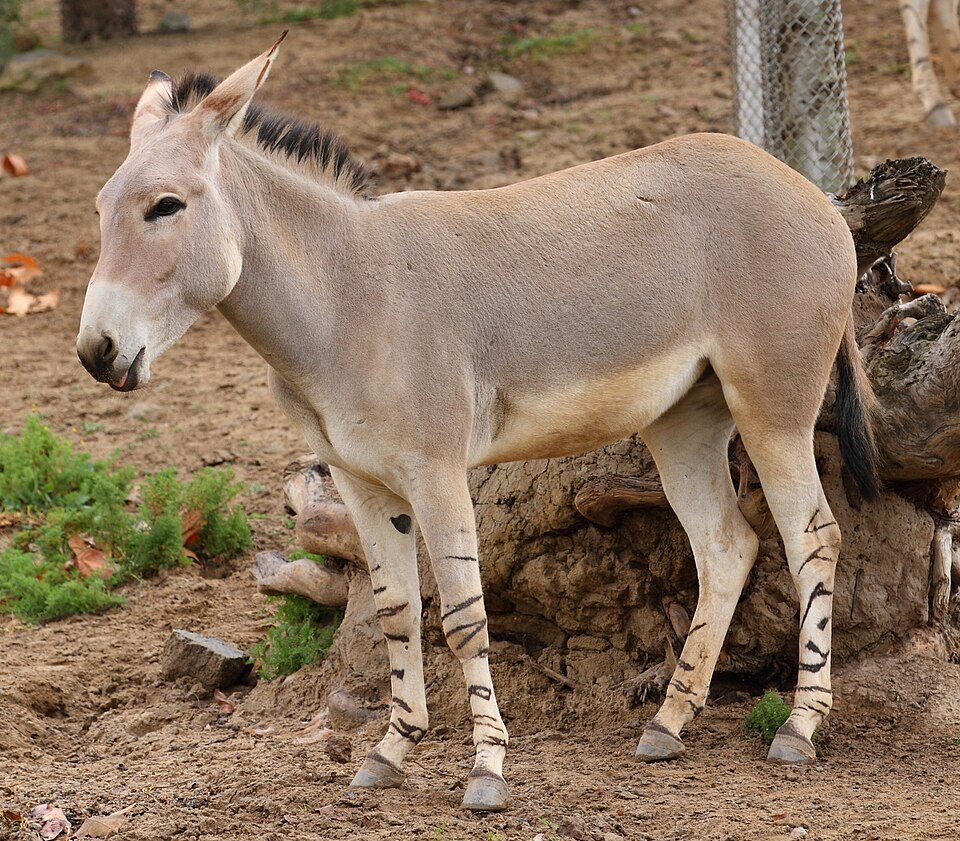
On the subject of creatures: the taldi and the gore frog attract attention. The latter is mentioned briefly at the end of the chapter, a poisonous creature and hazard of the local environment. The former is the specific type of animal the Kidona use as horses. Described as “black-muzzled, round-bellied striped-legged mounts” with stiff manes and almost bovine tails (52), such as “did not whinny, but squealed” (57), they evoke such animals as the Somali wild ass, the grullo/grulla, and the takhi (and note the relative similarity of name). Notable is that the evoked animals are distinctly Old World, an interesting motion against the largely US-Western setting of the novel, even as the depiction of their use and their users in the chapter accords with traditional depictions of such peoples as the Nʉmʉnʉʉ and Łibaį́ Ndé and their practices.

The matter of religion comes up again, as well, Nevare contrasting his remote and benevolent “good god” with Dewara’s present but fickle spirits of the land. It becomes clear from comments made that Nevare feels strongly about his faith, that it is not for him a thing of lip-service observance, even if it is perhaps not closely considered. Already, the comment has been made in the novel that a good soldier follows orders, and Nevare, it seems, very much wants to be a good soldier.

I’m pretty much always happy to write for you! Fill out the form below to get your piece started!

← Back

Thank you for your response. ✨

Or you can send your support along directly!

A Robin Hobb Rereading Series, Entry 512: Shaman’s Crossing, Chapter 2

Read the previous entry in the series here.
Read the next entry in the series
here.


The second chapter of Shaman’s Crossing, “Harbinger,” begins four years after the first chapter, with Nevare musing on the first news of plague. He notes of the day that he had been training under Sergeant Duril with his horse, Sirlofty, both of whom are described. Some of Duril’s youthful exploits are noted and given context, as is his familial situation, and socioreligious norms are expressed.

Surprisingly common in the Hill Country, as it happens…
Photo by Dmitry Demidov on Pexels.com

Duril interrupts Nevare’s horse drills with a pursuit exercise, during which Nevare attempts to track his tutoring sergeant while ruminating on the terrain and its perils. He is surprised to be struck by a rock sling-cast by Duril, who admonishes his pupil to remain cognizant of his surroundings even while tracking intently. Duril instructs Nevare to take up the rock that has struck him, and Nevare reflects on their practice of having him do so.

Exercises concluded, Nevare and Duril return to the family holdings. Their history is glossed, as is their arrangement. As Nevare and Duril return, they find present a chain-gang, criminals condemned to hard labor and relocation in lieu of harsher punishment. Nevare muses on pity for them, which Duril argues against until interrupted by the arrival of the messenger. The royal messaging service is glossed, and the unusual haste of the rider receives remark.

Afterwards, Duril delivers Nevare to his academic tutor, Rissle, from whom he accepts an afternoon of lessons. Following that, Nevare dresses for dinner and joins his family. The various members, as well as those in household service, are described, and conversation regarding the disposition of the family is undertaken. Reports of the children’s activities are made, following birth order, leaving Nevare third. He makes his report and asks after the messenger and his errand, receiving little information from his father in return. Nevare’s older brother, Rosse, asks further and receives more information. Nevare’s mother attempts to redirect conversation, succeeding only temporarily.

As months pass, more news of the plague spreads, and Nevare muses on what he hears and knows. The Gernian project to put a King’s Road to the Barrier Mountains, and its opposition by a people Nevare refers to as the Specks in what is clearly a derogatory term, are noted. The distance from his own life of such concerns receives comment from Nevare, although he notes an ongoing fascination with the topic.

Later, Nevare overhears a conversation among his father, Rosse, and a Scout Vaxton, who had served with Nevare’s father. The social situation of Scouts is noted, and Nevare is taken aback to hear his father overtly angry as he confers with Rosse about the putative sexual immorality of the Specks and their status as “a lesser race” (43). Nevare’s father comments aspersively on the eastern commander, a General Brodg, and bemoans the current state of affairs in the military. He also inveighs heavily against the Specks in general among a rambling conversation about changes and putative progress.

Nevare, after hearing his sisters called inside, makes his own way back inside. The next day sees him ask Duril oblique questions about what his father had said, to which the sergeant responds with remarks that soldiers reflect the qualities of their commanders.

To address the chapter-length issue: the present chapter, in the edition of the novel I’m rereading, runs another 24 pages in length. As with the first chapter, it is approximately 4.16% of the total main text and thus roughly proportional (rounding happens) to the full text. A cursory glance at the table of contents in the front matter indicates that not all chapters are thus proportional; as I reread, I’ll look to see if there is anything signified in the differences.

Also, again for indexing purposes, the following: Barrier Mountains, Bejawi, Burvelle Landing, Canby, Cavalla, Chafer, Cotton, Elisi Burvelle, General Brodg, General Prode, Gettys, Jankship, Kassler, Keft Burvelle, Kenzir bark, Kidona, King Troven, Lady Wrohe, Midlands, Nevare Burvelle, Old Thares, Plague, Rissle “Quills-and-Ink,” Rosse Burvelle, Scout, Scout Vaxton, Sergeant Duril, Selethe Burvelle, Shir, Sirlofty, Soudana River, Specks, Spond, Swick Reaches, Tefa River, Thares, Vanze Burvelle, Widevale, Writ, Yaril Burvelle. There are a lot of names in the chapter.

I note that the present chapter not only makes reference to religion, invoking a holy text–the Writ–but quoting from it: “Let each son rise up and follow the way of his father,” it says, and “Of those who bend the knee only to the king, let hem have sons in plenitude. The first for an heir, the second to wear the sword, the third to serve as a priest, the fourth to labor for beauty’s sake, the fifth to gather knowledge” (27-28). Nevare’s mother makes much of what the faith calls proper, and Nevare’s father gives information about his religion that situates it alongside demonstrable magics at work (while also making it overtly colonizing). This is another point of distinction from the Tolkienian tradition, in which (as I’ve remarked) religion is typically not nearly so prominent a force as in fantasy literature’s medieval(ist) antecedents, although I acknowledge the degree to which Hobb’s other writings engage such constructions. She does not develop practice in the Realm of the Elderlings to quite the same extent that even two chapters of the Soldier Son novels have, however, so that the increased development of religious doctrine in the present novel pulls it further away from its own antecedents, both by the author and in the genre.

I note, too, that the present chapter, being still early in the series, could be expected to offer much explication and does offer much explication. Aside from laying out religious structures (including faith-mandated days of rest), it points out quite a bit of social structure, asserting a markedly class-based system that both locks people into prescribed roles by birth (contrary to the stories folks in the United States like to tell about themselves) and addresses the issue of profligation of nobles; sons are expected follow their fathers’ careers, except for nobles, from whom spring other careers as well as their own. The son of a noble is only a noble if he is the first one; others have no such expectations. There are ways in which this parallels much imaginative work, as well as earlier real-world practice; stories abound, within fiction and without, of second sons striking out to seek their fortunes, often in military service, because they do not expect to inherit (and, I’d point out, Hobb’s Verity comments at one point that he was born to be second, the heavy hand to support his brother’s rule). But in such cases, the second son of a noble is a noble–not so in Hobb’s Gernia, which is an interesting point of distinction.

Also, as mentioned above, the present chapter decidedly situates Gernia, or at least the part of it where the Burvelles live, as a markedly colonialist state. Its laws and religion combine to drive overt settlement by Gernian populations at the expense of indigenous people, who are themselves either pushed from their ancestral lands or made a subjugate, client, even subaltern folk. Their native ways are denigrated and destroyed, with such vestiges as remain condemned as “savagery” in need of “civilizing” by the conquering Gernian people, spearheaded by compulsory generational military service and the exploitation of prisoner labor. Some indigenous populations are regarded along the lines of the “noble savage” trope that pervades much of the mythos of the United States, while others are described in flatly racist terms (some of which center on skin coloring), and I find myself again in mind of Helen Young’s article on the series.

Gernia additionally comes off as sexist. I note that, while Nevare’s father, brothers, and sisters are named, his mother is not yet. (I have since back-edited this commentary to include her name, but it is not yet present in the text.) I note, too, that much is made, both in the present chapter as in the previous, about what is and is not proper for young women of any reputation to do and not do, to hear and not hear. And I note that the Writ, at least as yet revealed, does not speak to what daughters, of nobles or otherwise, are to do, although it comes clear from context that they are to try to marry well (although “well” is left somewhat ambiguous a term). It seems Kyle Haven of Bingtown would be apt to find himself at ease in Gernia, and that is not a compliment.

All that said, I do not fall into the trap of thinking that what an author writes necessarily reflects that author’s belief. It does reflect the author’s understanding of the world, and I, living where I do and where I have, can look around and see and hear much of such as shows in Gernia–and I don’t have to work hard to do it, either. I also try not to fall into the trap of thinking that everything I read ought to agree with what I believe. There’s a lot I don’t know, for one, and for what I do know, there’s some value in sometimes confronting what disagrees with it. In a story, too, having something wrong means there’s an opportunity to put something right.

I’m still happy to write for you! Fill out the form below to get your piece started!
← Back

Thank you for your response. ✨

Or you can send your support along directly!