Read the previous entry in the series here.
Read the next entry in the series here.
The third chapter of Forest Mage, “Spindle Dance,” opens with Nevare delighting in returning to more and more familiar terrain as he makes his return home for his brother’s wedding. As he progresses, he notices a sign advertising the titular Spindle Dance and takes its direction thereto. Arriving thereat, Nevare reflects upon what he knows of the Dancing Spindle of the Plainsmen as he describes both the imposing object and its surroundings.
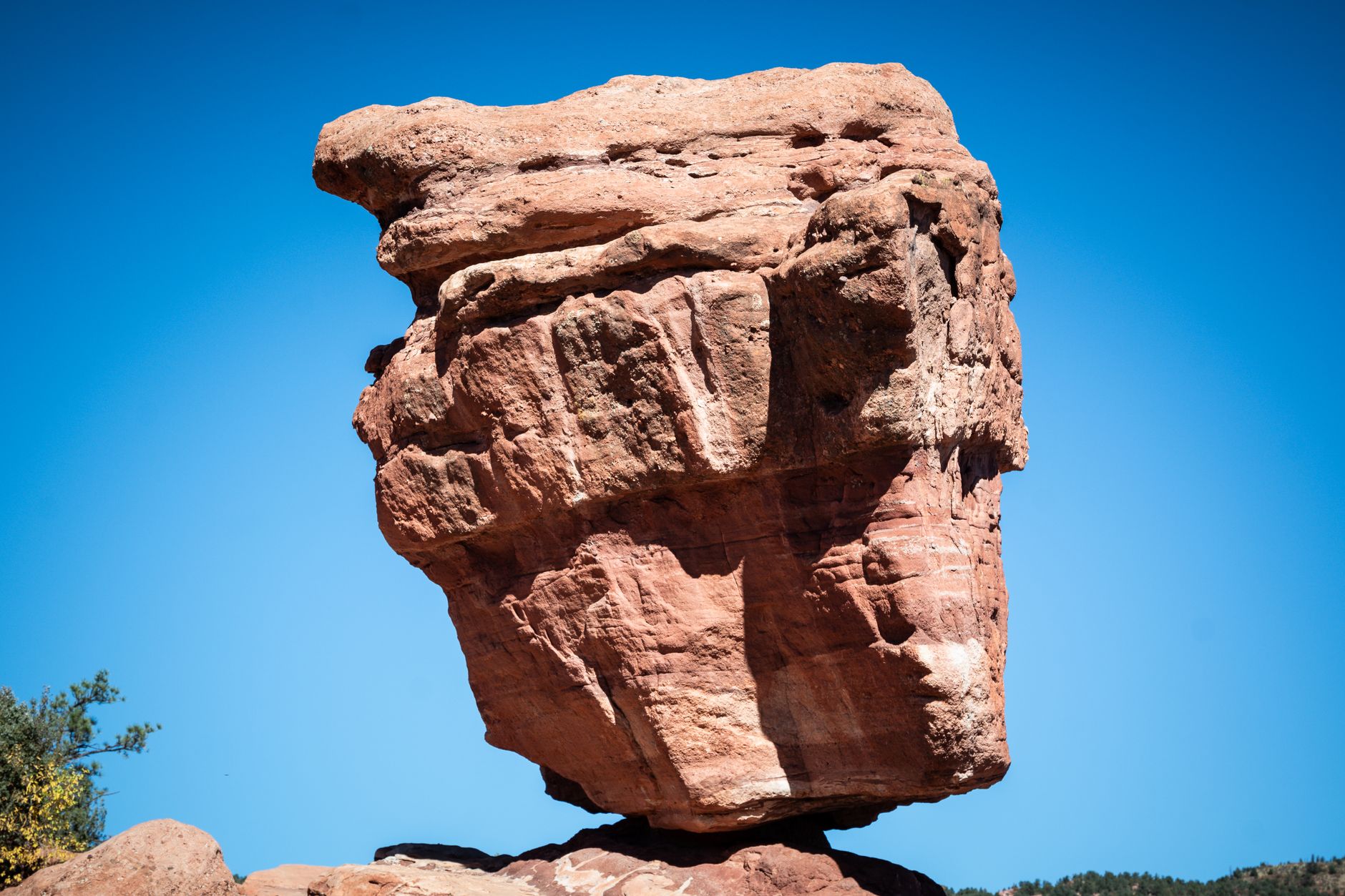
Photo by Bryan Dickerson on Pexels.com
Approaching the monument, Nevare is confronted by a tour guide hawking his craft, who makes him deeply uncomfortable and provokes a rude response from him. The guide withdraws, and Nevare presses on, his description of the Dancing Spindle continuing as he approaches it. He considers its possible origins and history as he moves ahead, and he recognizes a strange sensation emanating from it as it captivates his attention.
Nevare joins others looking at the Dancing Spindle, most of whom are relatively uninterested in it. As another guide finishes delivering material, Nevare is overcome by what he recognizes as a locus of magical power as his alternative self reawakens. The guide, a Plainswoman, suggests Nevare leave, and he demurs; the earlier guide arrives to mock him for his earlier dismissal. A youth present moves to deface the monument, earning rebuke from Nevare; the youth’s iron knife sends painful messages through the Spindle, and Nevare cries out. The ensuing tumult disperses those present, and the guides rebuke Nevare for his interference as well as for his insistence upon its magic.
As Nevare departs, he sees the vandalizing youth at it again, aided by his friends. He moves to intervene, and the youths panic at his approach. One of them begins to slip downard, and Nevare manages to rescue him, although the youth’s knife cuts him as he does so. Nevare slams the knife away, and it slips to the base of the Dancing Spindle; when it makes contact with it, the knife cuts off the gathering magic of the Plainsfolk. Nevare is stunned by the event, and, befuddled, he resumes his return home.
The remainder of Nevare’s journey home passes reasonably quickly and without incident. His arrival at his family’s estate, however, is unhappy. He is initially not recognized by the staff or even his kin, his body having changed greatly since his departure for the Academy, and his father’s displeasure with him is obvious. When, after Nevare has washed and changed–into ill-fitting clothes–he attends his father in his study, Keft rebukes him for his fatness and what he believes is the laziness associated therewith. He commands him to a three-day fast and manual labor, assigning him once again and immediately to Sergeant Duril.
To address the chapter-length issue: the present chapter, in the edition of the novel I’m rereading, runs 24 pages in length, approximately 3.28% of the novel.* Longer than average, much of the present chapter glosses more travel time; it is principally another bridging chapter in the novel, serving largely to move Nevare to where he needs to be, although the focus on the titular rock formation does both call back to earlier parts of the Soldier Son novels and carry implications for the milieu as a whole.
Also, for indexing purposes, the following: Breg, Burry, Carsina Grenatler, Dancing Spindle, Dark Evening, Elisi Burvelle, Gernian, Hector, Jard, Keft Burvelle, Kidona, King’s Cavalla Academy, King’s Road, Midlands, Nevare Burvelle, Old Thares, Plainspeople, Ret, Rosse Burvelle, Selethe Burvelle, Sergeant Erib Duril, Sirlofty, Skay, Specks, Spindle Dance, Spindle’s Tower, Stone mage, Tree Woman, Widevale, Yaril Burvelle. Despite the relative length of the chapter, there are few indexables, something perhaps appropriate to the overall function of the chapter as a bridge rather than as its own narrative unit.
Several points of interest present themselves as I reread the chapter. One of them is the reaction of the Plainsfolk guides to Nevare’s insistence upon the magic of the Dancing Spindle. Initially, Nevare approaches it with a typically Gernian perspective: skepticism of and derision for stories of the Plainsfolk. This is despite his overt experiences not only with the magics of the Plainsfolk (see Shaman’s Crossing‘s “Crossing the Bridge,” for example), but also of the Dappled People (see not only “Crossing the Bridge,” but also and especially “Plague.”). He has no reason to be doubtful on approach, and he finds himself believing in it as his alternative self reawakens and the vandalizing youths apply iron to the magical locus (see Shaman’s Crossing‘s “Magic and Iron” for one reference; there are several others). That the magic presents itself to him, a Gernian, but not to the Plainsfolk who guide tourists to the Dancing Spindle, offends them; one nearly strikes Nevare for his insistence on the Spindle’s motion and declaims “NO! It did not. It has never turned for me, and it could not turn for you, Gernian! It was a legend. That was all. Those who say they see it turning are fools, and those who claim to be lifted by it are liars! Liars! Go away! Get out of here! How dare you say it turns for you! It never turned for me and I am of the Plains! Liar! Liar” (56). Amid it all, there is certainly some colonialist discourse, the reaction of an indigenous person against appropriative claims made by an oppressor; how dare Nevare make such a claim, indeed! There is also the entirely understandable sorrow of a longed-for thing being given to another; I am put in mind of Molly Grue’s initial reaction to the presence of Amalthea in Beagle’s The Last Unicorn**:
[Captain Cully] burst out laughing, and Molly sprang up, red from hairline to throat hollow. “Where have you been?” she cried. “Damn you, where have you been?”….
[…]
“I am here now,” [Amalthea] said at last.
Molly laughed with her lips flat. “And what good is it to me that you’re here now? Where were you twenty years ago, ten years ago? How dare you, how dare you come to me now, when I am this?”
It is an affective reading, I know, that I am moved by both passages. Less affectively, given the extent to which Hobb is on record as endorsing Beagle (see, for example, Bishop’s interview of Hobb for Five Books, as well as Hobb’s own comments about his work on GoodReads, which will be coming into the Fedwren Project soon [I think]), I think it likely that there is an echo of Beagle’s scene in Hobb’s. Another scholarly someday might well delve more fully into that particular bit of source-study.
Another, touching on something somewhat closer to home but not restricted to it, is the presence and desecration of a balancing rock. Balancing rocks are large rocks or boulders that, through natural processes, perch upon stones or till that look far smaller than should be able to support them. That they can be interpreted as, or made in fictional works into, magical structures is easily understandable. That they attract the attention of vandals is even more unfortunate than it is well-documented. One notable instance of the latter comes from a place near where I live: Fredericksburg, Texas. There was in its vicinity a well-known balancing rock atop what is called Bear Mountain; there are photos of the thing, such as this one from UTSA‘s digital collections:
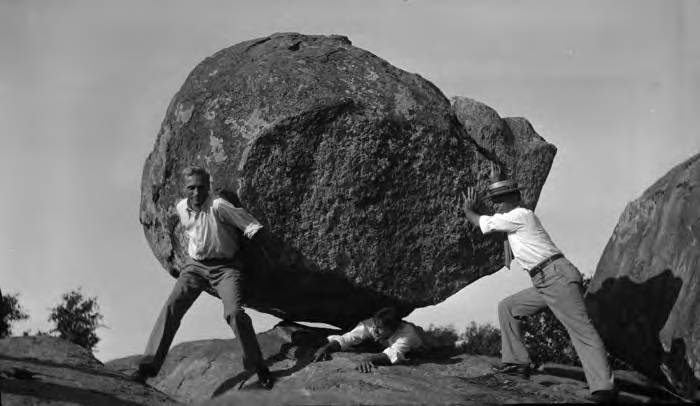
I believe that, as UTSA is a public institution, that this falls under Fair Use. I’m also an alumnus of the institution (BA, English, 2005; #birdsup), if that helps.
Alas, the balancing rock is no longer there, having been blasted from its former position, as Michael Barr reports. And it’s not the only such monument thus destroyed; the destruction of one at Goblin Valley, reported upon by Scott Neuman and others, comes to mind,† as does the later destruction at the Brimham Rocks (per Samantha Lui). Similar efforts are unfortunately ongoing, as Joey Martin reports, and I am sure there are others that do not pop up to a quick check into such events. While those in the readers’ world do not carry quite as much heft as that in Hobb’s novel, they do help to connect her work to their world, even if that connection is an unhappy one.
A final point of attention for now centers on Nevare’s return home; while the trope of a person going off to school and coming back changed is a thing, the reactions presented are quite severe in the present chapter. Again, I think rereading Metsäpelto is in order; the animus against fatness is very much on display as Nevare arrives again at Widevale. Keft is clearly angry and offended at the fact of his son’s fatness, unreasonably so, acting and speaking as if done to spite the family and the degree to which appearances must be kept up. Admittedly, given earlier commentaries about the political state of Gernia and the power blocs of so-called old and new lords, Keft has some reason to attend to appearances; he has to work to maintain his and his family’s status in the stratified society. But, if memory serves, he has had reports of Nevare’s illness, and I seem to recall that they include information from Dr. Amicas, who notes the unusual nature of Nevare’s symptoms. A shock might well be expected at seeing what has only been in report so far, but anger at such a thing…it is not a good sign, nor yet is the harsh restriction to which Nevare is immediately assigned. Once again, Hobb points forward to trouble for her protagonist, which this rereading will continue to treat as it emerges.
* To my great chagrin, as I was doing some other work, I realized that my earlier calculations were in error; I failed to account for the front matter of the present and previous volume in the series. This could be waved off as setting aside something that does not matter except that for the previous Soldier Son volume, I focused attention on the front matter (as witness this), and so I followed the model for the present volume (as witness this). Having made a point to include it, I should make a point to include it; I apologize for the earlier error and have made adjustments to the earlier relevant entries in this rereading series that I hope correct the error.
** Quotation is from Peter S. Beagle’s The Last Unicorn, first 40th anniversary edition, printed in 2008, pgs. 96-97.
† It’s even called a hoodoo, calling back to Shaman’s Crossing‘s “Crossing the Bridge” again.
Schools are back in session, and application season is in progress. If you’d like help with your stuff, fill out the form below!


[…] Read the previous entry in the series here.Read the next entry in the series here. […]
LikeLike
[…] the previous entry in the series here.Read the next entry in the series […]
LikeLike
[…] the previous entry in the series here.Read the next entry in the series […]
LikeLike
[…] citing Nevare’s present state as effective revenge against Keft; Nevare tells Dewara of his destruction of Dancing Spindle, prompting the older man to violence. Dewara stabs Nevare, and Duril shoots Dewara, leaving him […]
LikeLike
[…] remarks on his supply of hectors as he returns home from the King’s Cavalla Academy (see Forest Mage‘s “Spindle Dance”). Having a more detailed description of currency in the present chapter both makes it more of a […]
LikeLike